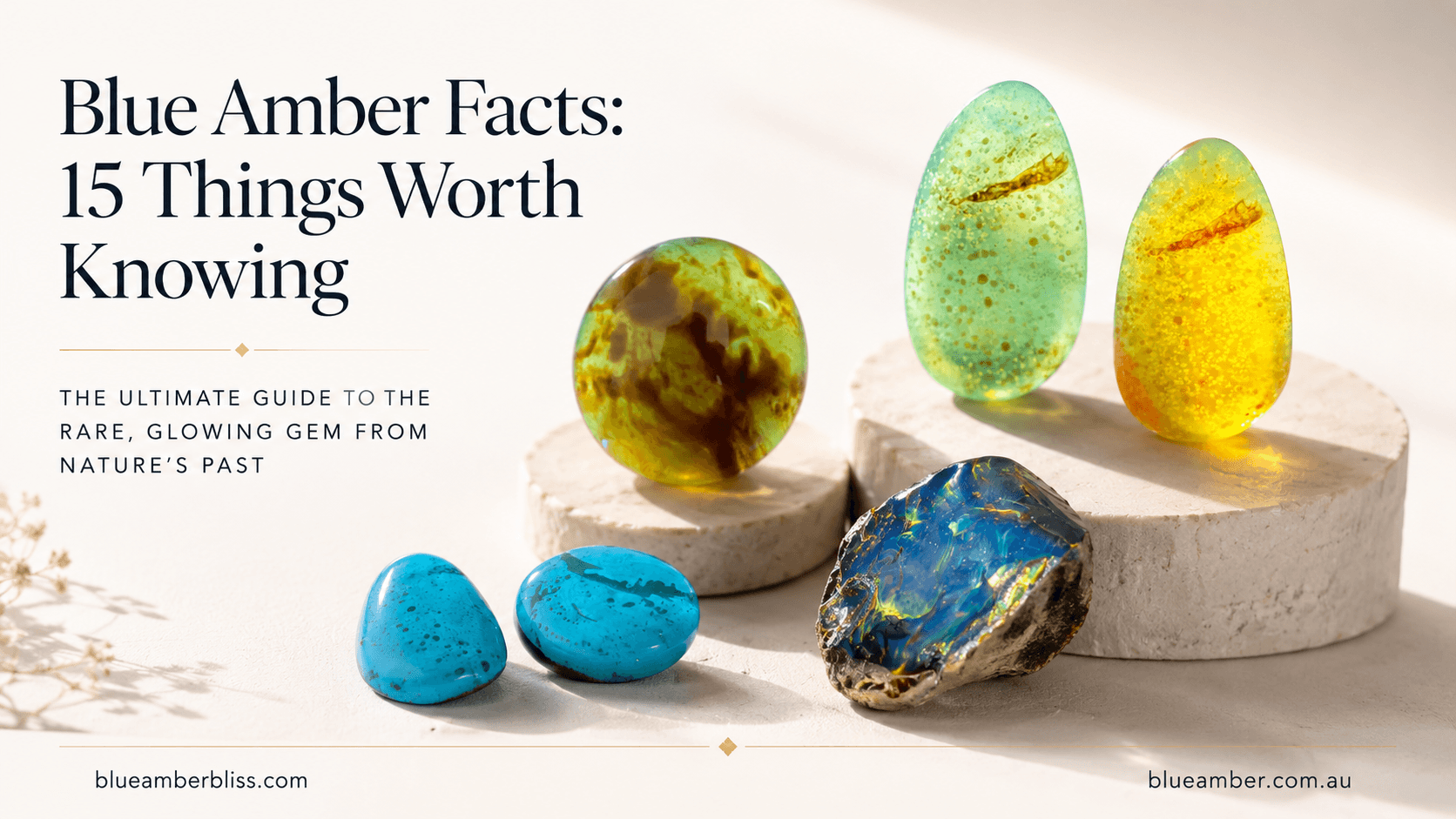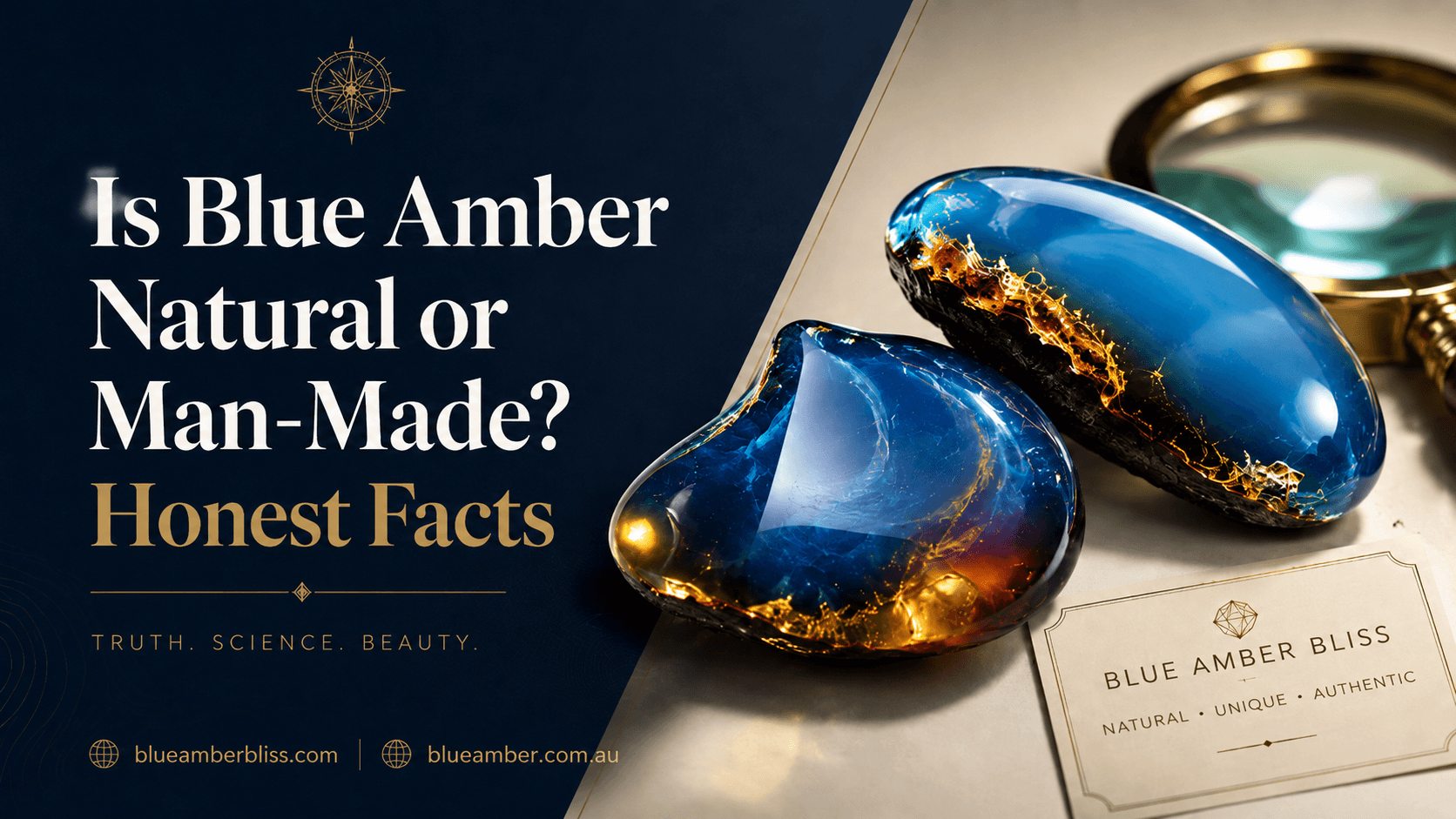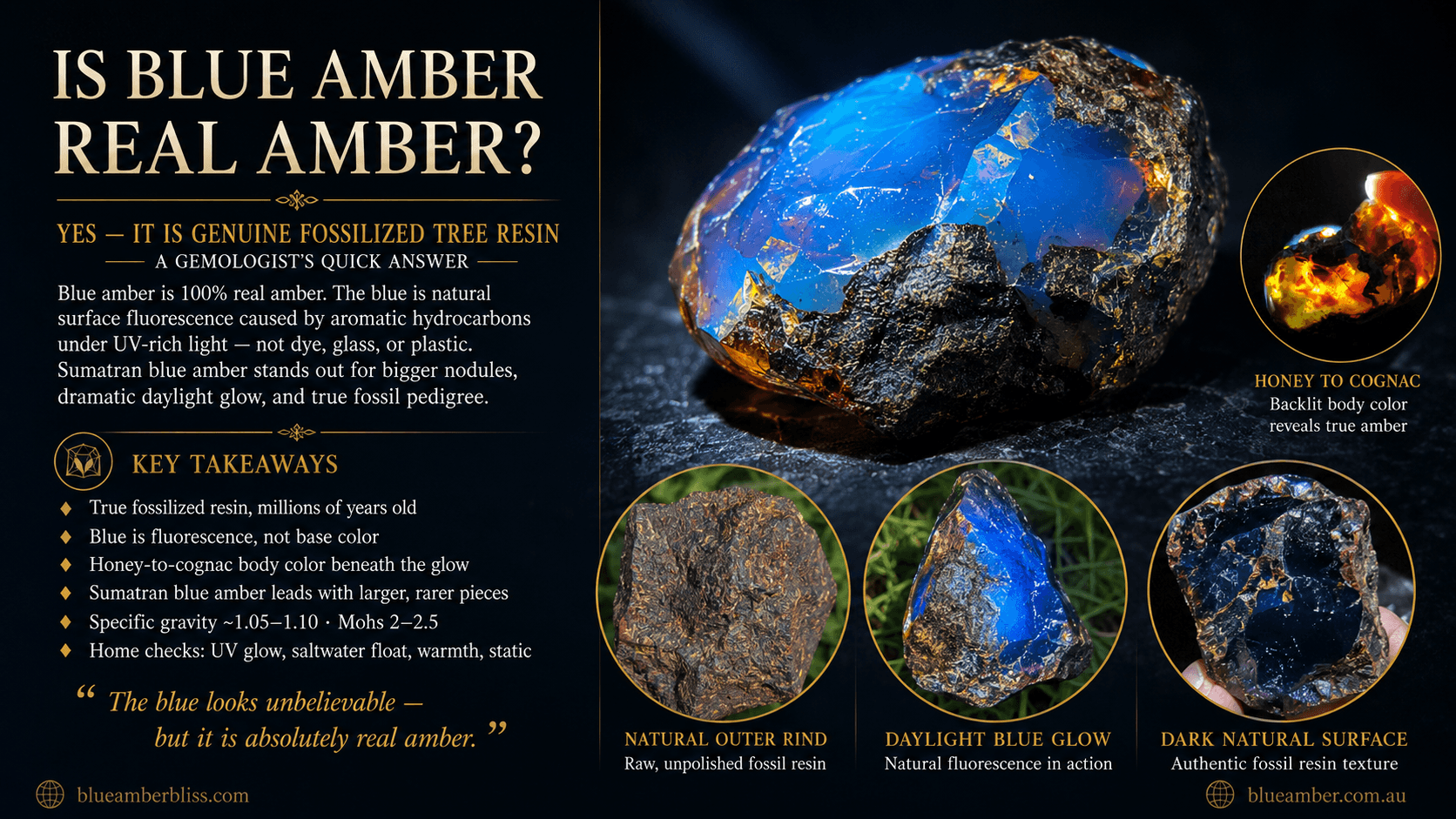
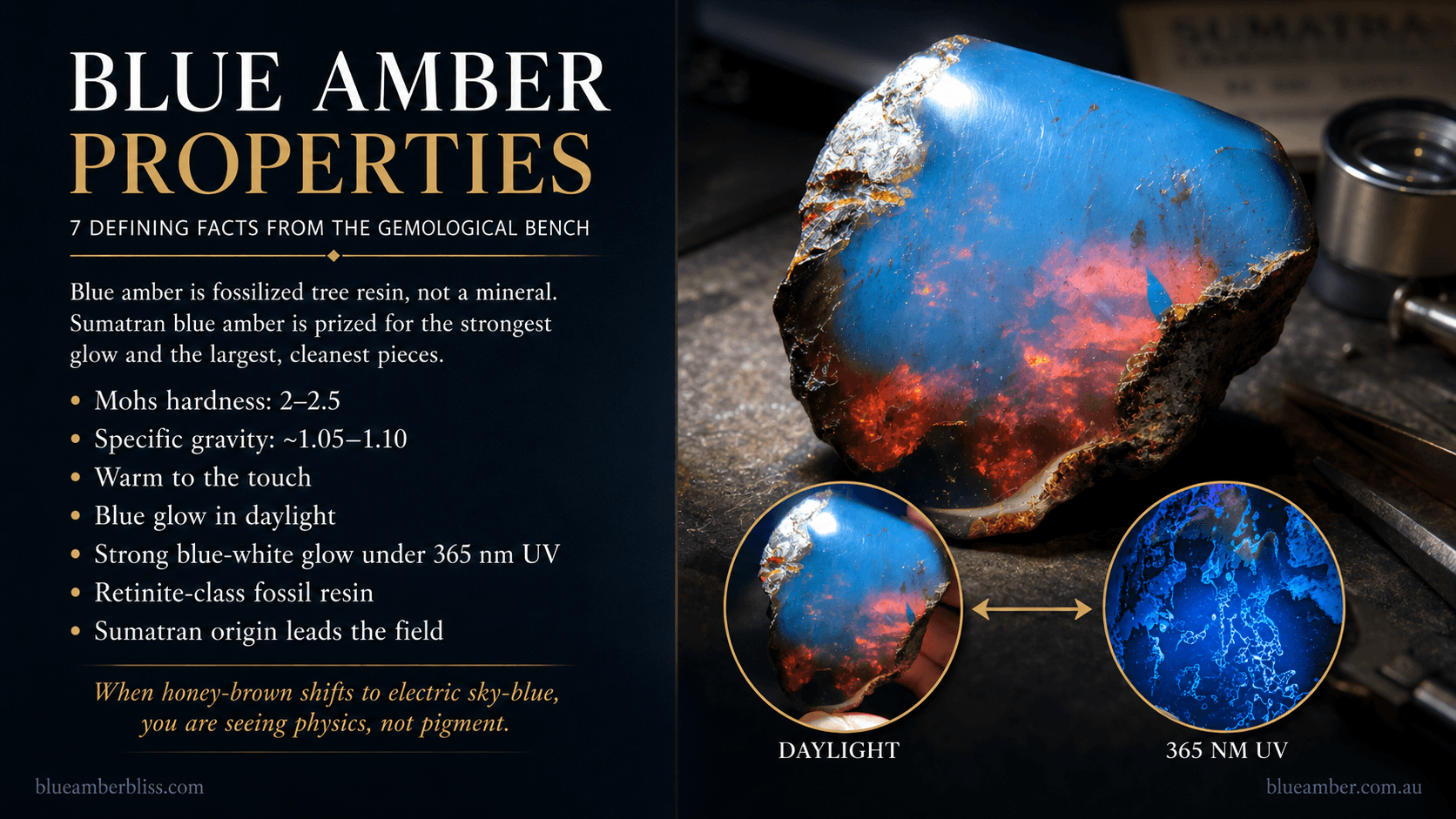
When you hold a piece of Sumatran blue amber to the sun and watch it shift from honey-brown to an electric sky-blue, you are seeing physics, not pigment. To care for it well and buy it confidently, you need to understand what this material actually is and how it behaves on the gemological bench. As a working gemologist, let me walk you through the seven defining blue amber properties that govern how it looks, how it wears, and how you should protect it – and the named chemistry, provenance, and lab evidence that put each fact on solid ground.
Key Takeaways
- Sumatran blue amber is the standout – the newest major source (Sinamar Formation, Jambi), with bigger nodules, excellent clarity, and the most dramatic daylight blue glow, making it the premium AAA+ material.
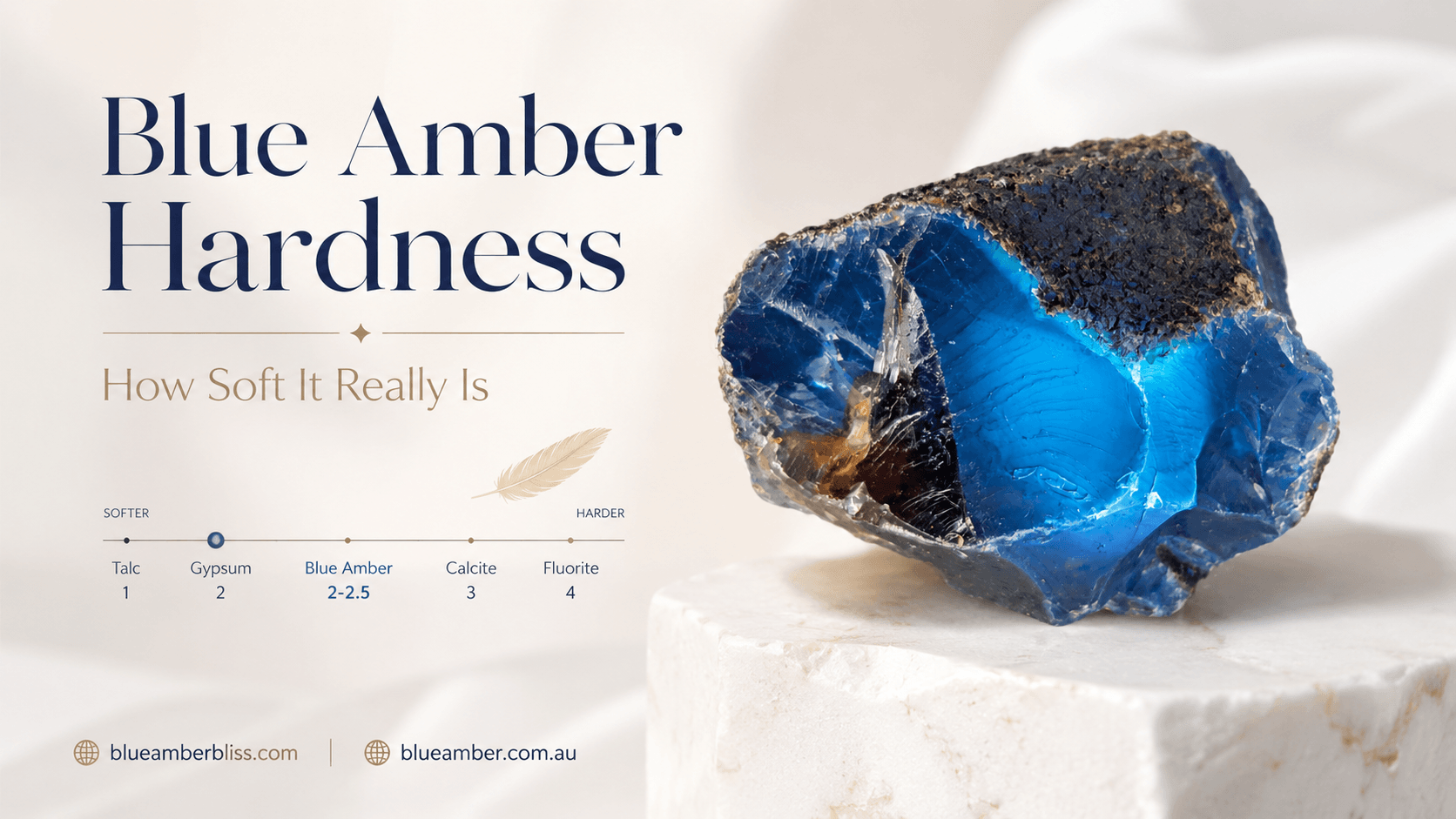
- It is soft: blue amber hardness sits at Mohs 2-2.5, similar to a fingernail or gypsum, so it scratches and chips easily.
- It is remarkably light: blue amber specific gravity is roughly 1.05-1.10, so it barely sinks in fresh water and floats in saturated saltwater.
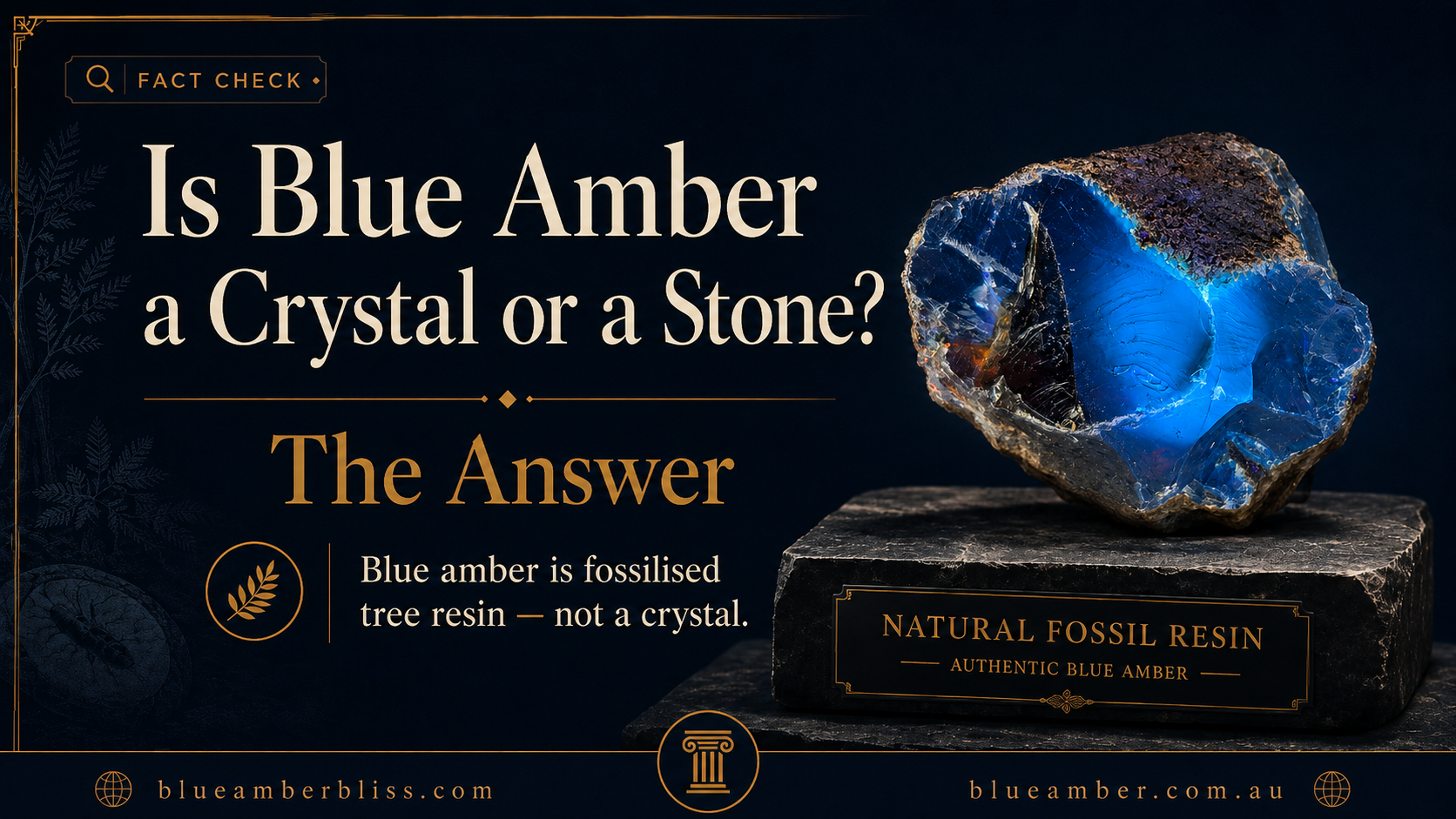
- It is organic, not mineral: blue amber is fossilized plant resin amberized millions of years, which explains its warmth, low density, and fluorescence.
- The blue is fluorescence plus scattering, driven by perylene and related polycyclic aromatic hydrocarbons (PAHs) and intensified under a 365 nm UV lamp – the core diagnostic among blue amber properties.
- Care follows from chemistry: avoid heat, solvents, perfume, and ultrasonic cleaners; clean gently with lukewarm water and a soft cloth.
What Makes Blue Amber Properties Unique Among Gems?
Most gemstones you encounter are minerals: crystalline solids with ordered atomic lattices, like quartz, sapphire, or diamond. Blue amber breaks that mold entirely. It is an organic gem – amberized, fossilized tree resin formed over millions of years. This single fact drives nearly every other property on this list.
Because it is amorphous (non-crystalline) fossil resin rather than a crystal, blue amber has no cleavage planes, no defined crystal faces, and a strikingly low density. Among all the blue amber properties gemologists test, the combination of extreme lightness, softness, and fluorescent glow is what makes identification both fascinating and reliable. For the wider context, see our primer on what blue amber is.
The “blue” is not body color. Sumatran blue amber is chemically a near-cousin of ordinary golden amber; the difference is an optical effect produced by trace fluorophores. That is why understanding blue amber properties means understanding light – absorption, re-emission, and scattering – not color in the everyday sense.
The 7 Proven Blue Amber Properties Explained
Here are the seven core blue amber properties every collector, jeweler, and buyer should know. Each has direct, practical consequences for wear, care, and authentication. I have ordered them from the most diagnostic to the most everyday, but all seven matter when you handle this gem.
1. Hardness: Mohs 2-2.5 (Soft and Scratchable)
Blue amber hardness sits at just 2 to 2.5 on the Mohs scale. To put that in perspective, your fingernail is about 2.5, gypsum is 2, and a copper coin is around 3. This places amber among the softest gem materials in regular use, far below quartz (7) or sapphire (9).
The low hardness is one of the most consequential blue amber properties for everyday wear. A blue amber ring worn daily will accumulate fine scratches; a pendant or earrings, which see less abrasion, fare much better. Store pieces separately so harder gems do not scuff the surface.
According to the GIA, amber’s softness and organic nature demand gentler handling than mineral gems. This is also why faceted amber is rare – the material is too soft to hold crisp facet edges, so cabochons, beads, and free-form polished nodules dominate the market.
2. Specific Gravity: ~1.05-1.10 (Almost Floats)
Blue amber specific gravity ranges from roughly 1.05 to 1.10, making it one of the lightest gem materials you can hold. Fresh water has a specific gravity of 1.00, so amber barely sinks in plain water and readily floats in saturated saltwater (brine of about 1.15-1.16).
This low specific gravity is a classic authenticity test. Dissolve enough salt into a cup of water to reach saturation; genuine amber floats while most plastics, glass, and cast resins sink. It is one of the most accessible blue amber properties for at-home checks, though it should never be your only test – see the full battery in how to tell if blue amber is real.
The lightness also affects how jewelry feels. A large Sumatran blue amber pendant that looks substantial feels surprisingly weightless around your neck – a comfort advantage over heavy mineral stones.
3. Warm to the Touch (Thermal Insulation)
Pick up a piece of blue amber and a piece of glass that have both been sitting at room temperature. The glass feels cold; the amber feels noticeably warmer. Amber is a poor conductor of heat – an organic insulator – so it does not pull warmth from your skin the way dense, conductive materials do.
This “warm to the touch” trait is among the most beloved blue amber properties, and it doubles as a quick screening test. Glass and many imitations feel cold and conduct heat away; amber stays comfortable against the skin almost immediately.
The same insulating behavior means amber generates a static electric charge when rubbed with cloth or wool. In fact, the Greek word for amber, elektron, is the root of our word “electricity,” a history detailed on Wikipedia’s amber entry.
4. Fluorescence: The Blue Glow
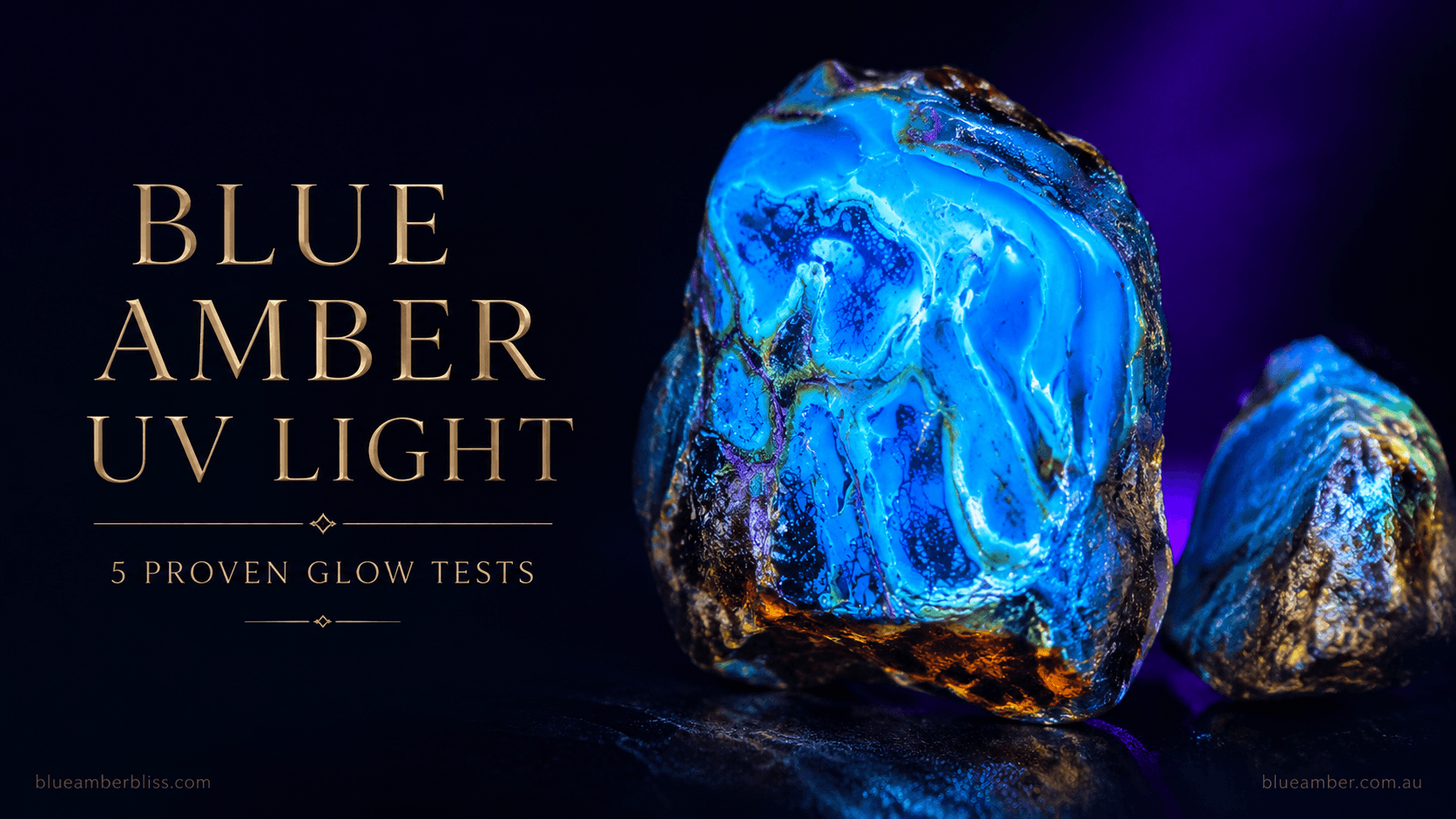
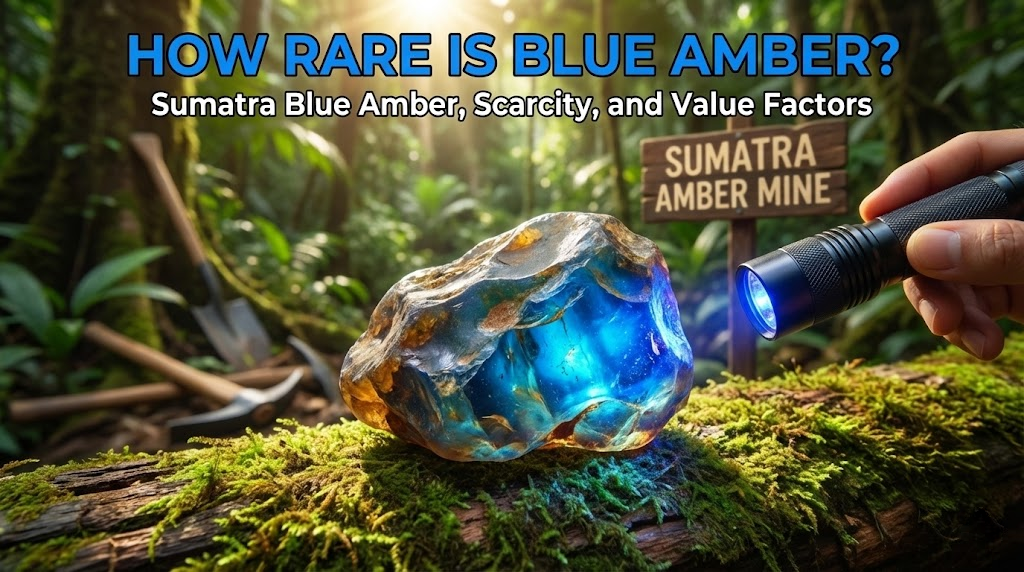
The signature property – the reason it is called blue amber at all – is fluorescence. Sumatran blue amber appears deep honey-brown by transmitted light but flashes vivid blue when daylight (which carries enough UV) strikes its surface against a dark background. Under a 365 nm long-wave UV lamp, the effect intensifies into an unmistakable electric blue, sometimes green-blue.
This optical glow is the most distinctive of all blue amber properties. Crucially, it is fluorescence, not phosphorescence: the glow appears the instant exciting light arrives and vanishes the instant it is removed, with no afterglow. Ordinary golden amber fluoresces faintly; blue amber fluoresces strongly because of specific trace compounds covered in property 6 below.
Sumatran material is especially prized for its dramatic, easily visible daylight glow across large surfaces – the hallmark of top AAA+ stones. For the full optical mechanism, read why blue amber glows blue.
5. Refractive Index: ~1.54
Blue amber has a refractive index of about 1.54 (commonly cited in the 1.539-1.545 range). Because amber is amorphous, it is singly refractive – it shows no birefringence or doubling, unlike many crystalline gems. This is a steady, reliable figure among the measurable blue amber properties.
The relatively low refractive index gives polished amber a soft, resinous luster rather than the high glassy or adamantine sparkle of diamond or zircon. Under magnification, that gentle glow is part of amber’s charm and another clue to its organic origin.
For gemologists, the RI reading combined with low specific gravity and softness creates a fingerprint that imitations struggle to match all at once – the strength of testing several blue amber properties together rather than relying on any single reading.
6. Organic Composition (Amberized Fossil Resin, Not a Mineral)
Chemically, amber is a complex mix of organic compounds – terpenoids, labdanoid diterpenes, resin acids, and hydrocarbons – derived from ancient tree resin that has undergone amberization: slow cross-linking and polymerization of the labdanoid/terpenoid resin over millions of years. It is essentially a natural polymer of biological origin, and this identity underlies the warmth, low density, softness, and fluorescence.
Sumatran and Dominican blue ambers are retinite-class fossil resins – low or no succinic acid – which sets them apart from Baltic amber, the succinite class rich in succinic acid. The blue fluorophores are perylene and other polycyclic aromatic hydrocarbons (PAHs); these absorb UV and violet light and re-emit it as blue. We unpack this in depth in the chemistry behind the blue (perylene and PAHs).
Being organic also means blue amber is sensitive to its environment. It can dry out, craze (develop surface crackling), oxidize, and darken with age and exposure – normal behaviors of fossilized resin and a defining piece of blue amber physical properties.
7. Brittleness and Conchoidal Fracture
Despite being soft, amber is also brittle. It has no cleavage but breaks with a conchoidal (shell-like, curved) fracture, the same way glass or obsidian does. A sharp knock against a hard surface can chip or crack a piece even though a fingernail can scratch it.
This pairing of softness and brittleness is one of the more counterintuitive blue amber properties. It means amber needs protection from both abrasion (scratches) and impact (chips and cracks) – two different threats requiring two different habits.
In practice: keep amber away from harder gems in storage, and remove amber rings before any rough activity. Respecting both vulnerabilities keeps your piece beautiful for generations.
Why Is Blue Amber “Not Really Blue”? Scattering Plus Fluorescence
Two optical mechanisms work together, which is why the blue shifts with viewing angle and lighting. First, fluorescence: perylene and related PAHs absorb short-wavelength UV/violet and re-emit visible blue near 450, 474, and 508 nm in Dominican material (GIA Gems & Gemology, Winter 2020). Second, Rayleigh/Tyndall scattering: short blue wavelengths scatter most strongly at the polished surface, layering a structural blue over the fluorescent blue.
Because neither effect is body color, blue amber looks honey-brown by transmitted light and blue only when light strikes the surface against a dark background. This is the gemological reason the gem is often described as “not really blue.” Understanding both mechanisms also explains why a dark backing dramatizes the glow – it removes the brown transmitted light so the surface blue dominates.
UV Response: 254 nm vs 365 nm vs 395 nm
The wavelength of your lamp changes everything you see. Long-wave 365 nm is the standard test wavelength and produces the strongest, truest visible blue. Cheap “UV” torches at 395 nm are partly visible violet and give a weaker, washed-out glow. Short-wave 254 nm excites differently and is a lab tool, not an everyday handheld choice.
| UV source | Type | Blue amber response |
|---|---|---|
| 254 nm | Short-wave (lab) | Excites fluorescence; specialist use, eye/skin hazard |
| 365 nm | Long-wave (standard) | Strongest, truest blue glow – the diagnostic wavelength |
| 395 nm | Long-wave / violet | Weak, washed-out glow; partly visible violet light |
| Daylight | Broadband + UV | Triggers signature “daylight blue” in strong Sumatran material |
How Does Blue Amber Compare to Lookalikes? Spec Grid
The fastest way to separate genuine blue amber from imitations is to read several properties at once. Copal (young, sub-fossil resin under millions of years in the making) and pressed/reconstructed amber (ambroid) are the trickiest; plastics, glass, and Baltic succinite each fail at least one diagnostic. This single grid is the canonical reference.
| Material | SG | RI | Mohs | UV (365 nm) | Acetone |
|---|---|---|---|---|---|
| Blue amber (Sumatran/Dominican) | 1.05-1.10 | ~1.54 | 2-2.5 | Strong blue fluorescence | Resists; surface unaffected |
| Golden amber | 1.05-1.10 | ~1.54 | 2-2.5 | Weak chalky blue-white | Resists |
| Copal (<1M yr) | ~1.03-1.08 | ~1.54 | 1.5-2 | Whitish/weak | Tacky in 20-60 s |
| Pressed amber (ambroid) | ~1.05-1.10 | ~1.54 | 2-2.5 | Patchy, flow-lined glow | May soften at seams |
| Plastic (PS / PMMA) | 1.05-1.20 | 1.49-1.59 | ~2-3 | Flat / dull / none | PS may soften; PMMA resists |
| Glass | 2.4-2.5 | 1.5-1.7 | 5-6 | Usually inert; cold to touch | No effect |
| Baltic amber (succinite) | 1.05-1.10 | ~1.54 | 2-2.5 | Milky blue-white | Resists |
Note that SG and RI alone cannot separate copal, golden amber, and blue amber – they overlap. The acetone response (mature amber resists; copal turns tacky) and the strength and color of 365 nm fluorescence do the discriminating. For the head-to-head, see how to tell copal from real amber and blue amber vs Baltic amber.
What Does an FTIR Lab Report Confirm?
For a definitive answer, FTIR spectroscopy on a GIA or IGI report is the gold standard. An infrared spectrum reads the molecular bonds directly: a carbonyl (C=O) stretch near 1735 cm⁻¹, C-H stretches around 2860-2930 cm⁻¹, and an exocyclic methylene band near 888 cm⁻¹ typical of amber resins. These features confirm an amberized fossil resin rather than plastic.
FTIR also settles the two questions a buyer cares about most. Young copal shows a stronger unsaturation band near 1640 cm⁻¹ and the tacky acetone response that mature amber lacks – the maturity test. Baltic succinite shows its characteristic absorption shoulder (the “Baltic shoulder”) around 1250-1175 cm⁻¹, distinguishing the succinite class from the retinite-class Sumatran and Dominican blue ambers. For what a report certifies and how to read one, see what a real amber lab report (GIA/IGI/FTIR) certifies.
Where Does Blue Amber Come From? Provenance and Source Trees
Provenance is part of the property profile because the source tree and deposit shape size, clarity, and glow. Sumatran blue amber comes from the Sinamar Formation in Jambi Province, part of the South Sumatra Basin in the Bukit Barisan foothills, mined from coal-bearing sediments. Its resin derives from Dipterocarpaceae trees – most likely Shorea – a tropical hardwood family. It dates to the Miocene epoch, millions of years old.
Dominican blue amber comes from the La Cumbre, La Toca, and Palo Quemado mines in the Cordillera Septentrional near Santiago. Its source tree is the extinct leguminous algarrobo Hymenaea protera, and it dates to the Oligocene-Miocene, millions of years in the making. Both are amberized retinite resins, but the different botany and geology give Sumatran material its larger, cleaner nodules. Mineralogical data for both deposits is catalogued on mindat.org. For deposit detail, see where blue amber comes from.
Blue Amber Physical Properties Table
This table summarizes the measurable blue amber physical properties in one place. Use it as a quick reference when evaluating a piece or comparing test results. The values reflect typical ranges reported for retinite-class blue amber across reputable gemological sources.
| Property | Value / Range | Practical Meaning |
|---|---|---|
| Mohs hardness | 2 – 2.5 | Soft; scratches easily, needs gentle wear |
| Specific gravity | ~1.05 – 1.10 | Very light; floats in saturated saltwater |
| Refractive index | ~1.539 – 1.545 (about 1.54) | Singly refractive; soft resinous luster |
| Composition | Organic retinite fossil resin | Warm to touch; low/no succinic acid |
| Fluorescence | Strong blue under 365 nm / daylight | Source of the blue glow; diagnostic (perylene/PAHs) |
| Fracture | Conchoidal, brittle | Chips on impact despite softness |
| Luster | Resinous | Gentle glow, not glassy sparkle |
| Thermal behavior | Insulator | Feels warm; builds static charge |
| Age / epoch | Miocene, millions of years | Fully amberized, not young copal |
How Do Sumatran and Dominican Blue Amber Properties Compare?
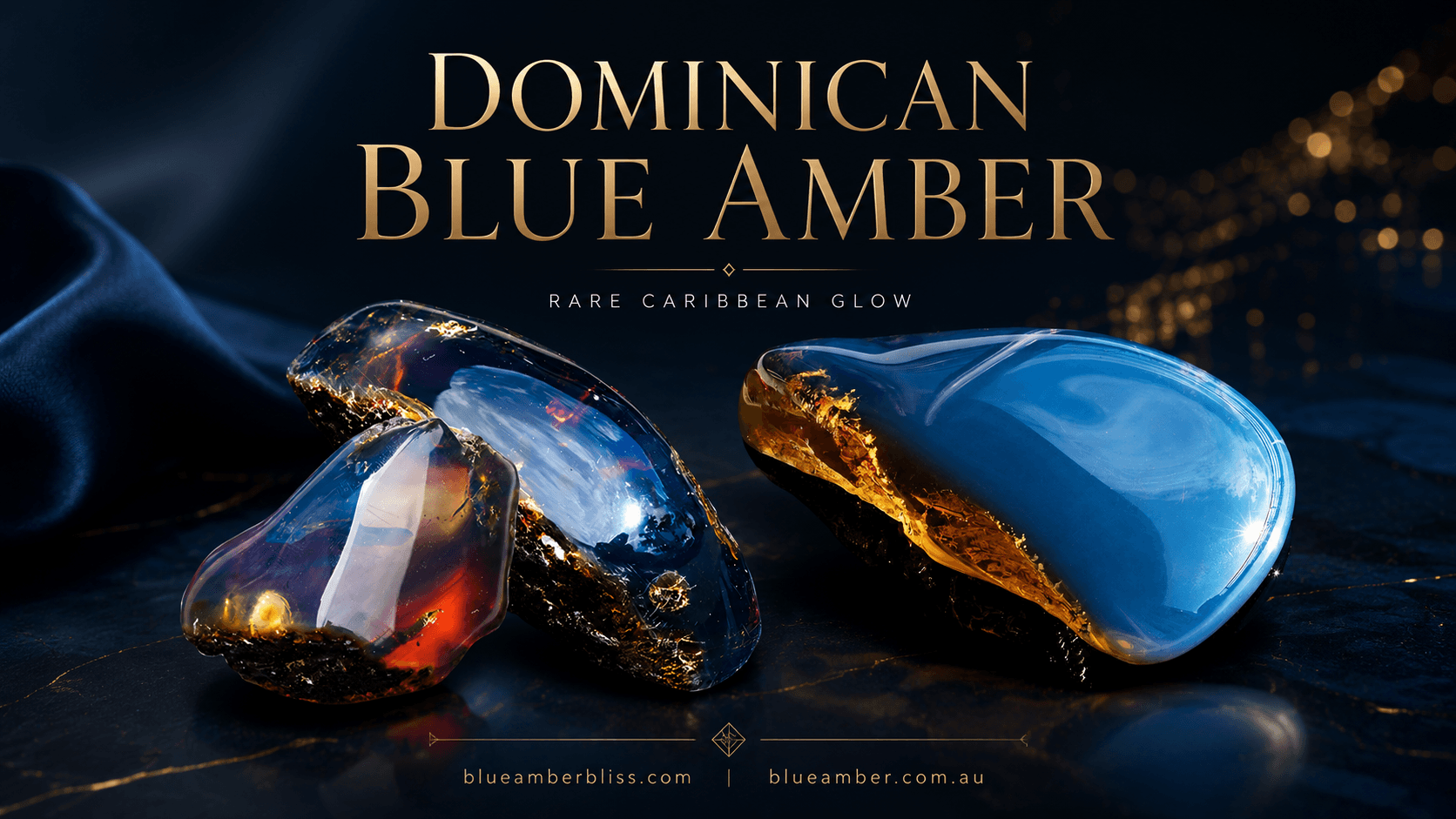
Both Sumatran (Indonesian) and Dominican blue amber share the same fundamental blue amber properties – the same softness, the same low specific gravity, the same fluorescent mechanism driven by perylene and PAHs. They are equal in core quality and value. The differences are matters of source, scale, and character rather than one being inherently superior in the lab.
That said, Sumatran blue amber is the standout in today’s market. As the newer major source, it tends to yield larger, cleaner nodules with a famously dramatic daylight blue glow on big surfaces. Those advantages – bigger pieces and consistently strong glow – make Sumatran blue amber the premium AAA+ material and the centerpiece of any serious collection.
| Aspect | Sumatran (Indonesian) | Dominican |
|---|---|---|
| Core properties | Mohs 2-2.5, SG ~1.05-1.10, strong fluorescence | Mohs 2-2.5, SG ~1.05-1.10, strong fluorescence |
| Geology | Sinamar Formation, Jambi, South Sumatra | La Cumbre, La Toca, Palo Quemado, Santiago |
| Source tree | Dipterocarpaceae (likely Shorea) | Hymenaea protera (algarrobo) |
| Age | Miocene, ~20-25M yr | Oligocene-Miocene, ~15-25M yr |
| Typical piece size | Larger, cleaner nodules common | Often smaller pieces |
| Overall standing | Standout; premium AAA+ | Equal core quality |
So treat their measurable blue amber properties as equals on the gemological bench, then recognize Sumatran as the hero for size and glow. For a fuller breakdown, see Sumatran vs Dominican blue amber compared and our guide to blue amber types and grades.
How Grading Tiers Read These Properties
Dealers grade blue amber in AA / AAA / AAA+ tiers based on glow intensity (percentage of surface that glows and how evenly), clarity, body color, and size. Sumatran deposits yield the larger, cleaner nodules and the dramatic daylight blue that define the top AAA+ band. Price tracks these properties: rough or low-glow material runs roughly $3-15/g, polished good-glow $15-60/g, high-grade clean AAA $60-200/g, and top AAA+ collector pieces $200-500+/g, with jewelry priced per piece.
What Do These Properties Mean for Wearing Blue Amber?
Every wear decision flows from the blue amber properties above. Because blue amber hardness is only Mohs 2-2.5, the gem is best suited to jewelry that avoids constant abrasion: pendants, earrings, brooches, and occasional-wear rings rather than a daily-driver ring or bracelet that knocks against keyboards and counters.
The light specific gravity is a genuine comfort benefit. A statement-sized Sumatran blue amber pendant drapes lightly and never feels like a burden, unlike a comparably sized agate or quartz piece. This makes bold, large designs practical to wear all day.
Brittleness means impact is the real enemy. Take amber rings off before sports, gardening, or housework, and favor protective bezel settings over exposed prongs. Treat the stone the way you would a fine pearl – beautiful and wearable, but deserving of mindful handling rather than rough use.
How Do Blue Amber Properties Affect Care and Cleaning?
The organic chemistry behind blue amber properties dictates a gentle care routine. Heat, solvents, and harsh chemicals are amber’s worst enemies because they attack the resin directly. A few simple habits will keep your piece glowing for decades.
- Never use ultrasonic or steam cleaners – vibration and heat can crack or craze amber instantly.
- Avoid perfume, hairspray, alcohol, acetone, and household cleaners – solvents dull and pit the surface.
- Clean with lukewarm water and a soft cloth, then dry promptly; never soak amber for long periods.
- Apply cosmetics and fragrance first, then put on your amber last to keep chemicals off it.
- Store away from heat and direct sun, and keep it apart from harder gems to prevent scratches.
Because amber can dry out over years, an occasional wipe with a tiny amount of natural oil (a drop of olive or jojoba oil buffed off completely) can restore luster. For full routines, follow how to clean blue amber and how to store blue amber safely. Gentle, consistent care preserves both the surface and the fluorescent glow that makes the gem special.
How Can You Use These Properties to Spot Real Blue Amber?
The same blue amber properties that define the gem also expose fakes. No single test is conclusive, but stacking several gives a confident answer. Imitations – plastic, glass, copal, and pressed amber (ambroid) – each fail at least one of these checks.
- Float test: genuine amber floats in saturated saltwater thanks to its low specific gravity; most plastics and glass sink.
- UV test: a 365 nm lamp triggers strong blue fluorescence in real blue amber; many fakes glow flat, weakly, or not at all.
- Warmth test: amber feels warm and is never cold like glass.
- Acetone test: mature amber resists acetone; young copal turns tacky in 20-60 seconds (edge only).
- Static test: rubbed amber attracts small bits of paper or hair.
Combining these readings – lightness, glow, warmth, and acetone resistance – creates a fingerprint that imitations rarely match all at once. For destructive checks like the hot-needle test and for definitive FTIR confirmation, work through how to tell if blue amber is real.
What We Notice When Selecting Sumatran Blue Amber
When we vet Sumatran blue amber at Blue Amber Bliss, the property we test first is UV response: a good Sumatran piece reads as a deep cognac-to-near-black body in the hand, then flips to a strong electric-blue glow the moment sunlight or a UV light hits it, and that daylight-to-glow contrast is far more dramatic than most people expect from a fossil resin. We also weigh the piece to confirm it floats in saltwater and check that inclusions and flow lines look natural rather than pressed or dyed, because those are the real tells of an ancient, untreated resin. It is genuinely one of nature’s rarer light tricks, and handling enough of it teaches you to read authenticity by body colour and glow strength alone.
If you would like to see these properties in person, we warmly invite you to explore our hand-selected Sumatran blue amber at Blue Amber Bliss. Shop hand-selected Sumatran blue amber →
Frequently Asked Questions About Blue Amber Properties
What is the hardness of blue amber?
Blue amber hardness is Mohs 2-2.5, comparable to a fingernail or gypsum. This makes it one of the softest gems in regular use, so it scratches easily and is best worn in pendants and earrings rather than daily rings.
What is the specific gravity of blue amber?
Blue amber specific gravity is roughly 1.05-1.10, among the lightest of all gem materials. Because fresh water is 1.00, amber barely sinks in plain water and floats in saturated saltwater (brine ~1.15-1.16), which is the basis of the classic float authenticity test.
Is blue amber a mineral or organic?
Blue amber is organic, not a mineral. It is amberized fossil tree resin polymerized over millions of years (Miocene epoch). This organic identity explains its warmth to the touch, low density, softness, and fluorescent glow – traits no crystalline mineral shares.
Why does blue amber glow blue?
The blue is fluorescence plus surface scattering. Perylene and other polycyclic aromatic hydrocarbons (PAHs) in the resin absorb UV and violet light from daylight or a 365 nm lamp and re-emit it as visible blue, while Rayleigh/Tyndall scattering adds structural blue at the surface. The amber itself is honey-toned by transmitted light.
Is blue amber fluorescent or phosphorescent?
Blue amber is fluorescent, not phosphorescent. The glow appears the instant exciting light arrives and stops the instant it is removed, with no lingering afterglow. Dominican blue amber emits near 450, 474, and 508 nm (GIA Gems & Gemology, Winter 2020).
What lab test definitively confirms blue amber?
FTIR spectroscopy on a GIA or IGI report is definitive. It reads molecular bonds – a carbonyl band near 1735 cm⁻¹ and amber C-H stretches – confirming an amberized fossil resin, distinguishing young copal (1640 cm⁻¹ unsaturation) and Baltic succinite (the Baltic shoulder) from retinite-class blue amber.
Is Sumatran or Dominican blue amber better?
They share equal core quality and value, with identical fundamental blue amber properties. However, Sumatran blue amber is the standout: from the Sinamar Formation in Jambi, it offers larger, cleaner nodules and a more dramatic daylight glow, making it the premium AAA+ material and the centerpiece of fine collections.
Can blue amber scratch or break easily?
Yes to both. Its Mohs 2-2.5 softness means it scratches readily, and its brittle, conchoidal fracture means it can chip or crack on impact. Protect it from abrasion in storage and from knocks during wear to keep it pristine.
How do I clean blue amber safely?
Use lukewarm water and a soft cloth, then dry promptly. Never use ultrasonic or steam cleaners, and keep perfume, alcohol, acetone, and household chemicals away from the surface. These solvents and heat attack the organic resin and dull the glow.
What is the refractive index of blue amber?
Blue amber has a refractive index near 1.54 (about 1.539-1.545) and is singly refractive because it is amorphous. This gives it a soft, resinous luster rather than the bright glassy sparkle of high-RI crystalline gems like zircon or diamond.
Related Blue Amber Guides
- Sumatran vs Dominican blue amber compared
- what a real amber lab report (GIA/IGI/FTIR) certifies
- the chemistry behind the blue (perylene & PAHs)
- how to tell copal from real amber
- blue amber vs Baltic amber
- how to store blue amber safely