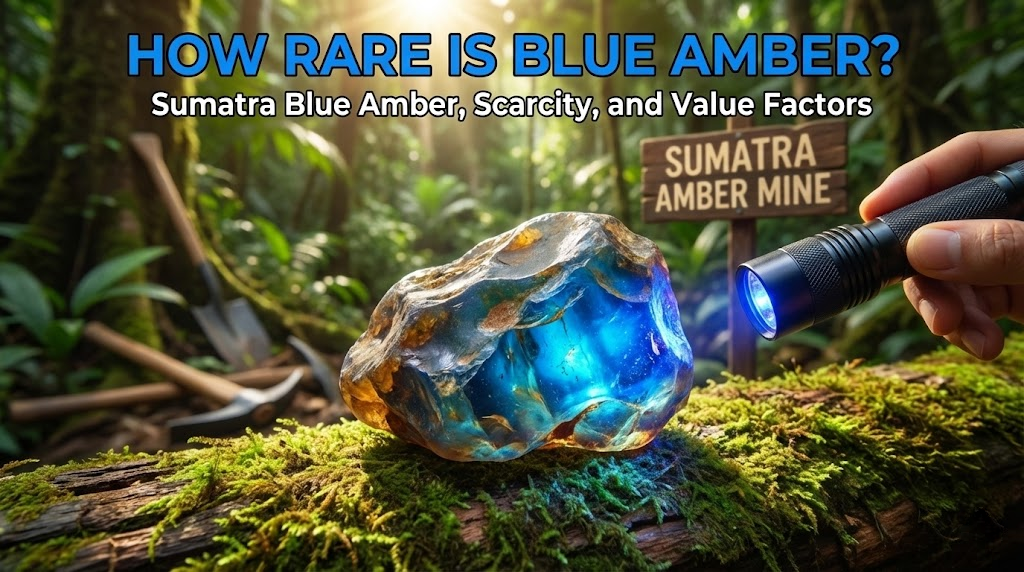
How rare is blue amber? Genuinely scarce: it forms in only two deposits on Earth, and within them just a single-digit percentage of stones glow strongly enough to be prized. The strong-glow Sumatran blue amber we specialise in at Blue Amber Bliss sits at the very top of that scale.
If you’ve ever watched a piece of amber suddenly flash electric blue in sunlight, you already know it doesn’t behave like an ordinary gem. From a gemologist’s bench, blue amber is rare on two levels at once — geologically (only a handful of fossil-resin deposits ever formed the right chemistry) and commercially (within those deposits, only a small fraction glows brightly). Sumatran’s newer, larger nodules deliver a dramatic “daylight blue” that older, smaller-stone sources rarely match.
This guide explains exactly where that rarity comes from, the grading vocabulary collectors use to talk about it, and how to read price differences the way a dealer does.
Quick Answer: How Rare Is Blue Amber?
- Only two regions — Indonesia’s Sumatra and the Dominican Republic — produce blue amber in any commercial quantity, from resin that fossilised over roughly millions of years.
- Within those deposits, perhaps a single-digit percentage of amber shows a genuinely strong blue glow under sunlight or 365 nm UV.
- Within that fraction, clean, large, even-glow pieces — the AAA and AAA+ material suitable for fine jewellery or carving — are a tiny elite.
- Bottom line: ordinary amber is abundant; fine blue amber is genuinely scarce, and top-grade Sumatran sits at the apex of that pyramid.
Key Takeaways
- Blue amber’s rarity is layered: deposit rarity → strong-glow rarity → high-grade rarity.
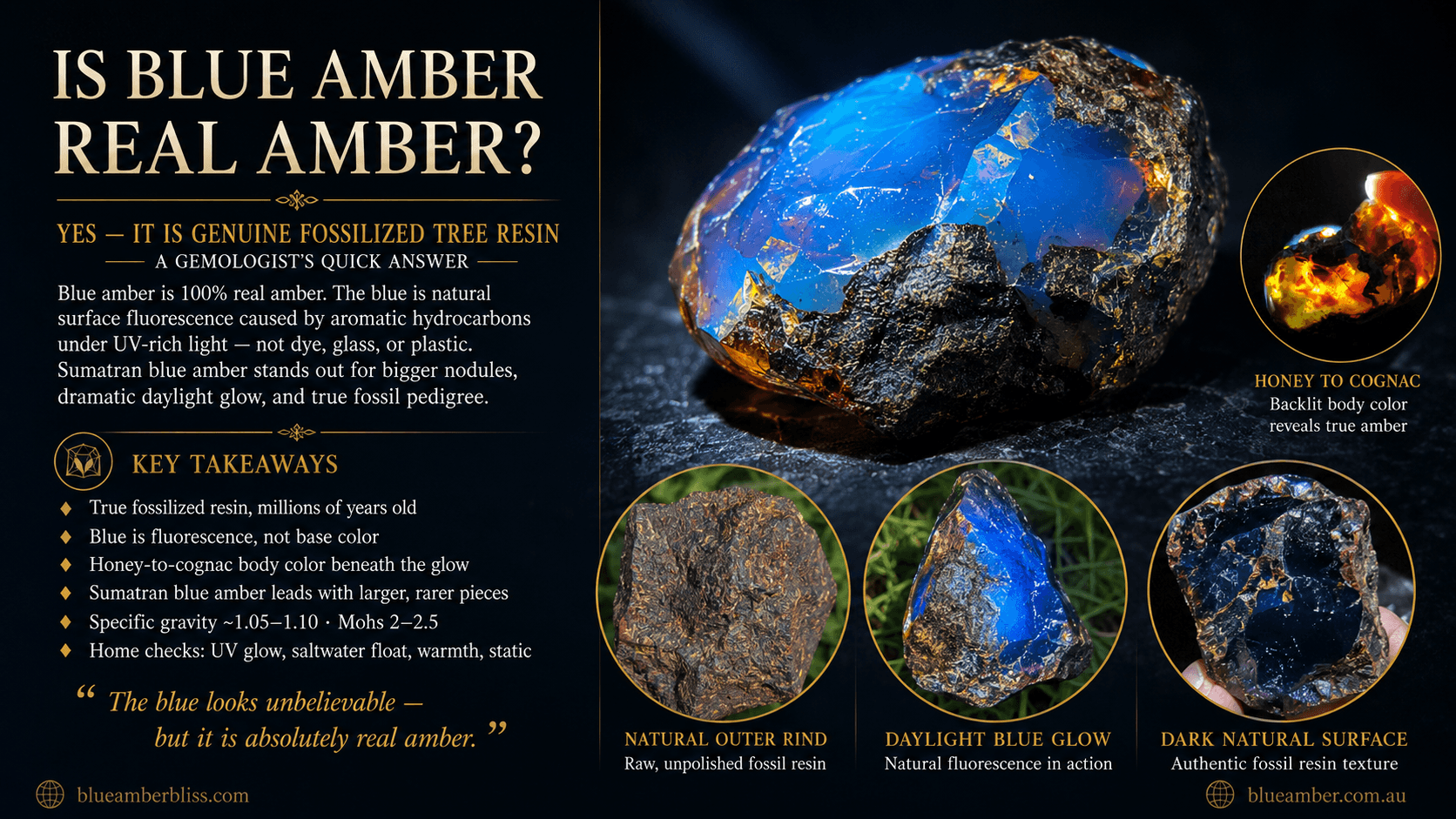
- The blue is fluorescence, not body colour — perylene and related PAHs re-emit blue light, so only specific resin chemistries qualify.
- Named provenance (Sinamar/Jambi for Sumatran; La Cumbre, La Toca and Palo Quemado near Santiago for Dominican) and lab documentation are what let value hold.
- Grade — AA, AAA, AAA+ — maps glow strength, clarity and size to price; that is how “strong vs weak glow” becomes a measurable scale.
- Sumatran is the hero: bigger, cleaner nodules and a stronger daylight blue make it the standout AAA+ material.
1. Geological Rarity: Why Blue Amber Is Unusual in Nature
All amber begins as tree resin, but not all resins are chemically equal. Blue amber is a member of the retinite class of fossil resins — low in succinic acid, unlike Baltic succinite — and it forms only when several conditions line up at once.
- The right source tree. Sumatran blue amber comes from resin of the Dipterocarpaceae family (most likely a Shorea), a tropical hardwood; Dominican amber comes from the now-extinct leguminous Hymenaea protera (the algarrobo). Both produced labdanoid/terpenoid resins that polymerised into amber over millions of years.
- The right molecular cargo. The resin had to carry traces of perylene and other polycyclic aromatic hydrocarbons (PAHs) — the fluorophores that make the blue possible.
- The right fossilisation. Heat, pressure, burial chemistry and deep geological time had to amberise the resin while preserving those fluorescent molecules rather than destroying them.
- The right survival. The deposit then had to escape erosion and remain mineable long enough to be found.
That combination is genuinely uncommon, which is why blue amber is effectively limited to two provinces of the Earth — and why even there, most of the amber pulled from the ground is not strongly blue. (For the geology in full, see how blue amber is mined and where the material actually comes from.)
It is worth pausing on that word amberise. Fresh resin is sticky and full of volatile terpenes; over millions of years of burial those volatiles are driven off and the remaining labdanoid molecules cross-link, or polymerise, into the hard, stable, amorphous (non-crystalline) solid we call amber. Copal — resin only partly through this journey — looks similar but still turns tacky under acetone.
Mature blue amber has completed the transformation, which is part of what keeps the trapped perylene and PAH fluorophores stable enough to glow tens of millions of years later. That long, fragile chemical road is the deepest reason the answer to how rare is blue amber begins underground, not at the jeweller’s counter.
The named deposits behind the rarity
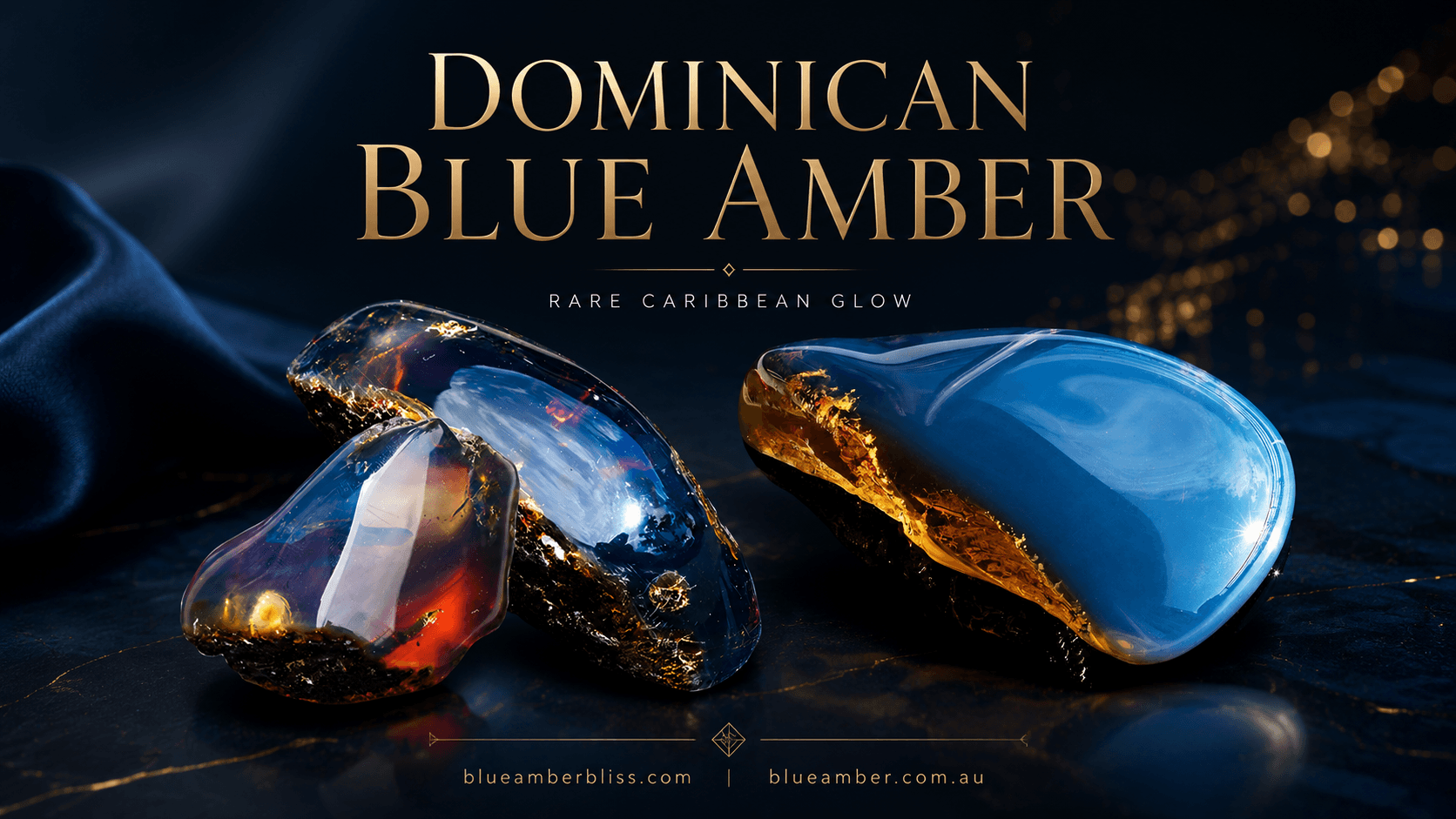
Rarity stops being abstract once you name the ground it comes from. Sumatran blue amber is recovered from the Sinamar Formation in Jambi Province, within the South Sumatra Basin along the Bukit Barisan foothills, where it is mined from coal-bearing Miocene sediments. Dominican blue amber comes from a cluster of mines — La Cumbre, La Toca and Palo Quemado — in the Cordillera Septentrional near Santiago. These are not sprawling industrial operations; they are localised, often hand-worked sites, which is the first reason supply is structurally tight (mindat.org catalogues amber occurrences and their mineralogy).
2. Rarity Inside the Deposit: Strong Glow vs Weak Glow
Picture a working deposit as a pyramid. The wide base is ordinary, weakly fluorescent amber; the narrow tip is the electric-blue material everyone wants. Within a single mine you’ll typically find:
- Stones with no visible blue glow at all
- Stones with a soft blue haze only under UV
- Stones with a clear but moderate glow
- A small percentage with an intense, neon-like blue or blue-green flash visible even in daylight
On our buying trips, it is normal to sort through a large lot of rough and keep only a small fraction that clears our bar for strong, clean fluorescence, attractive body colour, and a shape large and sound enough to cut or carve. That sorting ratio is the heart of why fine blue amber is rarer — and dearer — than ordinary amber.
The AA / AAA / AAA+ grading scale
Dealers turn “strong vs weak glow” into a usable scale with grade tiers. Treat them as a rough but widely understood map:
| Grade | Glow | Clarity & colour | Typical size |
|---|---|---|---|
| AA | Partial or patchy blue, mostly under UV | Some clouds/cracks acceptable | Small to medium |
| AAA | Strong, even blue in UV; visible in daylight | Clean, attractive warm body | Medium, sound |
| AAA+ | Intense, full-coverage daylight blue glow | Very clean, rich contrast | Large, carve-grade |
Sumatran deposits disproportionately yield the larger, cleaner nodules with the dramatic daylight blue that defines the AAA+ tier — one concrete reason it is the hero material here.
3. Why the Glow Is the Rarity (the Mechanism in Brief)
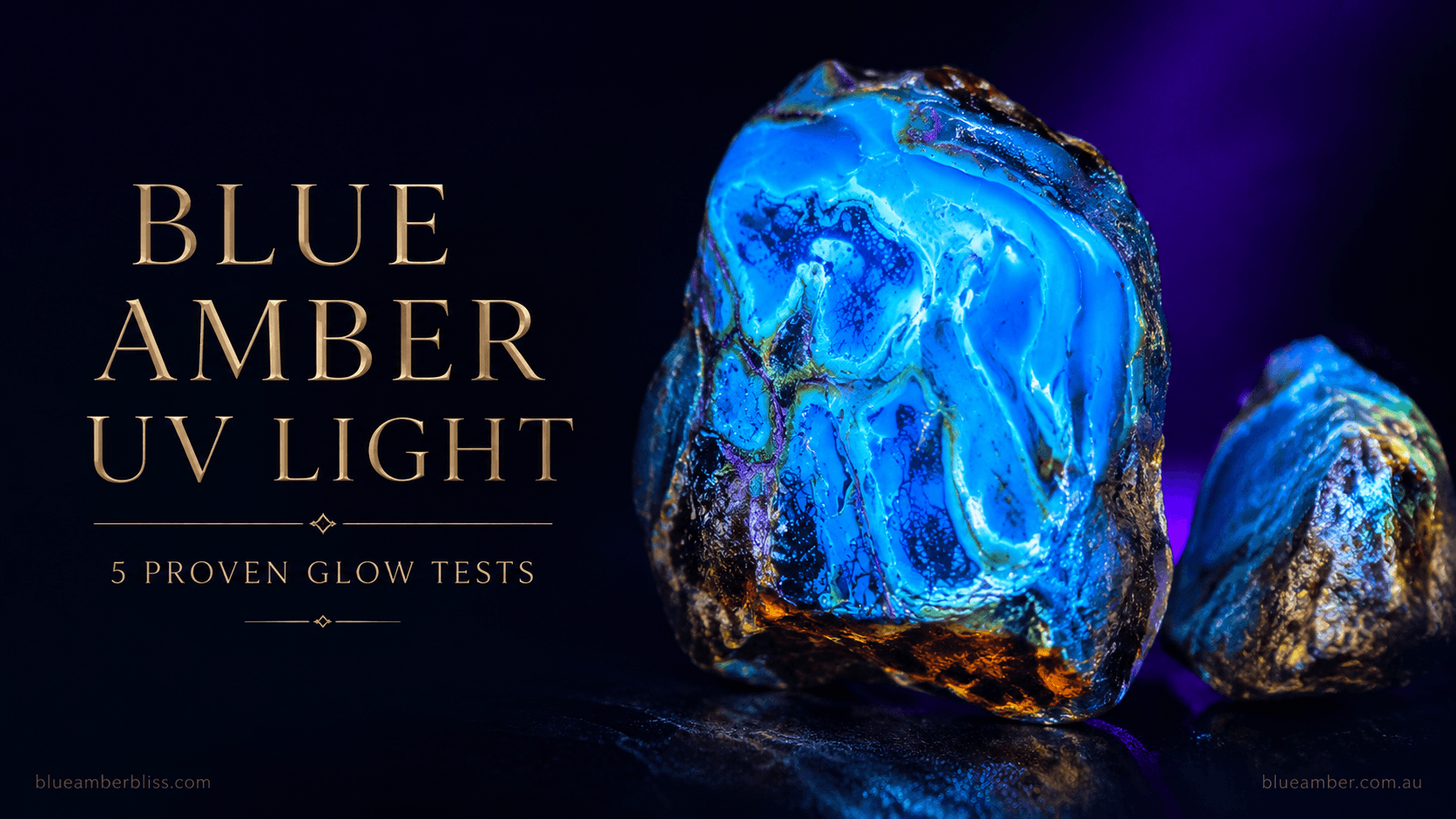
It helps to understand why only some stones glow, because that mechanism is the rarity. The blue you see is not body colour — it is fluorescence: perylene and other PAHs absorb ultraviolet and violet light and re-emit it as blue, while Rayleigh/Tyndall scattering of short wavelengths at the surface adds to the effect. Crucially, blue amber is fluorescent, not phosphorescent — the glow stops the instant the exciting light is removed. Lab work on Dominican material recorded emission peaks near 450, 474 and 508 nm (GIA Gems & Gemology, Winter 2020), which is the bluish-green you actually see.
This is also why the light source matters: 365 nm long-wave UV gives the truest, strongest blue and is the standard test wavelength; cheap 395 nm torches are partly visible violet and wash the effect out; and in strong Sumatran material, ordinary sunlight carries enough UV to trigger the signature daylight blue. For the full physics and chemistry, see our deeper comparison of Sumatran vs Dominican blue amber — here it’s enough to know that a resin without the PAH fluorophores simply cannot be made to glow, which is precisely why glowing material is scarce.
4. Sumatran vs Dominican: Which Is Rarer and More Valued?
Both are rare retinite ambers of similar Miocene age, and in pure quality terms they are equals. But they have different personalities — and different market positions.
Sumatran Blue Amber (the hero)
- Typically deeper honey, cognac or cola-brown body colour, giving the blue a dramatic dark stage
- Frequently shows very strong daylight blue or blue-green fluorescence
- The newer, bigger-nodule source — pieces large and clean enough for bold cabochons and carvings, the standout AAA+ grade
Dominican Blue Amber
- Often lighter body colour (yellow to light honey)
- Glow ranges from soft to medium, with that documented 450–508 nm bluish-green signature
- Studied and named first, so it carries more historical recognition
The two are equal in quality, but Sumatran is the newer, larger-stone, more-dramatic standout — which is exactly why Blue Amber Bliss curates Sumatran rather than offering a little of everything. For a side-by-side breakdown, read Sumatran vs Dominican blue amber compared.
5. Three Kinds of Rarity: Natural, Visual and Market
When you ask how rare is blue amber, you’re really asking three overlapping questions.
Natural rarity
- Only two deposits worldwide carry the right chemistry.
- Within them, strong-glow material is rarer still — and large strong-glow material rarer again.
Visual rarity
- A deep cola-brown stone that ignites into electric blue outdoors is something most people never see in person.
- Even among collectors, high-contrast AAA+ pieces are remembered and talked about by name.
Market rarity
- Mining at Sinamar and the Santiago-area sites is small-scale and often seasonal.
- Supply tightens fast when demand spikes or a site becomes harder to access.
- The best stones often move quietly from miner to carver to private collector, never reaching open retail.
Natural and visual rarity feed market rarity, which you experience as limited availability and firm prices — most sharply for standout pieces.
6. What Drives Blue Amber’s Value?
Think of these as dials. The more you turn up, the higher the price climbs.
1. Strength and evenness of the blue glow
This is the single biggest value driver and the basis of the AA/AAA/AAA+ scale. The premium goes to strong, even fluorescence that holds in daylight and at multiple angles — a clean transition from warm body to blue surface glow. Weak or patchy blue sits at the bottom of the price range.
2. Body colour and contrast
Rich honey, cognac and cola-brown bodies command more interest than pale or muddy tones. A dark, warm body gives the blue a dramatic stage — the coveted “embers under a night sky” effect that Sumatran material does so well.
3. Clarity and internal structure
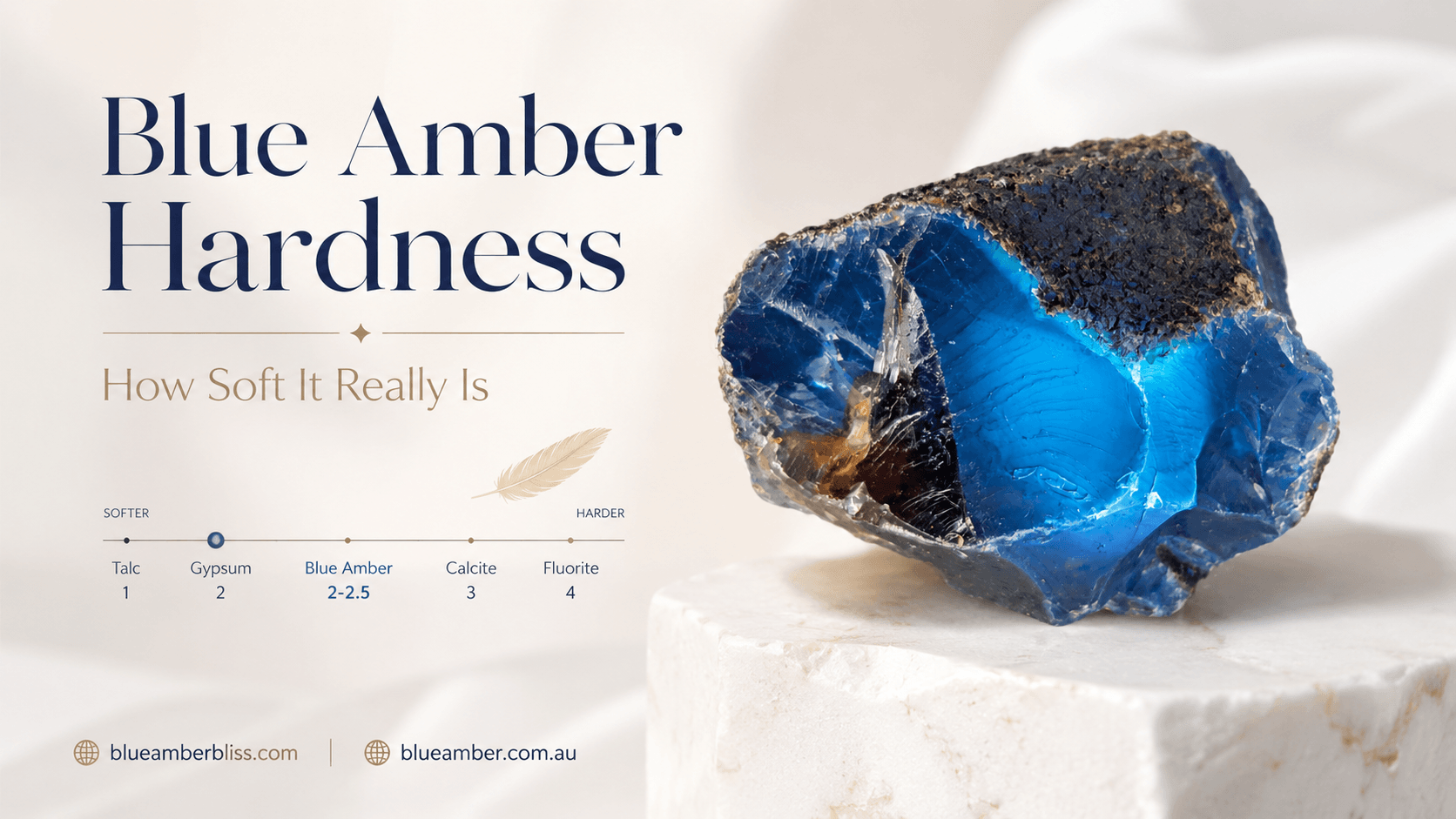
Fewer cracks and less cloudiness mean higher value, especially in larger stones, because amber is soft — Mohs 2–2.5 — and heavy fractures limit how a piece can be cut or set. Gentle clouds can add character; structural flaws subtract it.
4. Size and shape
Large stones with strong even glow are exponentially rarer than small ones, which is why the price curve steepens sharply with size. Natural forms that yield clean cabochons or carvings beat irregular fragments. Sumatran’s bigger nodules are a real advantage here.
5. Origin and documentation
See the dedicated section below — documented provenance and lab identification are what let a stone hold its value over time.
6. Craftsmanship (finished jewellery and carvings)
Expert cutting and polishing can dramatically enhance glow; protective settings matter because the stone is soft and warm to the touch, not hard like glass. A carving by a known hand becomes collectible art rather than “just a stone.”
7. Origin & Documentation: Why Provenance Lets Value Hold
For everyday pieces, a trusted specialist’s word and clear photos are enough. For high-end stones, documentation is what separates a confident purchase from a gamble — and it is central to whether blue amber holds its value.
- Provenance. A stone tied to a named source — Sinamar/Jambi for Sumatran, or the La Cumbre/La Toca/Palo Quemado mines near Santiago for Dominican — is easier to resell and discuss with other collectors.
- Lab identification. A GIA or IGI report, typically backed by FTIR spectroscopy, confirms the material is genuine fossil amber — retinite, distinct from Baltic succinite — and not copal or a plastic imitation. FTIR is also the definitive way to settle the copal-versus-mature-amber question.
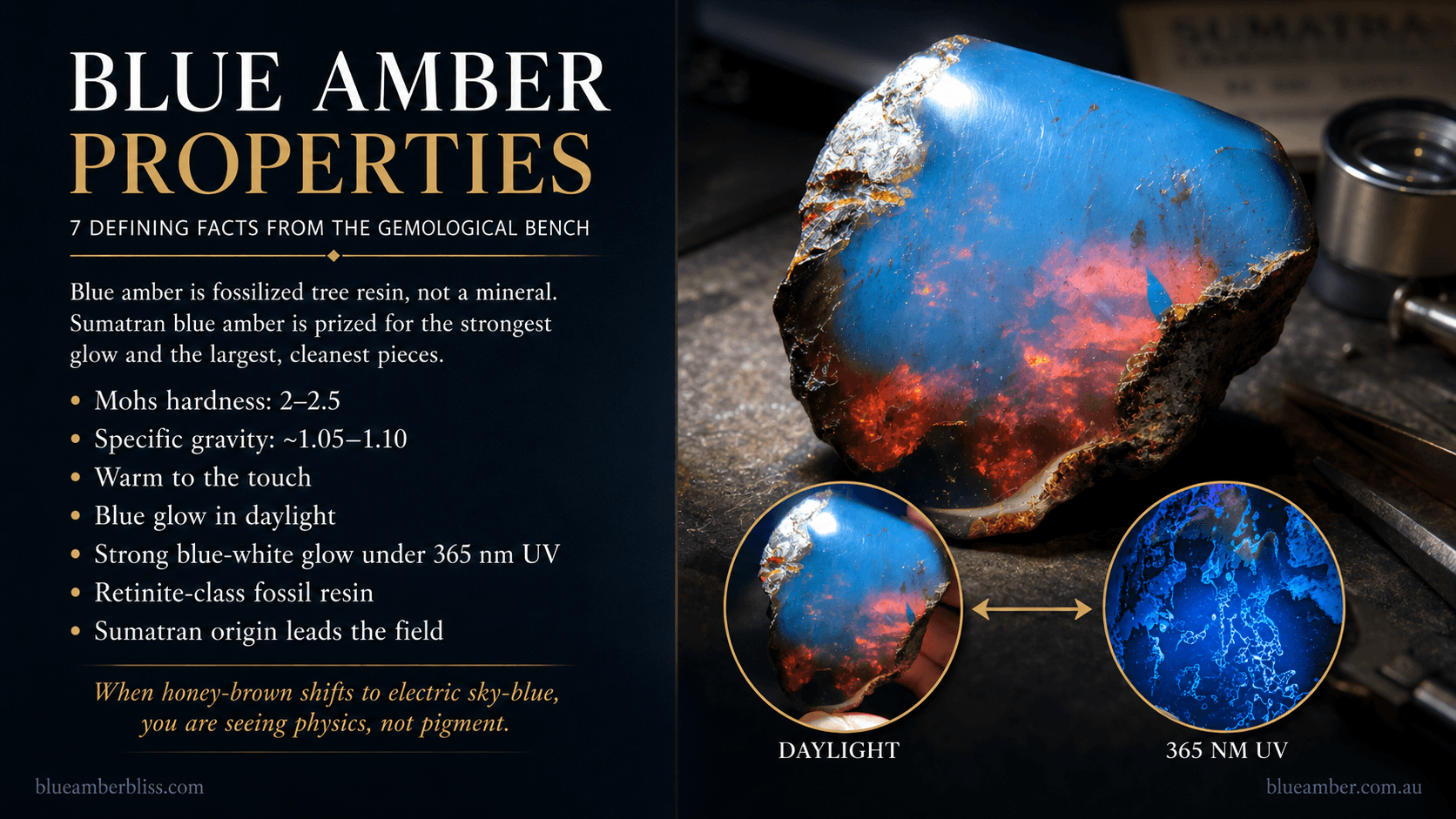
- Quick self-checks. The signature 365 nm / daylight blue glow, the saltwater float test (SG ~1.05–1.10, so it floats in saturated brine of SG ~1.15–1.16 but sinks in fresh water), and warmth to the touch are fast first-pass tells.
Why does the saltwater float test work so reliably? Genuine amber’s specific gravity of about 1.05–1.10 is barely denser than fresh water but lighter than saturated brine, so a real stone bobs up in salt water while most plastics and glass — being denser — sink. Pair that buoyancy check with the 365 nm UV glow and a refractive index near 1.54, and you have already screened out the commonest fakes before any lab is involved.
We keep the full battery short here on purpose — for the complete authentication walkthrough (acetone, hot-needle, UV and lab options), see our guide on telling real blue amber from fakes, and for the underlying material science, how the resin becomes amber.
8. Understanding Price Differences: How Rarity Becomes a Number
Rarity ultimately shows up as price per gram. Rough and low-glow material sits at the bottom; clean, strong-glow, large collector pieces sit at the top. As a working frame:
| Tier | What it is | Price per gram |
|---|---|---|
| Low | Rough or low-glow material | $3–15/g |
| Mid | Polished, good blue glow | $15–60/g |
| High | High-grade AAA, strong even daylight glow, clean | $60–200/g |
| Top | AAA+ large, clean, intense-glow collector pieces | $200–500+/g |
What Rarity Looks Like in the Hand
At Blue Amber Bliss, the rarity behind the price becomes obvious the moment a Sumatran piece leaves a display case and meets daylight: a dark cognac body that reads almost brown indoors flares into that deep blue glow outdoors, and only a small fraction of the rough we sort ever shows that strength cleanly. What we notice pushing genuine value is the combination that rarely coexists in one stone, a clean nodule of real size, dramatic daylight-to-glow contrast, and honest natural inclusions that mark it as ancient resin rather than an imitation. Those complete pieces are the scarce ones collectors chase, and we hand-select for exactly that overlap rather than color alone.
If you would like to see that rarity for yourself, you are welcome to explore our hand-selected Sumatran blue amber whenever you are ready. Shop hand-selected Sumatran blue amber →
Related Blue Amber Guides
Finished jewellery and carvings are priced per piece rather than purely by weight, because cutting, setting and artistry add value beyond the raw gram — and the largest, flawless, strong-glow Sumatran pieces command the real premium. For current numbers and worked examples, see the full blue amber price per gram guide and a look at the most expensive blue amber ever sold.
9. How to Choose a Piece That Holds Its Value
- Prioritise glow and contrast. A slightly smaller AAA stone with stunning daylight blue usually beats a bigger, duller one.
- Look for clean, sound shapes. They set more easily and survive longer in soft amber.
- Ask about origin. Clearly identified Sumatran or fine Dominican material is easier to resell and document.
- Buy from specialists. A focused seller sorts quality properly and stands behind authenticity.
- Follow your eye. The piece you keep reaching for is the one that’s truly valuable to you.
10. Is Blue Amber a Good Investment?
Buy blue amber first because you love it. That said, collectors see genuine upside: supply is naturally capped and can’t be scaled on demand, awareness of Sumatran material is growing, and top one-of-a-kind pieces often vanish into private collections for years once sold. If you’re thinking in those terms, concentrate on strong even glow, rich contrast and good size, keep your photos, invoices and origin notes, and store the stone carefully. We go deeper in is blue amber a good investment.
How Rare Is Blue Amber? Frequently Asked Questions
How rare is blue amber compared to ordinary amber?
Far rarer. Ordinary amber is abundant worldwide, but blue amber comes from only two regions — Sumatra and the Dominican Republic — and within those deposits only a small percentage glows strongly. Clean, large, strong-glow AAA+ pieces are a tiny elite, which is why fine blue amber is genuinely scarce.
What is the value of blue amber per gram?
Rough or low-glow material runs about $3–15 per gram; polished good-glow pieces $15–60; high-grade clean AAA with strong daylight glow $60–200; and top AAA+ collector pieces $200–500+ per gram. Finished jewellery and carvings are priced per piece. See our price guide for current figures.
Why is Sumatran blue amber considered the most valuable?
Sumatran and Dominican are equal in quality, but Sumatran is the newer source with larger, cleaner nodules and a more dramatic daylight blue glow. That combination of size, clarity and intense fluorescence puts top Sumatran material in the standout AAA+ tier and at the premium end of the market.
How old is blue amber?
Sumatran blue amber dates to the Miocene epoch, millions of years in the making; Dominican amber spans the Oligocene–Miocene, millions of years. Both are fossilised tree resin that polymerised over those timescales — not themillions of years sometimes claimed online.
Does blue amber really glow in daylight, or only under UV?
Both, depending on the stone. The blue is fluorescence from perylene and related PAHs, strongest under 365 nm UV. In strong Sumatran material, ordinary sunlight carries enough UV to trigger the signature daylight blue. It is fluorescent, not phosphorescent, so the glow stops the instant the light source is removed.
What documentation should high-value blue amber have?
For premium stones, a GIA or IGI report backed by FTIR spectroscopy confirms it is genuine retinite fossil amber rather than copal or plastic. Named provenance — Sinamar/Jambi for Sumatran, or the Santiago-area mines for Dominican — adds confidence and helps the piece hold its value on resale.