
You are spending real money on a rare gem, so you deserve real proof. Below, you’ll learn exactly what a lab tests, how to read every line of a report, when to demand one, which labs to trust, and the red flags that signal a fake document or a fake stone. Sumatran blue amber leads the conversation throughout, because it is the most valuable and dramatic blue amber on the market today.
Key Takeaways
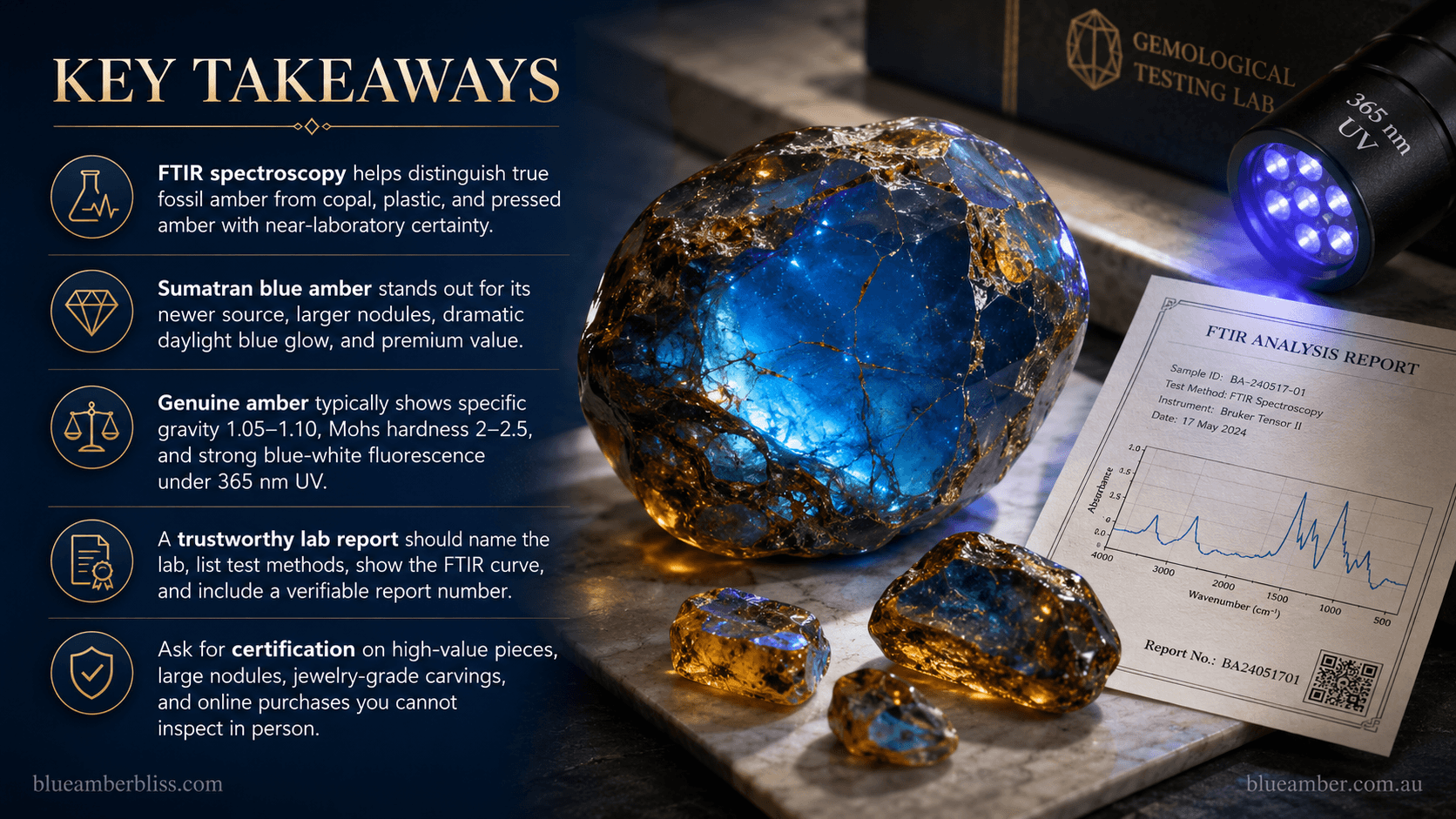
- Blue amber certification uses FTIR spectroscopy to distinguish true fossil amber from copal, plastic, and pressed (reconstructed) amber with near-laboratory certainty.
- Sumatran blue amber comes first: a newer source with larger nodules and a famously dramatic daylight blue glow, making it the standout and most valuable blue amber.
- Genuine amber shows specific gravity ~1.05-1.10, Mohs hardness 2-2.5, and intense blue-white fluorescence under 365 nm long-wave UV.
- A trustworthy blue amber lab report names the lab, lists test methods, shows the FTIR curve, and carries a verifiable report number.
- Demand a certificate for any high-value piece, large nodule, jewelry-grade carving, or online purchase you cannot inspect in person.
What Does Blue Amber Certification Actually Prove?
Blue amber certification proves three things at once: that the material is true amber, what kind it is, and whether anything was done to it. It converts your trust from “the seller says so” into “an independent lab measured it.” That difference matters enormously when you are buying a gem most people have never held.
First, it proves authenticity. The lab confirms the stone is genuine fossilized tree resin ancient natural resin, not a modern imitation. According to the Britannica entry on amber, true amber is fossil resin that has fully polymerized over geological time, which is precisely what testing verifies.
Second, it proves identity. Good reports note the likely origin and that the blue is a natural fluorescence effect, not surface dye or coating. This is where Sumatran blue amber shines, since its hallmark is a strong, visible blue glow in ordinary daylight.
Third, it proves condition. The report flags treatments such as heating, pressing, or impregnation. Honest disclosure here is the entire point of blue amber certification and is what separates a real gemological document from a marketing flyer.
Why Sumatran blue amber leads on certification value
Sumatran (Indonesian) blue amber is the hero of this category. It is a newer deposit than the classic Caribbean sources, and it yields noticeably larger nodules with strong, consistent blue fluorescence visible in daylight. Those bigger, cleaner pieces are exactly the ones worth certifying.
Sumatran and Dominican blue amber are equal partners in quality and value, both genuine and both beautiful. That said, Sumatran’s newer source, bigger pieces, and somewhat better overall quality make it the more valuable standout, prized for its dramatic daylight glow. List it first whenever you compare. A certificate simply puts that value on paper.
How Does FTIR Testing Confirm Real Blue Amber?
FTIR stands for Fourier-transform infrared spectroscopy. It shines infrared light through a tiny sample and records how the material absorbs specific wavelengths. Every substance has a unique “fingerprint” of absorption peaks, and amber’s fingerprint is well documented. This is the single most decisive test in blue amber certification.
The key feature labs look for is the so-called Baltic shoulder region and the broader carbonyl and C-H stretching pattern that mature fossil resin produces. Young copal, which is unfossilized resin only thousands of years old, shows a clearly different curve, especially around the 1640 cm-1 region tied to unsaturated bonds.
Plastic imitations and pressed amber also betray themselves. Cast resin and Bakelite produce peaks that fossil amber never shows. Pressed (reconstructed) amber, made by fusing small amber fragments under heat and pressure, can show subtle flow lines and a slightly altered spectrum that a trained analyst catches.
Is FTIR better than home tests?
Home tests are useful screening, not proof. The blue amber saltwater test checks density, since real amber floats in saturated saltwater while most plastics sink. The blue amber UV light check reveals fluorescence.
These home methods can be fooled, and they cannot separate copal from amber reliably. FTIR can. That is why serious blue amber certification always rests on instrument data, not just a float or a glow. Use home tests to screen, then let the lab confirm with spectroscopy before you commit to a high-value purchase.
How Do You Read a Blue Amber Lab Report?
A proper blue amber lab report reads like a short scientific document, not an advertisement. Once you know the parts, you can scan any certificate in under a minute and judge whether it is real. Below is what each line should tell you and why it matters to your purchase.
Start at the top with the lab name, logo, and contact details. A real laboratory is findable, has a physical address, and lets you verify reports by number on its website. If you cannot independently confirm the lab exists, treat the document as decorative.
Next, find the report number and date. This unique identifier ties the paper to a specific stone. Reputable labs maintain an online database where you type the number and see the same result. A certificate with no verifiable number is the most common red flag in fake paperwork.
What do the measurements on the report mean?
The body of any blue amber gemological certificate lists measured properties. Compare them against known amber values so nothing looks off. Here is what genuine amber should show, and what each figure tells you about the stone in your hand.
| Property | Genuine amber value | What it confirms |
|---|---|---|
| Specific gravity | ~1.05-1.10 | Low density; floats in saturated saltwater (~1.16) |
| Mohs hardness | 2-2.5 | Soft, organic; warns against scratch abuse |
| Refractive index | ~1.54 | Consistent with fossil resin, not glass (~1.5-1.7+) |
| UV fluorescence | Strong blue-white at 365 nm | Natural blue effect, not dye |
| FTIR spectrum | Mature resin fingerprint | Rules out copal and plastic |
| Hot-point / odor | Pine-resin scent | Distinguishes amber from synthetics |
If the report’s specific gravity reads 1.3 or its hardness reads 5, the stone is not amber. Numbers that fall far outside these ranges are an immediate stop signal, regardless of how official the paper looks.
What should the conclusion section say?
The conclusion is the verdict line. You want explicit language such as “Natural amber, no indication of treatment” or, if relevant, “Amber, pressed (reconstructed).” Vague wording like “amber-type material” or “organic gem” is evasive and should worry you.
A strong blue amber authentication report also states the test methods used, typically FTIR plus standard gemological observation. When methods are named and results stated plainly, you are holding genuine certification rather than a pretty printout designed to reassure rather than inform.
When Should You Demand Blue Amber Certification?
You do not need a lab report for a small inexpensive bead, but several situations make blue amber certification non-negotiable. The rule of thumb: the higher the price and the lower your ability to inspect in person, the more you need independent proof on paper.
Demand a report for any large Sumatran nodule. Big, clean pieces with that signature daylight glow command premium prices, and premium prices justify lab fees. The bigger the stone, the bigger the loss if it turns out to be pressed amber or resin.
Demand one for online or cross-border purchases where you cannot run your own tests first. If you are shopping remotely, see our guide on where to buy blue amber from sellers who stand behind their material with documentation and clear return terms.
Is blue amber certified at the point of sale?
Often, yes, for serious pieces. Many reputable dealers either supply a report or arrange testing on request. Asking “is blue amber certified for this exact stone?” is a fair, normal question, and a confident seller welcomes it rather than dodging.
For lower-value items, a seller’s own authenticity guarantee plus a generous return policy may suffice. Pair that with your own checks: review how to spot real blue amber so you can verify the obvious traits yourself before and after the parcel arrives.
Which Labs Are Trusted for a Blue Amber Gemological Certificate?
Not every “certificate” carries equal weight. A trustworthy blue amber gemological certificate comes from an established, independent laboratory with published methods and verifiable databases, not from an anonymous in-house “appraiser” with no accountability.
The Gemological Institute of America (GIA) is the global benchmark for gem identification and amber education, and its research underpins how amber and copal are separated worldwide. Other widely respected names include IGI, and amber-specialist institutes in Europe and Asia that routinely run FTIR on resin gems.
Regional amber laboratories near major trading hubs also produce solid reports, especially those that specialize in fossil resins and publish their spectroscopy protocols. What matters is independence, instrument capability, and a way to verify the document, not the country on the letterhead.
How do you verify a lab is legitimate?
Do three quick things. First, search the lab’s name and confirm it has a real website, address, and contact route. Second, use the lab’s online report-check tool with your certificate number. Third, confirm the report mentions FTIR or comparable instrumentation, not just visual inspection.
If any of those three fail, downgrade your trust. A genuine blue amber lab report survives all three checks easily. The whole value of blue amber certification collapses if the issuing body cannot be verified, so never skip this step on an expensive purchase.
What Are the Red Flags of Fake Blue Amber Certification?
Counterfeit paperwork is now as common as counterfeit stones. Sellers of fake blue amber sometimes attach official-looking certificates to dyed resin. Knowing the warning signs protects you from both fake stones and fake blue amber certification.
Here is a quick-scan checklist of red flags. If you spot more than one, pause the purchase and ask hard questions before any money changes hands.
- No report number or a number that does not verify in the lab’s database.
- No FTIR or test methods listed – only vague visual “appraisal” language.
- Impossible measurements – specific gravity, hardness, or RI far outside amber’s range.
- Generic stock certificate reused across many listings with the same photo.
- Evasive conclusion such as “amber-type” or “natural gemstone” instead of “natural amber.”
- Unverifiable lab with no website, address, or public method documentation.
- Price too good for a large, glowing Sumatran piece – a classic bait for resin fakes.
One subtle trap is a real report for a different stone. Always confirm the weight, dimensions, and photo on the paper match the exact piece you are buying. A mismatch means the certificate, even if genuine, does not describe your gem.
Can a certificate be real but still misleading?
Yes. A report may correctly say “amber” while quietly omitting that the piece is pressed or heat-treated. Read the treatment line carefully. Honest blue amber certification states treatments plainly; a careful read protects you from technically-true-but-incomplete documents.
Also watch for origin overreach. Pinpointing exact geographic source from a single stone is hard, so a responsible blue amber authentication report uses cautious language. Over-confident origin claims, especially ones that downplay Sumatran material, deserve healthy skepticism.
How Does Sumatran Blue Amber Compare to Dominican on Certification?
Both Sumatran and Dominican blue amber are genuine, certifiable, and beautiful, and both fluoresce that captivating blue. They are equal in quality and value as fossil resins. The certification process is the same for each: FTIR plus gemological measurement.
The distinction is supply and scale. Sumatran is the newer source, producing larger nodules and somewhat better overall quality, which makes it the more valuable standout and the one most worth certifying for big-ticket pieces. Its daylight blue glow is famously dramatic, which buyers prize.
| Factor | Sumatran (Indonesian) | Dominican |
|---|---|---|
| Source age | Newer deposit | Long-established |
| Typical nodule size | Larger pieces common | Often smaller |
| Daylight blue glow | Famously dramatic | Beautiful blue |
| Quality and value | Standout, somewhat higher | Equal-grade, genuine |
| FTIR fingerprint | Mature fossil resin | Mature fossil resin |
| Certification process | FTIR + gemological | FTIR + gemological |
Related Blue Amber Guides
Practically, this means your certificate should celebrate Sumatran material, not apologize for it. If a report or seller implies Dominican outranks Sumatran on value or fluorescence, that framing is outdated. The two are peers, with Sumatran the larger, newer, and more valuable standout.
Your 5 Proven Trust Checks Before You Buy
Bring everything together into one repeatable routine. Run these five checks in order and you will catch nearly every fake stone and fake document before your money is at risk. This is the heart of practical blue amber certification for everyday buyers.
- Verify the lab. Confirm it exists, has a real address, and offers online report verification by number.
- Confirm FTIR. The report must name spectroscopy, not just visual appraisal, to rule out copal and plastic.
- Match the stone. Check that weight, dimensions, and photo on the report match the exact piece you are buying.
- Read the verdict and treatments. Look for “natural amber” and explicit treatment disclosure, not vague wording.
- Cross-check yourself. Run the saltwater float and 365 nm UV checks, then compare to the report’s stated values.
If all five pass, you can buy with confidence. If even one fails on a high-value Sumatran piece, walk away. There is always another genuine stone, and a legitimate seller will respect your diligence rather than rush you.
What We Check Before We Certify a Sumatran Piece
At Blue Amber Bliss, the single most telling authenticity check on our Sumatran stock is the daylight-to-glow shift: we walk each piece from warm indoor light out into daylight (or under UV) and watch a dark cognac body flip to that deep electric blue in seconds, an optical response no dyed or synthetic imitation reproduces. We pair that with a close read of the natural inclusions and the honest surface after polishing, since flow lines, tiny gas bubbles, and specimen character are exactly what we expect from ancient natural resin millions of years in the making. When a nodule glows strong, shifts cleanly, and carries those internal fingerprints together, we’re confident it’s the real Sumatran article rather than something engineered to look the part.
If you’d like to see these trust checks in person, you’re welcome to explore our hand-selected Sumatran blue amber and find a piece whose glow and character you can verify for yourself. Shop hand-selected Sumatran blue amber →
Frequently Asked Questions
Is blue amber certified by default when I buy it?
Not automatically. Lower-value beads often ship with only a seller guarantee. For larger or pricier Sumatran pieces, ask directly whether a report is included or available. Reputable dealers either provide blue amber certification or arrange independent testing on request without hesitation.
What is the single most important test in a blue amber lab report?
FTIR spectroscopy. It produces a chemical fingerprint that cleanly separates mature fossil amber from young copal, plastic, and pressed material. No home test matches it. A blue amber lab report that lacks FTIR or equivalent instrumentation is incomplete and should not anchor a major purchase.
How much does blue amber certification cost?
Independent lab fees typically run from roughly 30 to 120 USD per stone, depending on the lab and tests requested. For a large Sumatran nodule worth hundreds or thousands, that fee is trivial insurance. For inexpensive beads, a seller guarantee plus your own checks is usually proportionate.
Can FTIR tell Sumatran blue amber from Dominican?
FTIR confirms the material is genuine mature fossil resin, but pinpointing exact geographic origin from spectrum alone is difficult. Both Sumatran and Dominican show a mature-resin fingerprint. A careful blue amber authentication report states authenticity confidently while keeping origin language appropriately cautious.
What specific gravity and hardness should real amber show?
Genuine amber has a specific gravity of about 1.05 to 1.10 and a Mohs hardness of 2 to 2.5. It floats in saturated saltwater near 1.16 density. Any blue amber gemological certificate showing values far outside these ranges describes something other than true amber.
Does the blue color need its own certification?
The blue is natural fluorescence, not a separate certifiable “color grade.” A good report notes strong blue-white fluorescence under 365 nm UV and confirms there is no dye or coating. Sumatran material is famous for its dramatic daylight blue, which a UV note on the report supports.
Are home tests enough instead of a lab report?
Home tests screen but do not prove. Saltwater float and UV glow can be mimicked or can fail to separate copal from amber. Use them first, then rely on instrument-based blue amber certification for any expensive piece you cannot personally examine before paying.
What does a fake blue amber certificate look like?
It usually lacks a verifiable report number, omits FTIR, lists impossible measurements, or reuses a generic stock photo. The conclusion hedges with terms like “amber-type.” If the issuing lab has no findable website or report-check database, treat the document as worthless.
Should I trust an in-house appraisal from the seller?
Treat it as a starting point, not proof. In-house appraisals lack independence. The gold standard for blue amber certification is a third-party lab with FTIR capability and a public verification system. Pair any seller appraisal with your own saltwater and UV checks for confidence.
Where can I learn to verify blue amber myself?
Start with the fundamentals of authenticity, then practice the density and UV checks. Our guides on spotting real blue amber, the saltwater test, and UV behavior walk you through each step so your own observations line up with what a proper lab report should confirm.
The Bottom Line on Certification
Genuine blue amber certification turns a leap of faith into a measured decision. FTIR confirms real fossil resin, gemological data confirms the physical properties, and a verifiable lab confirms the document itself. Run the five trust checks every time and counterfeits rarely survive your scrutiny.
Above all, buy Sumatran with pride. It is the newer, larger, more valuable standout of the blue amber world, celebrated for its dramatic daylight glow. A solid report does not diminish that story; it certifies it, so you can wear or collect your stone knowing exactly what you own.


