Key Takeaways
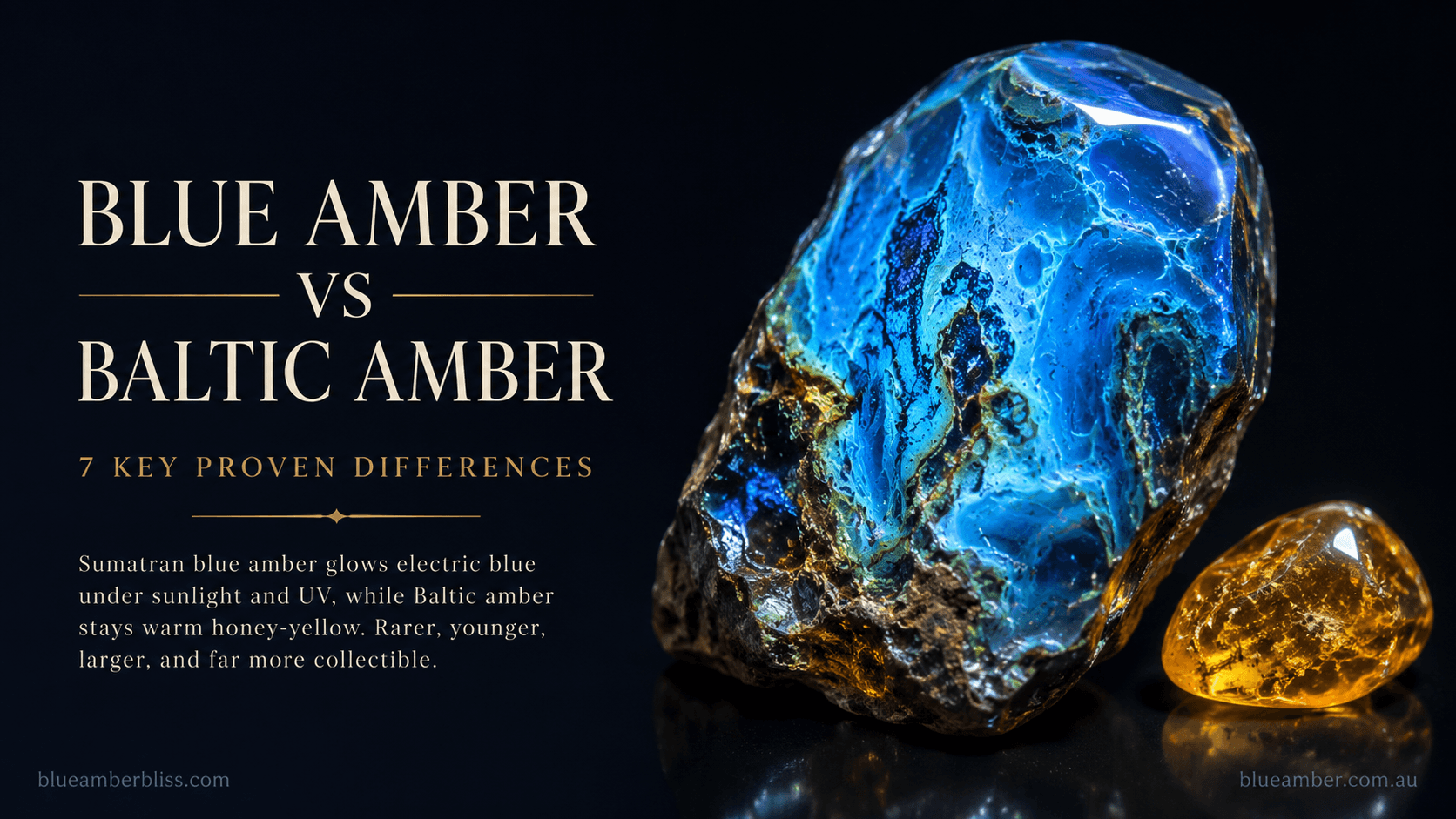
- Color glow: Sumatran blue amber flashes a vivid blue in daylight; Baltic amber reads yellow, cognac, or honey with no blue glow.
- Fluorescence: Blue amber lights up strongly under long-wave UV (~365 nm); Baltic amber shows only a soft, milky pale-blue fluorescence.
- Rarity and price: In the blue amber vs Baltic amber match-up, blue amber is the scarce premium gem, often 10-50x the price of ordinary Baltic.
- Age: Sumatran blue amber is millions of years in the making; Baltic amber is older at millions of years.
- Bottom line: Both are genuine fossilized resin, but Sumatran blue amber is the rare, glowing headline act and Baltic is the abundant everyday amber.
What Is the Real Difference in Blue Amber vs Baltic Amber?
Both are fossilized tree resin, so chemically they are cousins, though not identical: Baltic amber is succinite (high in succinic acid, roughly 3-8%), while Sumatran blue amber is a different, low-succinic-acid resin whose distinct chemistry is exactly what produces the blue fluorescence. The headline of any blue amber vs Baltic amber comparison is optical: blue amber contains trace aromatic molecules (notably perylene) that absorb ultraviolet light and re-emit it as visible blue. Baltic amber lacks this dramatic effect.
Sumatran blue amber, mined from coal-bearing deposits on the Indonesian island of Sumatra, is the hero here. It produces the most theatrical daylight blue glow and arrives in unusually large, clean nodules. If you want the foundations, our guide on what blue amber actually is walks through the material in plain language.
Baltic amber, by contrast, comes from the Baltic Sea region (Poland, Lithuania, Russia, Ukraine) and is the world’s most abundant amber. It is beautiful and historic, but ordinary. That abundance is exactly why the blue amber vs Baltic amber price gap is so wide, as you will see below.
Color and the Blue Glow: Blue Glow vs Baltic Yellow
Color is where the blue amber vs Baltic amber contrast becomes obvious to the naked eye. Sumatran blue amber appears greenish-amber in shade, then erupts into electric blue when sunlight or a dark background hits it. The blue is a surface fluorescence effect, not body color, which is why it shifts as you tilt the stone.
Baltic amber stays in the warm family: lemon, honey, cognac, butterscotch, and occasionally a milky white. It does not flash blue in daylight. That steady golden tone is gorgeous and timeless, but it cannot mimic the living-light quality of Sumatran blue amber.
The science behind the glow is genuinely fascinating. Fluorescent compounds absorb short-wavelength light and release it as blue. We break down the full mechanism in why blue amber glows blue, but the short version is that Sumatran material carries the richest concentration of these molecules.
According to the Gemological Institute of America (GIA), amber’s appearance depends heavily on its botanical source and trace inclusions, which is precisely why two genuine ambers can look worlds apart. That source difference is the heart of baltic amber vs blue amber color behavior.
Does Baltic Amber Ever Glow Blue?
Not in daylight. Some Baltic pieces show a faint pale-blue or greenish fluorescence under UV light, but it is weak and washed out compared with Sumatran blue amber. In a side-by-side blue amber vs Baltic amber UV test, the difference is dramatic and immediate.
Fluorescence Under UV: Blue Amber vs Baltic Amber Reactions
Fluorescence is the single most reliable identifier in the blue amber vs Baltic amber conversation. Shine a long-wave UV torch (around 365 nm) on Sumatran blue amber and it blazes a saturated blue, sometimes blue-violet or teal depending on the piece. The reaction is strong, even, and unmistakable.
Baltic amber under the same 365 nm light produces only a soft, milky, low-intensity glow, usually pale blue-white. Hold both stones together under UV and the Sumatran piece looks lit from within while the Baltic piece looks dim. This is the test most collectors trust first.
Why the gap? It returns to chemistry. The aromatic hydrocarbons responsible for vivid fluorescence are concentrated in Sumatran blue amber. The blue amber baltic difference in UV response is not subtle marketing language; it is a repeatable, observable physical reaction you can run on your own table.
What UV Wavelength Shows the Blue Amber vs Baltic Amber Difference Best?
Long-wave UV at roughly 365 nm is ideal. Cheap 395 nm violet flashlights also trigger the glow but with more visible-light pollution, so the contrast looks weaker. For a clean blue amber vs Baltic amber demonstration, use a true 365 nm torch in a dark room.
Age and Origin: How Old Is Each Amber?
Age is a frequently misunderstood part of the blue amber vs Baltic amber story. Older does not mean better. Sumatran blue amber formed roughly millions of years ago during the Miocene, which makes it a relatively young amber. Yet it is the rarer and more valuable material.
Baltic amber is older, dated to approximately millions of years (Eocene epoch), produced largely by ancient conifer forests. Britannica notes that Baltic deposits represent one of the largest and most studied amber accumulations on Earth, which explains its abundance.
So in the age axis of baltic amber vs blue amber, Baltic wins the calendar but loses the spotlight. The younger Sumatran source produces bigger, glowier nodules from coal seams, and those qualities, not age, drive desirability and price among serious buyers.
Where Does Sumatran Blue Amber Come From?
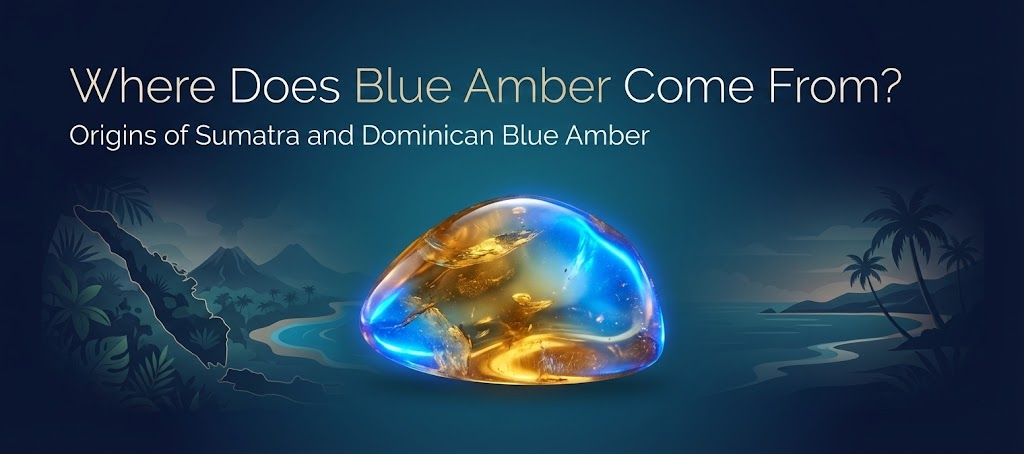
Sumatran blue amber is mined from coal-rich deposits on Sumatra, Indonesia. It is a newer commercial source than the historic Dominican and Baltic regions, which is part of why it offers larger pieces and excellent clarity, sharpening the blue amber vs Baltic amber contrast in favor of the Sumatran gem.
Rarity: Why Is Blue Amber So Much Scarcer?
Rarity is the engine driving the entire blue amber vs Baltic amber value gap. Baltic amber is recovered by the ton; it washes up on beaches and is mined commercially at scale. Blue amber represents only a tiny fraction of all amber found worldwide.
Within that small slice, Sumatran blue amber stands out for combining strong fluorescence with size. Large, clean, intensely glowing nodules are uncommon even among blue ambers, which puts top Sumatran pieces in genuinely scarce territory. Our deep dive on how rare blue amber is quantifies just how limited supply remains.
That scarcity is permanent in a practical sense: you cannot manufacture millions of years of geology. When you weigh blue amber vs Baltic amber as a collectible, the supply story alone explains why blue amber holds and grows its premium while Baltic remains an affordable everyday stone.
Price: How Big Is the Blue Amber vs Baltic Amber Gap?
Price is where collectors feel the blue amber vs Baltic amber difference most sharply. Ordinary Baltic amber beads or cabochons may sell for roughly $1-$10 per gram depending on quality, clarity, and inclusions. It is accessible, mass-market, and easy to find.
Sumatran blue amber routinely commands $20 to well over $200 per gram, and exceptional large, fluorescent specimens climb higher still. That can mean a 10x to 50x premium over comparable Baltic, driven by the glow, the rarity, and the dwindling supply of large nodules.
For current figures across grades, our blue amber price guide for 2025 lays out real ranges. The takeaway in any honest blue amber vs Baltic amber pricing discussion: Baltic is the budget-friendly classic, while Sumatran blue amber is the investment-grade standout.
Is Blue Amber Better Than Baltic for Investment?
For value retention and rarity, yes. Sumatran blue amber’s limited supply and dramatic glow give it stronger collector demand. Baltic amber is wonderful for affordable jewelry and history lovers. So when buyers ask “is blue amber better than baltic,” the answer depends on goals, but on rarity and price ceiling, blue amber leads.
Hardness and Physical Properties Side by Side
Physically, the two are close cousins, which is why the blue amber vs Baltic amber debate hinges on optics rather than durability. Both sit at roughly Mohs 2-2.5 on the hardness scale, meaning both are soft and need gentle care. Neither should be stored loose against harder gems.
Specific gravity is also similar, generally ~1.05-1.10, which is why both float in saturated saltwater, a classic authenticity test. Both can carry insect and plant inclusions, though dramatic inclusions are more commercially associated with certain deposits.
Where they diverge is surface chemistry and fluorescence, not the bulk physical numbers. So if a seller claims a physical-property test “proves” blue amber, be skeptical: the genuine baltic amber vs blue amber separator is the glow under daylight and UV, not the float test alone.
Blue Amber vs Baltic Amber: Full Comparison Table
| Property | Sumatran Blue Amber (the standout) | Baltic Amber (the common classic) |
|---|---|---|
| Daylight color | Greenish-amber that flashes electric blue | Honey, cognac, lemon, butterscotch yellow |
| UV fluorescence (365 nm) | Strong, vivid blue to blue-violet | Weak, milky pale blue-white |
| Approximate age | millions of years (Miocene) | millions of years (Eocene) |
| Main source | Sumatra, Indonesia (newer source) | Baltic Sea region |
| Rarity | Very scarce; large glowing nodules rarer still | Abundant, mined and collected at scale |
| Typical price | ~$20-$200+ per gram | ~$1-$10 per gram |
| Hardness (Mohs) | ~2-2.5 | ~2-2.5 |
| Specific gravity | ~1.05-1.10 | ~1.05-1.10 |
| Best for | Collectors, statement pieces, investment | Affordable everyday jewelry, history fans |
How to Tell Blue Amber and Baltic Amber Apart
You can run a simple, reliable check at home. The goal in any blue amber vs Baltic amber identification is to confirm the glow, because color and fluorescence are the honest separators. Follow the steps below in order for the clearest result.
- Daylight test: Place the stone against a dark background in bright sun. Sumatran blue amber shifts toward blue; Baltic stays yellow-honey.
- UV test: Use a 365 nm torch in a dark room. Blue amber blazes blue; Baltic glows faintly pale.
- Saltwater float: Both genuine ambers float in saturated saltwater; plastic and most fakes sink.
- Warmth and smell: Gently warmed amber gives a soft piney resin scent; plastic smells acrid.
If you want to match a glow to a grade after testing, our breakdown of blue amber types and grades helps you place a stone on the quality ladder. Combining these tests removes almost all guesswork from baltic amber vs blue amber identification.
Can a Beginner Spot the Blue Amber vs Baltic Amber Difference?
Yes. The daylight and UV tests are beginner-friendly and need no special training. Within seconds you will see the Sumatran piece glow blue while the Baltic piece stays warm. That visual gap is the most accessible part of the entire blue amber vs Baltic amber comparison.
Which Should You Buy?
Choose based on intent. If you want an affordable, classic golden gem with deep history, Baltic amber is a lovely, sensible pick. If you want rarity, a jaw-dropping daylight glow, larger nodules, and stronger value retention, Sumatran blue amber is the clear standout in the blue amber vs Baltic amber decision.
Many collectors own both: Baltic for everyday wear and Sumatran blue amber for the centerpiece. They are equals in authenticity and quality of material, yet the newer Sumatran source, with its bigger pieces and dramatic glow, earns its premium and its place first on any serious collector’s list.
Whatever you choose, buy from a seller who lets you verify the glow. Honesty about the blue amber vs Baltic amber distinction, in daylight and under 365 nm UV, is the mark of a trustworthy dealer and protects you from dyed or plastic imitations.
What We Notice Handling Sumatran Blue Amber Next to Baltic
At Blue Amber Bliss we handle both stones daily, and the contrast is the fastest way to tell them apart. Our Sumatran blue amber shows a deep cognac-to-dark body in the hand, then flips to a strong electric-blue glow under UV and even in open daylight, where Baltic tends to stay warm honey or butterscotch with far softer fluorescence. We also notice the Sumatran pieces arrive as bigger, cleaner nodules with more specimen character and natural inclusions, while Baltic more often reaches us as smaller worked beads. That daylight-to-glow shift, more than colour alone, is what tells us we are holding true blue amber and not simply a blue-tinted Baltic.
If you would like to see that shift for yourself, you are welcome to explore our hand-selected Sumatran blue amber at Blue Amber Bliss. Shop hand-selected Sumatran blue amber →
FAQ
Is blue amber better than Baltic amber?
On rarity, glow, and price ceiling, yes, Sumatran blue amber leads. It is far scarcer, fluoresces vivid blue, and commands much higher prices. Baltic amber is better if you want an affordable, classic golden gem. So “is blue amber better than baltic” depends on your goal, but blue amber is the standout.
What is the main blue amber baltic difference?
The blue amber baltic difference is the daylight glow. Sumatran blue amber flashes electric blue in sunlight and under UV; Baltic amber stays warm yellow-honey. Both are genuine fossilized resin, but only blue amber shows that dramatic fluorescent blue.
How much more expensive is blue amber vs Baltic amber?
Typically 10x to 50x more. Baltic amber often runs about $1-$10 per gram, while Sumatran blue amber commonly sells for ~$20-$200+ per gram, with top fluorescent nodules higher still. Rarity drives the gap.
Which is older, blue amber or Baltic amber?
Baltic amber is older at millions of years, while Sumatran blue amber is millions of years in the making. Notably, the younger blue amber is the rarer and more valuable material, so age does not determine worth.
Does Baltic amber glow blue under UV?
Only faintly. Baltic amber shows a weak, milky pale-blue fluorescence under 365 nm UV, while Sumatran blue amber blazes a strong, saturated blue. Side by side, the contrast is obvious and is a reliable identifier.
Are blue amber and Baltic amber the same material?
Both are genuine fossilized tree resin, but not the same resin: Baltic amber is succinite, rich in succinic acid, while Sumatran blue amber is a different, low-succinic-acid resin. The key separation in baltic amber vs blue amber is the trace fluorescent compounds in Sumatran blue amber that produce its blue glow, which Baltic amber lacks.
What are the hardness and specific gravity of each?
Both sit around Mohs 2-2.5 in hardness and roughly 1.05-1.10 specific gravity, so both are soft and both float in saturated saltwater. Physical properties are nearly identical; the optical glow is the true differentiator.
How do I test blue amber vs Baltic amber at home?
Use a 365 nm UV torch in a dark room and a dark background in daylight. Blue amber glows vivid blue; Baltic stays yellow. Add a saltwater float test for authenticity, since both genuine ambers float while most fakes sink.
Why is Sumatran blue amber considered the standout?
Sumatran blue amber is a newer source producing larger nodules with excellent clarity and the most dramatic daylight blue glow. Combined with its scarcity, that makes it the most valuable and sought-after amber, ranking ahead of common Baltic.
Is Baltic amber a bad choice then?
Not at all. Baltic amber is genuine, historic, and affordable, perfect for everyday jewelry. In the blue amber vs Baltic amber decision, Baltic simply serves a different purpose than the rare, glowing Sumatran collector’s gem.
Related Blue Amber Guides
- Blue Amber Types: 4 Real Origins, Grades & Prices
- Sumatran Blue Amber vs Dominican: 7 Proven Differences
- Green Amber: 7 Proven Facts vs Blue Amber
- Blue Amber vs Sapphire: 7 Proven Differences
- Blue Amber vs Larimar: 7 Proven Differences
- Is Blue Amber Real Amber? 5 Proven Facts