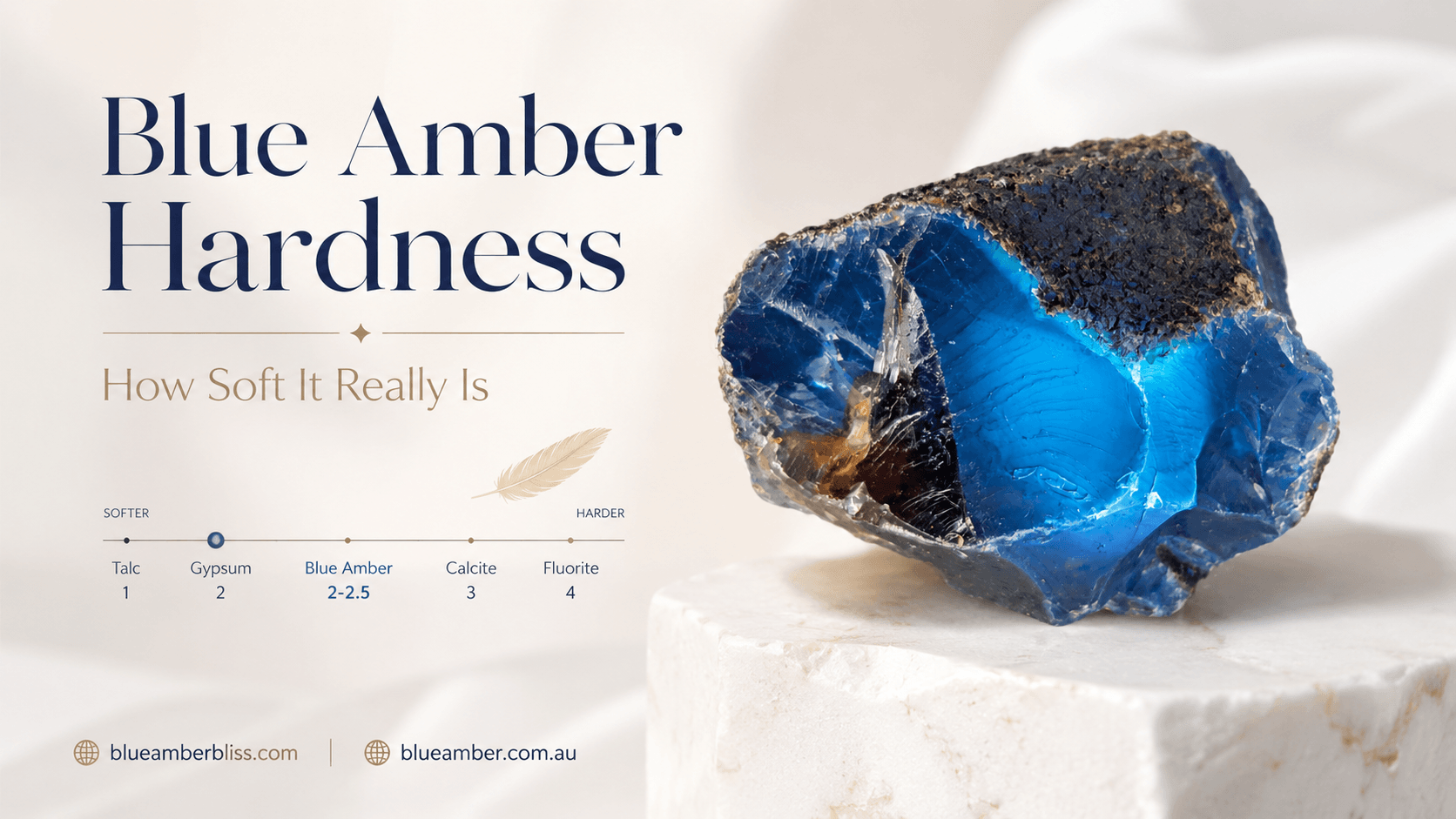
Blue amber hardness sits at just 2 to 2.5 on the Mohs scale, about as soft as your fingernail. Sumatran blue amber, the standout, is fossilized tree resin rather than a mineral, so it scratches easily yet lasts for generations when you use protective settings and gentle care. Here is what that softness really means for you.
Understanding how soft your stone is changes everything about how you wear it, clean it, and store it. This guide focuses tightly on hardness and durability. If you want the complete physical profile, our blue amber properties page covers density, color, and fluorescence in depth.
Key Takeaways
- Blue amber hardness is 2 to 2.5 on the Mohs scale, comparable to a fingernail (about 2.5) and softer than a copper coin (3).
- Blue amber is amorphous, meaning it has no cleavage planes; instead it breaks with a smooth, curved conchoidal fracture.
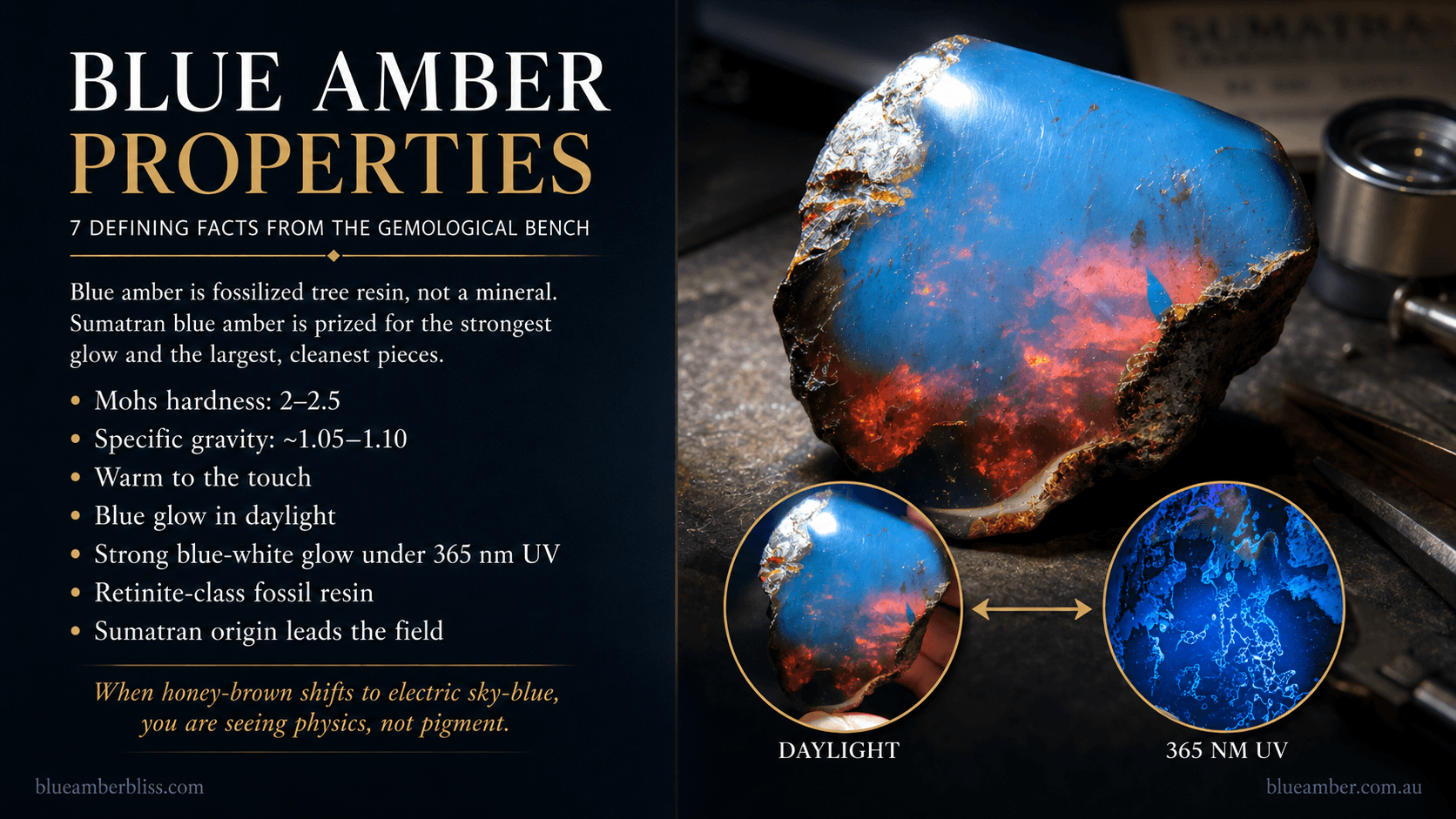
- Its specific gravity is roughly 1.05 to 1.10, light enough to float in saturated saltwater, and its refractive index is about 1.54.
- Because it is soft, blue amber scratches easily and needs protective settings; never use ultrasonic cleaners, steamers, or harsh chemicals.
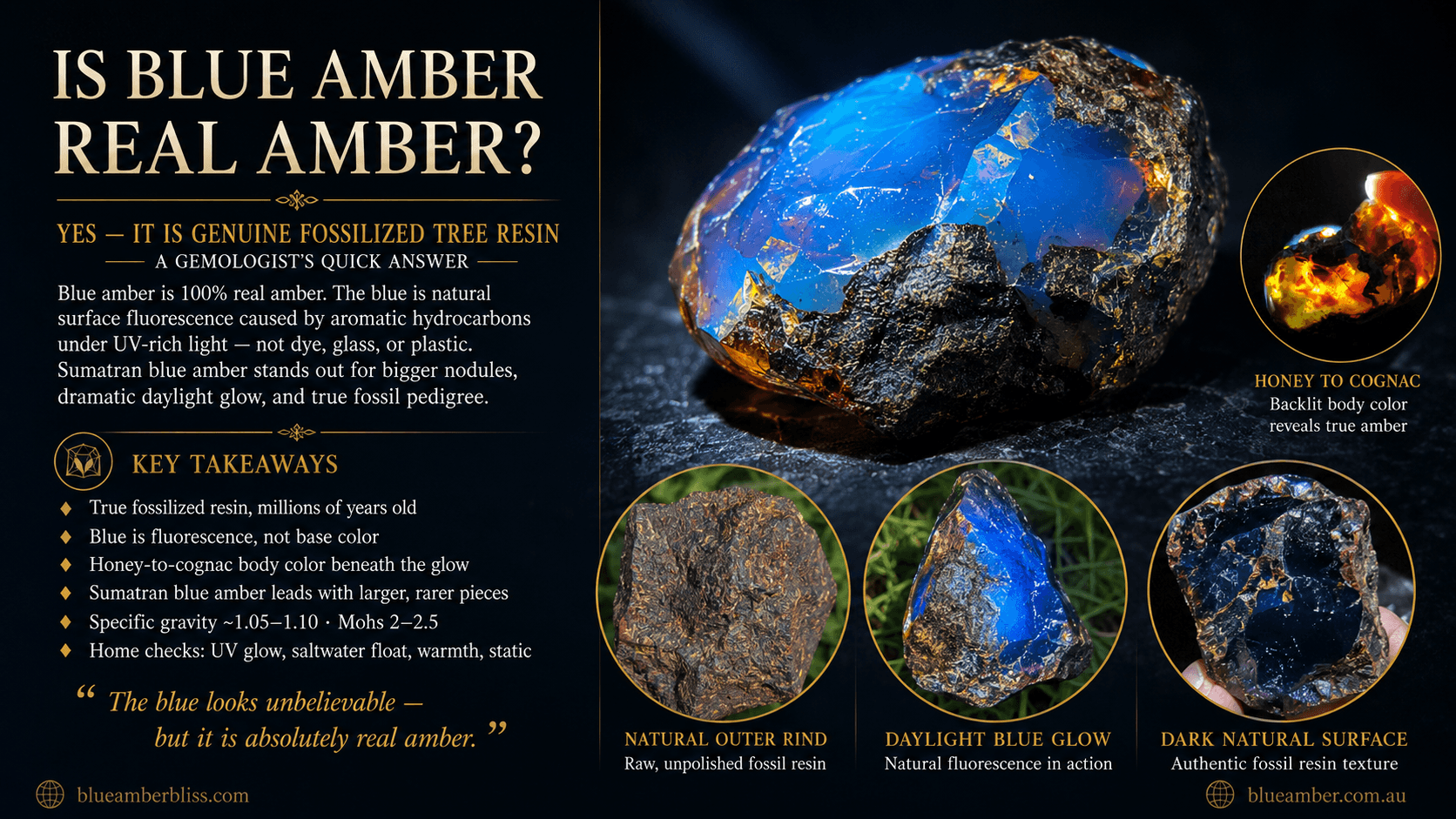
- Sumatran blue amber, the hero of this material, forms in large nodules and is prized for its dramatic daylight blue glow.
- With gentle handling, a soft stone like blue amber can still be enjoyed for decades or passed down for generations.
What Is Blue Amber’s Mohs Hardness?
The blue amber Mohs hardness rating is 2 to 2.5. The Mohs scale, created by mineralogist Friedrich Mohs in 1812, ranks minerals from 1 (talc, the softest) to 10 (diamond, the hardest) based on which material can scratch another. A stone with a Mohs value of 2 to 2.5 is genuinely soft.
To put that in everyday terms, your fingernail rates about 2.5 on the Mohs scale. That means a determined fingernail can leave a faint mark on amber under pressure. This is not a flaw; it is simply the nature of fossilized resin, which is organic rather than crystalline like quartz or sapphire.
So when people ask about blue amber hardness, the honest answer is that it belongs among the softest gem materials you will ever wear. That softness is exactly why it feels warm to the touch and carries light so beautifully, and also why it deserves thoughtful care.
Why is amber so much softer than most gemstones?
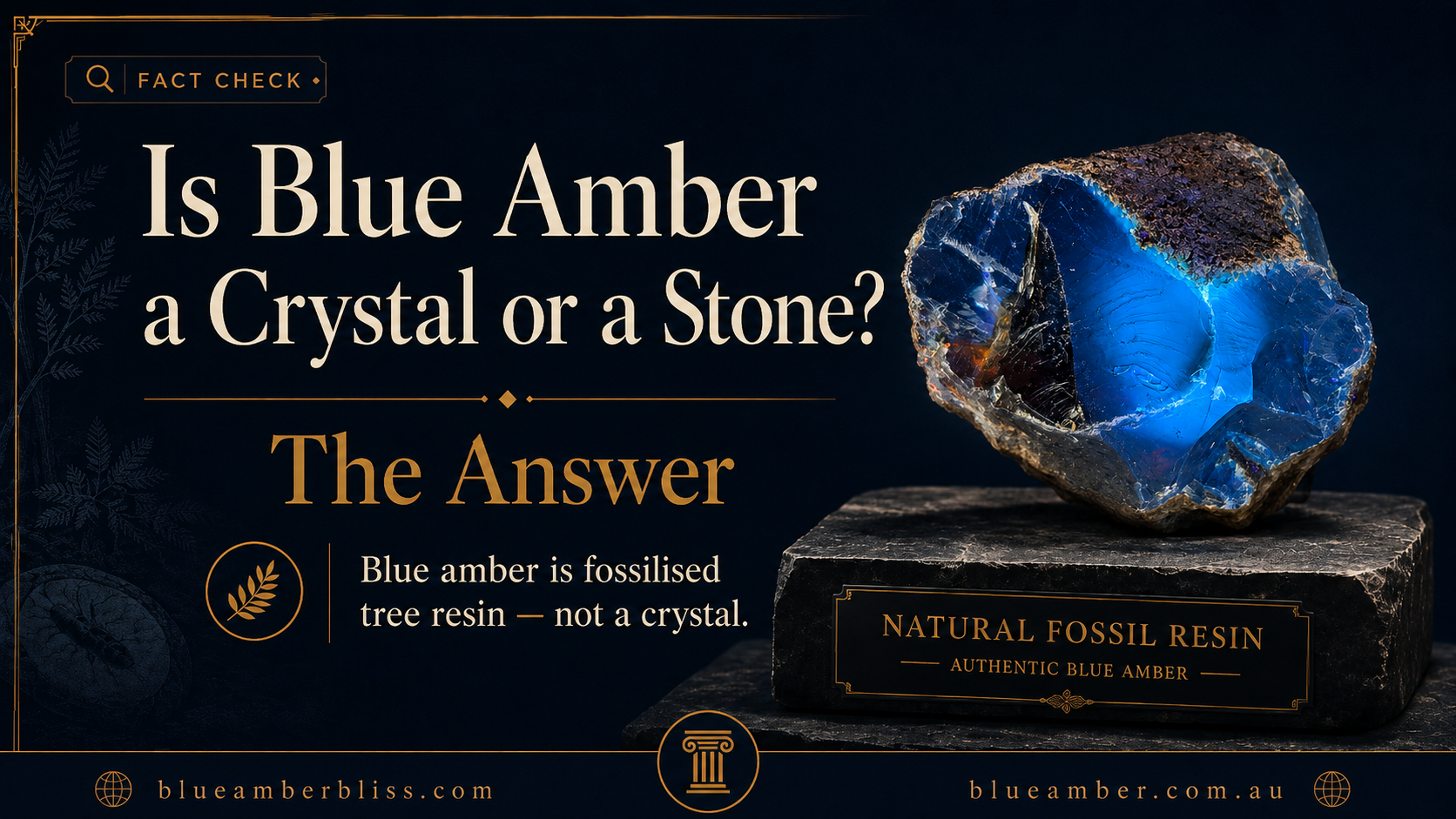
Amber is not a mineral at all. It is the fossilized resin of ancient trees, hardened over millions of years through a process called polymerization. Because it lacks a rigid crystal lattice, its structure is amorphous. That organic origin explains the low blue amber hardness and its warm, almost bodily feel against your skin.
Genuine amber, according to the GIA, forms from resin secreted by prehistoric trees and can be ancient natural resin. Sumatran blue amber is among the more recent finds, yet it still represents deep geological time.
How Hard Is Blue Amber Compared to Other Gems?
If you are wondering how hard is blue amber relative to familiar stones, a side-by-side comparison makes it obvious. Blue amber lands near the very bottom of the Mohs scale, close to talc and pearl, and far below everyday jewelry stones like quartz, topaz, and sapphire.
| Material | Mohs Hardness | Everyday Reference |
|---|---|---|
| Talc | 1 | Softest known mineral; crumbles |
| Blue amber | 2 – 2.5 | Softer than a fingernail |
| Fingernail | ~2.5 | Human reference point |
| Pearl | 2.5 – 3 | Also organic and delicate |
| Copper coin | ~3 | Will scratch amber |
| Opal | 5.5 – 6.5 | Popular but fragile gem |
| Quartz | 7 | Common dust and grit |
| Sapphire | 9 | Extremely durable |
| Diamond | 10 | Hardest natural material |
Notice something important in that table: ordinary household dust often contains quartz particles at Mohs 7. That is far harder than blue amber. This is precisely why a stone with modest blue amber hardness can pick up hairline scratches simply from being wiped with a gritty cloth, and why gentle cleaning matters so much.
Is blue amber softer than pearl or opal?
Yes, blue amber is slightly softer than pearl (2.5 to 3) and considerably softer than opal (5.5 to 6.5). All three are considered delicate gems that reward careful handling. Among them, the low blue amber hardness means it is the most vulnerable to surface scratches, so treat it at least as gently as you would treat fine pearls.
What Does Mohs 2 to 2.5 Mean in Practice?
Numbers on a scale are abstract, so let us translate them into real life. A blue amber Mohs hardness of 2 to 2.5 means several concrete things about how the stone behaves during ordinary wear.
- It scratches from everyday contact. Keys, coins, zippers, seatbelt buckles, and even sand at the beach can leave marks.
- It dislikes hard knocks. A sharp impact against a countertop or door frame can chip or fracture it.
- It reacts to heat and chemicals. Perfume, hairspray, alcohol, and solvents can dull or craze the surface.
- It cannot survive machine cleaning. Ultrasonic cleaners and steam are strictly off-limits.
- It polishes back beautifully. Light surface scratches can often be buffed out by a skilled lapidary.
That last point is the silver lining. Because blue amber is soft, minor scuffs are also relatively easy to re-polish, unlike a chip in a hard but brittle stone. The modest blue amber hardness cuts both ways: easy to mark, but also easy to restore.
Does blue amber have cleavage or fracture?
Blue amber has no cleavage. Cleavage describes how crystalline minerals split cleanly along flat planes, and because amber is amorphous, it simply has no such planes. Instead it displays a conchoidal fracture, the same smooth, shell-like curved break you see in glass or obsidian. This matters for durability: a knock produces an unpredictable curved chip rather than a clean split.
Is Blue Amber Durable Enough for Jewelry?
Here is the question that matters most: is blue amber durable enough to wear? The honest answer is yes, with conditions. Softness and durability are related but not identical. Durability combines hardness, toughness (resistance to breaking), and stability (resistance to chemicals, heat, and light). Blue amber is soft and only moderately tough, but it is remarkably stable when protected.
Think of it this way. Pieces of amber have survived tens of millions of years underground, and museum specimens remain intact for centuries. The material itself endures. What it cannot tolerate is careless daily abuse, which is a different challenge from geological survival.
So the low blue amber hardness does not disqualify it from jewelry; it simply steers you toward the right pieces. Earrings, pendants, and brooches, which rarely take impacts, are ideal. Rings and bracelets, which constantly brush against surfaces, need protective settings and mindful wear.
Which jewelry pieces suit a soft stone best?
Pendants and earrings top the list because they hang freely and avoid friction. Brooches are excellent too. If you love the idea of an amber ring, choose a bezel setting where metal wraps and shields the stone’s edges. Our guide to blue amber jewelry walks through protective settings that let you enjoy daily wear despite the modest blue amber hardness.
Blue Amber Density, Refractive Index, and Other Physical Clues
Hardness is one property; the fuller physical picture helps you understand and authenticate your stone. Blue amber density is famously low. Its specific gravity ranges from roughly 1.05 to 1.10, meaning it is barely denser than water. In fact, real amber floats in saturated saltwater (a brine of about 1.15 density), a classic at-home authenticity test.
The refractive index of blue amber is about 1.54, similar to many resins and useful for gemological identification. Combined with its warmth to the touch, its low blue amber density, and its lack of cold, glassy heft, these clues help separate genuine amber from denser plastic or glass imitations.
| Property | Value | What It Tells You |
|---|---|---|
| Mohs hardness | 2 – 2.5 | Soft; scratches easily |
| Specific gravity | ~1.05 – 1.10 | Very light; floats in brine |
| Refractive index | ~1.54 | Typical of fossil resin |
| Structure | Amorphous | No cleavage planes |
| Fracture | Conchoidal | Smooth, curved breaks |
| Feel | Warm to the touch | Not cold like glass |
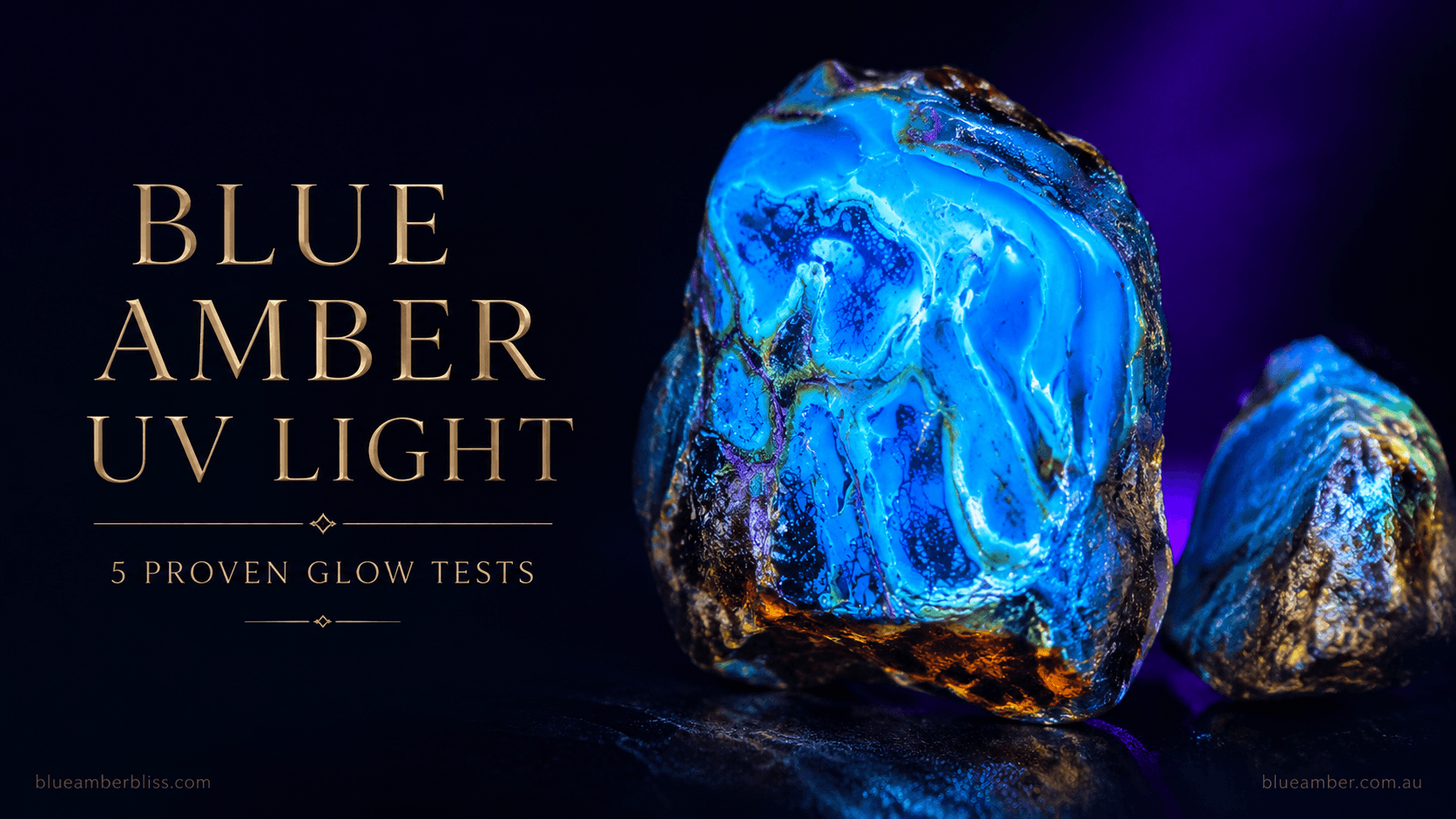
These figures are consistent with amber generally, as documented by Britannica. What sets Sumatran blue amber apart is not a different blue amber hardness but its striking optical character: a vivid blue fluorescence that glows in daylight and under UV light around 365 to 400 nm.
What makes Sumatran blue amber the standout?
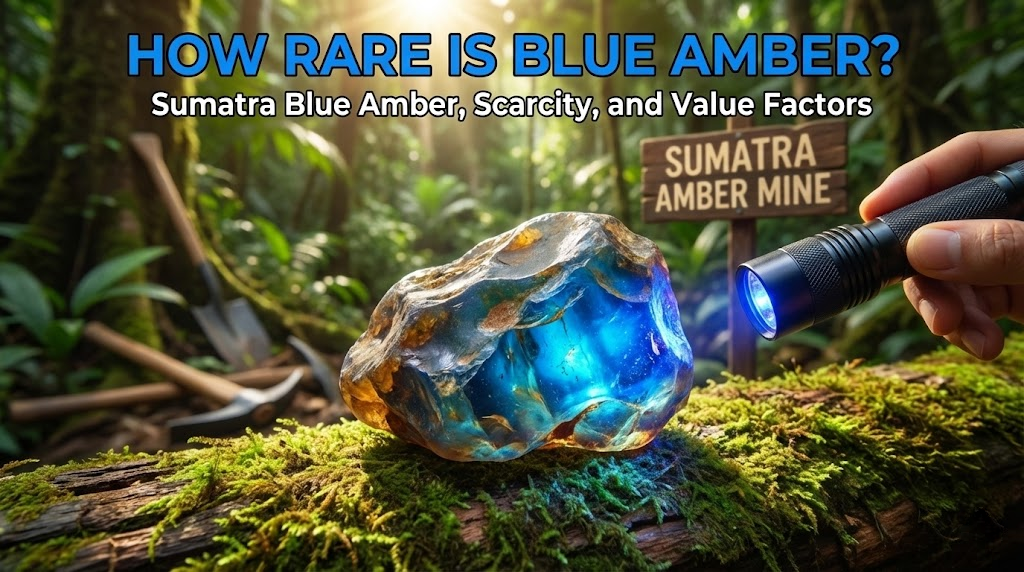
Sumatran blue amber, mined in Indonesia, is a relatively newer source that yields large nodules and consistently strong, dramatic daylight blue. Its size and quality make it especially prized and, in many collectors’ eyes, more valuable than other blue ambers. Its blue amber hardness matches amber worldwide at 2 to 2.5, but its bigger, cleaner pieces give cutters more to work with. Learn the basics on our what is blue amber hub.
How Do You Protect Blue Amber’s Scratch Resistance?
Since blue amber scratch resistance is inherently low, protection is about avoiding contact with harder materials. Remember, common dust contains quartz at Mohs 7, so even a rough cloth can mar the surface over time. A few simple habits preserve that glassy polish for years.
- Apply the “last on, first off” rule. Put jewelry on after makeup, perfume, and hairspray, and remove it before anything else.
- Wipe only with a soft, damp microfiber cloth. Skip abrasive tissues and gritty rags.
- Remove it for chores. Cleaning, gardening, sports, and dishwashing all threaten a soft stone.
- Keep it away from heat. Direct sun, radiators, and hot cars can craze the surface.
Because blue amber scratch resistance is limited, the goal is prevention rather than repair. That said, if scratches do appear, a professional can gently re-polish the surface thanks to the very softness that made it vulnerable in the first place.
Can scratches on blue amber be repaired?
Often, yes. Light surface scratches can be buffed out by a lapidary or jeweler experienced with amber, because the low blue amber hardness makes the material easy to re-polish. Deeper gouges or chips from impact are harder to fix and may require reshaping. Prevention still beats repair, so protect the surface and you will rarely need this.
How Should You Clean a Soft Stone Like Blue Amber?
Cleaning is where many owners accidentally damage their stone. Given the low blue amber hardness, the rules are strict but simple. Never use ultrasonic cleaners, steam cleaners, boiling water, alcohol, acetone, or commercial jewelry dips. These can dull, crack, or craze amber almost instantly.
Instead, dampen a soft microfiber cloth with lukewarm water and a tiny drop of mild soap, wipe gently, then dry immediately with another soft cloth. That is all a healthy blue amber piece needs. For a full walkthrough of safe methods, see our guide on how to clean blue amber.
You can also refresh the shine occasionally with a microscopic amount of natural oil, such as jojoba, buffed off completely. This nourishes the surface without chemicals. Respecting the modest blue amber hardness during cleaning is the single biggest factor in how long your stone stays flawless.
How Do You Store and Wear Blue Amber So It Lasts Generations?
Storage is the quiet hero of longevity. Because blue amber hardness is low, the greatest storage risk is contact with harder gems that will scratch it. Diamonds, sapphires, quartz, and even other amber edges can all leave marks if pieces are tossed together in a drawer.
- Store each piece separately in a soft pouch or a lined, individual compartment.
- Keep it away from heat and direct sunlight, which can dry and craze the resin over time.
- Maintain moderate humidity. Extremely dry air can, over years, encourage surface crazing.
- Never bundle it with harder jewelry. Contact with Mohs 7-plus stones guarantees scratches.
For a deeper routine, our article on how to store blue amber covers pouches, humidity, and travel. Treated this way, a stone with modest blue amber hardness easily becomes an heirloom you pass to the next generation.
Can you wear blue amber every day?
You can, if you choose the piece wisely. Pendants and earrings handle daily wear gracefully because they avoid friction and impact. A bezel-set ring can also work with mindful habits. Just respect the low blue amber hardness: remove it before rough tasks, and it will reward you with warmth and glowing color for decades.
What We Notice About Hardness When Handling Sumatran Blue Amber
At Blue Amber Bliss, working with Sumatran blue amber every day, we can feel how soft this ancient natural resin really is compared to gemstones people are used to. Its lower hardness is exactly why our Sumatran pieces take such a deep, warm polish and reveal that dramatic daylight-to-glow blue shift, but it also means each nodule shows small natural inclusions and needs gentle care rather than the abrasive treatment a mineral gem would shrug off. We select cabochons and specimens with clean, well-finished surfaces precisely because a good polish on a soft resin is a sign of patient, skilled hands, and we always suggest storing pieces away from harder jewelry that could scratch them.
If you would like to see how that soft, luminous character looks in person, we warmly invite you to explore our hand-selected Sumatran blue amber at Blue Amber Bliss. Shop hand-selected Sumatran blue amber →
FAQ
What is the blue amber hardness on the Mohs scale?
Blue amber hardness is 2 to 2.5 on the Mohs scale. That places it among the softest gem materials, roughly equal to a fingernail (about 2.5) and softer than pearl (2.5 to 3). This softness applies to all amber, including prized Sumatran blue amber.
How hard is blue amber compared to a diamond?
Blue amber is dramatically softer than diamond. Diamond rates 10, the top of the Mohs scale, while blue amber rates only 2 to 2.5. Because Mohs steps are not linear, diamond is thousands of times harder in practice. This is why blue amber needs far gentler handling than most gems.
Is blue amber durable enough for a ring?
Blue amber can work in a ring if it sits in a protective bezel setting and you remove it for rough activities. Rings face constant contact, and the low blue amber hardness makes exposed stones vulnerable. Pendants and earrings are safer choices for daily wear with fewer precautions.
Why does blue amber scratch so easily?
Blue amber scratches easily because its hardness of 2 to 2.5 is lower than everyday grit. Household dust often contains quartz at Mohs 7, far harder than amber, so even wiping with a gritty cloth can leave hairline marks. Gentle cleaning and careful storage prevent this.
What is the density of blue amber?
Blue amber density is very low, with a specific gravity of about 1.05 to 1.10. It is barely heavier than water and will float in saturated saltwater, which is a classic authenticity test. Its refractive index is around 1.54, typical of fossilized tree resin.
Can I use an ultrasonic cleaner on blue amber?
No. Ultrasonic cleaners, steamers, and harsh chemicals can crack, craze, or dull blue amber almost immediately. Given the low blue amber hardness and its organic nature, clean it only with a soft, slightly damp cloth and a drop of mild soap, then dry it right away.
Does blue amber break or chip easily?
Blue amber has no cleavage but breaks with a conchoidal (curved) fracture, similar to glass. A sharp knock can chip it, so avoid hard impacts against counters, floors, or door frames. Its softness means edges are especially prone to marking, which protective settings help prevent.
Is Sumatran blue amber harder than other blue amber?
No, the blue amber hardness is the same worldwide at 2 to 2.5, because all amber shares the same organic origin. What makes Sumatran blue amber the standout is its large nodules and dramatic daylight blue glow, qualities that make it especially prized and valuable rather than physically harder.
How can I keep blue amber looking new for years?
Store each piece separately in a soft pouch away from harder gems, keep it out of direct heat and sun, and clean it only with a gentle damp cloth. Apply the “last on, first off” rule with cosmetics. These habits offset the low blue amber hardness and preserve its shine.
Can scratched blue amber be re-polished?
Yes. Because the blue amber hardness is low, a skilled lapidary can often buff out light surface scratches and restore the glossy finish. Deep gouges or impact chips are harder to repair. Preventing scratches through careful wear and storage remains the easiest way to keep your stone flawless.