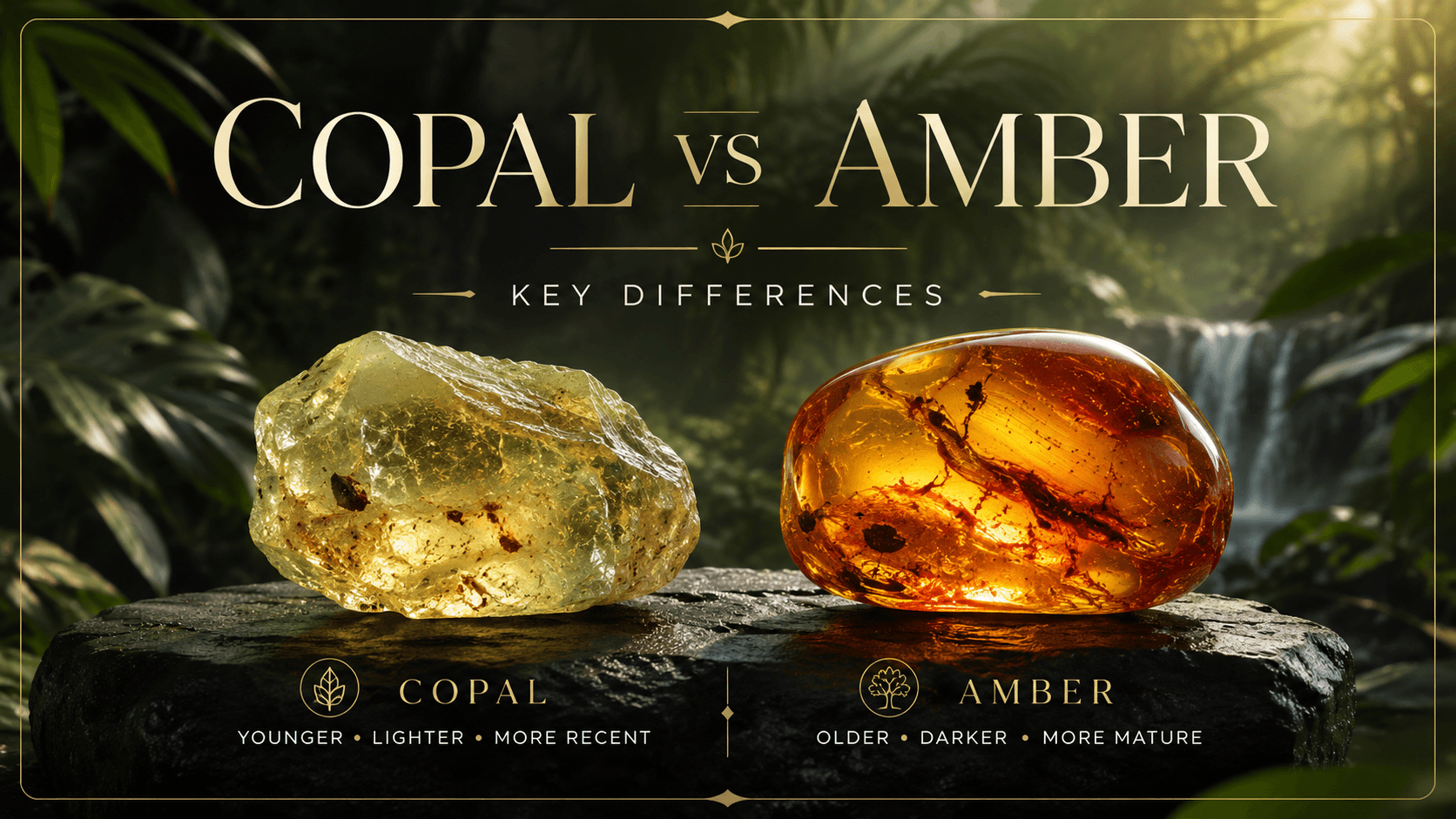
The copal vs amber question matters because copal is young, immature tree resin that has not fully polymerized, while amber is ancient resin that has fossilized over millions of years. You tell them apart with acetone, a hot needle, 365 nm UV light, hardness, density and provenance. For blue amber buyers, especially Sumatran, this single distinction protects your money.
If you are shopping for blue amber, the copal vs amber debate is not academic trivia. It is the biggest single reason buyers overpay for something that is not real amber at all. As a gemologist, I want to walk you through exactly how the two materials differ at the molecular level, why the confusion persists, and how you can confidently separate genuine fossil amber from copal on your own bench or before you ever click buy.
Key Takeaways
- Copal is young, immature resin (roughly 250 years to a few hundred thousand years old), while true amber has fully polymerized over millions of years.
- The most decisive home test is acetone: copal goes tacky in 20-60 seconds; mature amber resists it.
- Genuine amber sits at Mohs 2-2.5, refractive index ~1.54, and specific gravity ~1.05-1.10, floating in saturated saltwater.
- A hot needle makes copal smell sweet and soften readily; amber gives a piney, resinous scent and chars rather than melts.
- For blue amber this matters most: Sumatran blue amber is genuine retinite-class fossil amber with a dramatic daylight glow that copal can never reproduce.
What Is Copal and What Is Amber?
Both copal and amber begin the same way: as sticky terpenoid resin oozing from trees. The difference is time and chemistry. Amber is resin that has completed amberization, the slow polymerization and loss of volatile compounds that turns a soft labdanoid resin into a stable, cross-linked solid over millions of years. Copal is the in-between stage, resin caught partway through that journey.
In the copal vs amber comparison, think of copal as amber’s younger, softer sibling. According to mindat.org and standard gemological references, copal covers sub-fossil resins roughly 250 years to a few hundred thousand years old. They simply have not had the geological time, heat and burial pressure to mature into true amber.
This is why “young amber copal” is such a fitting description. Copal is, quite literally, amber that never finished growing up. It looks similar, polishes to a shine, and traps insects beautifully, which is exactly why some sellers blur the line.
How old does resin have to be to count as amber?
Most gemologists draw the line at maturity of polymerization rather than a single year count, but a practical threshold is several million years. The Gemological Institute of America defines amber as fossilized tree resin that has hardened over geologic time. Copal, by contrast, is geologically recent and still chemically reactive, retaining volatile terpenes that amber has long since shed.
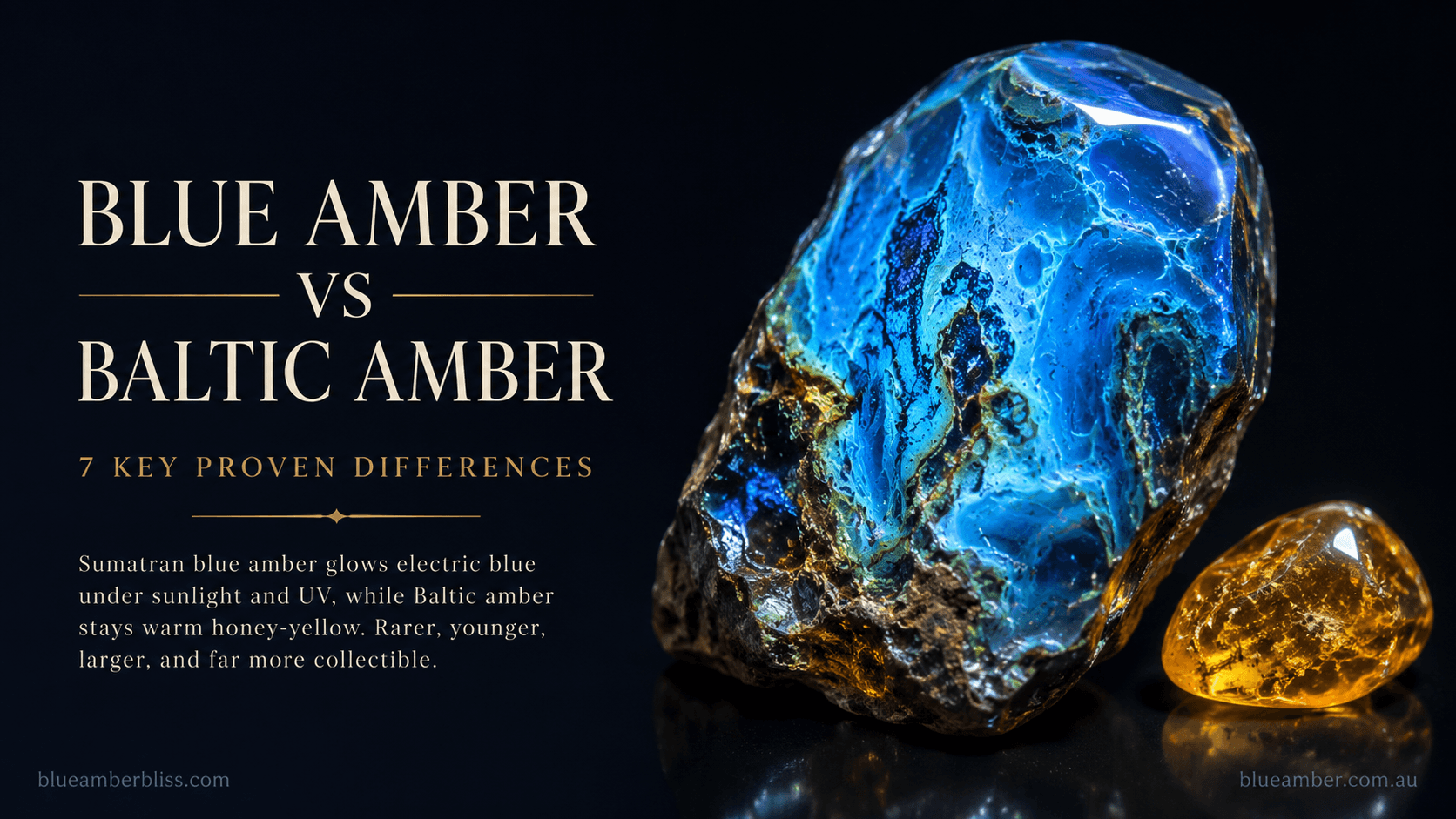
Sumatran blue amber, the hero material we work with, dates to the Miocene epoch, millions of years in the making. Dominican blue amber spans the Oligocene to Miocene, millions of years. That deep age produces the structural stability and the fluorescent compounds neither of which copal can match.
The Source Trees: Botany Behind the Glow
Chemistry starts with botany, and the parent tree decides what a resin can become. Sumatran amber formed from Dipterocarpaceae resin, most likely the genus Shorea, a tropical hardwood. Dominican amber and most Central American copal come from Hymenaea, the leguminous algarrobo tree, with Dominican material specifically from the extinct Hymenaea protera.
Baltic amber is different again: it formed from Pinus succinifera-type conifers and is classed as succinite, a resin rich in succinic acid. Sumatran and Dominican ambers are retinite-class resins with little or no succinic acid. These botanical fingerprints, captured later by infrared spectroscopy, are why labs can separate one deposit from another even when polished pieces look identical.
Why does fossilization create the blue glow?
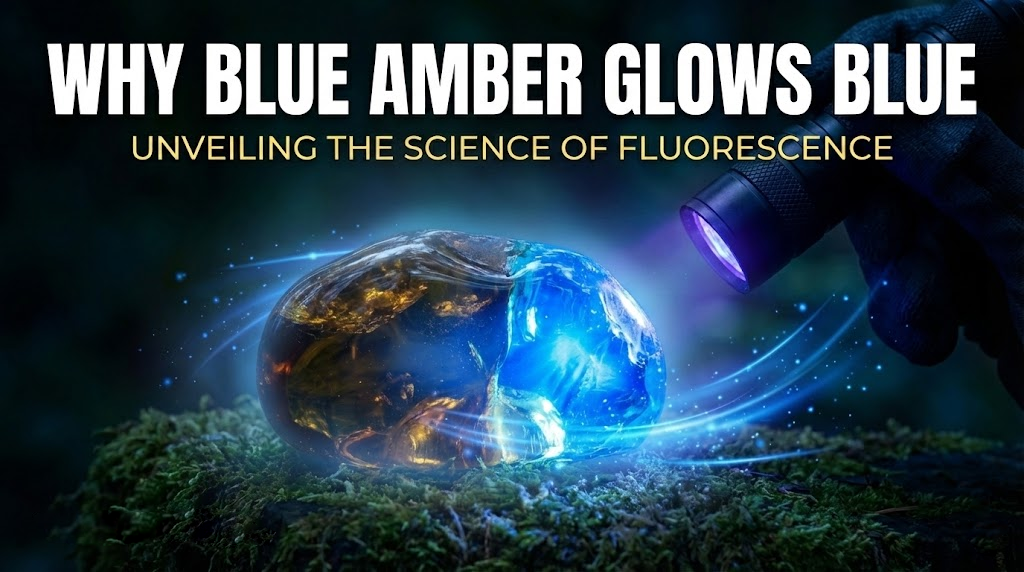
During deep amberization, trace polycyclic aromatic hydrocarbons (PAHs), principally perylene, concentrate within the resin. These molecules absorb invisible ultraviolet and violet light and re-emit it as visible blue, the surreal daylight glow of fine blue amber. Young resin simply has not had time to develop them.
This is the crux for our buyers. Copal lacks those fossilization-born fluorophores, so it cannot truly glow. The effect is fluorescence, not phosphorescence: the glow stops the instant the exciting light is removed. GIA’s Gems & Gemology (Winter 2020) measured Dominican blue amber emitting near 450, 474 and 508 nm. Copal produces nothing like it. For the full mechanism, see our deep dive on blue amber properties.
The Science: How Resin Becomes Amber
Understanding the chemistry makes every test below click into place. Fresh resin is a soup of volatile terpenes and organic acids. Over geologic time, heat, pressure and burial drive off the volatiles and trigger polymerization, where small terpenoid molecules cross-link into long, stable chains. Amber is the finished, fully cross-linked product. Copal sits early on that timeline.
Because copal’s molecules have only partly linked, it still holds volatile compounds that keep it soft, soluble and reactive. This single fact explains the entire copal vs amber divide: the acetone, heat and aging tests all probe how completely polymerization has finished. They are not folk tricks; they are crude readouts of molecular maturity.
What does FTIR spectroscopy actually measure?
Labs settle the difference between copal and amber with Fourier-transform infrared (FTIR) spectroscopy. The diagnostic clue is the exocyclic methylene C=C absorption near ~1640 cm-1. This band is strong in fresh copal and fades progressively as the resin polymerizes and matures, so a tall ~1640 cm-1 peak flags young material. Baltic succinite adds its own tell: the “Baltic shoulder,” a broad absorption between roughly 1250 and 1175 cm-1 tied to its succinic acid esters.
You will not run FTIR at home, but knowing labs read maturity this precisely reassures you the divide is real and measurable. For high-value pieces, a GIA or IGI lab report with FTIR data is the definitive separation of copal from amber, and of retinite from succinite.
The 7 Proven Ways to Tell Copal vs Amber Apart
Here is the practical core of the copal vs amber question: the tests you can actually run. I have ordered them from most reliable and accessible to most specialized. Use several together, because no single test is perfect, and always test on an inconspicuous edge. For the complete authentication battery, see how to spot real blue amber.
1. The acetone test (the most decisive)
Use pure acetone, not diluted nail-polish remover; impure solvent gives muddy results, so solvent purity matters. Place a drop on a hidden spot. Copal becomes tacky, sticky or cloudy within 20-60 seconds because acetone attacks its unstable resin. Mature amber shrugs it off and stays smooth. In the copal vs amber world, this is the closest thing to a definitive home test.
Watch for one specialist trap: heated or “matured” copal. Some sellers gently bake copal to drive off volatiles and harden the surface, then sell it as young amber. Heat-treated copal can resist acetone better than raw copal, so pair this test with FTIR-grade provenance for anything expensive.
2. The hot needle test
Heat a needle until red and touch it briefly to a concealed spot. Copal softens at a lower temperature and releases a sweet, floral, almost incense-like smell. True amber chars and crackles, giving off a distinctly resinous, pine-forest aroma. Plastic, by contrast, smells acrid and chemical, like burning electronics.
This test marks the piece, so reserve it for samples you are willing to scar and work only on a back edge. The difference between copal and amber here is melting point: copal softens around 150 C, while amber tolerates considerably more heat before degrading.
3. UV fluorescence (365 nm)
Under a 365 nm long-wave UV light, genuine amber fluoresces a noticeable blue, green or milky tone; blue amber blazes. Copal shows a much weaker, whitish-pale glow or little reaction. Use 365 nm, not a cheap 395 nm “UV” torch: 395 nm is partly visible violet and gives a washed-out result that muddies the verdict.
The same fluorophores that make Sumatran amber shimmer in daylight are largely absent in copal, making UV a fast screening tool. Because the blue is a surface and fluorescence effect rather than a body color, it appears strongest where short-wavelength light scatters off the polished face.
4. Hardness (Mohs scale)
Amber registers about Mohs 2-2.5, hard enough to resist a fingernail but scratchable by a copper coin, with a refractive index around 1.54 and an amorphous, non-crystalline structure. Copal is softer, often closer to Mohs 1.5-2, and gouges more easily. Both feel warm to the touch, not cold like glass, a quick tactile screen against imitation.
Combine hardness with the other tests. On its own it is suggestive, not conclusive, because the ranges overlap. Still, a piece that scratches alarmingly easily deserves suspicion.
5. Specific gravity (the saltwater float)
Dissolve salt into water until saturated (brine SG ~1.15-1.16). Both amber and copal have a specific gravity near 1.05-1.10 and float, while denser plastics and glass sink. This mainly rules out heavy imitations rather than separating copal from amber directly. See the saltwater float test for blue amber for the exact recipe and pitfalls.
Because copal and amber share similar density, the float confirms a natural resin but cannot finish the copal vs amber verdict alone. Pair it with acetone and UV.
6. The age and origin clue
Provenance tells a story. Genuine amber comes from named, fossil-age deposits; copal does not. Most commercial copal originates from Colombia, Madagascar and East Africa, where deposits are geologically young. If a seller cannot name a credible fossil-age source, treat the “young amber copal” label as a warning and ask for documentation.
Reputable dealers disclose origin openly. When the source is vague or shifts between answers, the odds tilt toward copal. A clear deposit name is part of buying real amber, and it is also how the question is blue amber real amber gets answered honestly.
7. Solvent crazing and aging over time
Copal degrades faster than amber. Exposed to air, light and handling, copal develops a fine network of surface crazing within years, while amber stays stable for decades. Ether or alcohol also soften copal’s surface more than amber’s, echoing the acetone result and confirming incomplete polymerization.
If you examine an older piece and see heavy spontaneous crazing despite gentle care, that aging pattern leans copal. In a long-term copal vs amber view, durability is one of amber’s defining advantages.
Provenance: Copal Sources vs Amber Deposits
Origin is so diagnostic that it deserves its own table. Genuine amber comes from a short list of named, dated geological formations; copal comes from young surface deposits. Matching a piece to a credible deposit is half the authentication battle.
| Material | Parent tree | Source / deposit | Approx. age |
|---|---|---|---|
| Sumatran blue amber | Dipterocarpaceae (Shorea) | Sinamar Formation, Jambi, South Sumatra Basin (Bukit Barisan foothills) | Miocene, ~20-25 M yr |
| Dominican blue amber | Hymenaea protera | La Cumbre, La Toca, Palo Quemado mines, near Santiago (Cordillera Septentrional) | Oligocene-Miocene, ~15-25 M yr |
| Baltic amber (succinite) | Pinus succinifera | Baltic / Kaliningrad coast | Eocene, ~34-44 M yr |
| Colombian copal | Hymenaea | Colombia (surface deposits) | ~250 yr and up |
| Madagascar copal | Hymenaea verrucosa | Madagascar | Sub-fossil, recent |
| East African copal | Hymenaea (East African) | Tanzania / coastal East Africa | Sub-fossil, recent |
Copal vs Amber Comparison Table
This side-by-side summarizes the practical differences. Use it as a quick reference when you evaluate a piece or listing. The strongest conclusions come from combining several rows, not relying on one.
| Property | True Amber (incl. Sumatran blue) | Copal (young resin) |
|---|---|---|
| Age | Millions of years (fully polymerized) | ~250 to a few hundred thousand years |
| Hardness (Mohs) | 2-2.5 | ~1.5-2 (softer) |
| Refractive index | ~1.54 | ~1.53-1.54 |
| Specific gravity | ~1.05-1.10 (floats in brine) | ~1.03-1.08 (also floats) |
| Acetone test | Resists, stays smooth | Tacky in 20-60 s, cloudy |
| Hot needle | Chars, pine-resin scent | Softens ~150 C, sweet smell |
| FTIR ~1640 cm-1 (C=C) | Weak/faded (mature) | Strong (immature) |
| UV (365 nm) | Strong blue/green fluorescence | Weak, pale, or none |
| Surface aging | Stable for decades | Crazes within a few years |
Related Blue Amber Guides
Copal vs Blue Amber: Why It Matters More Here
For most amber, the copal vs amber question is about price fairness. For blue amber the stakes are higher, because the very thing you pay for, the glow, is something copal cannot fake. This is where the copal vs blue amber distinction becomes critical to your wallet.
Sumatran blue amber is our hero stone and the standout of the blue amber world. It is a newer source than Dominican, yields larger, cleaner nodules, and delivers the most dramatic daylight blue. Its glow under sunlight is unmistakable, the signature of strong, fluorescent AAA+ material. Both Sumatran and Dominican are graded across AA / AAA / AAA+ tiers by glow intensity and evenness, clarity, body color and size.
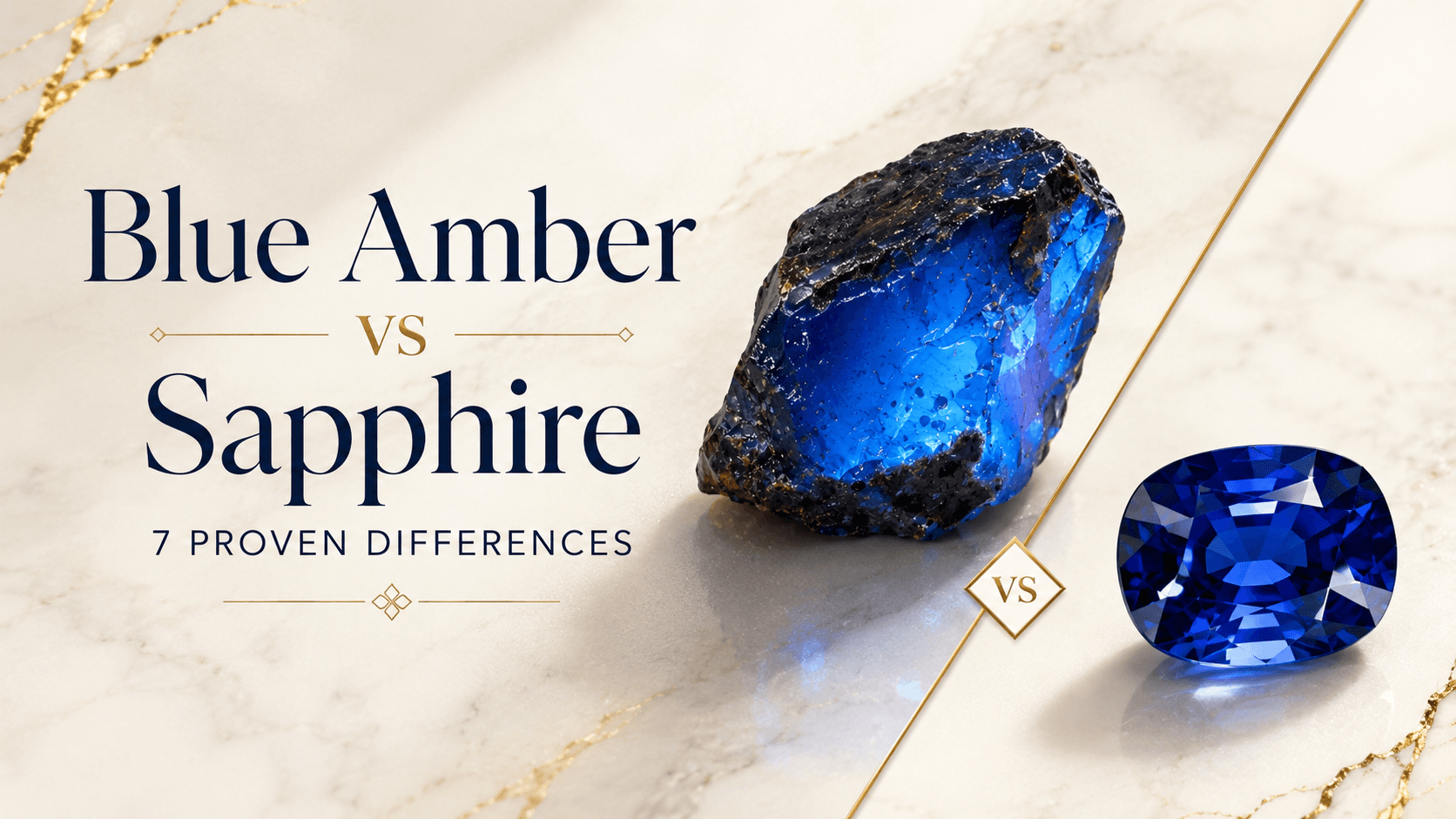
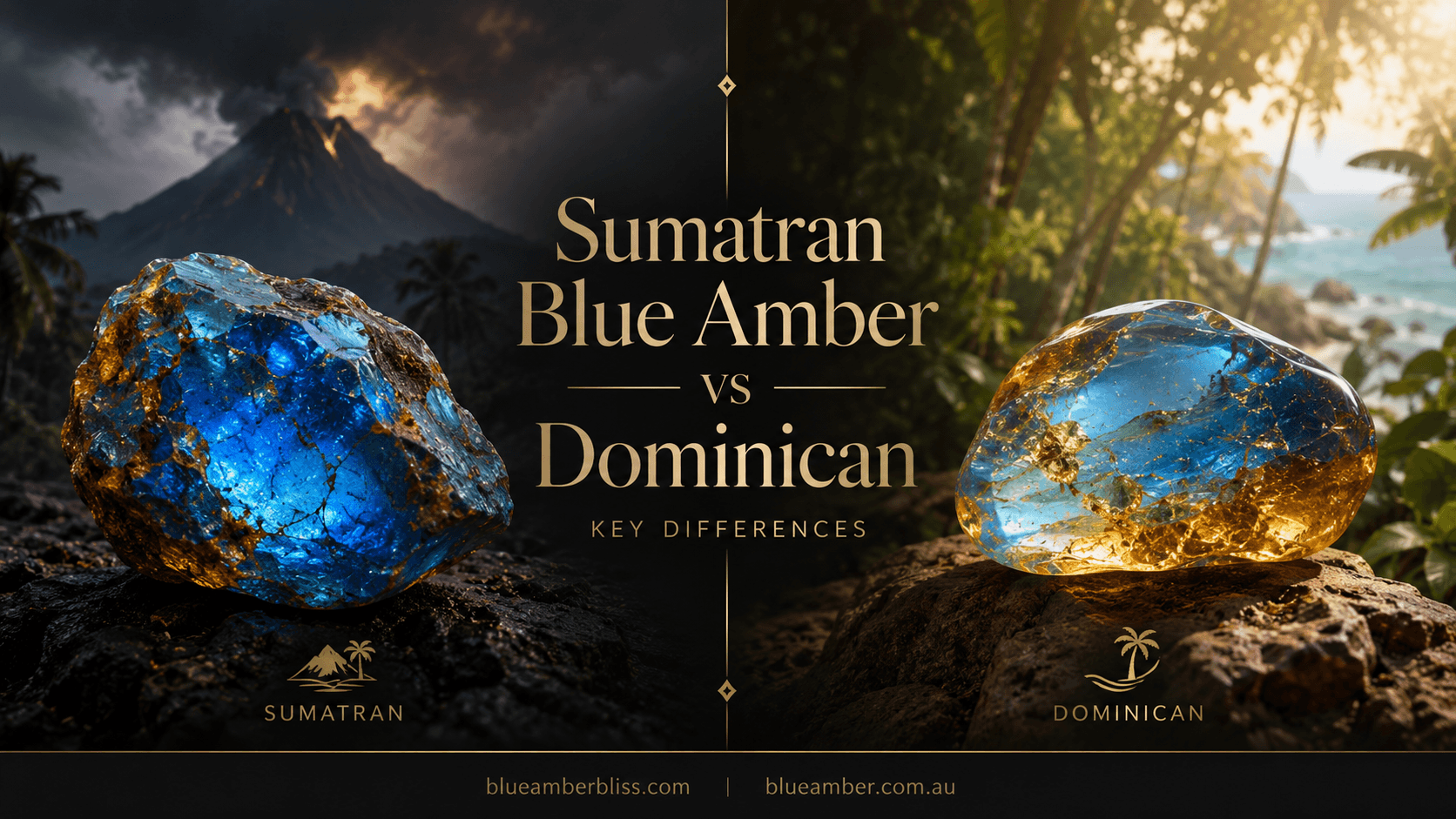
Dominican blue amber is also genuine, prized fossil amber and equal in fundamental quality. But Sumatran’s bigger pieces and intense daylight glow have made it the showpiece collectors chase first. Either way, both are real amber. Copal is not, and copal will never glow blue like authentic Sumatran material. To see how this stacks against succinite, compare blue amber vs Baltic amber.
How does this affect what I should pay?
Genuine Sumatran blue amber runs roughly $15-60 per gram for good polished blue, $60-200 per gram for high-grade AAA with strong even glow, and $200-500+ per gram for top AAA+ collector pieces; rough or low-glow material starts at $3-15. Copal might sell for a few dollars per piece. Paying amber prices for copal can mean overspending many times over on a misrepresented stone, which is exactly why honest buyers learn these tests.
Common Red Flags That Signal Copal
Once you have run the tests a few times, patterns emerge. Certain listing habits and physical traits reliably hint that a piece is copal dressed up as amber. Treat the following as a quick screening checklist before you commit money.
- Suspiciously cheap “amber” with flawless insects: copal traps clear, perfect bugs and sells for pennies, so an unbelievable price plus a pristine inclusion is a classic tell.
- Vague or shifting origin: sellers who dodge a clear deposit name, or who slip “young amber copal” into an amber listing, are hedging.
- Tacky or slightly sticky surface: copal can feel faintly soft in warm hands, while amber stays firm.
- Fine spontaneous crazing: a young piece already webbed with tiny surface cracks is aging like copal.
- No glow under 365 nm: for blue amber especially, the absence of any UV or daylight glow is a red flag.
None of these alone is proof, but two or three together strongly tip the scale toward copal. When warnings stack up, slow down and run the acetone and UV tests before paying amber prices.
What should I do if a seller refuses testing or returns?
Walk away. A confident, honest amber dealer expects scrutiny and welcomes questions about origin, age and authenticity. A seller who resists a simple acetone test, withholds provenance, or bans returns is protecting something. In the copal vs amber marketplace, transparency is the cheapest insurance you can buy.
Buy from specialists who photograph the daylight glow, state the Sumatran origin plainly, name the Sinamar Formation source, and back their pieces. The small premium you pay a reputable source is far less than the cost of a misrepresented stone.
How to Confidently Verify Before You Buy
You do not need a laboratory to shop smart. Start with provenance and seller transparency, then apply the acetone and 365 nm UV tests on arrival if your purchase allows returns. For higher-value Sumatran pieces, a GIA or IGI gemological report with FTIR data adds definitive peace of mind.
The bottom line of the copal vs amber discussion is simple: real amber rewards a little diligence. A handful of cheap tests, an honest dealer, a named fossil deposit and a clear grasp of how the glow forms will keep you on the right side of the line every time.
What We Notice When Telling Copal From Amber
At Blue Amber Bliss, the fastest tell we rely on when sorting our Sumatran material is the UV response: true blue amber, ancient resin that has been millions of years in the making, flips from a deep cognac-brown body in daylight to that unmistakable electric-blue glow, while copal stays flat and washed out. We also watch how a piece behaves under gentle heat and solvent at the bench, where copal softens and turns tacky far sooner than our hardened Sumatran stones. In hand, the difference in polish and density is obvious too, our nodules take a crisp, glassy finish and hold their inclusions and specimen character rather than smearing or crazing the way young copal often does.
If you would like to see that daylight-to-glow shift for yourself, we warmly invite you to explore our hand-selected Sumatran blue amber at Blue Amber Bliss. Shop hand-selected Sumatran blue amber →
FAQ
Is copal the same as amber?
No. Copal is young, immature resin that has not fully polymerized, while amber is ancient resin hardened over millions of years. In the copal vs amber comparison, copal fails the acetone and UV tests that real amber passes, shows a strong ~1640 cm-1 FTIR band, and is far softer and less stable.
What is the easiest difference between copal and amber to test at home?
The acetone test is easiest and most decisive. A drop of pure acetone makes copal tacky and cloudy within 20-60 seconds, while genuine amber stays smooth and unaffected. Test on a hidden edge, and confirm with 365 nm UV light for the clearest difference between copal and amber.
Is copal amber if it contains insects?
No. Copal frequently traps insects, sometimes more clearly than amber because it is younger and more transparent. The presence of an inclusion does not prove fossilization. So asking is copal amber based on a bug inside misses the point: age, polymerization and chemistry, not inclusions, define real amber.
How can I tell copal vs blue amber specifically?
Use 365 nm UV light. Genuine Sumatran blue amber fluoresces a vivid blue and shows a daylight glow, while copal gives a weak, pale reaction at best. The copal vs blue amber difference is dramatic, because copal lacks the perylene-type PAHs that create the blue fluorescence.
Why is young amber copal sold as real amber?
Because copal is cheap, abundant and visually similar, some sellers relabel young amber copal as genuine amber to charge far higher prices. Some even heat-treat copal to harden it. Running the acetone and hot needle tests, and asking for a named fossil deposit, protects you from paying amber rates for immature resin.
Does copal float in saltwater like amber?
Yes, both float. Copal and amber share a specific gravity near 1.05-1.10, so the saltwater test only rules out heavier plastics and glass. It cannot finish the copal vs amber verdict on its own, so always combine it with the acetone and UV tests.
What hardness is amber compared to copal?
Amber sits at Mohs 2-2.5, while copal is softer at roughly 1.5-2. Copal scratches and dents more easily. Hardness is a useful clue when separating copal from amber, but because the ranges overlap slightly, treat it as supporting evidence rather than proof.
Is Dominican or Sumatran blue amber better?
Both are genuine, high-value fossil amber and equal in fundamental quality. Sumatran blue amber is the newer source with larger nodules and a dramatic daylight glow, which makes it the standout and the more valuable choice for many collectors today. Neither is copal.
Will copal turn into amber eventually?
In principle, over millions of years and the right burial conditions, copal can continue polymerizing toward amber. But the copal you can buy today is nowhere near that point. For practical purposes in the copal vs amber debate, copal is and remains immature resin, not amber.
Is copal a fake or a natural material?
Copal is genuinely natural resin, not a synthetic fake like plastic. The issue is only honest labeling. Copal sold and priced as copal is perfectly legitimate. The difference between copal and amber matters because copal sold as amber is a misrepresentation that costs buyers money.