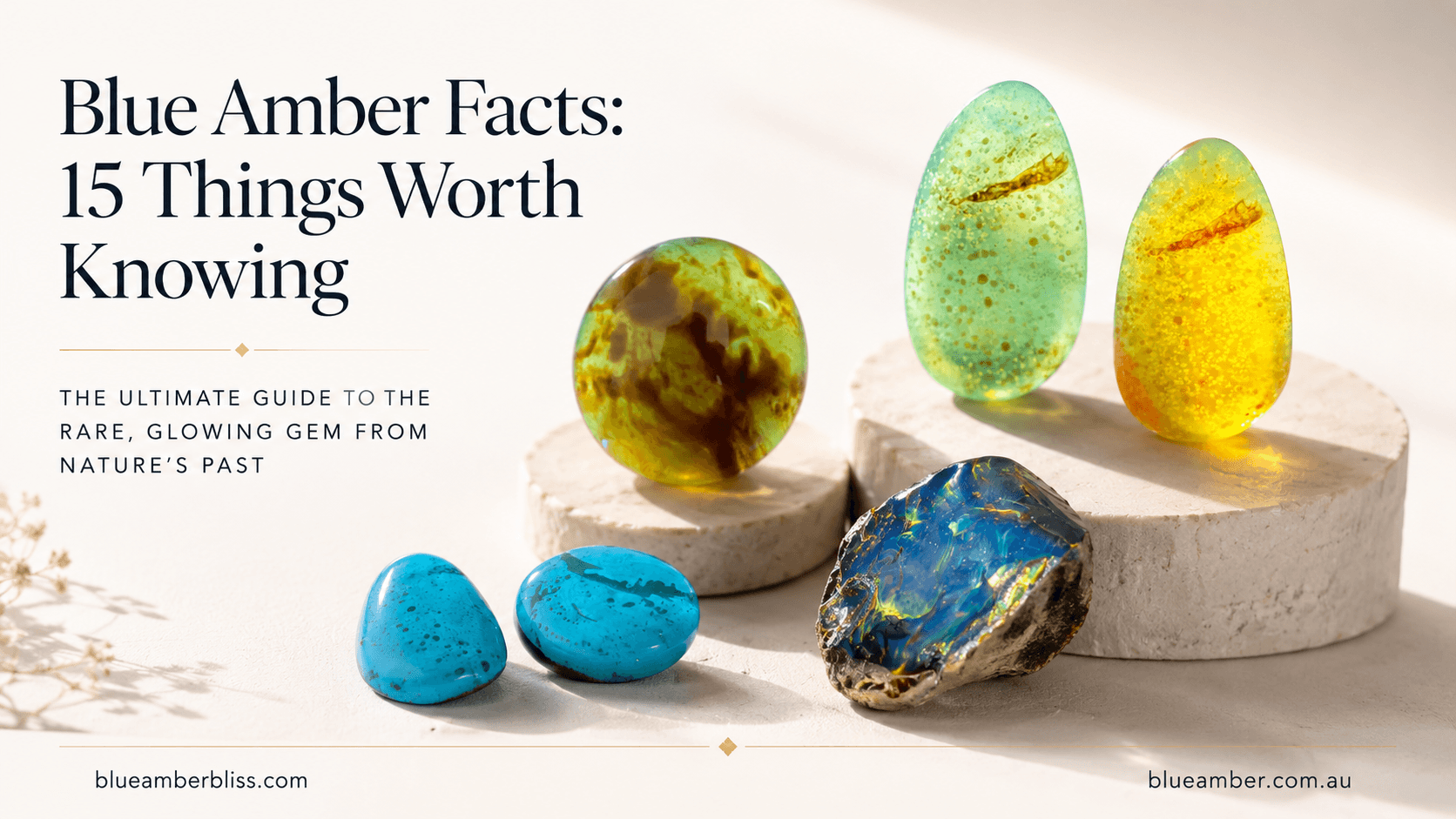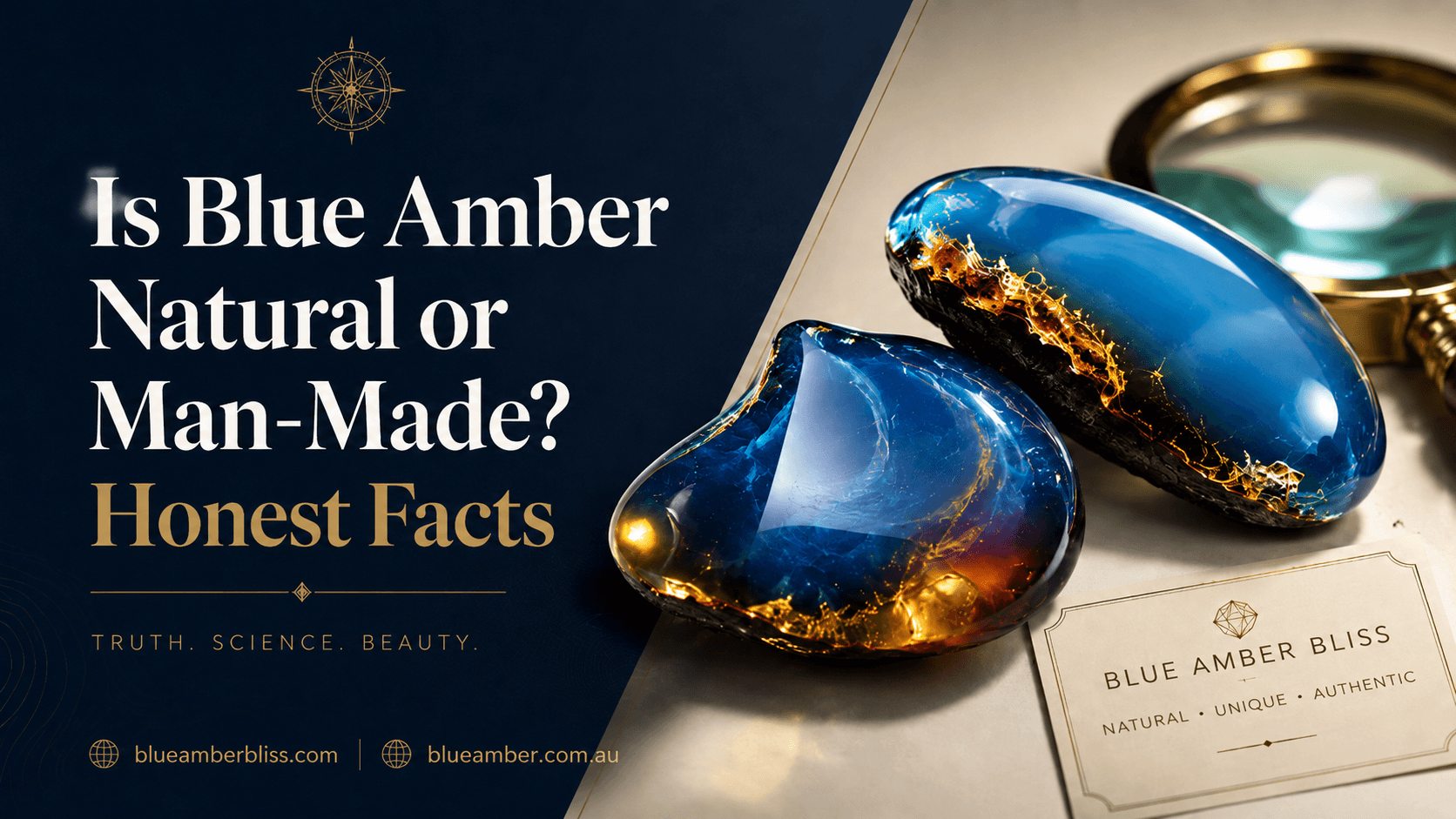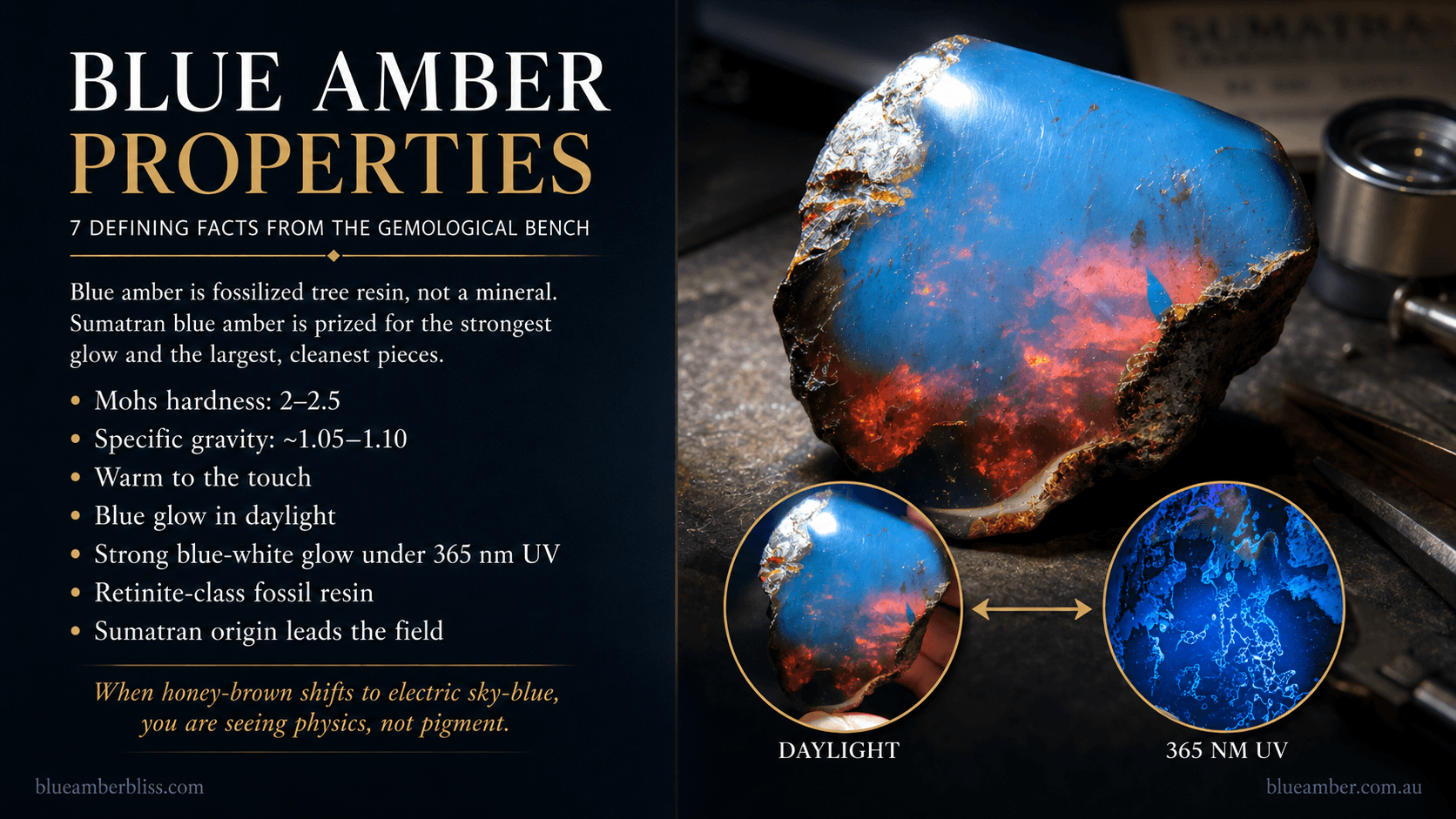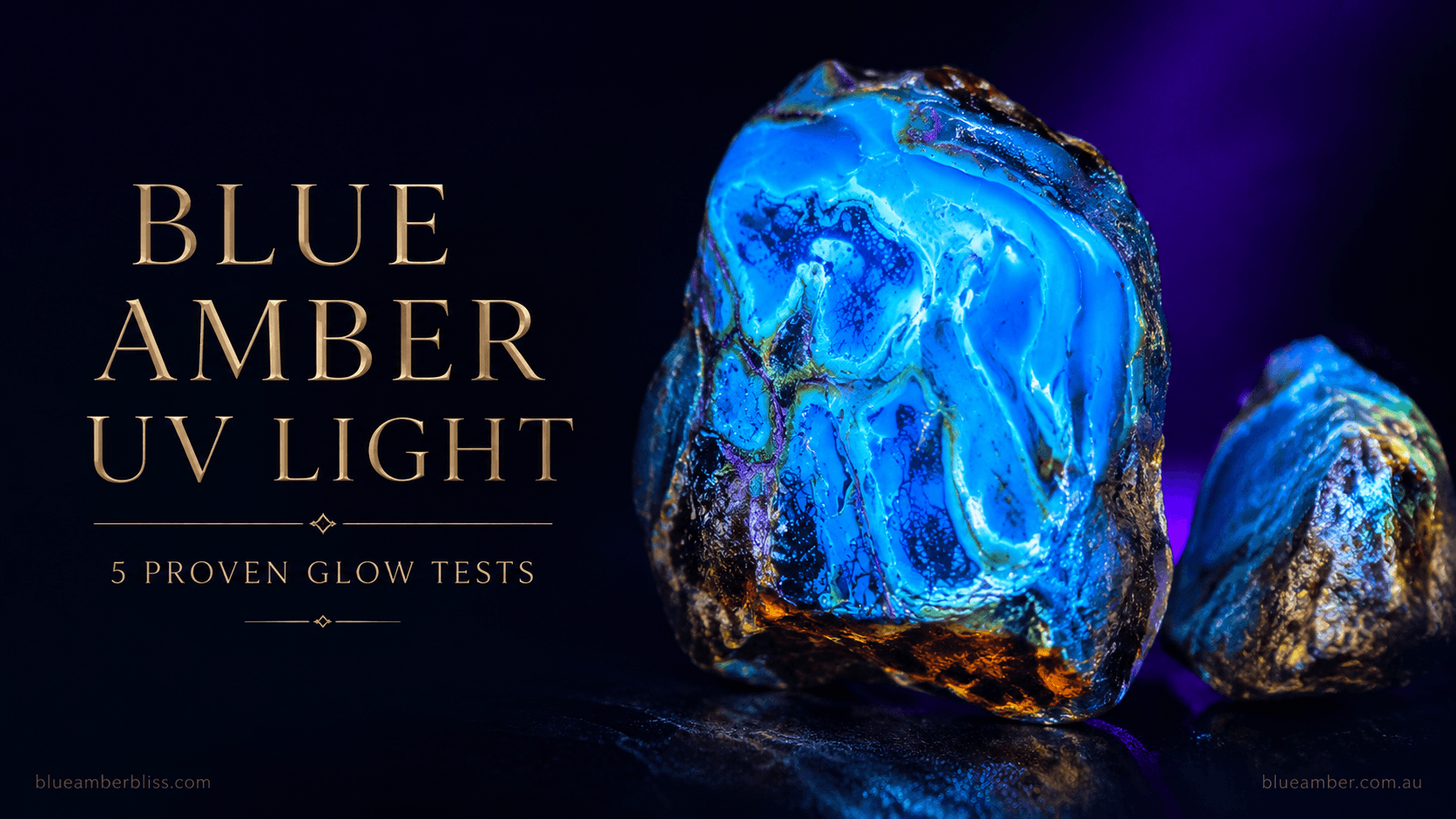
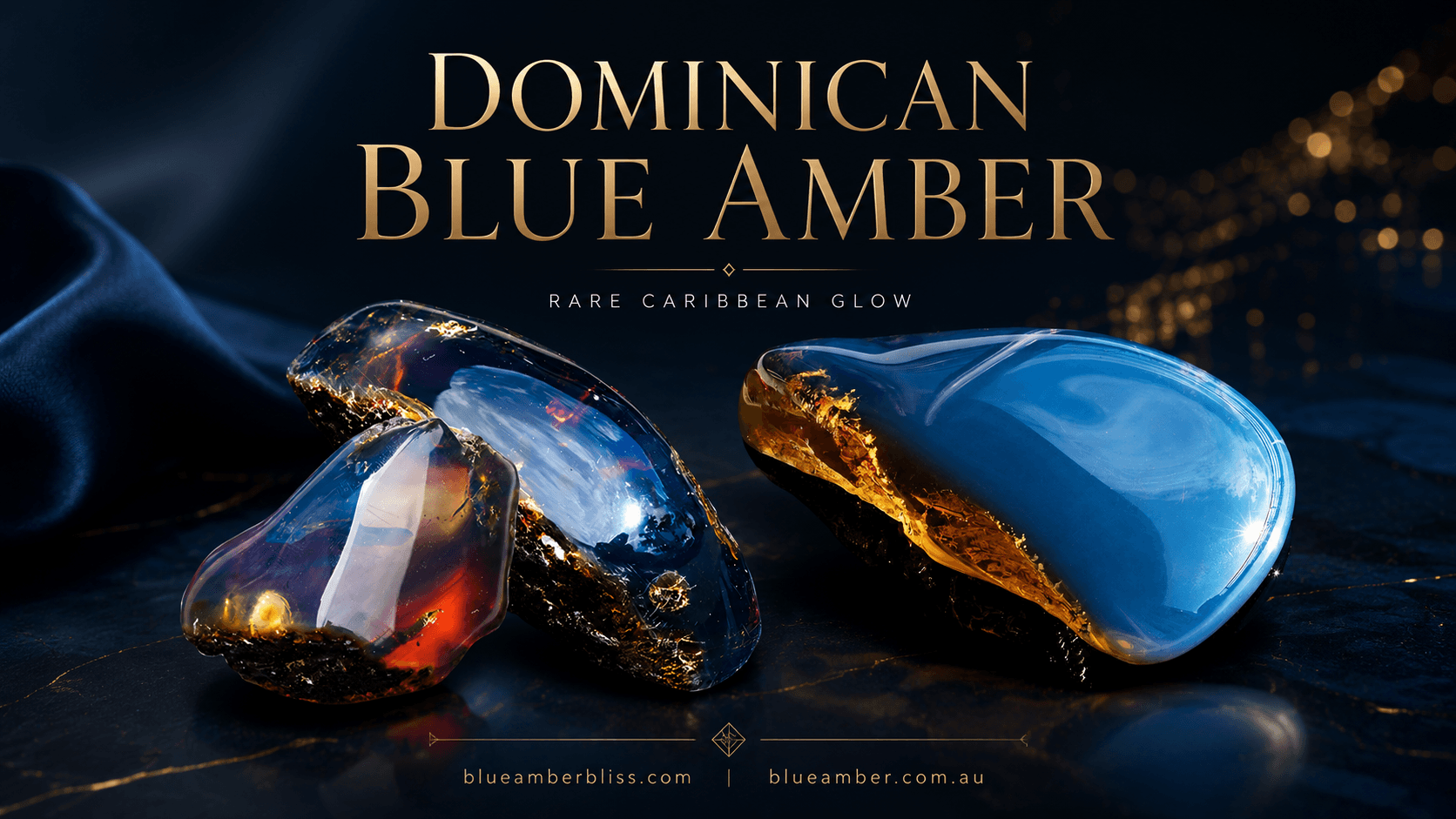
Dominican blue amber is fossilized tree resin from the Dominican Republic that shows a warm honey-gold body in ordinary light yet glows an electric blue under sunlight and UV. It formed millions of years ago from an extinct tree, Hymenaea protera. Alongside Sumatran (Indonesian) blue amber, it is one of the world’s two celebrated blue-glowing ambers.
At Blue Amber Bliss we specialize in Sumatran blue amber, the newer, larger-nodule source that many collectors now treat as the standout of the two. This page is a straight, factual profile of the Dominican material so you understand exactly what the term means, where it comes from, and why it fluoresces.
Key Takeaways
- Dominican blue amber is genuine fossilized resin, not glass, plastic, or dyed copal, and it comes from the northern Dominican Republic.
- It is mined in the Cordillera Septentrional near Santiago, chiefly at the La Cumbre, La Toca, and Palo Quemado mine areas.
- Its source tree, Hymenaea protera, is extinct, but the genus Hymenaea (the West Indian locust) still grows in tropical forests today.
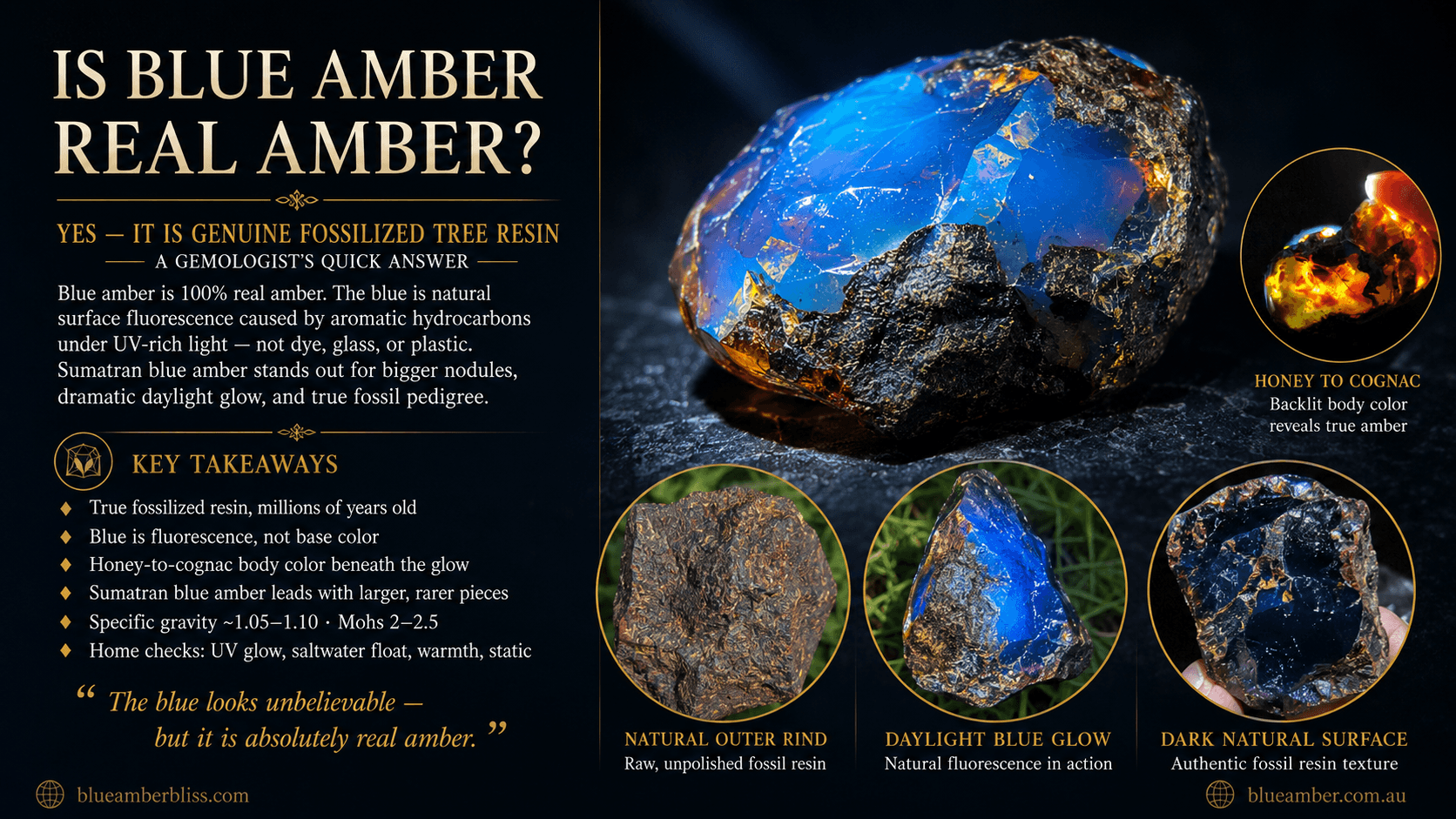
- The blue effect is fluorescence: the honey body absorbs ultraviolet and near-UV light and re-emits it as visible blue.
- Dominican and Sumatran blue amber are equal in quality and value as gem materials, yet Sumatran is the newer source with bigger nodules and slightly finer material, which makes it the more valuable standout.
What Is Dominican Blue Amber?
Dominican blue amber is a rare color variety of Dominican amber that displays a blue glow rather than the ordinary yellow, orange, or red tones most amber shows. In transmitted light it usually looks honey-gold to cognac. Turn it toward the sun or a UV lamp against a dark background, and the surface flashes blue to blue-violet. That daylight blue reaction is what makes it a prized collector material worldwide.
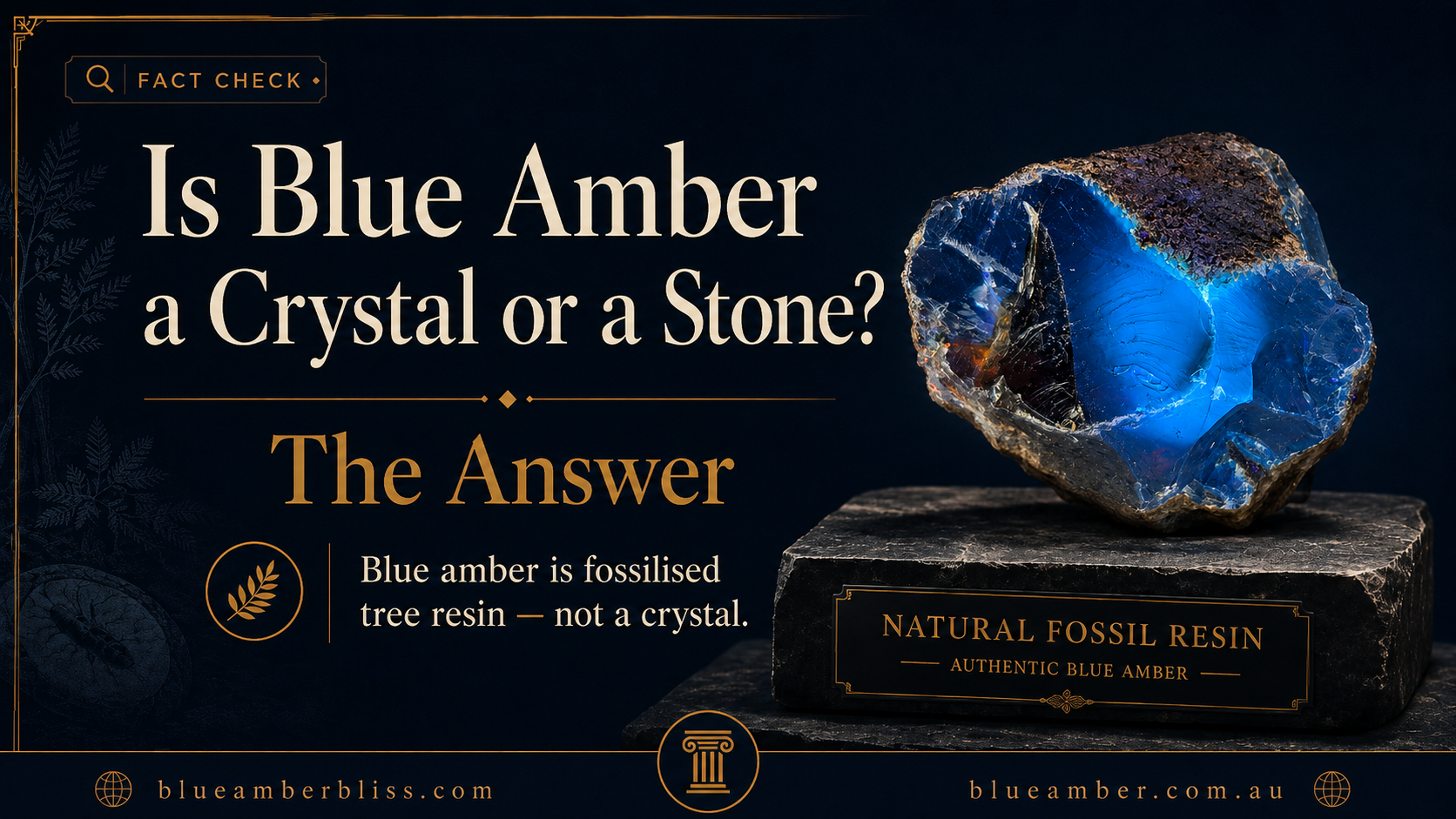
It is true amber, meaning fully polymerized and fossilized resin, not soft young copal. If you want the fundamentals of the gem itself, our guide on what blue amber is covers the science and the color families in depth. The short version: blue is not a pigment inside the stone but an optical trick of fluorescence layered over a warm base color.
People often assume the whole piece is blue like a sapphire. It is not. The body color of Dominican amber remains golden; the blue is a thin, luminous sheen that shifts and travels as you rotate the stone under a directional light source. That mobility is one reason the material is so photogenic and so hard to fake convincingly.
Where Does Dominican Blue Amber Come From?
Dominican amber comes almost entirely from the northern Dominican Republic, in and around the mountain range called the Cordillera Septentrional. The most productive deposits sit in the hills south and east of the city of Santiago, with a second historic district near the town of El Valle in the northeast. These are the sources that feed nearly all of the world’s supply of this particular blue-glowing amber.
The amber here is found in sedimentary rock, mostly sandstones and clay-rich layers, that were once coastal or deltaic environments. Miners follow thin amber-bearing seams underground through narrow, hand-dug tunnels. It is difficult, low-mechanization work, which is part of why fine dominican blue amber reaches the market in limited, irregular quantities.
For the wider picture of every deposit that yields blue-fluorescing amber, including Indonesia and Mexico, see our overview of where blue amber comes from. Geography matters here because origin drives both the look of the stone and its scarcity.
What Are the Main Dominican Amber Mines?
The classic dominican amber mines cluster in the mountains near Santiago. Three names come up again and again among miners, dealers, and gemologists studying the material:
- La Cumbre — a well-known mining zone in the Cordillera Septentrional prized for producing amber with strong blue fluorescence.
- La Toca — a group of historic workings that has yielded large amounts of clear, insect-bearing, and blue-reacting amber.
- Palo Quemado — another productive locality in the same range whose material is often noted for good blue response.
These mines are typically small operations reached on foot or by rough track, worked with hand tools and simple supports. The narrow, sometimes unstable tunnels make extraction slow and genuinely hazardous, so supply stays tight and pricing stays firm on the best blue grades.
What Tree Made Dominican Blue Amber?
The resin that became dominican blue amber flowed from an extinct leguminous tree that scientists call Hymenaea protera. It was a broad tropical hardwood, related to the modern West Indian locust, that oozed sticky resin from wounds in its bark and trunk. Over millions of years that resin hardened, was buried, and slowly polymerized into amber.
One point causes a lot of confusion, so let us be precise. The specific species, Hymenaea protera, is extinct. The genus Hymenaea is not. Living relatives such as Hymenaea courbaril, the West Indian locust or stinking toe tree, still grow across the Caribbean and Central and South America today. So the exact tree is gone, but its plant family line continues.
This leguminous origin matters for chemistry. Resins from Hymenaea and related trees produce amber with characteristic terpenoid compounds. According to the Gemological Institute of America, amber is fossilized plant resin, and its exact botanical source shapes its color, fluorescence, and durability, which is why different origins look and behave differently.
How Old Is Dominican Blue Amber?
Most estimates place dominican blue amber in the range of millions of years in the making, spanning the late Oligocene into the Miocene epoch. Some scientific literature gives a tighter early-Miocene bracket of millions of years, while other studies extend the older bound towardmillions of years for parts of the deposit. The safe, widely cited figure ismillions of years.
That age puts the material firmly in the “true amber” category. Age alone does not make amber, but it is a useful marker: genuine Dominican material is many millions of years old and fully fossilized, unlike copal, which is typically only thousands to a few hundred thousand years old and stays comparatively soft and reactive to solvents.
For context, Britannica notes that most commercial amber worldwide dates from roughly the Cretaceous through the Miocene. Dominican amber sits at the younger, Miocene end of that window, which is one reason its material is often exceptionally clear.
Why Does Dominican Blue Amber Glow Blue?
The blue in dominican blue amber is fluorescence, not body color. The amber absorbs high-energy ultraviolet and near-ultraviolet wavelengths, then re-emits that energy at longer, visible wavelengths in the blue part of the spectrum, roughly 450 to 470 nanometers. Because sunlight is rich in UV, the effect appears in bright daylight, not just under a lab lamp.
The glow is strongest against a dark, non-reflective background because the blue emission is subtle compared with the golden light passing straight through. Set the same stone on white paper and the blue nearly vanishes, swamped by transmitted honey-colored light. This is exactly why sellers photograph blue amber on black, and why you should test loose pieces the same way.
The fluorescing agents are thought to be aromatic and polycyclic hydrocarbon compounds within the fossilized resin. Trace differences in these compounds explain why some pieces glow a deep sky blue, others a greener teal, and a few a rare violet. It is a natural, permanent optical property, not a coating or treatment.
What Are the Physical Properties of Dominican Blue Amber?
As a gem material, dominican blue amber shares amber’s core physical traits: it is light, warm to the touch, and soft compared with mineral gemstones. These numbers are worth knowing whether you are testing a stone or comparing a purchase.
| Property | Typical value for Dominican blue amber |
|---|---|
| Specific gravity | ~1.05–1.10 (barely sinks in fresh water; floats in saturated saltwater) |
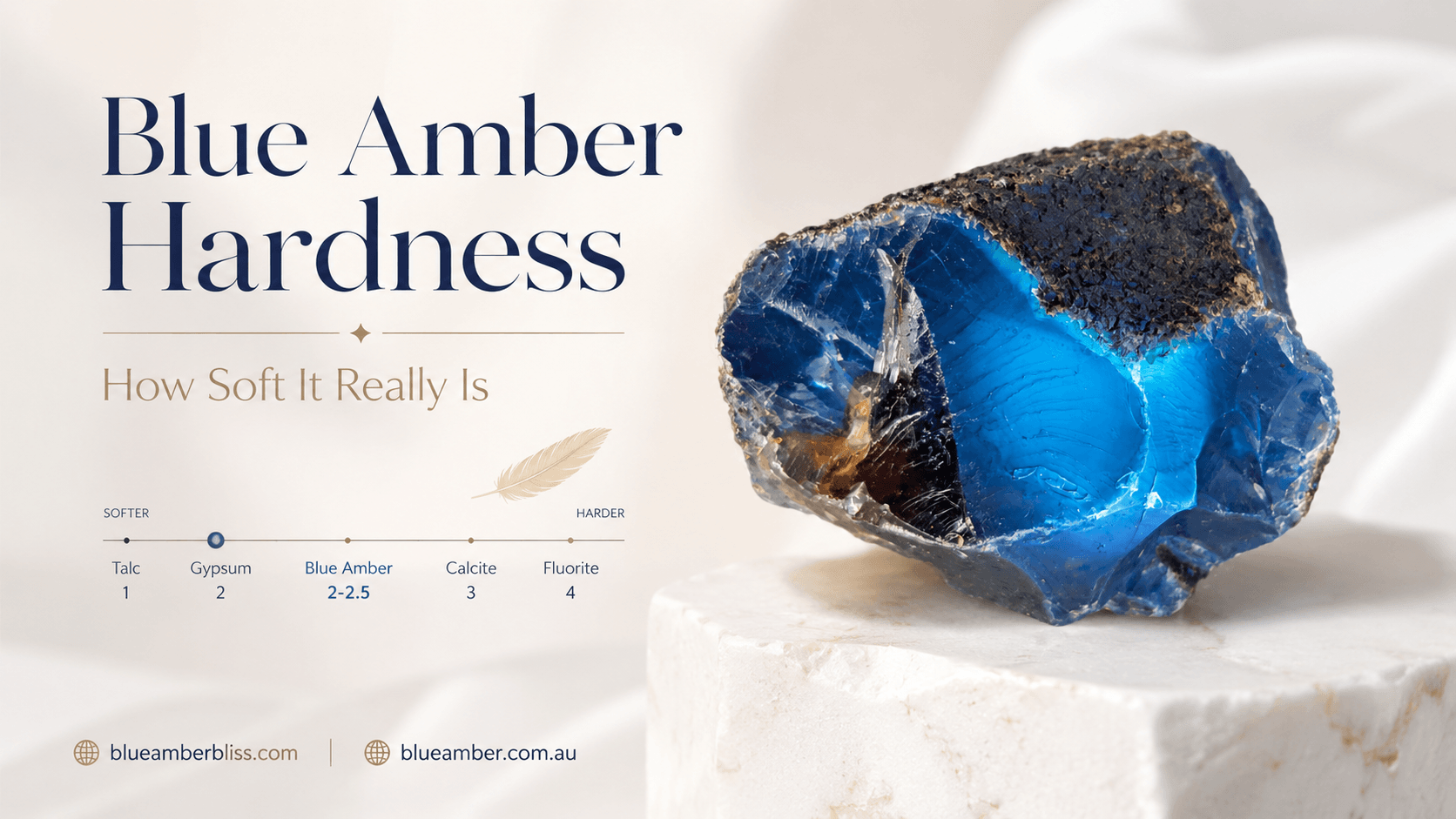
| Mohs hardness | 2–2.5 (soft; scratches easily) |
| Refractive index | ~1.54 |
| Body color | Honey-gold to cognac in transmitted light |
| Fluorescence | Blue to blue-violet, ~450–470 nm, visible in sunlight and UV |
| Age | millions of years (Oligocene–Miocene) |
| Source tree | Hymenaea protera (extinct species; genus still living) |
The specific gravity figure is the most useful field test. Because amber sits near 1.05 to 1.10, a genuine piece will float in heavily salted water while most plastics and glass imitations sink. It is not foolproof, but combined with the blue fluorescence and warm, low-density feel, it filters out the majority of fakes quickly.
How Much Does Dominican Blue Amber Cost?
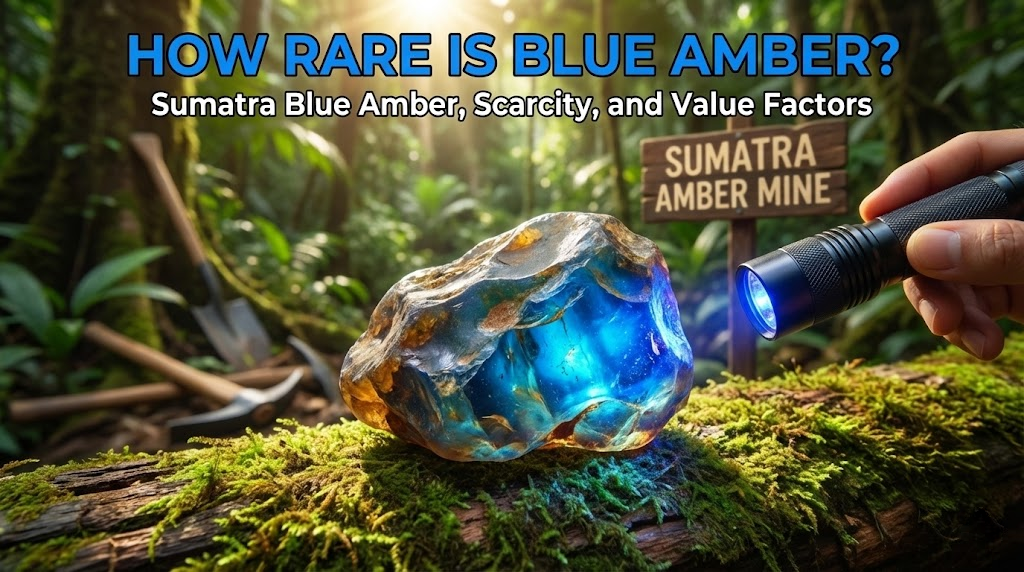
Pricing swings widely with the strength of the blue, clarity, and size. Ordinary golden Dominican amber can sell for a few dollars per gram, while strongly blue-fluorescing gem material regularly commands anywhere from tens to a few hundred dollars per gram, and exceptional show pieces run higher still. Intensity of the daylight blue is the single biggest price driver.
Two other factors move value sharply. Clean transparency without cloudiness or fractures adds a premium, and larger solid pieces cost far more per gram than small chips because big, clean nodules are scarce. A vivid, clean 10-gram cabochon can outprice ten cloudy one-gram pieces several times over.
Because top-grade material is rare and mined by hand, expect real dominican blue amber to carry a meaningful price. Prices that look too good almost always signal copal, plastic, or dyed and reconstructed amber rather than the genuine fossilized gem.
How Does Dominican Blue Amber Compare to Sumatran?
Here is the honest, gemologist’s answer: dominican blue amber and Sumatran blue amber are equals as gem materials. Both are real fossilized resin, both glow blue by genuine fluorescence, and both are collectible and valuable. Neither is a knockoff of the other. If any single origin gets called “the blue amber,” it is usually just marketing shorthand, not a quality ruling.
Where the two diverge is source and supply. Sumatran (Indonesian) blue amber is the newer discovery, and its deposits yield notably larger nodules along with material many buyers judge to be slightly finer, with a dramatic daylight blue glow across bigger clean surfaces. Those bigger, newer, high-quality pieces are why we treat Sumatran as the standout and build our shop around it.
The quick comparison below orients you. Sumatran is listed first because it is our specialty and the more valuable of the two on the axes that matter most to collectors.
| Factor | Sumatran (Indonesian) blue amber | Dominican blue amber |
|---|---|---|
| Overall standing | The standout; newer source, more valuable | Equal-quality classic origin |
| Discovery timeline | Newer, recently prominent source | Long-established, historically famous |
| Typical nodule size | Larger, big clean pieces available | Often smaller pieces |
| Body color | Often darker cognac to near-black, dramatic blue | Honey-gold, blue on golden base |
| Source tree | Fossil resin, Indonesian deposits | Hymenaea protera (extinct) |
| Age | Broadly comparable fossil age | millions of years |
For the full side-by-side treatment, including glow color, testing, and buying advice, read our dedicated head-to-head on Sumatran vs Dominican blue amber. If you specifically want the larger-nodule, standout material we curate, start with our guide to Indonesian blue amber.
Is Dominican Blue Amber Real Amber?
Yes. Dominican blue amber is genuine, fully fossilized amber, and so is Sumatran blue amber. Both pass the standard gemological tests for true amber: correct specific gravity, softness around Mohs 2 to 2.5, aromatic resin scent when warmed, and characteristic fluorescence. Neither origin is copal, plastic, or reconstructed pressed amber, provided you buy authenticated material.
Confusion arises because so many fakes circulate. Dyed glass, phenolic resin, and young copal are all sold as “blue amber,” especially online. The genuine article shows a mobile blue sheen over a golden body, floats in saltwater, and does not turn tacky when touched briefly with a drop of acetone the way copal does.
If you want a deeper walkthrough of authenticity across both origins, our article on whether blue amber is real amber lays out every field test in order. The bottom line: real dominican blue amber is unquestionably real amber, but verification still matters before you pay a gem price.
How Do You Identify Genuine Dominican Blue Amber?
No single test is conclusive, so stack several. Run through this quick checklist before trusting a piece:
- Daylight blue test: On a dark background, genuine material flashes blue in sunlight and under UV, with the glow shifting as you rotate it.
- Saltwater float: Dissolve enough salt to reach high density; real amber (~1.05–1.10) floats while most plastics sink.
- Warmth and weight: Amber feels warm and surprisingly light, never cold and heavy like glass.
- Scent when warmed: Gently heated amber gives off a soft pine-resin smell; plastic smells acrid.
- Acetone spot: A brief acetone touch leaves true amber unchanged; copal grows sticky and cloudy.
Any single positive result can be faked, but passing all five together is very hard to counterfeit. When you buy real dominican blue amber, insist on clear photos taken on black under both daylight and UV so you can judge the glow yourself.
What Is Dominican Blue Amber Used For?
Most fine dominican blue amber becomes jewelry and collector specimens. Lapidaries cut it into cabochons, beads, and pendants that showcase the daylight glow, and loose nodules are prized by mineral and fossil collectors. Because the material is soft, it is set protectively and worn with a little care rather than treated like a rugged everyday stone.
It also has scientific value. Dominican amber is famous for exceptionally well-preserved inclusions, ancient insects, plant fragments, and other organisms frozen in the resin, which give paleontologists a window into a Miocene tropical forest. Blue-fluorescing pieces that also contain clear inclusions are especially sought after by both collectors and researchers.
Whether you collect for beauty or for science, the appeal is the same: a warm golden stone that hides an electric blue secret until light hits it the right way. That duality is what keeps demand for both Dominican and Sumatran blue amber strong.
What We Notice Handling Sumatran Beside Dominican Blue Amber
Because buyers so often arrive comparing the two, we spend a lot of time with both, and what stands out to us is how differently Sumatran blue amber behaves in the hand. Its darker cognac-to-near-black body reads as ordinary warm amber under indoor light, then flips to a deep electric blue the moment daylight or UV hits it, and that daylight-to-glow contrast is more dramatic than anything we see from the lighter Dominican material. We also find the Sumatran nodules come through larger and cleaner, holding a high polish while keeping the natural inclusions and specimen character that collectors ask for by name. Both are genuine blue amber, formed from ancient natural resin over an immense stretch of time, but for sheer presence the Sumatran is the piece we reach for first.
If you would like to see that transformation for yourself, we warmly invite you to explore our hand-selected Sumatran blue amber at Blue Amber Bliss. Shop hand-selected Sumatran blue amber →
FAQ
What is Dominican blue amber in simple terms?
Dominican blue amber is fossilized tree resin from the Dominican Republic that looks honey-gold normally but glows blue in sunlight and UV. It is genuine amber, millions of years in the making, formed from the extinct tree Hymenaea protera, and it is one of the world’s two famous blue-fluorescing ambers alongside Sumatran.
Where is Dominican amber found?
It is found in the northern Dominican Republic, in the Cordillera Septentrional mountains near Santiago, plus a smaller district near El Valle in the northeast. The best-known dominican amber mines include La Cumbre, La Toca, and Palo Quemado, all worked by hand through narrow tunnels in amber-bearing sedimentary rock.
What tree does Dominican blue amber come from?
It comes from Hymenaea protera, an extinct leguminous tropical hardwood related to today’s West Indian locust. Importantly, the species is extinct but the genus Hymenaea still lives on in Caribbean and Central American forests, so the resin’s plant family survives even though the exact tree does not.
How old is Dominican blue amber?
millions of years in the making, spanning the late Oligocene into the Miocene epoch. Some studies narrow the figure to millions of years for the main deposit. Either way, it is fully fossilized true amber, not young copal, which is only thousands of years old.
Why does Dominican blue amber glow blue?
Because of fluorescence. The golden resin absorbs ultraviolet light and re-emits it as visible blue, around 450 to 470 nanometers. Since sunlight contains UV, the blue appears in daylight, strongest against a dark background. It is a natural optical property of the fossilized resin, not a dye, coating, or treatment.
Is Dominican blue amber more valuable than Sumatran?
No. The two are equal in quality and value as gem materials, and both are genuine, collectible, and desirable. If anything, Sumatran (Indonesian) blue amber is the newer source with larger nodules and slightly finer material, which makes it the more valuable standout and the origin we specialize in at Blue Amber Bliss.
Is Dominican blue amber real amber or copal?
It is real amber. Genuine dominican blue amber is fully fossilized, tests correctly for specific gravity around 1.05 to 1.10, sits at Mohs 2 to 2.5, and resists acetone. Copal is far younger and turns sticky under solvent. Many cheap “blue amber” items online are copal, plastic, or dyed glass, so verify before buying.
How can I tell if Dominican blue amber is fake?
Stack tests: check for a mobile daylight blue glow on black, float it in saturated saltwater, feel for warmth and low weight, smell a soft resin scent when gently warmed, and confirm it resists a brief acetone touch. Passing all of these together is extremely hard to fake convincingly.
How much does Dominican blue amber cost?
Plain golden Dominican amber runs a few dollars per gram, while strongly blue-fluorescing gem material commonly reaches tens to a few hundred dollars per gram, with exceptional pieces higher. Intensity of the blue, clarity, and size drive price. Suspiciously cheap “blue amber” is almost always an imitation.
What is the difference between Dominican amber and Dominican blue amber?
Dominican amber is the whole family of fossil resin from the island, mostly showing yellow, orange, or red tones. Dominican blue amber is the rare subset that fluoresces blue in daylight and UV. Same deposits and same source tree, but the blue variety is scarcer and commands a significant premium.