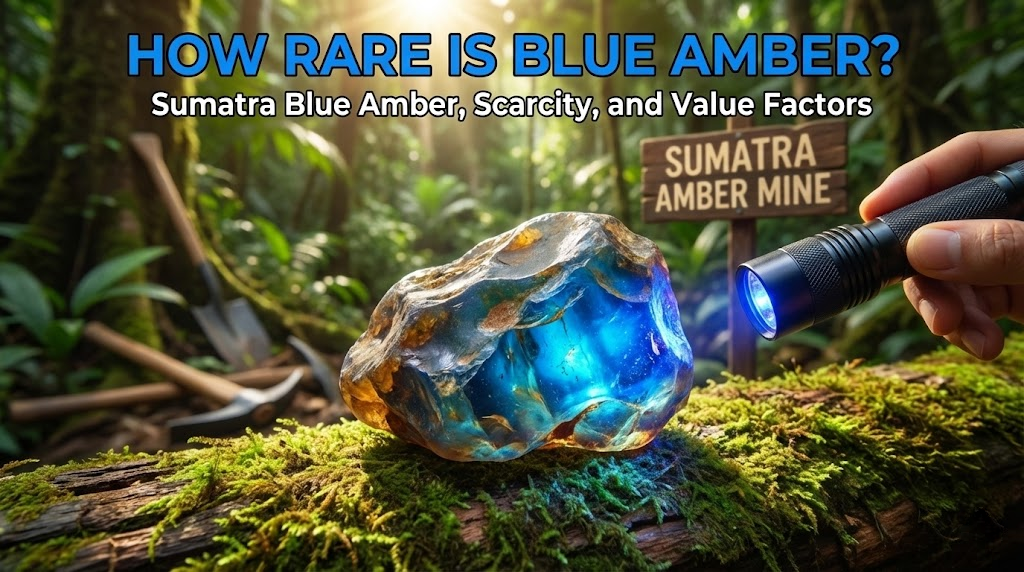
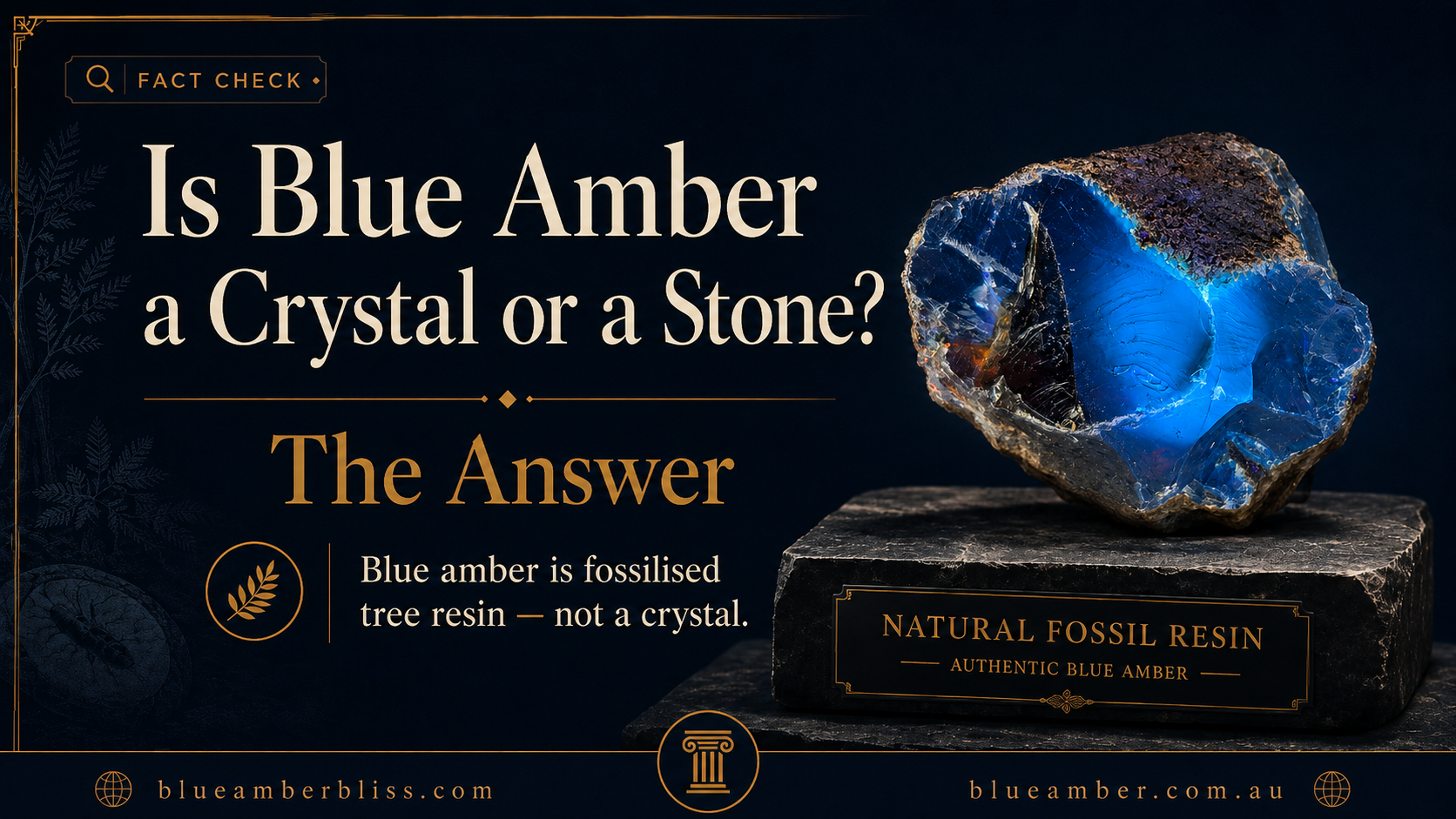
Is blue amber a crystal? No. Blue amber is not a crystal or a mineral – it is an amorphous organic gem, fossilized tree resin with no crystal lattice and no cleavage. It belongs alongside pearl, jet and coral as an “organic gemstone,” and Sumatran blue amber is its most dramatic example.
Key Takeaways
- Is blue amber a crystal? No – it is amorphous, meaning its atoms have no repeating, ordered lattice like quartz or diamond.
- It is a fossil and an organic gem at the same time: hardened tree resin roughly 20-40+ million years old.
- By gemology’s rules it is not a mineral (minerals are inorganic and crystalline); it sits with pearl, coral and jet.
- Crystal-healing sellers call it a “crystal” colloquially, not scientifically – and that is fine if you know the difference.
- Sumatran blue amber is the standout example: large nodules and a vivid daylight blue glow.
- Physically it is soft (Mohs ~2-2.5) and light (specific gravity ~1.05-1.10), which are organic-resin traits, not mineral ones.
Is Blue Amber a Crystal? The Direct Answer
Here is the honest gemologist’s answer: is blue amber a crystal? No. A crystal is defined by an ordered, repeating internal arrangement of atoms – a lattice. Blue amber has none. It is amorphous, the same word we use for glass and opal. When resin oozes from a tree and slowly polymerizes over millions of years, the molecules lock into a tangled, random network, not neat geometric rows.
So when people reach for that word, they are usually thinking of the everyday meaning – a pretty, glowing collectible stone. Under that loose definition you can call it whatever you like. Under gemology’s precise definition, blue amber fails the crystal test on the single most important point: no lattice.
That distinction matters more than it sounds. How you answer “is blue amber a crystal” quietly changes how you should clean it, store it, and understand its value. Treating an organic resin like a hard mineral crystal is how collectors accidentally scratch or crack their pieces.
What Makes Something a Crystal or a Mineral?
To see why is blue amber a crystal gets a firm “no,” you need the textbook definition. According to standard gemology and the GIA, a mineral must meet four tests: it is naturally occurring, inorganic, solid, and has a definite chemical composition and an ordered crystal structure.
A crystal is the physical result of that ordered structure – atoms stacked in a repeating 3D pattern that often produces flat faces and clean geometry. Quartz, diamond, garnet and amethyst are crystals. They grow in defined systems (cubic, hexagonal, and so on) and can split along flat planes called cleavage.
Blue amber breaks every one of those rules except “naturally occurring” and “solid.” It is organic (it came from a living tree), it has no fixed chemical formula (it is a mix of terpenes, resins and succinic compounds), and it has no lattice. That is the whole reason the answer lands firmly on no.
What is the difference between a crystal and a stone?
In casual speech “stone” is a catch-all – any hard, polished lump you’d set in jewelry. A “crystal” is a stone with an ordered atomic lattice. So every crystal is a stone, but not every stone is a crystal. Amber is a stone in the loose sense and a gem in the trade sense, yet it is not a crystal in the scientific sense.
Is Blue Amber a Crystal or a Stone? Crystal vs Stone vs Organic Gem
The cleanest way to settle is blue amber a crystal or a stone is a side-by-side comparison. “Stone” is informal, “crystal” and “mineral” are technical, and “organic gem” is the category blue amber actually lives in. The table below shows where it fits.
| Category | Ordered lattice? | Origin | Examples | Blue amber? |
|---|---|---|---|---|
| Crystal / mineral | Yes | Inorganic, geological | Quartz, diamond, amethyst | No |
| Rock / “stone” (loose) | Sometimes | Mineral aggregate | Granite, marble | Only informally |
| Organic gem | No (amorphous) | Living organisms | Pearl, coral, jet, amber | Yes – this is it |
| Amorphous mineraloid | No | Varies | Opal, obsidian, glass | Shares this trait |
Read across the “Blue amber?” column and the pattern is obvious. It is a solid “no” against crystal and mineral, an informal “yes” against stone, and a confident “yes” against organic gem. So is blue amber a crystal or a stone? It is best called an organic gem – a stone loosely, never a crystal precisely.
If you want the underlying chemistry behind that classification, our deep dive on blue amber composition walks through the terpenes and succinic acid that make it organic rather than mineral.
Is Blue Amber a Gemstone or a Fossil?
It is both – and that is not a contradiction. “Fossil” describes its origin: blue amber is fossilized tree resin, typically ancient natural resin, with Sumatran deposits usually dated to the Miocene (millions of years). “Gemstone” describes its use: it is cut, polished and set into jewelry. A pearl is an organic gem too, just not a fossil; amber is the rare gem that is both.
So the question “is amber a gemstone or fossil” has a satisfying answer: yes to both. As Britannica describes it, amber is a fossil resin valued as a gem – a fossilized organic gemstone. That dual identity is exactly why the classification confuses people – a fossil clearly is not a mineral crystal, yet it sparkles and sells like a gem, so “is blue amber a crystal” keeps getting asked.
For the full origin story – how the resin forms, hardens and turns blue – start with our hub page on what blue amber is.
Why Do Crystal Sellers Still Call It a Crystal?
Walk any metaphysical shop and you’ll see amber shelved under “crystals.” This is not fraud; it is vocabulary drift. In the healing and manifestation world, “crystal” has become a blanket term for any energetically-used stone – including amorphous ones like obsidian, opal and amber. The word means “spiritual tool,” not “lattice.”
So if a seller says amber is a crystal, they usually mean it is used in crystal work, not that it has crystalline structure. The tension only appears when a buyer takes the marketing literally and then asks a gemologist “is blue amber a crystal.” Both people are right within their own vocabulary – they are just using one word for two different ideas.
Our take: use the word that helps you, but know the science underneath. Blue amber’s warmth and light-body energy are precisely why practitioners love it, and knowing it is organic rather than mineral actually deepens that story rather than diminishing it.
Can you use blue amber like a crystal even though it isn’t one?
Absolutely. Its amorphous, organic nature does not stop it from being paired, gridded or carried like any other stone. If anything, its living-tree origin gives it a distinct “solar” quality many practitioners prize. We cover combinations and intentions in our guide to blue amber crystal pairings, written for exactly this audience.
Is Blue Amber a Mineral? The Science
No – and this is the cleanest scientific “no” of all. To be a mineral, a substance must be inorganic. Blue amber is organic by definition: it is polymerized plant resin, carbon-based, born from a living conifer. That single fact disqualifies it from mineral status before we even discuss structure.
Gemologists sometimes use the softer word “mineraloid” for amber – a naturally occurring, mineral-like solid that lacks crystalline structure. Opal, obsidian, pearl and jet share that label. So if you must file blue amber somewhere on the mineral shelf, “mineraloid” is the accurate drawer, and it still means the answer to “is blue amber a mineral” is technically no.
This is also why comparing “is amber a crystal or a stone” to something like quartz never quite works: quartz is a hard, lattice-bound mineral, and amber is a soft, latticeless organic. They sit in genuinely different scientific families.
What Are Blue Amber’s Physical Properties?
The physical numbers confirm everything above. Blue amber behaves like resin, not rock. These are the traits that separate an organic gem from a mineral crystal, and they are why the answer to is blue amber a crystal stays consistent across every test.
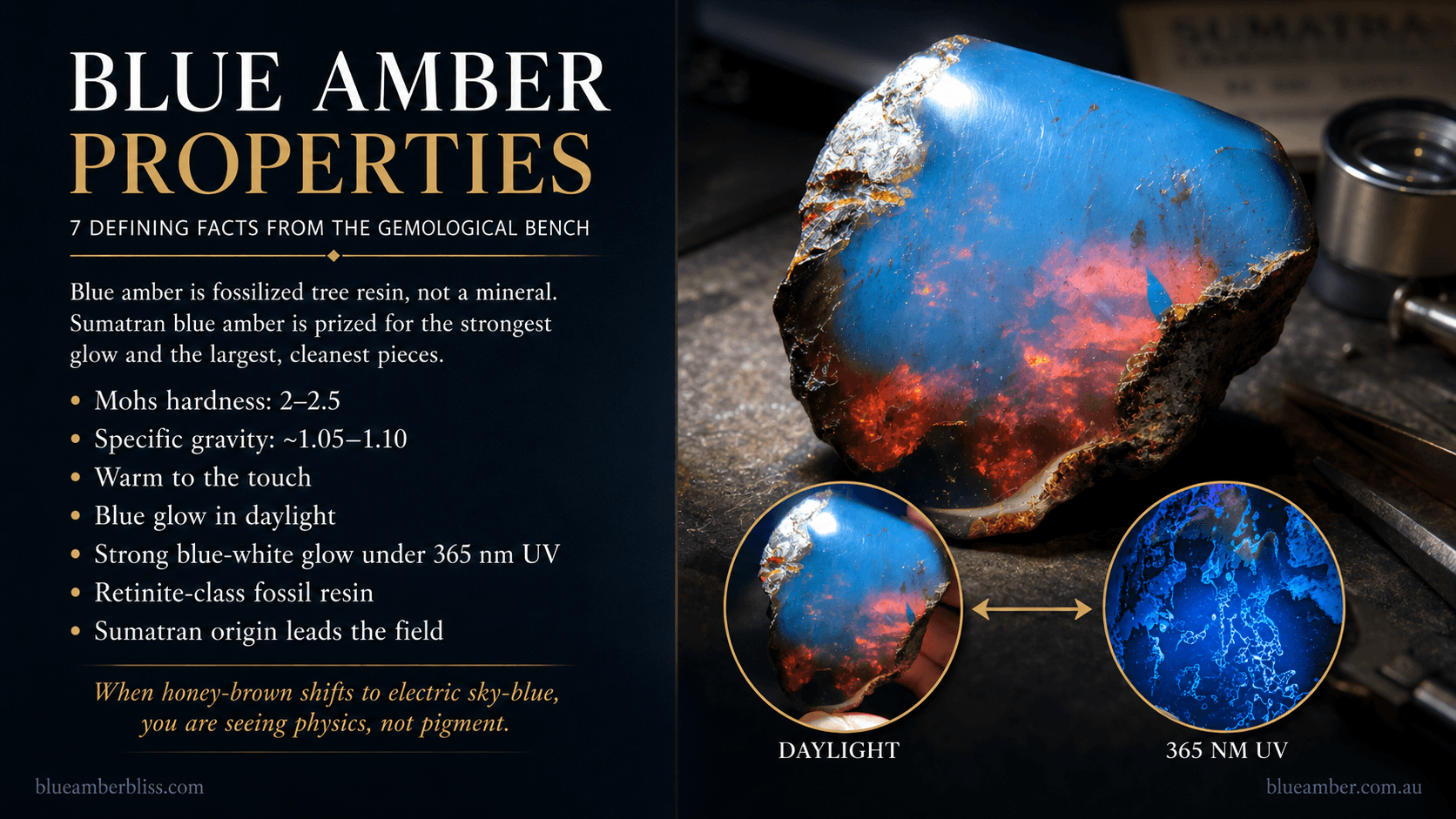
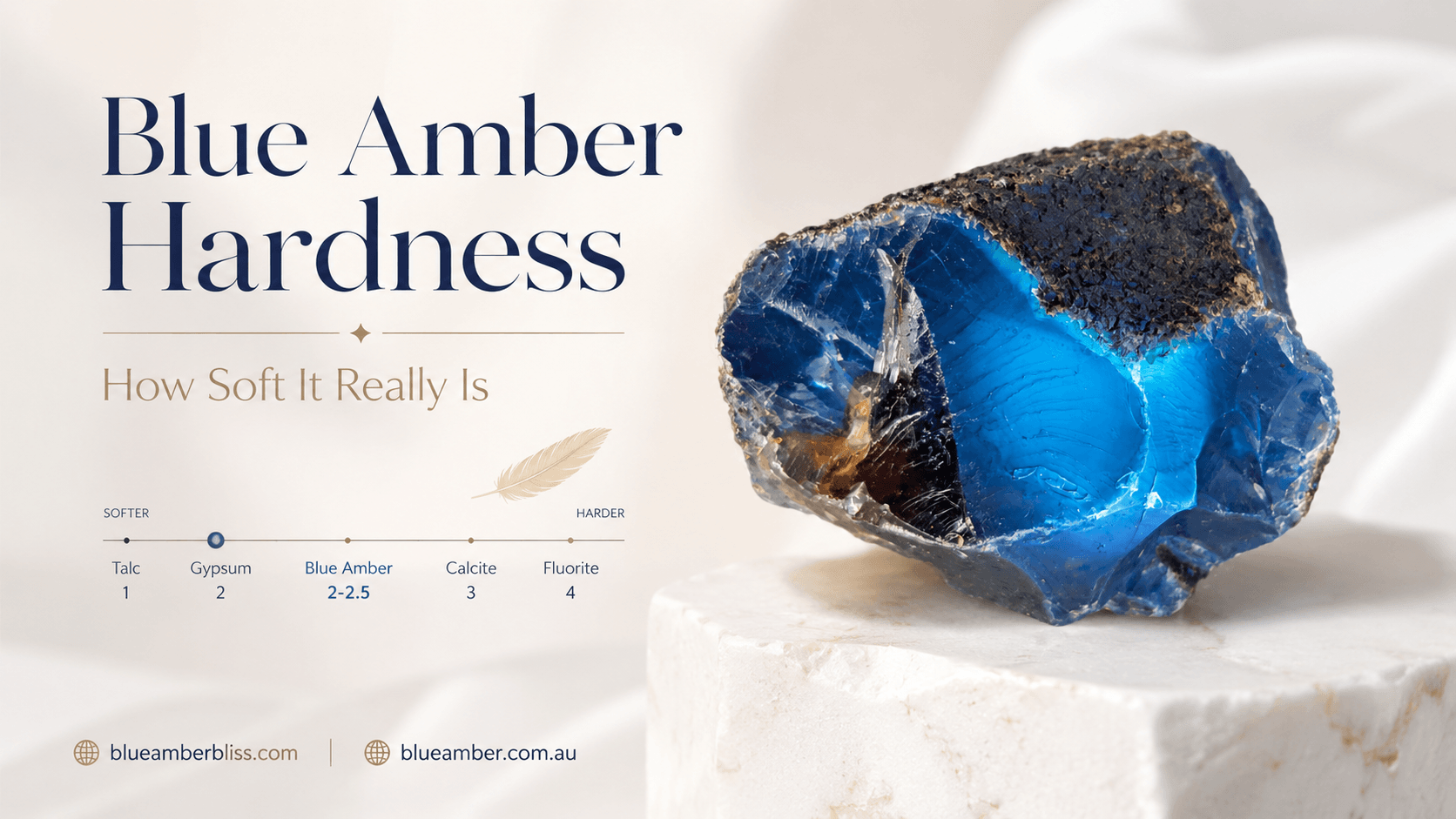
- Mohs hardness ~2-2.5 – soft enough to scratch with a copper coin; real crystals like quartz sit at 7.
- Specific gravity ~1.05-1.10 – so light it nearly floats, and it will float in saturated saltwater, unlike dense minerals.
- No cleavage – it fractures conchoidally (curved, shell-like), the classic sign of an amorphous solid.
- Warm to the touch – a poor heat conductor, unlike cool mineral crystals.
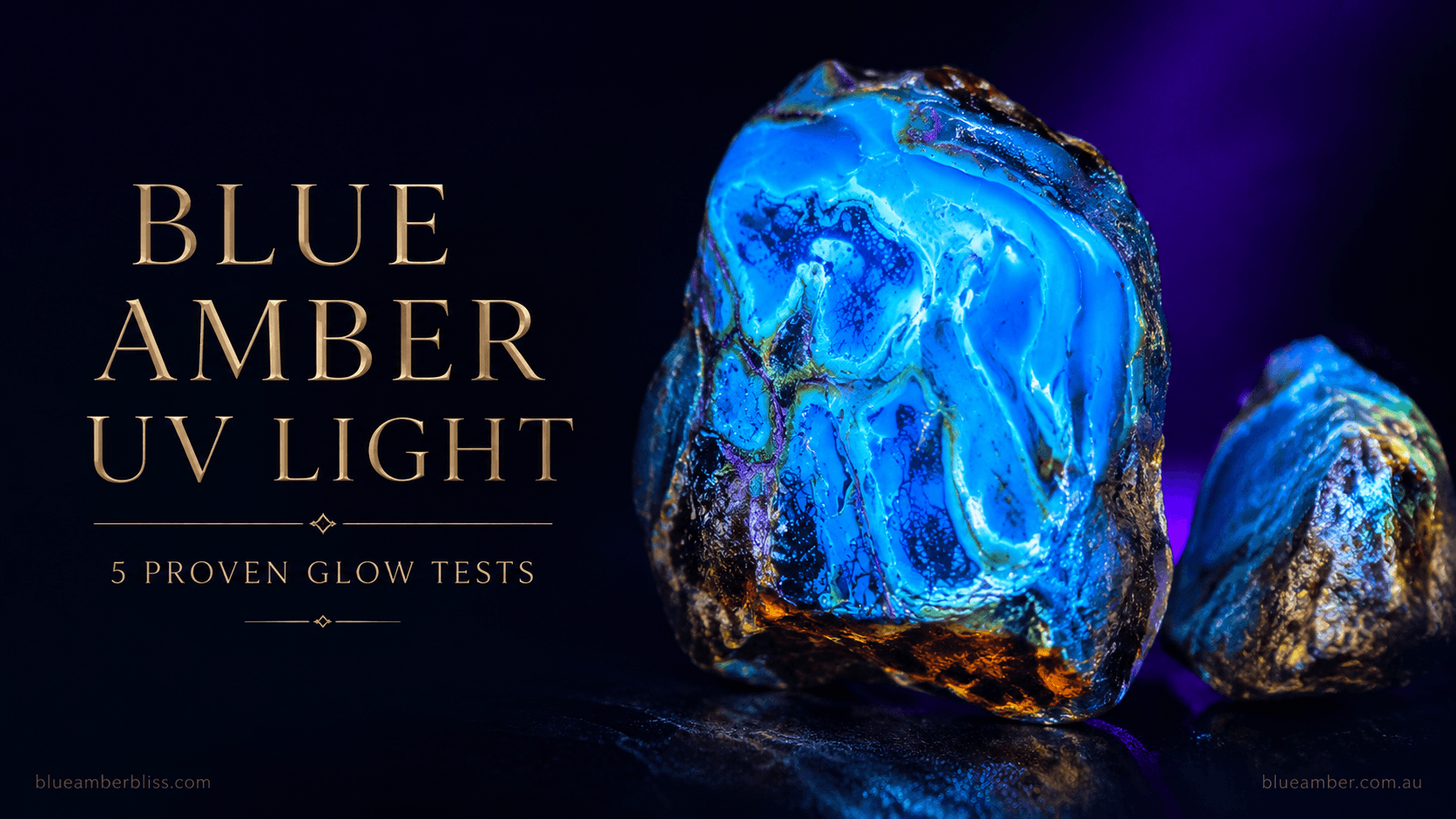
- Fluorescence – glows under UV (~365 nm long-wave), and the finest blues show a striking daylight glow under the sky’s UV.
- Amorphous internal structure – no faces, no growth system, no lattice.
Compare that to quartz – Mohs 7, specific gravity ~2.65, a definite hexagonal lattice – and the gulf is obvious. A stone you can scratch with a coin and that floats in brine is not behaving like a mineral crystal. For the full data set, see our page on blue amber properties.
Why does blue amber glow blue if it isn’t a crystal?
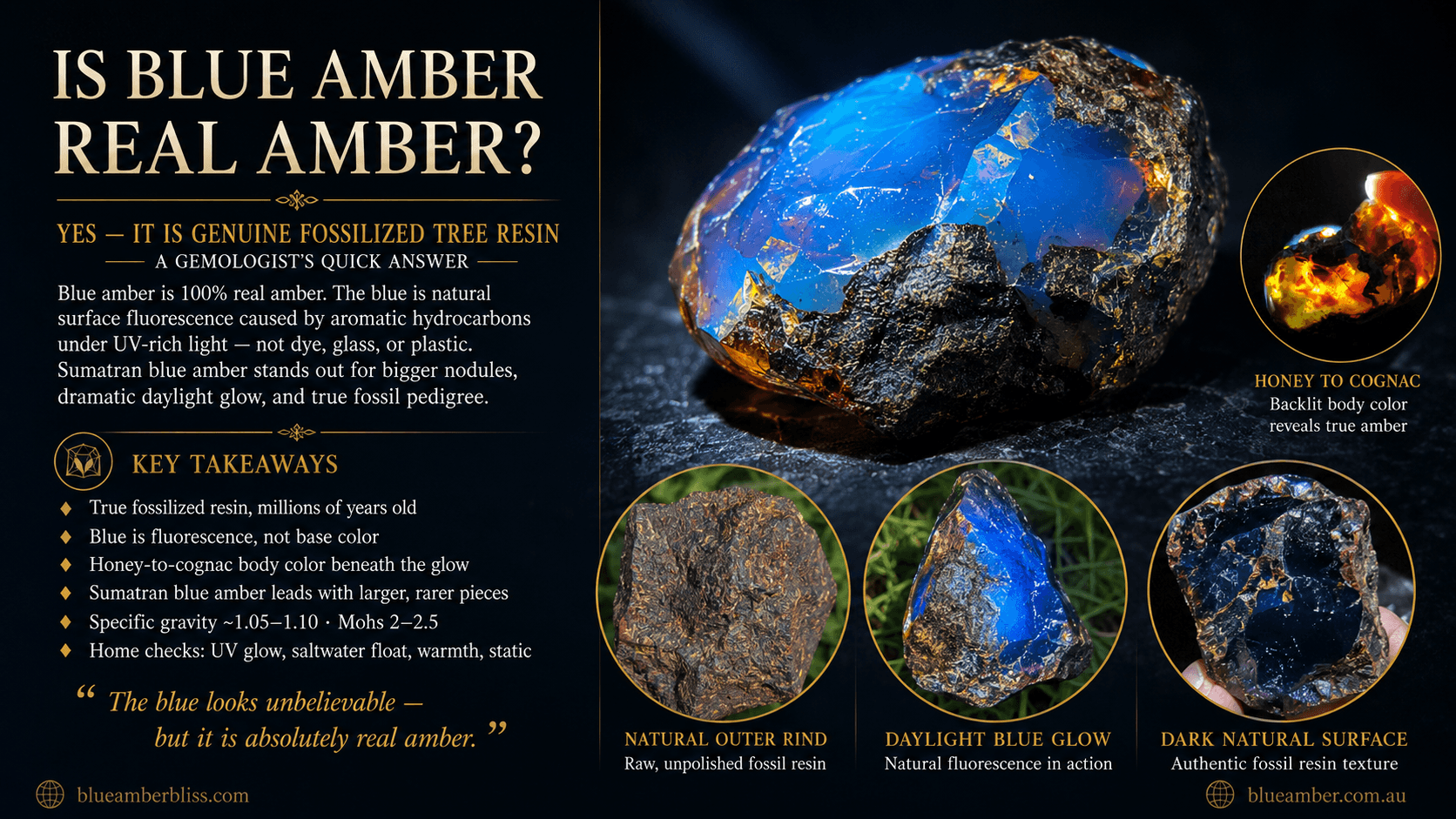
The blue is fluorescence, not crystal structure. Ultraviolet light – from the sun or a ~365 nm lamp – excites hydrocarbon molecules trapped in the resin, which re-emit visible blue light. It is a chemical, molecular effect, so it needs no lattice at all. That is why an amorphous organic gem can still out-glow many hard crystals, and why judging it by its glow is a trap – the glow proves chemistry, not crystallinity.
Sumatran Blue Amber: The Standout Organic Gem
Among all blue amber, Sumatran (Indonesian) material is the one we hold up as the benchmark. It is a newer source than the historic deposits, and it tends to arrive in larger nodules with a famously vivid daylight blue glow. Bigger, cleaner rough and that dramatic fluorescence make Sumatran blue amber the standout – and, in our view, the more valuable and collectible.
Importantly, none of that changes its classification. Sumatran blue amber is still an amorphous organic gem, still a fossil, still not a mineral. Its greatness is about size, color and glow – not about becoming a crystal. So even for the world’s most prized pieces, the answer to is blue amber a crystal remains a confident no.
The practical upshot: buy Sumatran blue amber for its light-play and rarity, not because a listing calls it a “crystal.” Understanding it as a premium organic gem is what protects you as a buyer.
Is Sumatran blue amber real amber if it isn’t a crystal?
Yes – being a non-crystal has nothing to do with authenticity. Genuine amber is supposed to be amorphous resin; that is what real amber is. Whether a given piece is authentic (versus copal, plastic or glass) is a separate question we answer in full at is blue amber real amber. Classification and authenticity are two different tests – do not confuse them.
How Does Blue Amber Compare to Other Organic Gems?
Blue amber is not alone in the “not a crystal” club. Four classic organic gems share its outsider status, and seeing them together makes the classification click. None have a lattice, all come from living things, and all are cut and worn as fine jewelry – proof that a gem does not need to be a crystal to be treasured.
Pearl grows inside a mollusk from layers of aragonite and conchiolin. Coral is the calcified skeleton of tiny marine animals. Jet, like amber, is fossilized plant matter – compressed wood rather than resin. Each is beautiful, valuable, and firmly outside the mineral kingdom. Blue amber simply happens to be the one that also glows.
That shared identity is why gemologists treat “is blue amber a crystal” as the same kind of question as “is a pearl a crystal.” The answer in every case is no – and in every case, the gem is prized precisely for qualities a lattice could never give it: iridescence, warmth, history, or in amber’s case, that electric daylight blue.
Sumatran blue amber earns its place at the front of that lineup. Where a pearl relies on nacre and coral on color, Sumatran amber offers scale and a fluorescent light show in one organic package – a reminder that the most collectible gems are often the ones science refuses to call crystals.
What Does This Mean If You Use It for Crystal Work?
Practically, three things follow from blue amber being an organic gem rather than a mineral crystal. None of them stop you from using it spiritually – they just help you use it well and keep it intact for decades.
- Clean it gently. Skip ultrasonic cleaners, salt scrubs and harsh solvents. At Mohs 2-2.5 it scratches easily; use a soft cloth and lukewarm water only.
- Charge it without water or salt. Because it floats and can be damaged, favor moonlight, sound or intention over saltwater or water bowls used for hard crystals.
- Store it separately. Harder crystals in the same pouch will scratch it. Give blue amber its own soft compartment.
Knowing that is blue amber a crystal resolves to “no, it’s an organic gem” is genuinely useful here. The care that keeps quartz pristine can quietly ruin amber. Respect its resin nature and a good Sumatran piece will glow for generations. For deeper energetic context, the crystal pairings guide linked above is the natural next step.
What We Notice Handling Sumatran Blue Amber
At Blue Amber Bliss, the moment you pick up a piece of Sumatran blue amber the crystal-versus-stone question tends to answer itself: it is warm and surprisingly light in the hand, never the cold, dense heft of a true mineral. Because it is ancient hardened resin rather than a crystalline solid, we see no facets or cleavage lines under the loupe, but we do find the trapped bubbles, flow bands and fine inclusions that only an organic material carries. What still surprises first-time buyers is how that dark cognac body stays quiet in the hand, then flips to a deep electric-blue glow the instant daylight or UV hits it, something no ordinary gemstone does.
If you would like to feel that difference for yourself, we warmly invite you to explore our hand-selected Sumatran blue amber at Blue Amber Bliss. Shop hand-selected Sumatran blue amber →
FAQ
Is blue amber a crystal?
No. Blue amber is not a crystal – it is an amorphous organic gem (fossilized tree resin) with no crystal lattice and no cleavage. It is grouped with pearl, jet and coral, not with quartz or diamond. Crystal sellers may use the word colloquially, but scientifically the answer to is blue amber a crystal is no.
Is blue amber a crystal or a stone?
Neither in the strict sense. “Stone” is an informal umbrella term, and blue amber fits it loosely, but it is not a crystal because it lacks an ordered atomic lattice. The precise classification is “organic gem” or “mineraloid,” the same family as opal and pearl.
Is blue amber a gemstone?
Yes. Blue amber is absolutely a gemstone – specifically an organic gemstone, cut and polished for jewelry and collecting. It just is not a mineral gemstone like sapphire. Being organic makes it a gem, not a crystal, and Sumatran blue amber is the premier example.
Is amber a crystal or a stone?
Amber is best described as an organic gem, informally a “stone,” and definitely not a crystal. It has no repeating lattice, so it fails the scientific test for crystal or mineral. It behaves like hardened resin because that is exactly what it is.
Is blue amber a mineral?
No. Minerals must be inorganic and crystalline; blue amber is organic and amorphous, so it cannot be a mineral. Gemologists sometimes call it a “mineraloid,” a mineral-like solid without crystal structure, alongside opal and obsidian.
Is amber a gemstone or fossil?
Both. Amber is a fossil (ancient tree resin, oftenmillions of years in the making) and a gemstone (cut and worn as jewelry) at the same time. That rare dual identity is unique among common gems and is a big part of blue amber’s appeal.
Why do sellers call blue amber a crystal if it isn’t one?
In metaphysical retail, “crystal” has become a blanket word for any stone used energetically, including amorphous ones like obsidian and amber. It signals “spiritual tool,” not lattice structure. So that label is a vocabulary convention, not a scientific claim about crystal structure.
Does blue amber have healing or metaphysical properties?
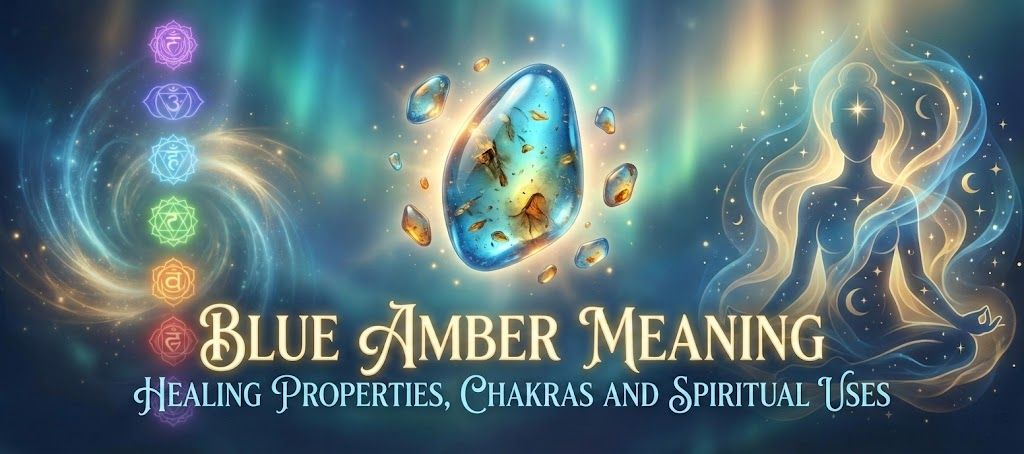
Practitioners associate blue amber with warmth, protection and solar, uplifting energy, and it is widely used in crystal work despite not being a mineral crystal. These are traditional and spiritual associations, not proven medical claims. Its organic, tree-born origin gives it a distinctive energetic reputation.
Is blue amber harder or softer than quartz?
Much softer. Blue amber sits at Mohs 2-2.5 versus quartz at 7, and its specific gravity (~1.05-1.10) is far lower than quartz’s ~2.65. You can scratch amber with a coin and it nearly floats – both signs it is an organic gem, not a hard mineral crystal.
Is Sumatran blue amber a crystal?
No – and neither is any other blue amber. Sumatran material is the standout for its large nodules and dramatic daylight blue glow, which makes it more valuable and collectible, but it is still an amorphous organic gem. Its prestige comes from size and fluorescence, not from being a crystal.