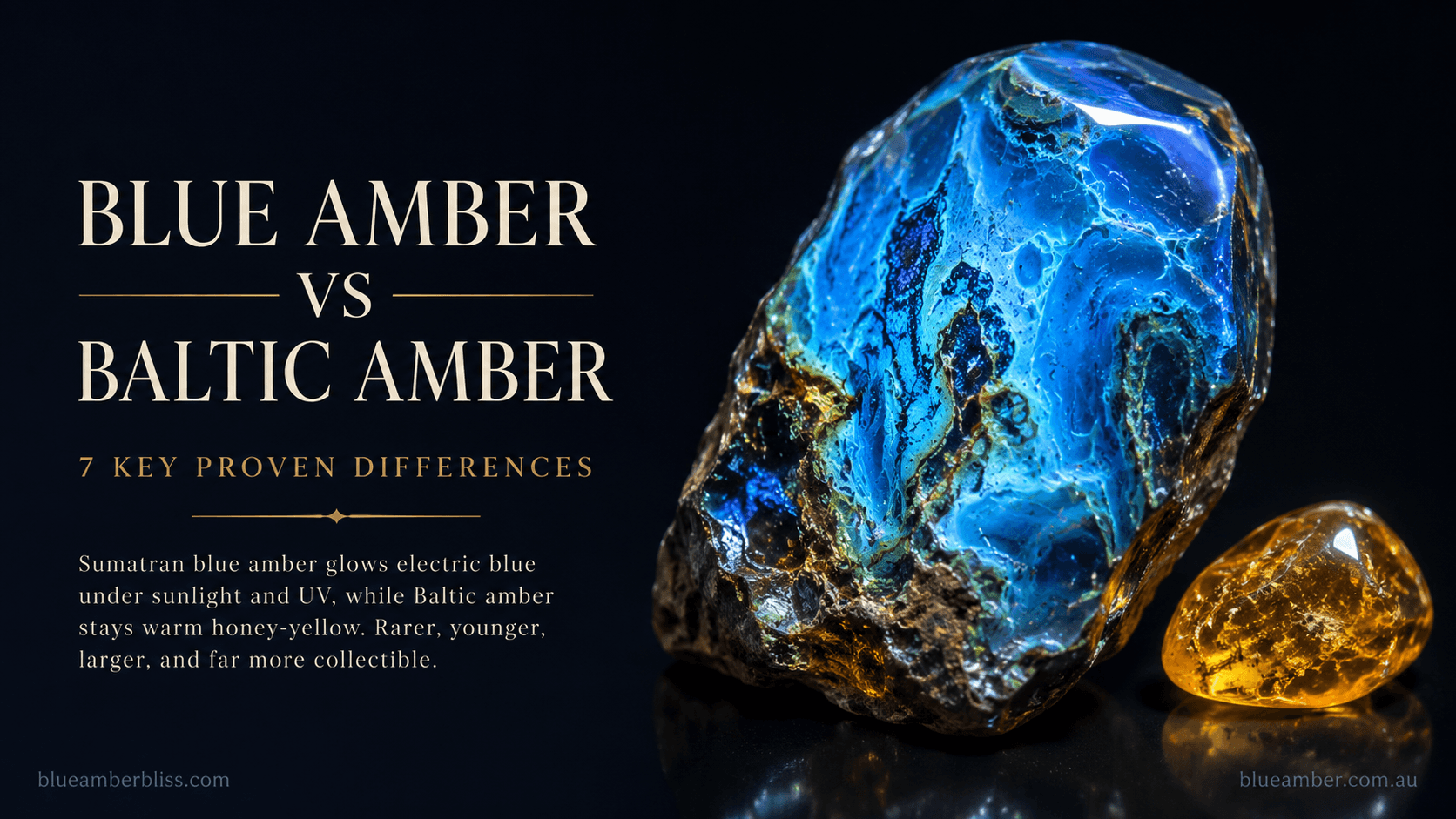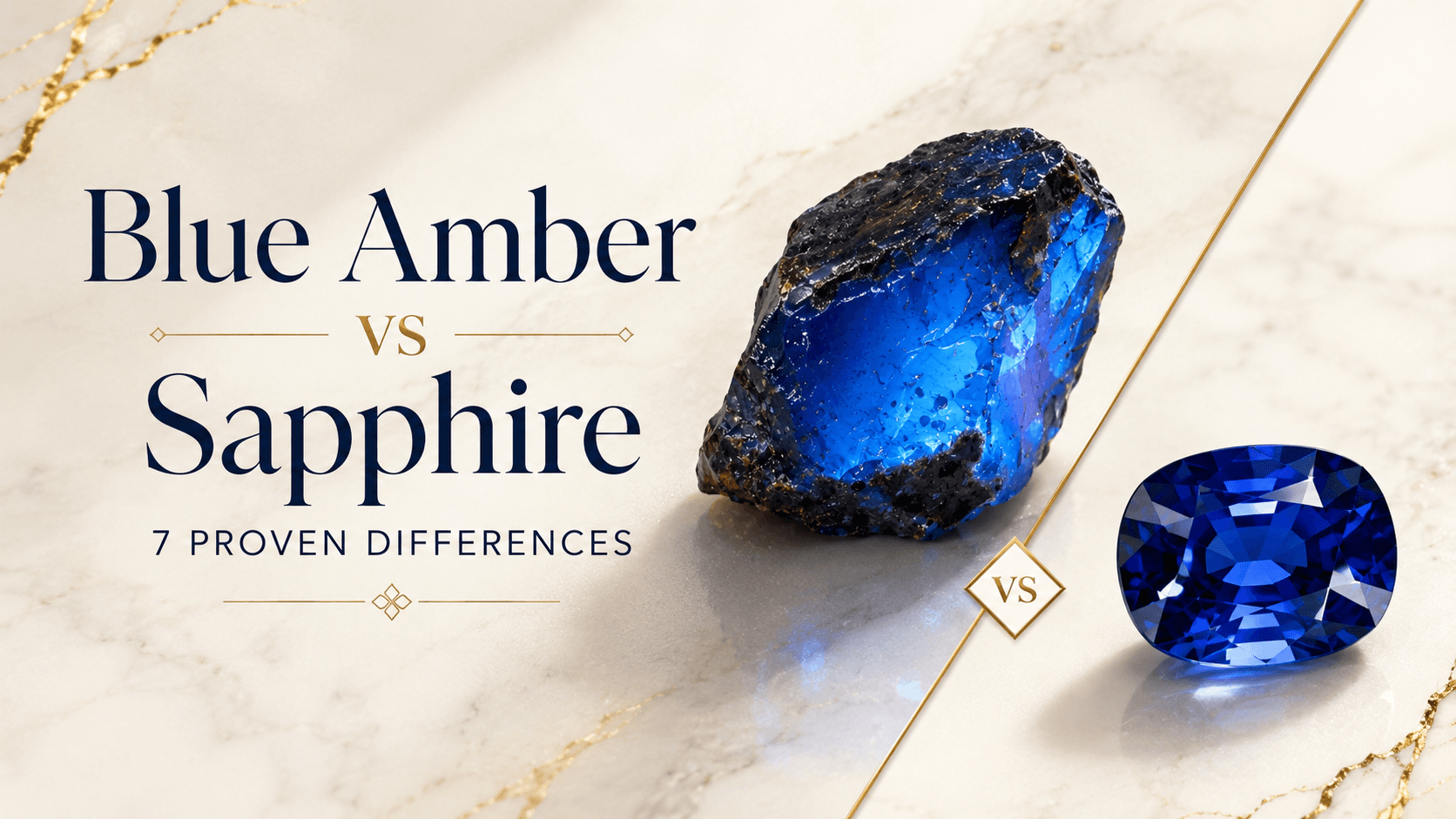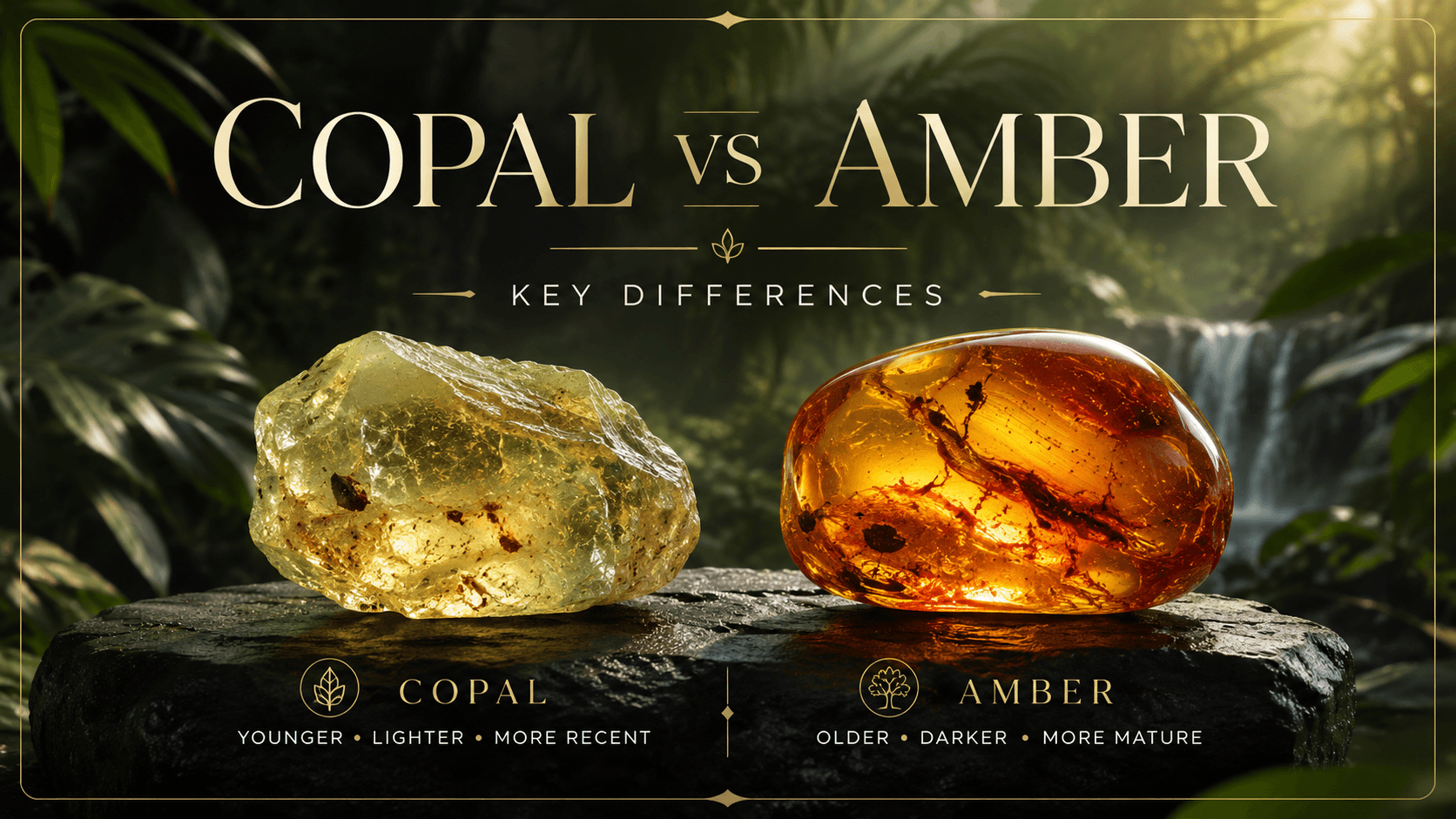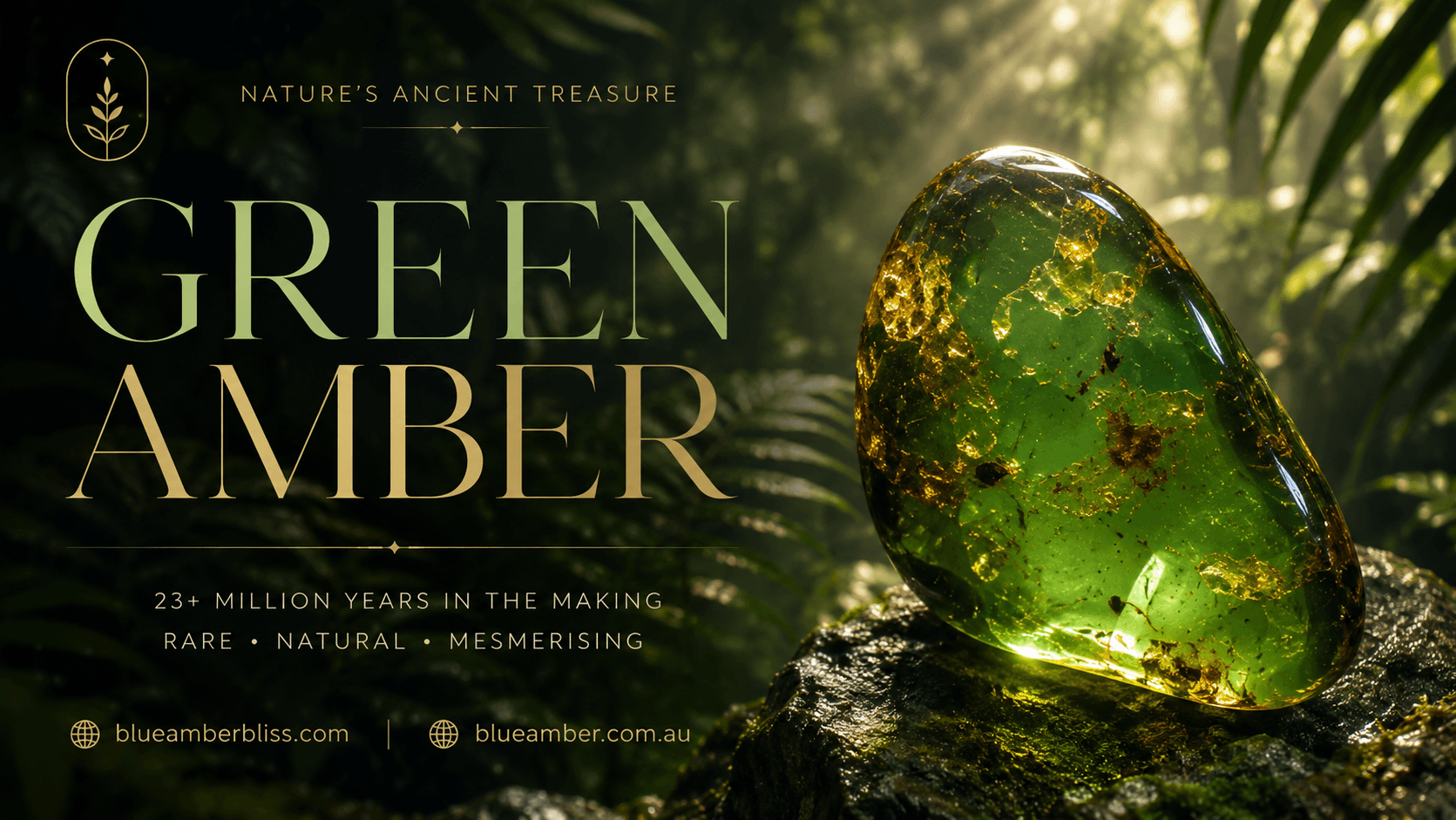

At Blue Amber Bliss we specialize exclusively in Sumatran (Indonesian) blue amber and its famous daylight blue glow — the standout among today’s blue amber types, with Dominican as its well-known cousin. Below, a practising-gemologist framework walks you through every category, then shows how origin, color and grade combine into the price you actually pay. We build on the foundations in our gemologist’s overview of what blue amber is.
Key Takeaways
- Three axes define every piece: the blue amber types break down by origin, fluorescent color, and quality grade — read all three together, never just one.
- Origin drives price most: top Sumatran and Dominican stones command the highest prices, with Sumatran’s larger nodules often pushing the value higher; Mexican and Myanmar blue amber are rarer on the market and less standardized.
- The glow is the grade: stronger, more saturated, fuller-coverage blue fluorescence (AAA/AAA+) can be worth 5-10x a faint Grade A piece of the same size.
- Body color is a clue, not the color: blue amber looks honey, cognac, cola or near-black in plain light and only flips to blue under UV (365nm) or sunlight.
- Specific gravity ~1.05-1.10 and Mohs 2-2.5 hold across all blue amber types, so physical tests are a consistency check that, combined with the acetone and UV tests, supports authenticity.
- Buy on documented origin plus a witnessed glow rather than a seller’s grade label alone — grading is not yet standardized industry-wide.
What Are the Main Blue Amber Types?
When gemologists talk about blue amber types, they usually mean one of three classification systems layered on top of each other. The first and most important is geographic origin: where the fossil resin was mined. The second is fluorescent color: the hue the stone throws under ultraviolet light or sunlight. The third is quality grade: how strong, pure and well-distributed that glow is across the stone.
Confusing these three is the most common buyer mistake. A “Grade AAA” label tells you nothing if you don’t know the origin; a “Sumatran” label says nothing about whether the glow is exceptional or barely there. Read together, the three axes pin down what a piece is and what it should cost — which is exactly why understanding all the blue amber types matters before you spend a cent.
Underlying all of them is one shared chemistry. Blue amber is genuine fossilized tree resin — true amber, broadly Miocene-to-Oligocene in Sumatra and millions of years in the making in the Dominican Republic. As the Gemological Institute of America notes, amber is fossilized resin valued as a gem for millennia. The blue glow comes from a trace fluorophore, and the classification systems below simply describe how strongly and in what hue that effect appears.
Why does blue amber look honey-colored until it glows?
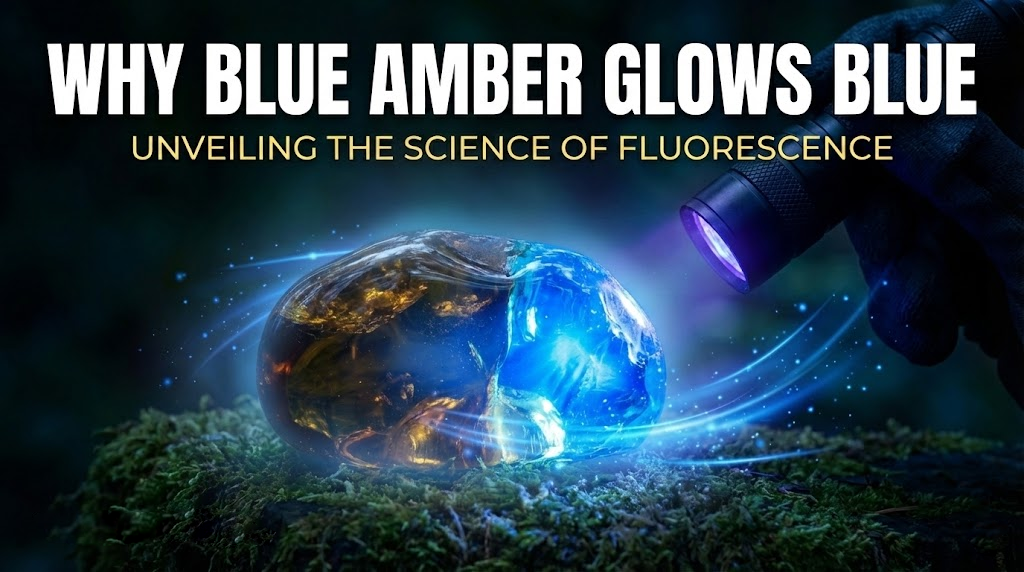
Because the blue is fluorescence, not body color. In ordinary indoor light the resin’s true body color shows through — honey, cognac, cola, amber-brown, even near-black. Only when ultraviolet light (or sunlight, which contains UV) hits the surface does the stone fluoresce, casting that signature blue. This is the single fact that separates real blue amber types from dyed imitations, and we unpack the photophysics in our deep dive on why blue amber glows blue.
What actually causes the blue fluorescence?
The honest answer is that the chemistry is still being studied. The blue glow is most likely caused by trace polycyclic aromatic hydrocarbons in the resin, with perylene the leading candidate — its emission and excitation spectra closely match those measured in blue amber. But the exact fluorophore has never been successfully isolated or its structure confirmed in actual blue amber, and some researchers have proposed alternatives such as azulene for certain deposits. So treat perylene as the best current hypothesis, not settled fact. What matters for buyers is that the effect is real, natural, and very hard to fake — and it underpins every one of the blue amber types you will meet below.
Blue Amber Types by Origin: The 4 Main Sources
Origin is the backbone of blue amber classification because it correlates with body color, glow character, typical nodule size, available supply, and ultimately price. Four sources matter; two dominate the market.
Sumatran (Indonesian) blue amber
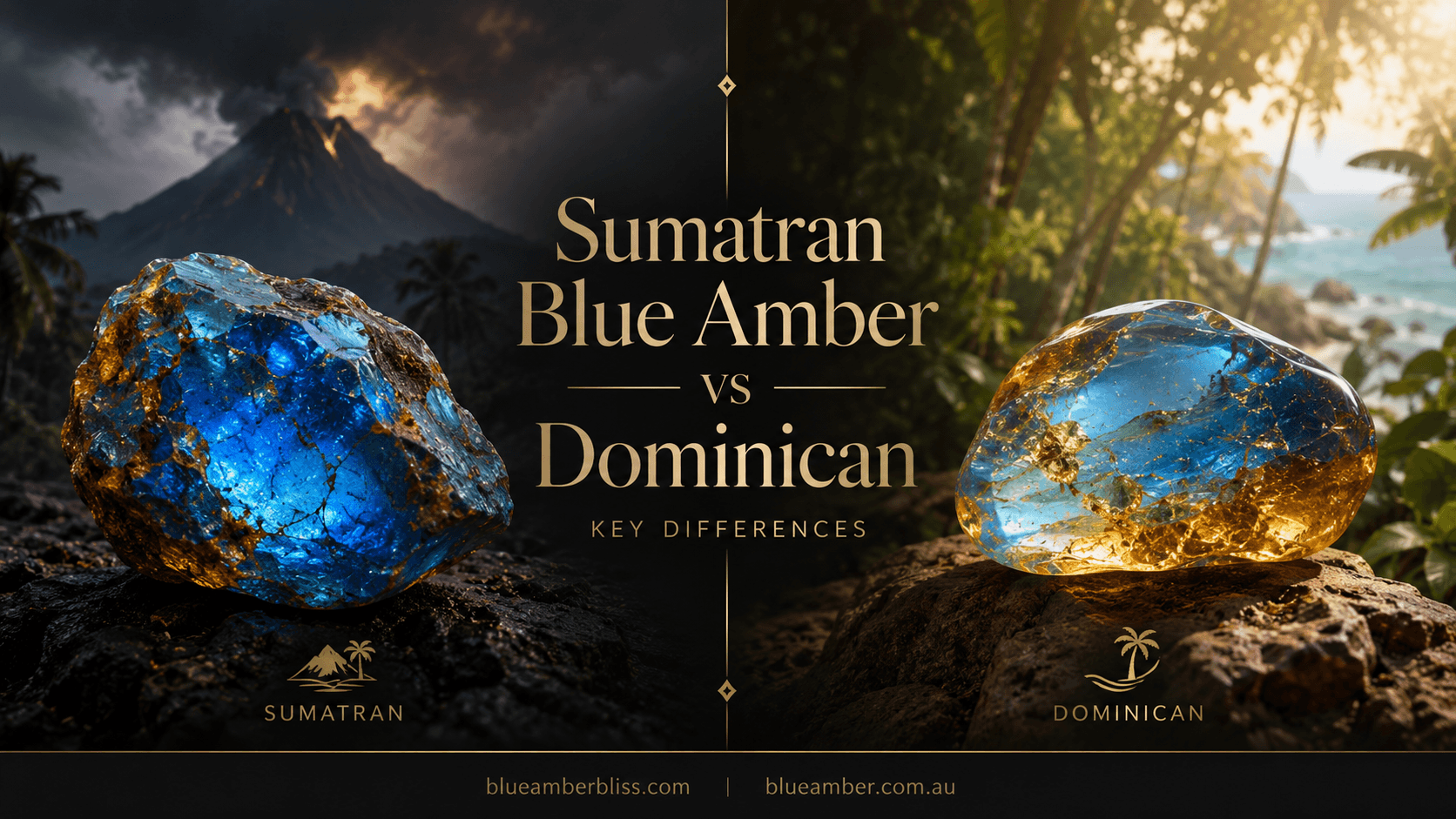
Mined chiefly in Jambi province and across the South Sumatra Basin, Sumatran blue amber is our specialty — and, in our experience, the standout among all blue amber types. It typically has a darker body — deep cognac, cola, dark cherry, sometimes near-black — and is famous for a dramatic glow you can often see in plain daylight, not just under a lamp. The fluorescence skews toward a deep blue, teal, or greenish-blue. As a newer source, Sumatra yields notably large nodules, and that combination of bigger, daylight-glowing pieces is a big part of why Sumatran ranks as the most valuable and most sought-after of the blue amber types on the market today.
Dominican blue amber
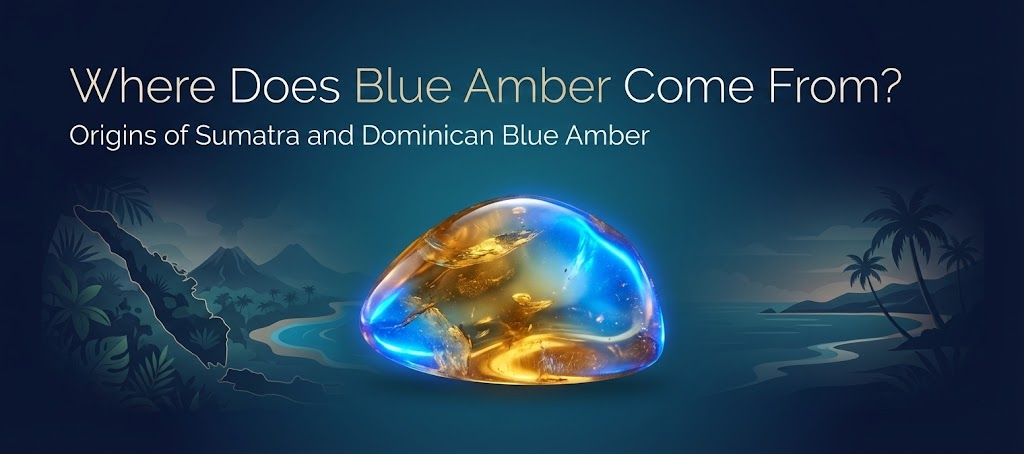
The other classic blue amber, mined in the Cordillera Septentrional mountains around Santiago. Dominican stones usually have a lighter, clearer honey-to-golden body and show a bright, sky-blue fluorescence under UV. It is a beautiful, well-respected material, equal to Sumatran in fundamental quality and value, though it tends to come in smaller nodules than Sumatran blue amber. We map both source regions in detail in our guide to where blue amber comes from.
Mexican (Chiapas) blue amber
Found in Chiapas, Mexican amber occasionally shows a violet-blue to pale-blue fluorescence. It is far less consistent than Sumatran or Dominican blue amber, the strongly fluorescent pieces are uncommon, and it is harder to source reliably as a distinct “blue” category.
Myanmar (Burmite) and other rare sources
Burmite from Myanmar is among the oldest amber on Earth — dated to millions of years, in the Cretaceous — and some pieces fluoresce blue, but it is collected far more for its dinosaur-era inclusions than for blue-amber jewelry. Sporadic blue-fluorescing material is also reported from Sulawesi and a few other deposits. Treat these as collector curiosities rather than mainstream blue amber types.
How Do Sumatran and Dominican Blue Amber Compare?
This is the comparison that matters most to buyers, because these two origins make up the vast majority of the market and anchor how most people picture blue amber types. Here is the side-by-side a gemologist actually uses.
| Trait | Sumatran blue amber | Dominican blue amber |
|---|---|---|
| Body color (plain light) | Dark cognac, cola, cherry to near-black | Light honey to golden, clearer |
| Glow color | Deep blue, teal, greenish-blue | Bright sky-blue |
| Daylight glow | Often dramatic in plain sun | Usually needs UV to pop strongly |
| Typical nodule size | Frequently large | Often smaller, more fractured |
| Approx. age | Miocene-Oligocene (estimates vary) | millions of years (Miocene) |
| Source profile | Newer source, larger pieces, standout supply | Long-mined, smaller grades |
| Price per gram | Equal-to-higher; large daylight-blue pieces top the market | Equal value for comparable size and glow |
Both are excellent, and in fundamental quality and value the two are equals. Where Sumatran pulls ahead is practical: it glows blue in daylight more readily, comes in larger nodules, and — as the newer, standout source — delivers more carat and more drama for your money. If you want that classic bright sky-blue under UV and the historic Caribbean name, Dominican is a lovely choice; for the biggest, most daylight-dramatic stones, Sumatran is the hero of the blue amber types.
What Colors Does Blue Amber Come In?
Within the broad “blue amber” label, the fluorescent hue varies, and that variation is a real part of how the blue amber types are sorted. The color you see depends on the resin’s trace chemistry, the light source, and the background it sits against.
- Blue — the classic, most sought-after saturated electric blue. Both Sumatran and Dominican produce it.
- Sky blue — a brighter, lighter blue seen in fine Sumatran and Dominican material.
- Teal / turquoise — a blue-green crossover seen often in Sumatran stones.
- Green — leans away from pure blue toward green; some “green amber” sold today is actually treated, so verify carefully.
- Violet / purple-blue — the rarest hue, occasionally from exceptional Sumatran and Dominican pieces, and sometimes Chiapas.
One caution: much commercial “green amber” is heat- or backing-treated yellow amber rather than naturally green-fluorescing fossil resin. Natural blue-to-violet fluorescence in untreated stone is the rare, valuable phenomenon — and the hallmark you are paying for across the genuine blue amber types.
Is green amber the same as blue amber?
Not exactly. Naturally fluorescent fossil resin sits on a blue-to-green spectrum driven by the same trace fluorophore chemistry, so a single Sumatran stone can read teal or greenish-blue depending on the light. But a lot of “green amber” on the market is treated Baltic amber with a dark backing or heat treatment that shifts apparent color. Genuine, untreated blue-green fluorescence is rarer and more valuable than treated green; treated green is a manufactured look, not one of the natural blue amber types.
Blue Amber Grades: What Do A, AA, AAA and AAA+ Mean?
Grading is where most of the price difference lives — and where the most marketing fog sits, because no single global lab standard governs blue amber grades the way the 4Cs govern diamonds. Reputable dealers use a consistent internal scale built on four factors: glow intensity, color purity, coverage (how much of the stone fluoresces), and clarity/body quality.
| Grade | Glow intensity | Coverage | Typical use | Relative value |
|---|---|---|---|---|
| A | Faint to moderate, needs strong UV | Partial, patchy | Entry jewelry, beads | Baseline (1x) |
| AA | Clear, even blue under UV | Most of the stone | Quality jewelry | ~2-3x A |
| AAA | Strong, saturated, some daylight glow | Near-full coverage | Fine jewelry, collectors | ~4-6x A |
| AAA+ / museum | Intense electric blue, glows in daylight | Full, uniform, deep | Investment, showcase | ~7-10x+ A |
Because the labels are not standardized, one seller’s “AAA” can be another’s “AA.” That is why we always anchor grade to two things you can verify yourself: how strongly the piece fluoresces under a 365nm UV torch, and whether it shows any blue in plain daylight. Daylight glow is the toughest test to fake and the clearest sign of a genuinely high grade among the blue amber types.
What is the rarest, most valuable grade of blue amber?
The rarest combination is a large, clean Sumatran or Dominican stone with deep, uniform, daylight-visible blue or violet fluorescence — effectively AAA+ or museum grade. Because Sumatran nodules run larger, the biggest and most dramatic museum-grade examples among the blue amber types tend to be Sumatran. Pieces like this are scarce because the trace chemistry that produces intense, full-coverage glow occurs in only a small fraction of mined material. We explain why supply is so thin in our breakdown of how rare blue amber really is.
Raw vs Polished: Do These Count as Blue Amber Types?
Form is a fourth, simpler axis on top of the classification we have already covered. Raw (rough) blue amber is unworked nodules straight from the mine; polished blue amber has been shaped, smoothed and finished into cabochons, beads or set stones. Form affects price and how you assess a stone, even though it is not a “type” in the origin/color/grade sense that defines the core blue amber types.
- Raw blue amber — cheaper per gram, lets you inspect natural surface and glow, but the true color and clarity are hidden under a weathered crust until cut.
- Polished blue amber — costs more (labor plus loss during cutting), but reveals the real body color, clarity and the full strength of the glow.
- Cabochons and loose stones — the standard polished form for jewelry; easiest to grade because the glow is fully visible.
For collectors, fine raw Sumatran nodules with a visible daylight glow can be prized in their own right. For most buyers, a well-polished stone is the safer purchase because nothing about the grade is hidden.
How Do You Identify and Grade Blue Amber Yourself?
You do not need a lab to sort most blue amber types. A 365nm UV torch, a 10x loupe, a small jar of acetone, and good daylight cover the essentials. Run these checks in order before you trust any seller’s label.
- Check body color in plain light. Genuine blue amber looks honey, cognac, cola or near-black indoors — never an unnatural flat blue. A piece that is vividly blue in ordinary light is dyed or synthetic.
- Test the glow under 365nm UV. Real stones fluoresce a saturated blue; note the hue (blue, sky, teal, green, violet) and how much of the stone glows. This sets both color-type and grade.
- Check for daylight glow. Hold it in strong sun. Visible blue in daylight points to a high grade and, often, Sumatran origin — the hallmark that puts a stone at the top of the blue amber types.
- Screen the density. With a specific gravity of ~1.05-1.10, amber floats in saturated saltwater (about 200g of salt per litre). This rules out copal and dense plastics like bakelite (~1.3), acrylic (~1.18) and polyester (~1.2-1.4) — but be aware it does not exclude polystyrene, a common “lemon amber” imitation whose density (~1.04-1.09) overlaps real amber.
- Run the acetone test for copal. A drop of acetone (or pure nail-polish remover) on the surface leaves true amber unchanged but makes young copal resin turn tacky or cloudy within a minute. This is the test the float check cannot do on its own.
- Confirm hardness and inspect under the loupe. Amber sits at Mohs 2-2.5 — firm but not glass-hard. Natural flow lines and varied bubbles are good signs; identical evenly-spaced bubbles, a mold seam, or a burning-plastic smell from a brief hot-needle touch (real amber smells of pine resin) signal polystyrene or another fake. Our full step-by-step authenticity tests walk through each one.
No single test is a magic bullet. Specific gravity ~1.05-1.10 and Mohs 2-2.5 are consistency checks; combined with the acetone test (copal turns tacky), the hot-needle smell, and UV plus loupe inspection, they together support authenticity. Done in sequence, these steps also let you place almost any stone on the origin, color and grade axes — which is the entire point of understanding blue amber types in the first place.
What Drives the Price Across Blue Amber Types?
Price across the blue amber types is the product of all three axes multiplied together. A faint Grade A Sumatran bead and a daylight-glowing AAA+ cabochon are both “blue amber,” yet can differ in price by more than 50x per gram. The biggest single lever is glow quality, followed by origin and size.
As a rough orientation, modest pieces of either origin can start in the low tens of dollars per gram, while top daylight-blue, museum-grade Sumatran material — and comparable Dominican — can reach several hundred dollars per gram and climb higher for large, flawless specimens. Because Sumatran nodules run larger and glow in daylight more readily, the headline-priced examples among the blue amber types are frequently Sumatran. Always price a stone by what you can see glowing, not by the grade label printed on the listing.
What We Notice When Grading Sumatran Blue Amber
Working across all four origins, we find Sumatran blue amber the easiest to identify in the hand: its darker cognac-to-near-black body reads amber-brown in daylight, then flips to a strong electric-blue glow the moment UV or bright sun hits it, and that daylight-to-glow contrast is more dramatic than anything else we handle. Because Sumatran rough tends to form in bigger, cleaner nodules, we can select larger specimen pieces that keep their natural inclusions and character rather than being cut down to hide flaws. When we grade, we weigh that glow intensity and body contrast far more heavily than a single origin label, since a well-formed Sumatran stone routinely outperforms lighter material on the same UV test. It is resin that has been millions of years in the making, and the collector presence of a top Sumatran piece is hard to mistake once you have compared a few side by side.
If you would like to see how these grades look in person, we invite you to explore our hand-selected Sumatran blue amber and compare the daylight-to-glow shift for yourself. Shop hand-selected Sumatran blue amber →
Frequently Asked Questions
What are the different types of blue amber?
Blue amber types are classified three ways: by origin (Sumatran, Dominican, Mexican/Chiapas, Myanmar), by fluorescent color (blue, sky blue, teal, green, violet), and by quality grade (A, AA, AAA, AAA+). Sumatran and Dominican dominate the market, with Sumatran the standout for size and daylight glow. Read origin, color and grade together — each on its own tells you only part of what a piece is worth.
Which is better, Sumatran or Dominican blue amber?
They are equals in fundamental quality and value, but Sumatran blue amber edges ahead in practice: it has a darker body, frequently glows blue in plain daylight, comes in larger nodules, and as the newer, standout source delivers more carat and drama per gram. Dominican blue amber has a lighter honey body and a bright sky-blue glow under UV in smaller pieces. Choose Sumatran for big, daylight-dramatic stones and standout value; Dominican for classic sky-blue under UV.
What is the rarest type of blue amber?
The rarest is a large, clean stone with intense, full-coverage blue or violet fluorescence visible even in daylight — effectively AAA+ or museum grade. Violet and pure-blue daylight glow occur in only a small fraction of mined material, and because Sumatran nodules run larger, the biggest museum-grade examples are usually Sumatran, which is why such pieces command the highest prices per gram.
What do the grades A, AA, AAA and AAA+ mean for blue amber?
They rate glow quality: A is faint and patchy, AA is clear and even under UV, AAA is strong and saturated with some daylight glow, and AAA+ or museum grade is intense, uniform, and visibly blue in daylight. Because no global lab standard governs these labels, verify the grade yourself with a 365nm UV torch and a daylight check rather than trusting the listing alone.
What color is real blue amber in normal light?
In ordinary indoor light, real blue amber looks honey, cognac, cola, amber-brown, or near-black — its true body color. The blue only appears as fluorescence under ultraviolet light or sunlight. A stone that is flatly blue in plain light, with no honey body color, is almost certainly dyed or synthetic rather than genuine fossil resin.
Is green amber a type of blue amber?
Partly. Natural fossil resin fluoresces along a blue-to-green spectrum, so genuine Sumatran stones can read teal or greenish-blue. However, much commercial “green amber” is treated or backed yellow amber, not naturally green-fluorescing material. Naturally blue-green fluorescent amber is rare and valuable; treated green is a manufactured look and not one of the true natural blue amber types.
Does blue amber come from anywhere besides Sumatra?
Yes. Sumatra (Indonesia) is the standout source, prized for large nodules and a strong daylight blue glow, with the Dominican Republic the other major, historically famous origin. Chiapas in Mexico produces occasional violet-blue material, and Myanmar (Burmite) yields some blue-fluorescing pieces, though it is prized mainly for inclusions. Sumatran and Dominican remain the two mainstream blue amber types.
How can you tell the grade of blue amber?
Judge four factors under a 365nm UV torch and in daylight: glow intensity, color purity, coverage across the stone, and clarity of the body. Faint, patchy glow under UV is Grade A; strong, saturated, near-full-coverage glow that shows blue in daylight is AAA or higher. Daylight glow is the hardest trait to fake and the clearest sign of a top grade.
How do you tell blue amber from plastic or copal?
Use several tests, not one. Amber’s specific gravity (~1.05-1.10) lets it float in saturated saltwater, which screens out dense plastics, while an acetone drop turns young copal tacky but leaves amber unchanged. The float test alone will not catch polystyrene, whose density overlaps amber, so also check UV fluorescence character, a pine-resin (not burnt-plastic) smell, and the absence of mold seams or uniform bubbles.
How much do different blue amber types cost?
Price depends on origin, glow grade and size combined, and can range from the low tens of dollars per gram for modest pieces to several hundred dollars per gram for daylight-blue, museum-grade Sumatran material and comparable Dominican. Sumatran’s larger, daylight-glowing nodules often top the market. Glow quality is the biggest price driver, so always value a stone by the strength of its visible blue, not by the grade label alone.
Putting the Three Axes Together
Understanding blue amber types comes down to one habit: never read a single label in isolation. Origin tells you the likely body color, glow character and supply. Color tells you where on the blue-to-violet spectrum the stone sits and how rare that hue is. Grade tells you how strong and complete the glow is. Multiply the three and you have the real identity — and fair price — of any piece among the blue amber types.
Whatever type you are weighing, the daylight blue glow is the through-line that defines genuine blue amber and the trait we hold every Sumatran stone to at Blue Amber Bliss. Verify it under UV and sunlight, anchor the grade to that glow, and you will buy with the confidence of a gemologist.
Related Blue Amber Guides
- Sumatran vs Dominican blue amber compared
- blue amber vs Baltic amber
- blue amber vs larimar
- green amber and how it differs
- blue amber vs sapphire