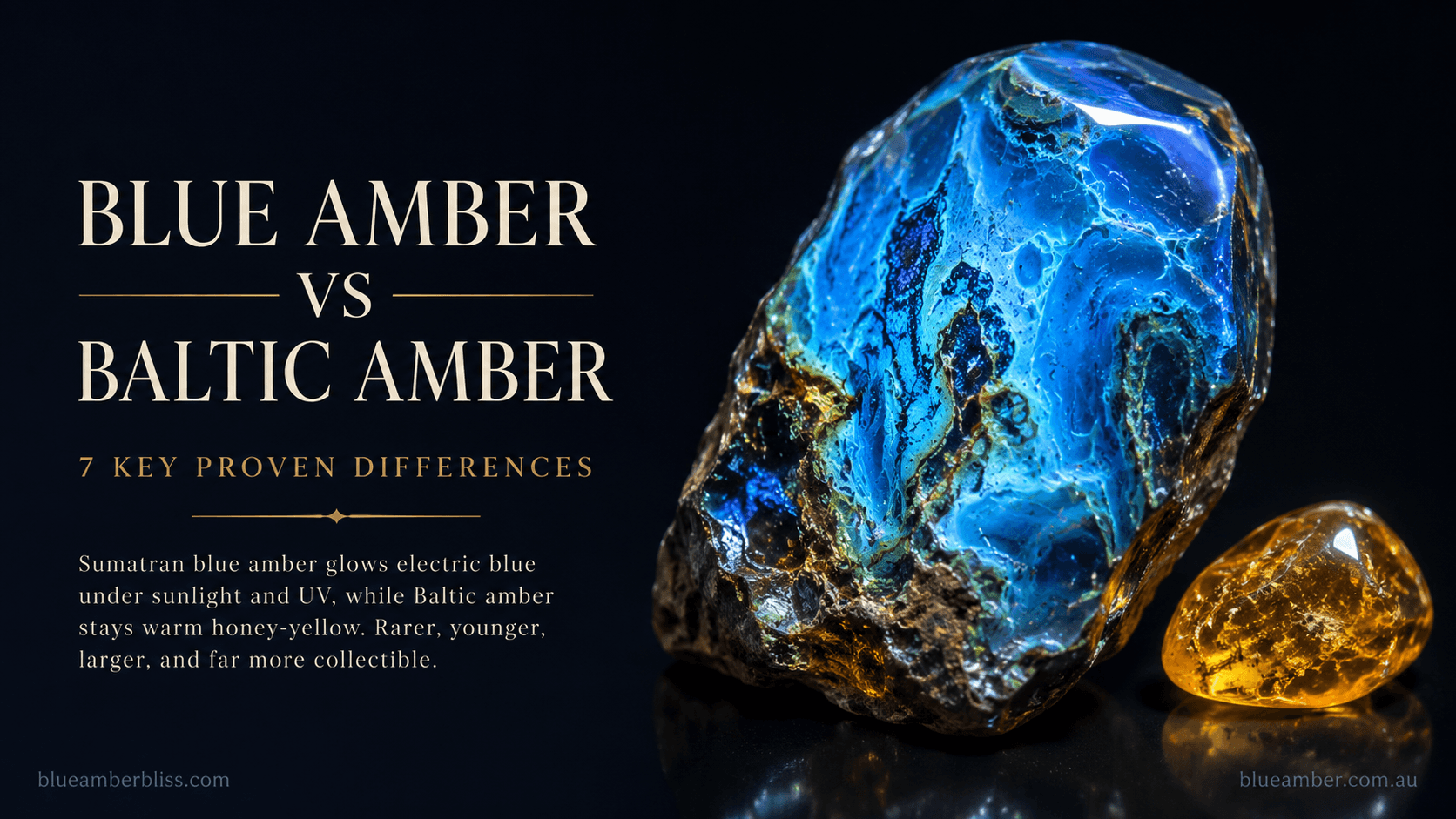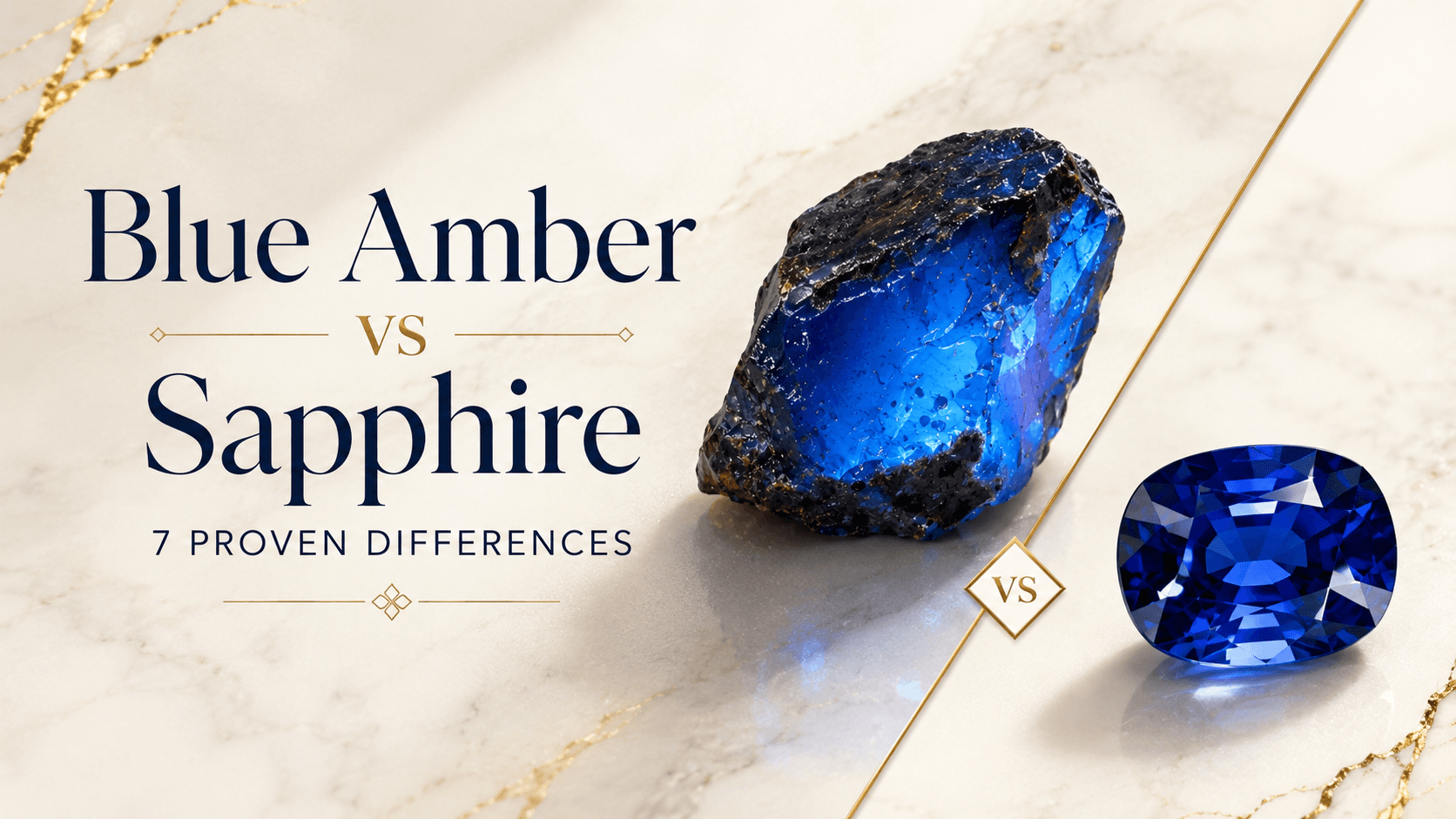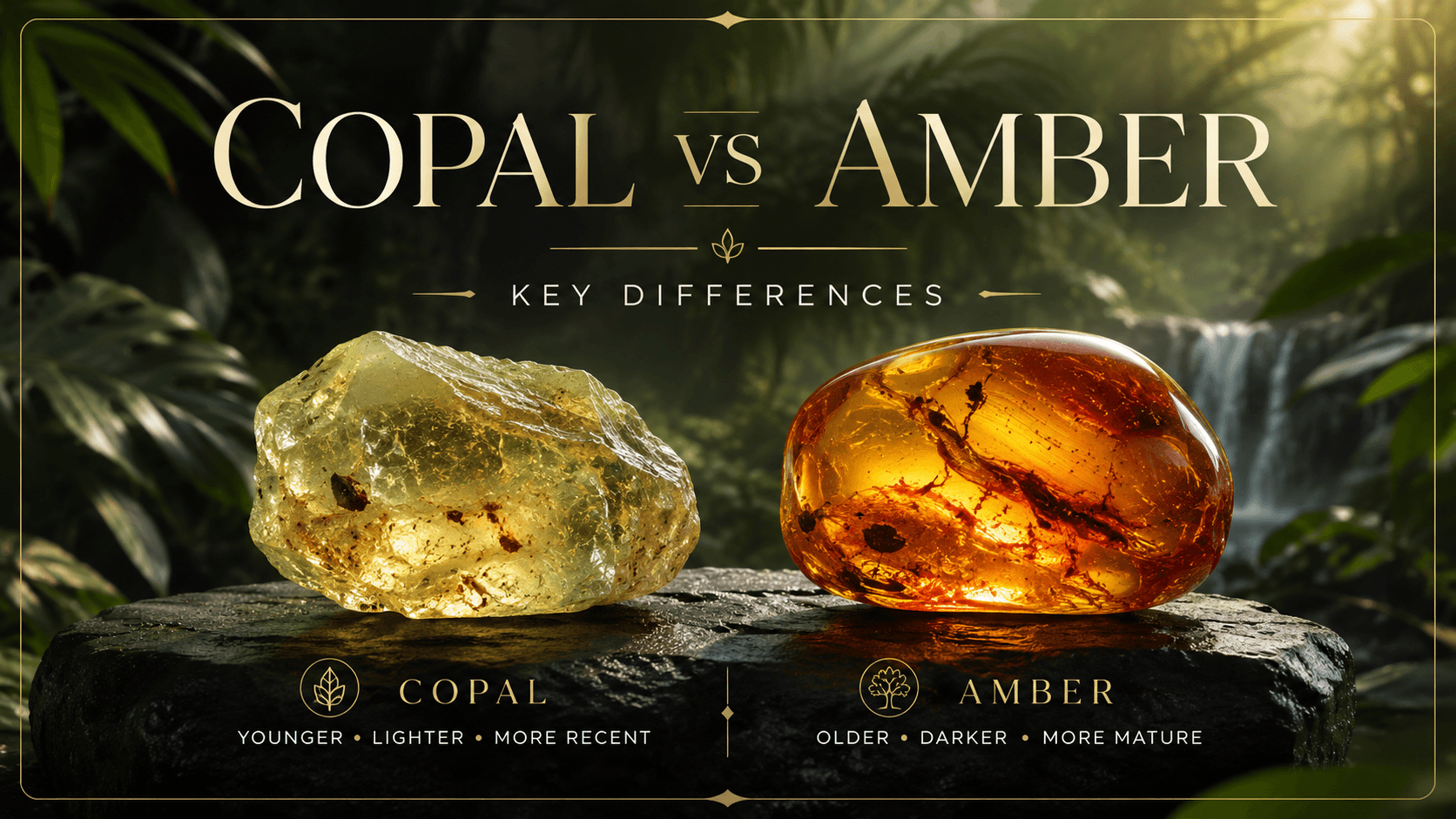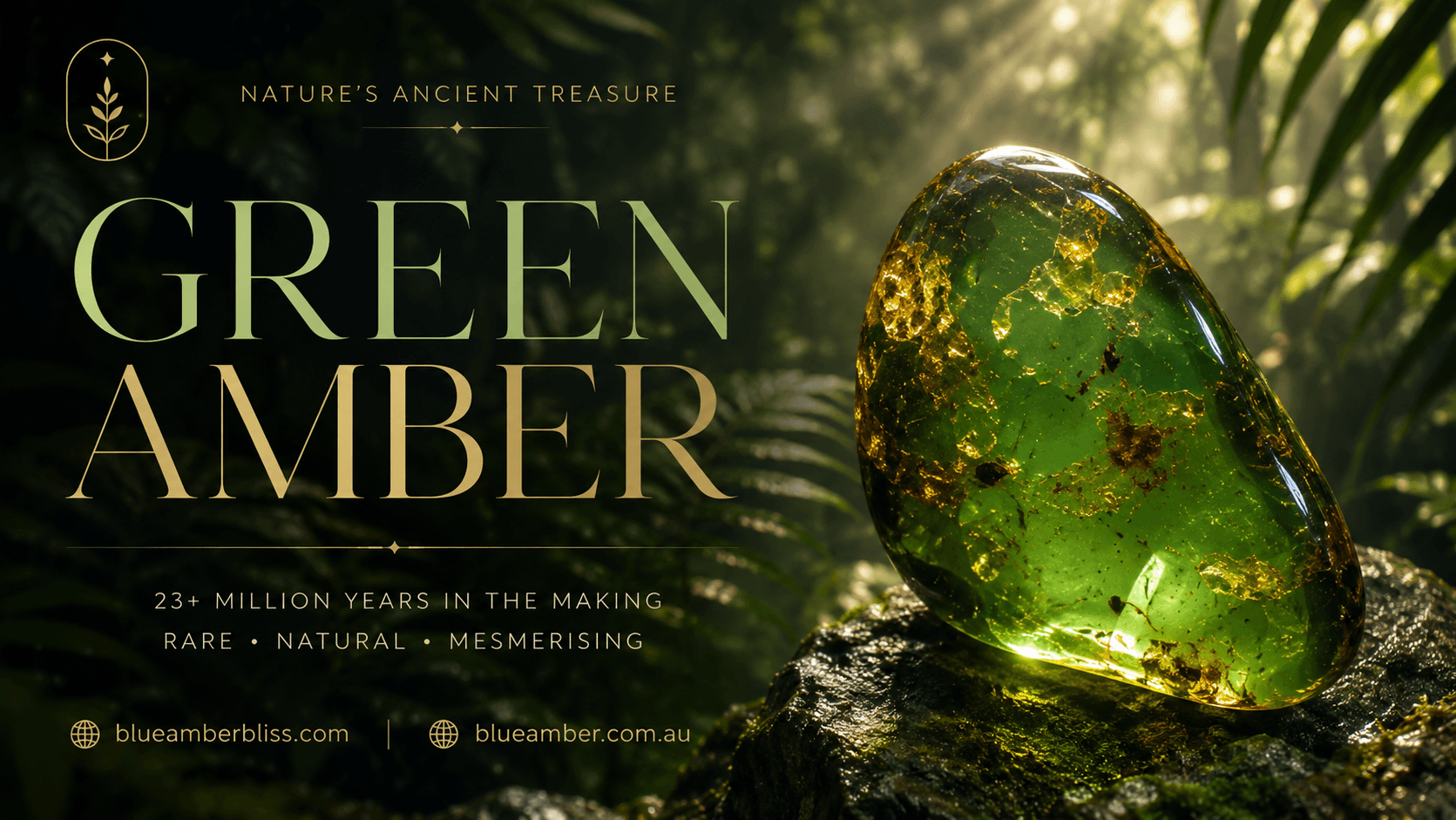
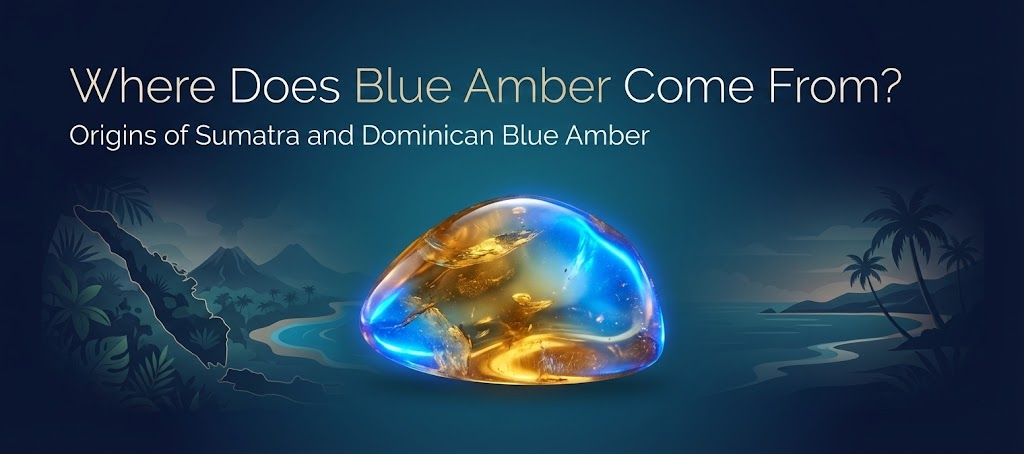
When people first discover this glowing gemstone, the next question after “What is blue amber?” is almost always: where does blue amber come from? The short answer is that blue amber comes from just two commercially significant places on Earth — Sumatra in Indonesia and the Dominican Republic — where ancient tropical tree resin fossilised over tens of millions of years.
The Sumatran material is the newer, larger-nodule, more valuable standout, prized for its dramatic daylight-blue glow, which is why we specialise in it at Blue Amber Bliss. This article maps the exact formations, mines and source trees behind each origin, and shows you how to verify provenance with objective tests rather than guesswork.
Key Takeaways
- Two real sources: Sumatra (Indonesia) and the Dominican Republic produce essentially all jewellery-grade blue amber.
- Sumatra: the Sinamar Formation in Jambi Province / the South Sumatra Basin, in the Bukit Barisan foothills; millions of years in the making (Miocene).
- Dominican Republic: the La Cumbre, La Toca and Palo Quemado mines in the Cordillera Septentrional near Santiago; millions of years in the making (Oligocene–Miocene).
- Different trees: Sumatran resin came from Dipterocarpaceae (most likely Shorea); Dominican from the extinct Hymenaea protera.
- The blue is fluorescence, not body colour — verifiable, which makes origin testable.
Quick Answer: Where Does Blue Amber Come From?
Blue amber comes primarily from two regions:
-
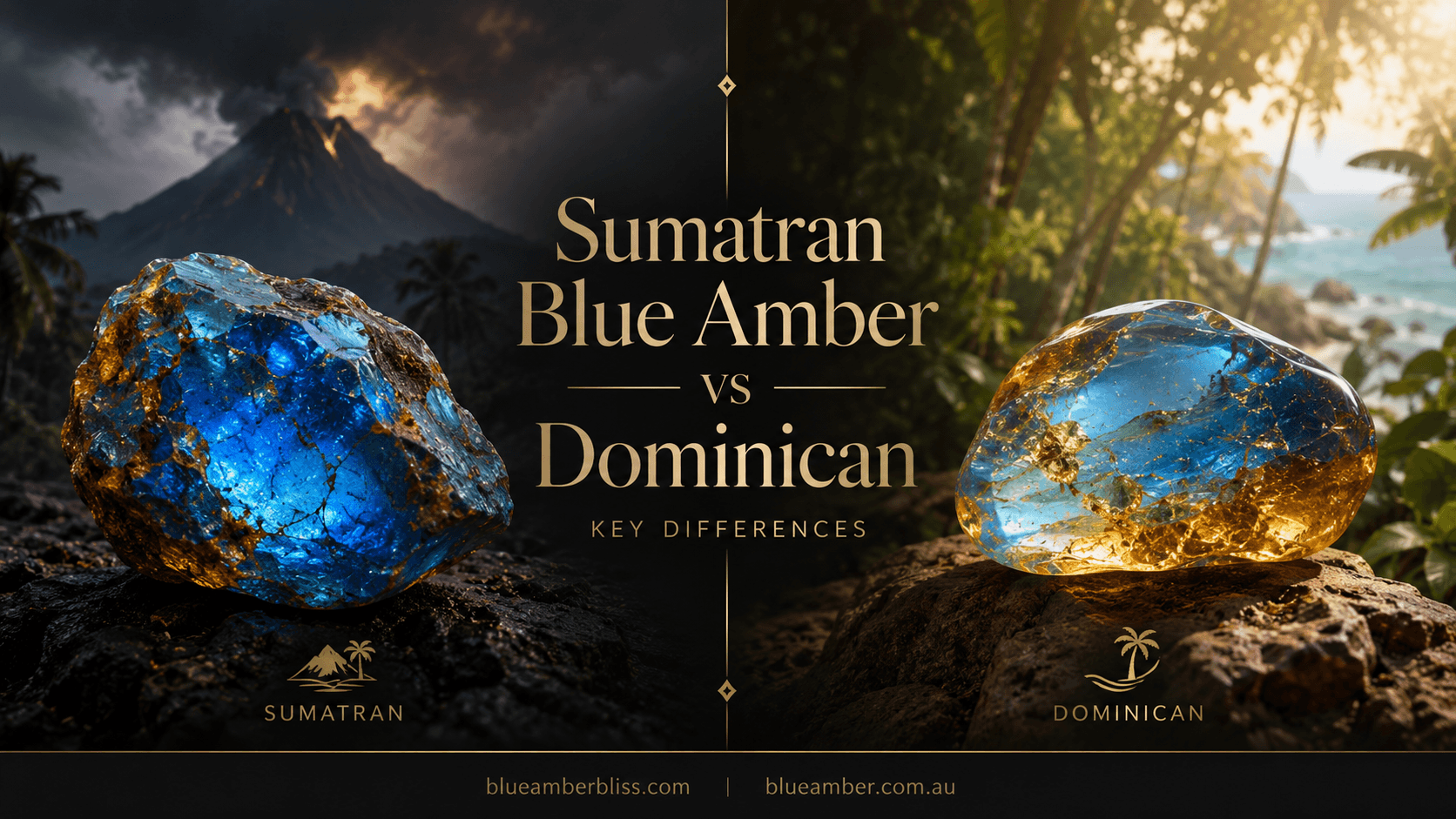
Sumatra, Indonesia – deep honey-to-cola body colour, the strongest, most even neon blue/blue-green glow, and the largest, cleanest nodules. This is the modern AAA+ benchmark.
-
Dominican Republic – the historically famous source, with often lighter body colour and a softer-to-medium glow.
Faint blue fluorescence is occasionally reported in other resins and younger copal, but in practice almost every strong-glow piece you see in jewellery and collections comes from these two regions. The two are equal in fundamental quality — both are retinite-class fossil resins — but Sumatran material is the bigger-nodule, more valuable standout for dramatic daylight blue. You can see the visual difference for yourself in our Sumatra blue amber collection.
How Blue Amber Formed in Ancient Tropical Forests
Long before there was an “Indonesia” or a “Caribbean” on the map, vast tropical forests were dripping resin. The broad sequence was the same in both regions, but the trees and timing differed.
-
Resin flowed from ancient trees. In Sumatra the source was the Dipterocarpaceae family — most likely Shorea, a tropical hardwood whose terpenoid resin protected wounds from insects and fungi. In the Dominican Republic it was Hymenaea protera, an extinct leguminous algarrobo tree. Different chemistry, same defensive purpose.
-
Resin trapped fragments of life. As it dripped it captured bubbles, plant matter and the occasional insect — the famous inclusions that make some amber scientifically priceless.
-
Burial and protection. Sediment buried the resin, sealing it from oxygen and decay. In Sumatra it was preserved within coal-bearing sediments of the Sinamar Formation.
-
Amberization. Over millions of years (Sumatran Miocene; Dominican Oligocene–Miocene, millions of years), the labdanoid/terpenoid resin polymerised into mature amber. Both are retinite-class resins with little or no succinic acid — chemically distinct from Baltic succinite.
For the full chemistry of why that maturation matters — and how perylene and other polycyclic aromatic hydrocarbons (PAHs) became locked inside — see our deep dive on how blue amber formed.
What “Amberization” Actually Changes
Fresh resin is a soft, soluble mixture of volatile terpenes. Over millions of years of heat and pressure, those molecules cross-link and polymerise, the volatiles escape, and the mass hardens into an amorphous (non-crystalline) solid. This maturation is the dividing line between true amber and copal, a younger resin that has not finished the journey. It also concentrates the trace aromatic compounds — including perylene — responsible for the blue. So in a chemical sense the origin is a very specific, very slow transformation that only certain deposits ever completed.
Why It Glows: The Origin of the Blue
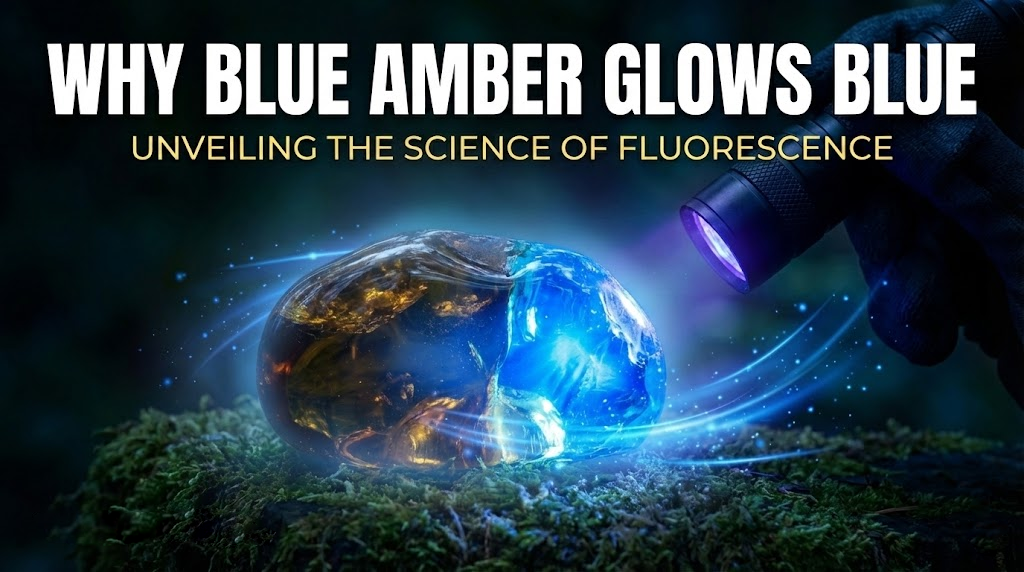
The single most important fact about provenance is that the blue is not body colour. Hold a piece in warm indoor light and it reads honey, cognac or cola brown. The blue appears only when short-wavelength light hits it, because trace perylene and related PAHs absorb UV and violet light and re-emit it as visible blue — this is fluorescence, not pigment. A surface Rayleigh/Tyndall scattering of short wavelengths adds to the effect.
Because it is fluorescence, the glow stops the instant the exciting light is removed — blue amber is fluorescent, never phosphorescent. GIA Gems & Gemology (Winter 2020) measured Dominican blue amber emitting near 450, 474 and 508 nm (see GIA’s amber resource). This matters for origin because the glow itself is a measurable, repeatable signal you can compare under controlled UV. For the full mechanism, see why blue amber glows blue.
Two optical effects stack to create the look. Fluorescence dominates: perylene-type PAHs convert invisible UV into the vivid blue you see. Surface scattering (the Rayleigh/Tyndall effect) preferentially bounces back short blue wavelengths, adding a haze of blue across the polished face. The richer the body colour and the more even the trace-PAH distribution, the cleaner and more uniform the glow — which is precisely where the best Sumatran nodules excel.
Sumatra Blue Amber (Indonesia)
For modern collectors, carvers and jewellery lovers, Sumatra blue amber has become the gold standard.
Geological Setting: The Sinamar Formation
Sumatran blue amber is mined from the Sinamar Formation in Jambi Province, within the broader South Sumatra Basin along the Bukit Barisan foothills. The amber occurs in coal-bearing sediments, recovered alongside lignite during open-cut and artisanal coal extraction. The region’s tectonic setting — a fore-arc basin shaped by the subduction that built the Bukit Barisan range — created exactly the burial-heat history that matured Miocene Dipterocarp resin into fluorescent amber (mindat.org). Note that, contrary to some listings, this material is not from Aceh; the productive deposits sit in the Jambi / South Sumatra basin.
Why Coal-Bearing Sediments Matter
The link to coal is not a coincidence. The same swampy, oxygen-poor lowland forests that buried vast plant matter to form lignite also entombed the resin nodules that became amber. That burial chemistry — rapid sealing from oxygen, steady low-grade heat — is ideal for amberization. It explains why Sumatran rough so often emerges large and clean: the nodules sat protected in fine sediment rather than being battered through long river transport. This geological story is a big part of the real answer to where does blue amber come from, because the setting itself selects for quality.
Visual Characteristics
-
Deep honey, cognac or cola-brown body in normal indoor light.
-
Powerful, even neon blue or blue-green glow in sunlight and under 365 nm UV.
-
A dramatic “daylight blue” — strong Sumatran material glows in plain sunlight, because daylight carries enough UV to trigger it.
-
Often large, clean nodules suitable for cabochons and detailed carvings.
Sumatran deposits yield the larger, cleaner nodules and the most even glow — the standout AAA+ material. When we select stones for our collection, we look for this “two-worlds” effect: embers by candlelight, a piece of night sky in daylight.
Dominican Blue Amber
Before Sumatra became widely known, blue amber meant the Dominican Republic.
Geological Setting: The Mines Near Santiago
Dominican blue amber is mined in the Cordillera Septentrional, the mountain range north of Santiago. The classic workings are the La Cumbre, La Toca and Palo Quemado mines — narrow, hand-dug bell-pit tunnels following amber-bearing seams in marine and deltaic sandstones. The resin came from Hymenaea protera and dates to the Oligocene–Miocene, millions of years in the making (mindat.org).
Visual Characteristics
-
Lighter body colour, yellow to bright honey.
-
A blue glow that ranges from subtle to medium-strong.
-
A relatively high proportion of pieces with insect and plant inclusions alongside blue fluorescence — the material that made Dominican amber scientifically famous.
It remains prized and historically important. In quality terms the two origins are equals; in modern visual drama — especially for the strongest, most even daylight glow — top Sumatran material is the more valuable standout. For a side-by-side breakdown, see Sumatran vs Dominican blue amber compared.
Sumatra vs Dominican: Origin at a Glance
The table below summarises the two answers to where does blue amber come from, with the canonical facts that distinguish them.
| Feature | Sumatra (Indonesia) | Dominican Republic |
|---|---|---|
| Deposit / formation | Sinamar Formation, Jambi / South Sumatra Basin | La Cumbre, La Toca, Palo Quemado mines |
| Geological region | Bukit Barisan foothills | Cordillera Septentrional, near Santiago |
| Age | Miocene, millions of years | Oligocene–Miocene, millions of years |
| Source tree | Dipterocarpaceae (likely Shorea) | Hymenaea protera (extinct algarrobo) |
| Resin class | Retinite (low/no succinic acid) | Retinite (low/no succinic acid) |
| Body colour | Deep honey, cognac, cola brown | Lighter yellow to bright honey |
| Glow | Strong, even, dramatic daylight blue | Subtle to medium-strong, often UV-dependent |
| Typical nodule size | Larger, cleaner | Smaller, often inclusion-rich |
How Blue Amber Is Mined and Sourced Ethically
Both origins are worked largely by hand. Sumatran amber is a by-product of coal extraction in Jambi; Dominican amber comes from small bell-pit tunnels near Santiago. Because these are artisanal operations, traceability and fair, conflict-free sourcing matter. We cover the practical realities of extraction in how blue amber is mined, and our approach to ethical, conflict-free blue amber sourcing in a dedicated guide.
Hand mining shapes what reaches the market in two ways. First, supply is irregular: nodules emerge in small lots tied to whatever coal seam or bell pit is being worked that season, so strong-glow material cannot simply be scaled up on demand. Second, the rough is sorted by eye on site, which means provenance is only as reliable as the chain of hands behind it. That is why a specialist who works directly with named Sumatran sources can vouch for origin in a way an anonymous reseller cannot.
Other Reported Occurrences of Blue-Fluorescent Amber
Faint blue or bluish-green fluorescence is occasionally reported in amber and younger resins from other localities. In practice:
-
Most are subtle effects, not the bold even glow of true blue amber.
-
Some are copal — younger resin that has not fully amberized (it turns tacky in an acetone test within 20–60 seconds; mature amber resists).
-
Others are isolated finds, not large, consistent deposits.
When you see a strong blue amber piece, it almost certainly comes from Sumatra or the Dominican Republic, with Sumatra dominating the market for visually striking material.
Why Origin Matters: Look, Feel and Value
Appearance
-
Sumatra: deeper body colours, higher contrast, a more electric and even neon-blue glow that fires in daylight.
-
Dominican: generally lighter body colours, often a softer or more diffused blue.
Availability
Sumatran deposits have brought a wave of larger, cleaner material to market, but high-even-glow nodules are still carefully sorted and limited. Dominican top pieces are largely already in collections. For how scarcity drives price, see how rare blue amber really is.
Value
As a rough guide, low-glow or rough material runs about $3–15 per gram; polished pieces with good blue glow $15–60 per gram; high-grade AAA with strong even glow $60–200 per gram; and top AAA+ collector pieces — large, clean, intense daylight glow — $200–500+ per gram. Jewellery is priced per piece, with large flawless strong-glow Sumatran pieces commanding the premium. For full pricing logic, see our blue amber price guide.
Grading by Glow
Dealers sort blue amber into AA, AAA and AAA+ tiers based on glow intensity and evenness, clarity, body colour and size. Origin feeds directly into grade: because Sumatran deposits yield the largest, cleanest nodules with the most even daylight blue, the bulk of genuine AAA+ collector material is Sumatran. That is the commercial reason origin and quality are so tightly linked at the top of the market, where the finest Sumatran rough is funnelled toward carvers and collectors rather than mass jewellery.
How to Verify Where Your Blue Amber Comes From
Origin should be evidenced, not merely asserted. These are the objective checks a gemologist actually uses on the bench.
Compare the UV-Glow Profile
Examine the stone under a 365 nm long-wave UV torch — the standard test wavelength, which gives the strongest, truest blue. Cheap 395 nm “UV” torches are partly visible violet and wash the colour out, so they are unreliable for comparison. Strong Sumatran material also shows the signature daylight blue in plain sunlight, a useful first discriminator: pronounced, even daylight glow leans Sumatran; a softer, UV-dependent glow on a lighter body leans Dominican.
Confirm It Is Amber at All
Before origin, confirm authenticity. The saltwater float test works because amber’s specific gravity (~1.05–1.10) lets it float in saturated brine (SG ~1.15–1.16) while most plastics and glass sink. Real amber is warm to the touch, never cold like glass, and has a refractive index near 1.54. These and the acetone, hot-needle and FTIR checks are covered in full in how to tell if blue amber is real.
Mind the Mohs Hardness
Amber is soft — just 2–2.5 on the Mohs scale — so it scratches easily and benefits from protective settings. This softness is also a quiet authenticity clue: glass and many hard plastics resist scratching very differently. It does not pin down origin on its own, but combined with the saltwater float and the UV-glow profile it builds a consistent picture before you ever reach for lab gear.
Get Lab Documentation for Definitive Proof
For high-value stones, a GIA or IGI report with FTIR spectroscopy is the definitive route. FTIR distinguishes mature amber from copal and separates retinite (Sumatran/Dominican) from Baltic succinite, and its spectral fingerprint, read alongside the documented emission peaks, supports an origin opinion far better than any seller’s word. At Blue Amber Bliss we identify Sumatra blue amber explicitly because we curate from those deposits, so you are never guessing.
Why Blue Amber Bliss Focuses on Sumatra Blue Amber
We deliberately specialise in Sumatra blue amber from Indonesia because:
-
It offers the strongest, most even daylight blue glow in the market.
-
Its rich warm body colour makes each piece compelling in any light.
-
The Sinamar deposits yield nodules large and clean enough for ambitious carvings and statement jewellery.
We work directly with suppliers and carvers to hand-select rough and polished pieces, confirm a genuine natural glow, and present blue amber in a way that honours both its beauty and its ancient origin. If you are ready to buy, our guide to where to buy blue amber walks through what to check first.
What We Notice When Comparing Sumatran and Dominican Blue Amber
Handling stones from both origins side by side, what stands out to us at Blue Amber Bliss is how much the Sumatran material carries its provenance in the body itself: a deep cognac-to-near-black tone in daylight that flips to a vivid blue glow the moment UV or bright indoor light hits it, with a contrast far more dramatic than the lighter Dominican greens we’ve examined. We also find Sumatran nodules tend to come in larger, cleaner pieces with characterful natural inclusions and flow lines, which gives each specimen a distinct collector presence. Every piece we keep is resin that has been millions of years in the making, and we select for that daylight-to-glow shift first, because it is the clearest fingerprint of genuine Sumatran origin.
If you’d like to see that shift for yourself, you’re welcome to explore our hand-selected Sumatran blue amber whenever you’re ready. Shop hand-selected Sumatran blue amber →
FAQ: Where Does Blue Amber Come From?
Where does blue amber come from?
Blue amber comes from two commercially significant sources: Sumatra in Indonesia (the Sinamar Formation in Jambi Province / the South Sumatra Basin) and the Dominican Republic (the La Cumbre, La Toca and Palo Quemado mines near Santiago). Sumatran material is Miocene, millions of years in the making, from Dipterocarpaceae resin; Dominican is Oligocene–Miocene, millions of years in the making, from Hymenaea protera.
Which country has the best blue amber?
Both Indonesia and the Dominican Republic produce blue amber, and the two are equal in fundamental quality. Many modern collectors consider Sumatra blue amber the most visually impressive because it shows a stronger, more even neon-blue glow, a dramatic daylight blue and richer body colour, plus larger, cleaner nodules — which is why we focus on Sumatran stones.
Where exactly is blue amber mined?
Sumatran blue amber comes from the Sinamar Formation in Jambi Province / the South Sumatra Basin, recovered from coal-bearing sediments in the Bukit Barisan foothills. Dominican blue amber comes from the La Cumbre, La Toca and Palo Quemado mines in the Cordillera Septentrional near Santiago.
How old is blue amber, and what tree did it come from?
Sumatran blue amber is Miocene, about millions of years in the making, from Dipterocarpaceae resin (most likely Shorea). Dominican blue amber is Oligocene–Miocene, roughly millions of years in the making, from the extinct Hymenaea protera.
How do I know where my blue amber piece comes from?
Compare its glow under a 365 nm UV torch and in daylight, confirm it is genuine amber with the saltwater float and warmth checks, and for valuable stones obtain a GIA or IGI report with FTIR spectroscopy. Body colour and glow give hints, but lab documentation and the measured emission profile are what definitively support an origin opinion.
Explore the Complete Blue Amber Guide
- Sumatran vs Dominican blue amber compared
- ethical, conflict-free blue amber sourcing
- how blue amber formed
- how blue amber is mined