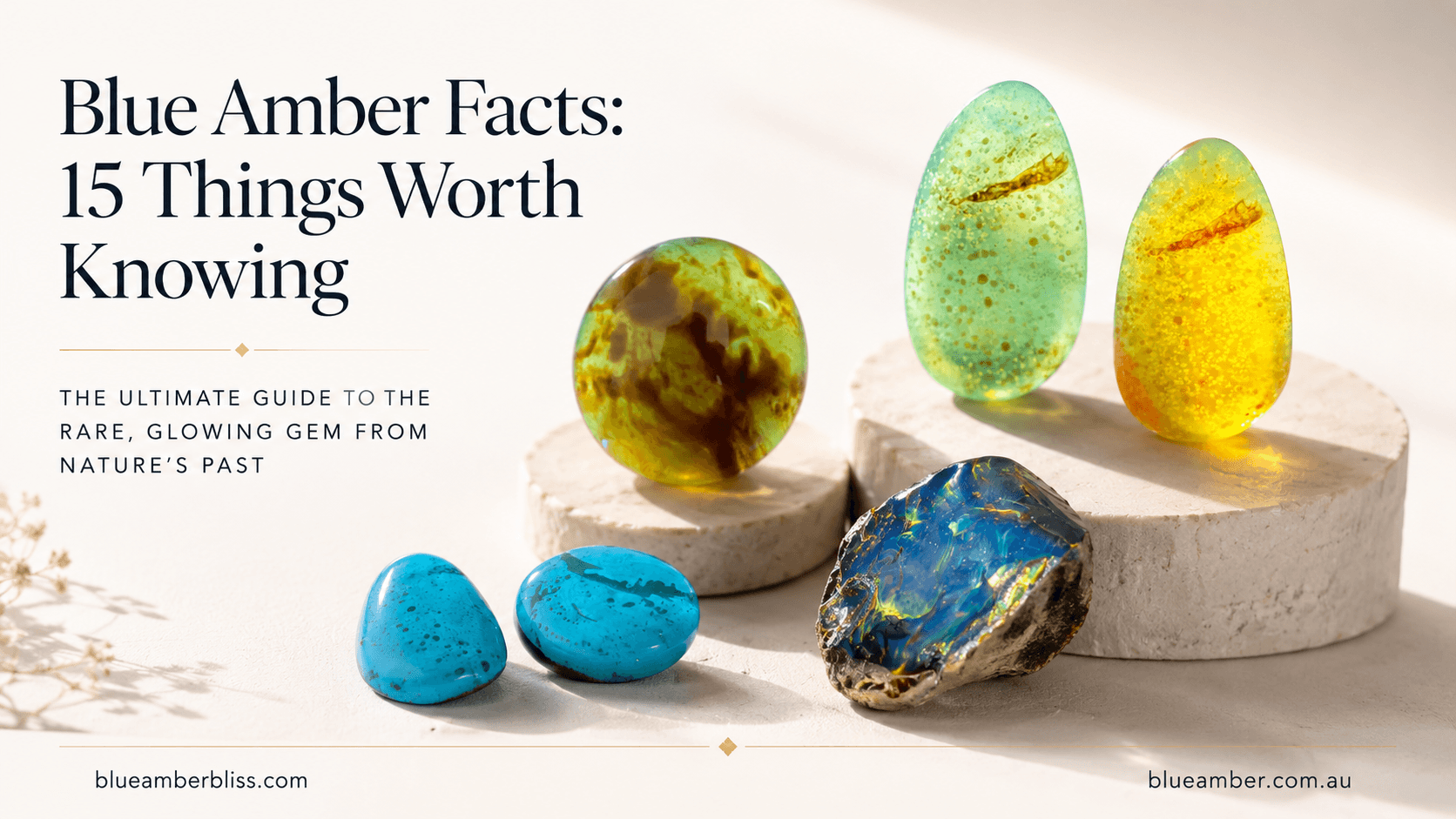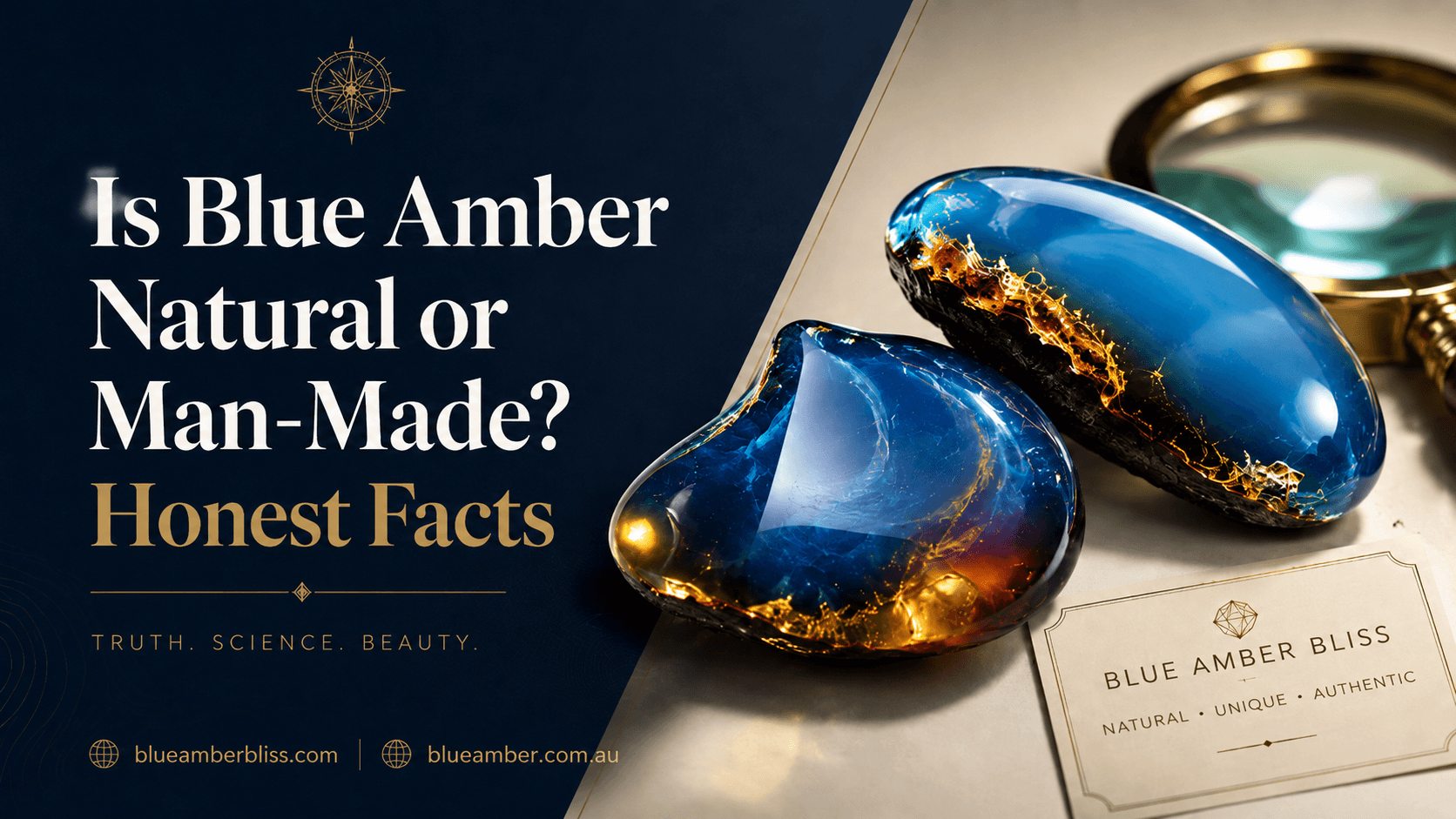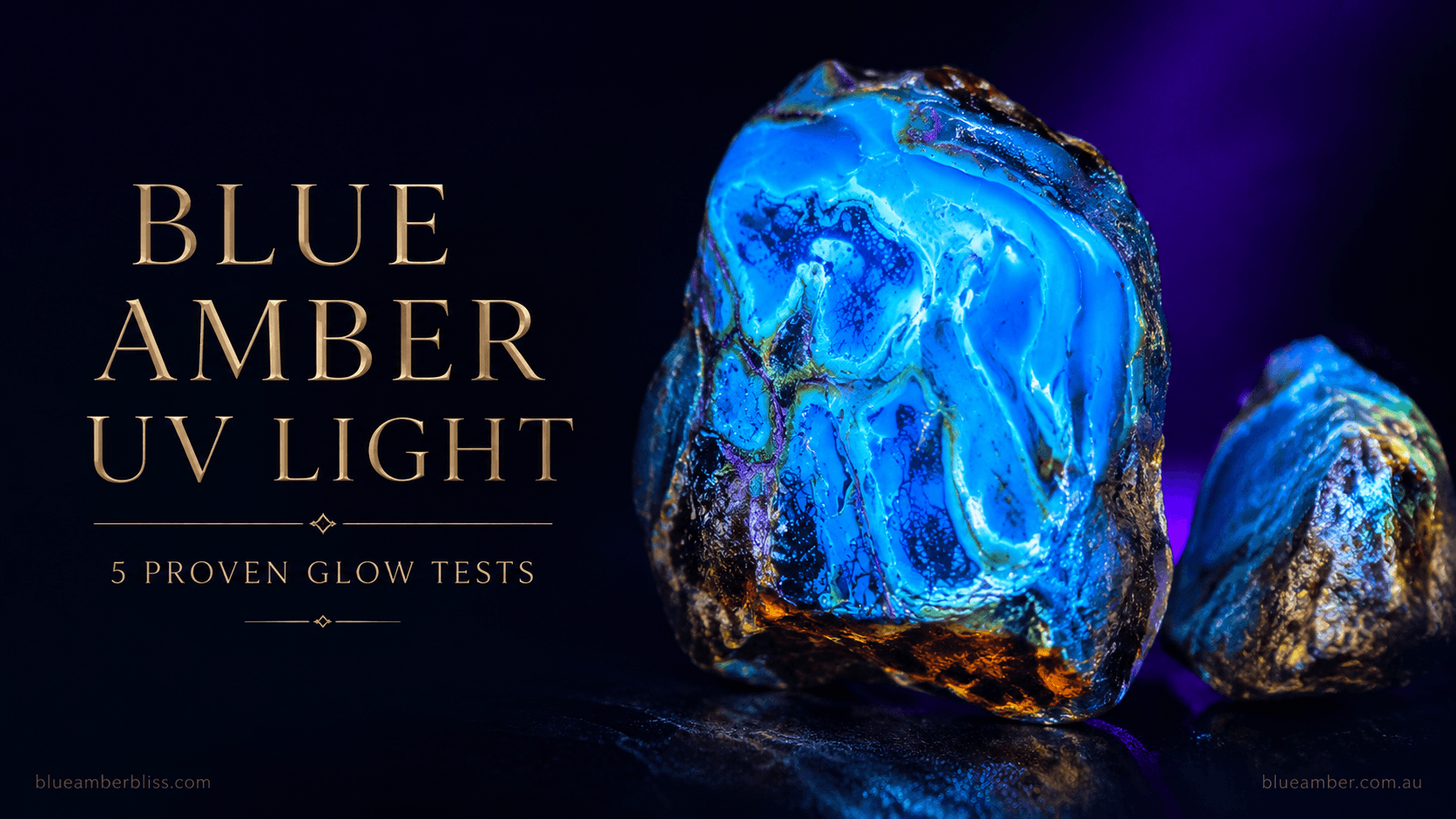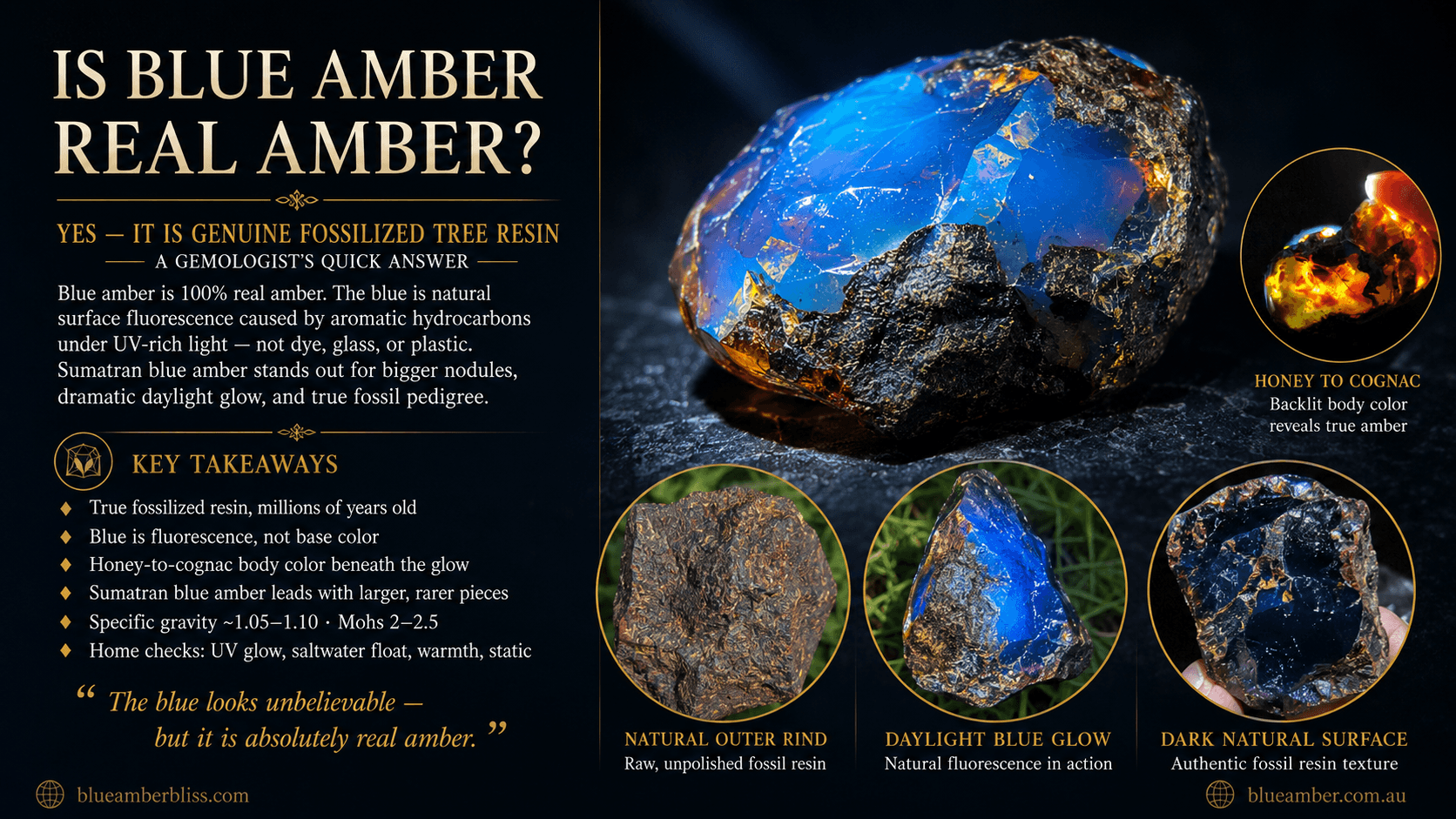

Blue amber is a rare variety of amber – fossilised tree resin ancient natural resin – that looks honey-gold or brown in ordinary light but shows a vivid blue or blue-green glow in sunlight and under UV. It is genuine amber, not glass or dyed plastic, and the blue is fluorescence: trace molecules called perylene and related polycyclic aromatic hydrocarbons (PAHs) absorb ultraviolet light and re-emit it as blue.
This page is the pillar guide to the gemstone. Below you will find what blue amber is scientifically and symbolically, where it comes from (jump to provenance), how to tell a real piece from a fake (jump to the test battery), and why Sumatran blue amber is the standout material we specialise in at Blue Amber Bliss. Each section links down to a dedicated deep-dive so you can go as far as you like.
Key Takeaways
- What it is: a fluorescent, retinite-class fossil resin – real amber, organic in origin, around Mohs 2-2.5 in hardness.
- Why it glows: perylene and other PAHs fluoresce blue under UV; surface light-scattering adds to the effect. It is fluorescent, not phosphorescent – the glow stops the instant the light is removed.
- Age and source: Sumatran material is Miocene, millions of years in the making, from a Dipterocarpaceae (likely Shorea) tree; Dominican is Oligocene-Miocene, millions of years in the making, from the extinct Hymenaea protera.
- Where from: Sumatra’s Sinamar Formation (Jambi Province) and the Dominican mines near Santiago.
- Test it: 365 nm UV glow, the saltwater float test (SG ~1.05-1.10), an acetone copal check, and a lab FTIR report for certainty.
- Hero material: Sumatran blue amber yields larger, cleaner nodules with a dramatic daylight-blue glow – the standout AAA+ grade.
Short Definition: What Is Blue Amber?
When people ask “what is blue amber?”, they are really asking two things at once:
- Is it natural? Yes. It is genuine fossilised tree resin, the same gem family as Baltic amber, just with a rarer optical property. If you want the full forensic answer, see is blue amber real amber.
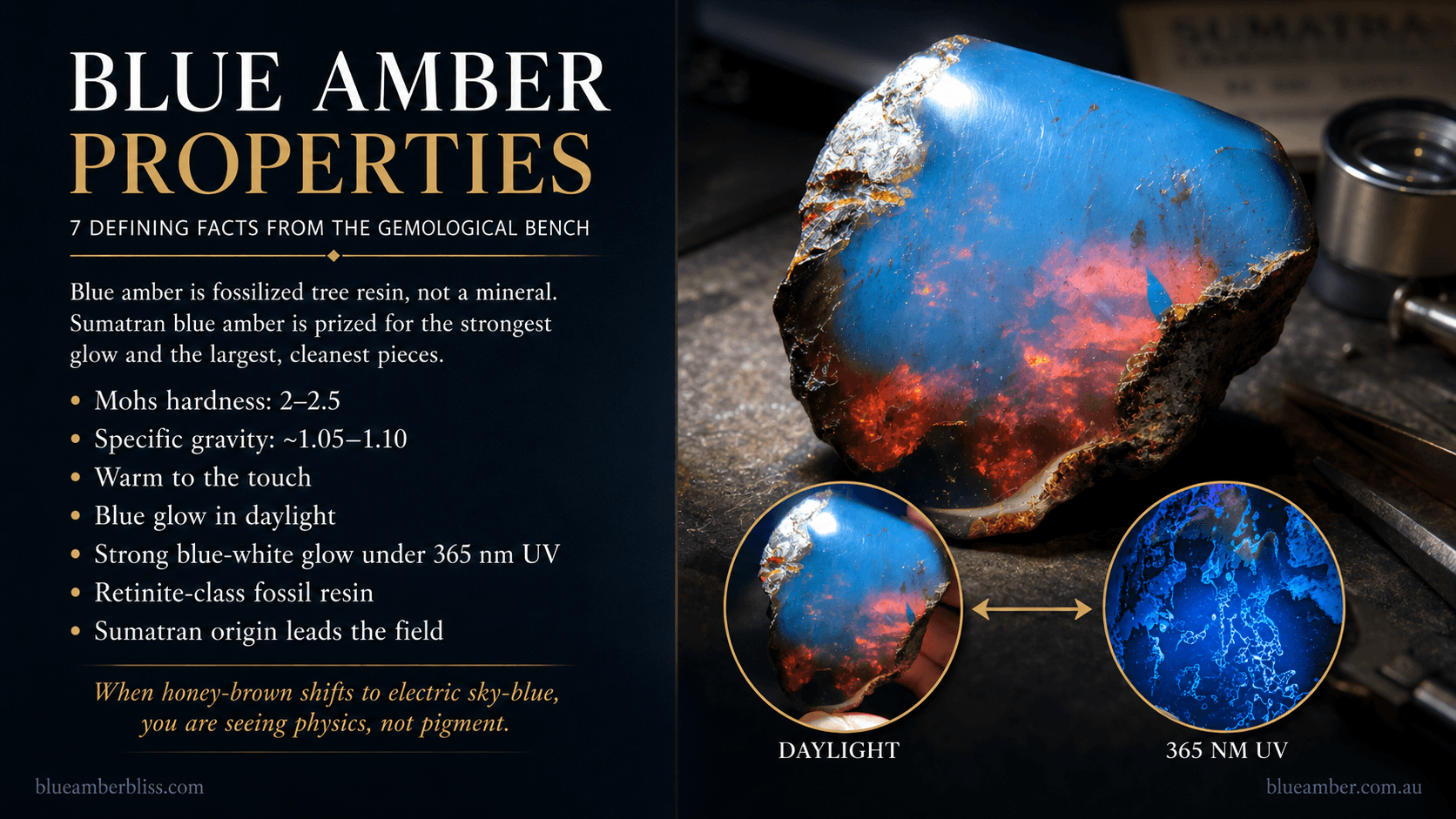
- Why is it blue? Because trace fluorescent molecules inside the resin absorb high-energy light and re-emit part of it as blue. This is fluorescence, not body colour and not dye.
So the cleanest definition is: warm-coloured fossil resin with a natural blue halo that switches on under UV-rich light. It is amorphous (non-crystalline), warm to the touch rather than cold like glass, and light enough to float in saltwater.
What Blue Amber Is Made Of
Chemically, amber is not a single mineral but a complex polymer of cross-linked terpenoid molecules. Gemologists classify it as an organic, amorphous solid with no crystal lattice and no fixed melting point – it softens and chars rather than melting cleanly. Its refractive index sits near 1.54 and its specific gravity falls between roughly 1.05 and 1.10, both useful diagnostic numbers.
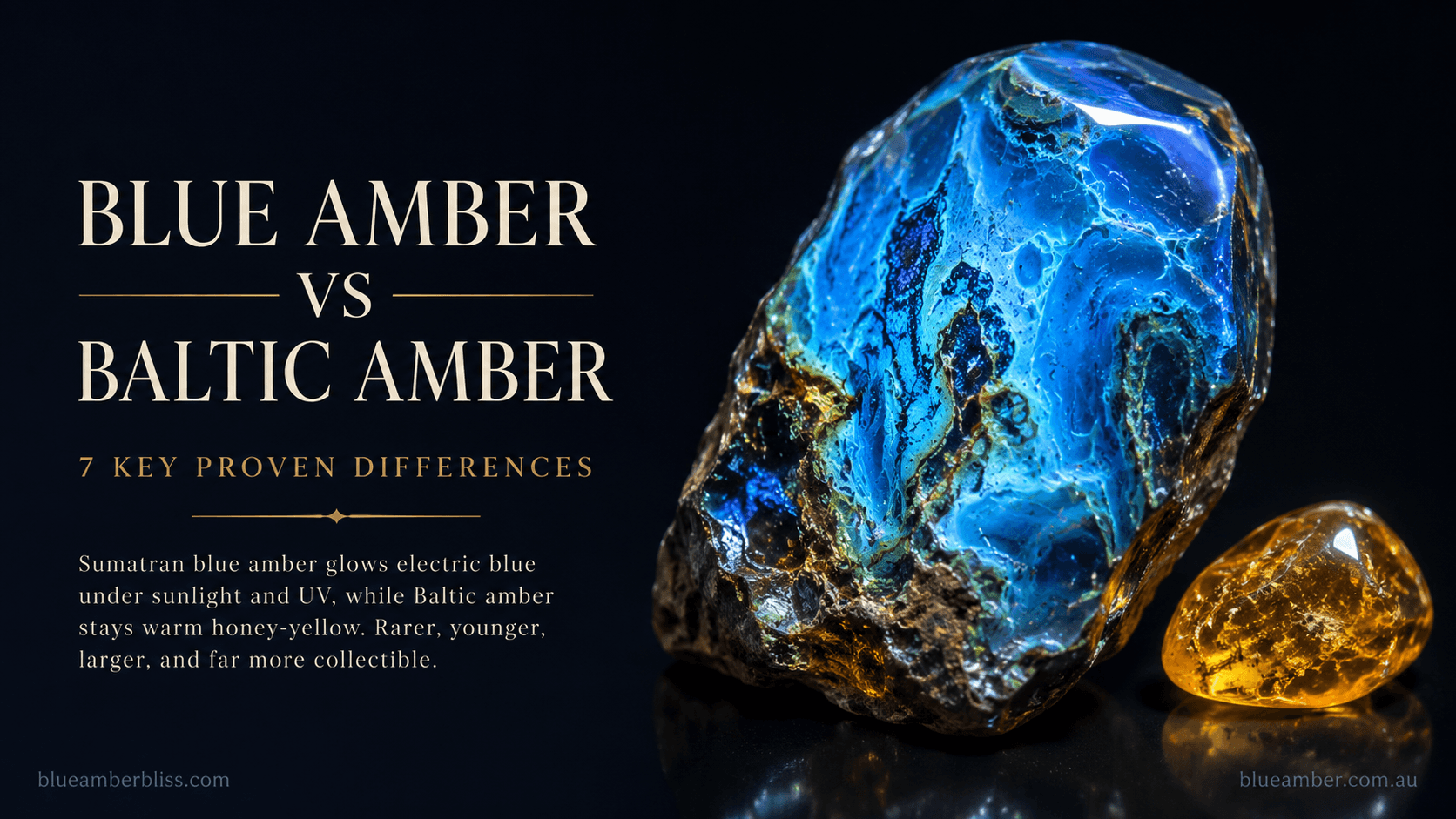
Within amber, two broad chemical classes matter for blue material. Baltic amber is succinite, rich in succinic acid. Sumatran and Dominican blue amber are retinite, low in or free of succinic acid. That single chemical fact separates the two families under lab analysis and explains why blue amber behaves differently in some tests. The fluorescent perylene and PAHs are present only in trace amounts, yet they dominate the gem’s most striking visual property.
How Amber Forms (So Blue Amber Makes Sense)
All amber, blue included, begins as resin and ends as a polymerised solid:
- Ancient trees in warm forests exuded sticky terpenoid resin, often trapping bubbles, bark, pollen and the occasional insect.
- The resin was buried in sediment and sealed from oxygen.
- Over millions of years, heat and pressure drove off volatile components and cross-linked the molecules – amberization, the polymerisation of labdanoid resin into stable amber.
Because it comes from living trees, amber is an organic gemstone like pearl or coral: light in the hand, warm to the touch, and soft at Mohs 2-2.5, which is why it needs protective settings. The fossil cargo of bubbles and debris is itself a study; see fossil inclusions trapped in blue amber.
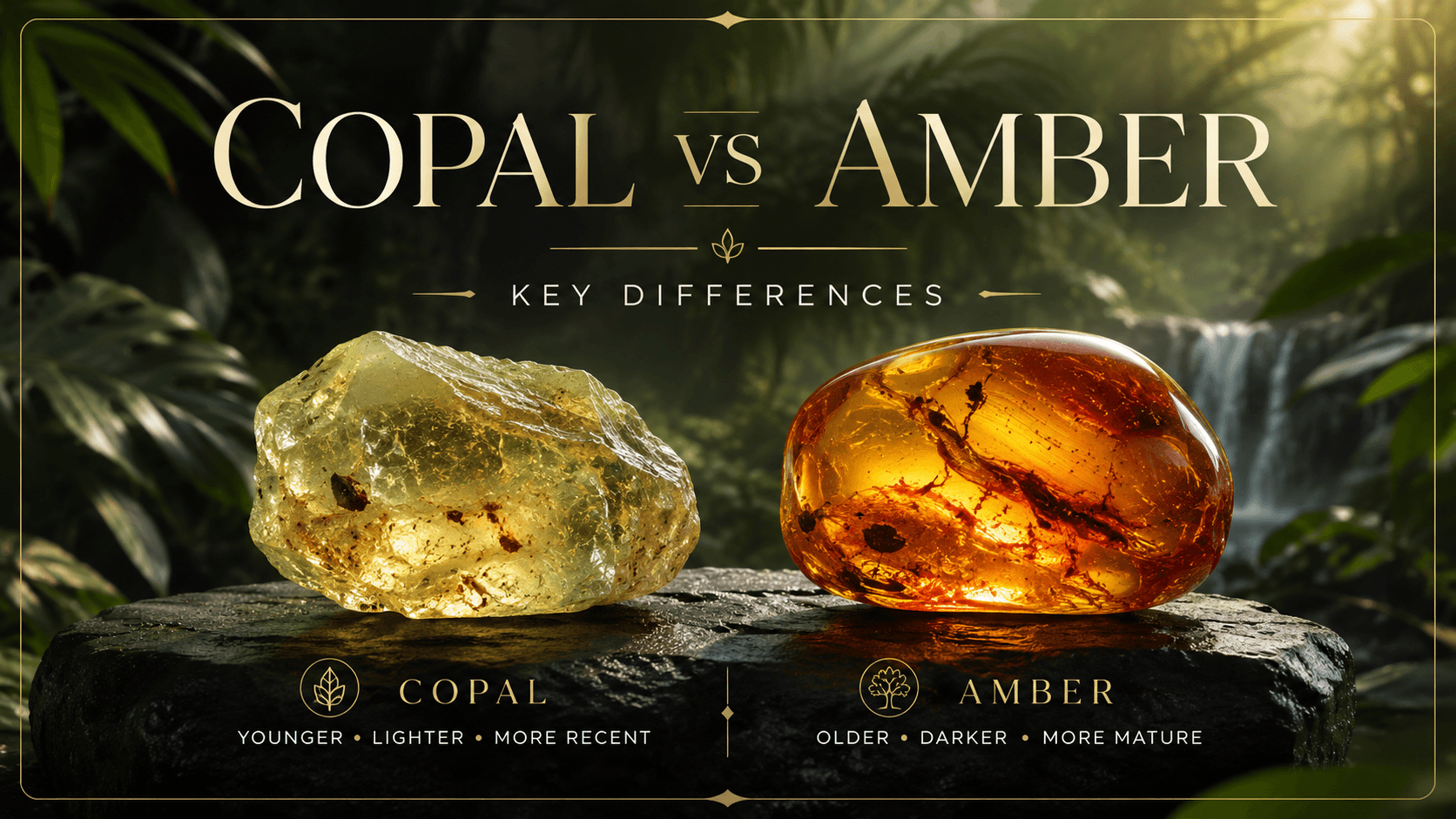
This maturity matters. Resin that has not fully polymerised is called copal – younger, softer and chemically incomplete. True amber has spent millions of years cross-linking, which is why the acetone and hot-needle tests can separate the two. Blue amber follows this same path; what sets it apart is the chemistry of the original resin – specifically the trace aromatic molecules that survive into the finished gem.
Why Blue Amber Glows Blue (the Mechanism)
The “blue” is not a paint, a dye, or a solid body colour like sapphire. It is a two-part optical effect.
Fluorescence first. Dissolved in the resin are perylene and related polycyclic aromatic hydrocarbons (PAHs). These molecules absorb ultraviolet and violet light and re-emit it at longer, visible wavelengths. GIA’s Gems & Gemology (Winter 2020) measured Dominican blue amber emitting near 450, 474 and 508 nm – squarely in the blue. Because it is fluorescence, the glow vanishes the instant the exciting light is removed; blue amber is fluorescent, not phosphorescent.
Scattering second. At the polished surface, short-wavelength light undergoes Rayleigh/Tyndall scattering, much like the physics that makes the sky blue. This is why the blue sits on the surface while the interior, viewed from the side, still reads honey or brown.
This is also why lighting changes everything. Tungsten and warm LED bulbs emit almost no ultraviolet, so indoors the gem reads as plain cognac amber. Step outside, and sunlight carries enough UV to trigger the signature glow – the “daylight blue” that strong Sumatran material shows without any torch at all. Hold the same piece against a dark background and the contrast makes the blue look even more electric.
The full chemistry of the fluorophores is covered in the chemistry behind the blue (perylene & PAHs). For everyday viewing: under warm indoor light it looks like ordinary cognac amber; in daylight or under a 365 nm torch the surface lights up electric blue.
Where Does Blue Amber Come From?
Only a handful of deposits ever produced resin with the right chemistry. The two that matter are Sumatra and the Dominican Republic – geologically distinct, with different source trees and different ages.

Sumatran Blue Amber (Indonesia) – Our Specialty
The most visually dramatic material comes from Sumatra, mined from coal-bearing sediments of the Sinamar Formation in Jambi Province (the South Sumatra Basin, in the Bukit Barisan foothills). It is Miocene, millions of years in the making, and its source tree was a member of the Dipterocarpaceae family – most likely Shorea, a tropical hardwood. Sumatran deposits yield larger, cleaner nodules and a striking daylight blue, which is why this is the standout AAA+ grade and the gem our shop is built around.
Because it is recovered alongside lignite and coal seams, Sumatran rough often arrives dark – a deep cola brown to near-black – that hides its glow until it is cut and polished. That dark body is part of what makes the fluorescent blue read so vividly against it, and it is one reason Sumatran material has become so prized among modern collectors.
Dominican Blue Amber
Blue amber was first widely documented in the Dominican Republic, mined from the La Cumbre, La Toca and Palo Quemado deposits in the Cordillera Septentrional near Santiago (see mindat.org). It is Oligocene-Miocene, millions of years in the making, from the extinct leguminous algarrobo tree Hymenaea protera. Dominican material is genuinely beautiful and often shows softer, lighter tones.
The two are equal in quality, but Sumatran is the newer, bigger-nodule, more-valuable standout for its dramatic daylight glow. For a full side-by-side, read Sumatran vs Dominican blue amber compared, and to see where it sits in the wider gem world, blue amber vs Baltic amber. A deeper geological breakdown lives at where blue amber comes from.
How to Tell If Blue Amber Is Real
Because genuine blue amber is valuable, imitations – dyed resin, plastic, glass and immature copal – are common. Here is the quick test battery; for the full procedure with photos, see how to tell if blue amber is real.
- UV / daylight glow (365 nm). Long-wave 365 nm gives the strongest, truest blue – the standard test wavelength. Cheap “395 nm” torches are partly visible violet and wash the glow out; 254 nm short-wave is harsher and less useful here. Strong Sumatran material even triggers its signature blue in plain sunlight.
- Saltwater float test. Amber’s specific gravity is ~1.05-1.10, so it floats in saturated brine (SG ~1.15-1.16) but sinks in fresh water. Most plastics and glass sink in both.
- Acetone (copal) test. A drop of acetone leaves mature amber unaffected; young copal turns tacky within 20-60 seconds.
- Acid / succinic-acid note. Blue amber is a retinite-class resin, low or free of succinic acid – unlike Baltic succinite. This distinction shows up clearly under lab FTIR.
- Hot-needle (last resort, edge only). Real amber gives a piney, resinous scent, not acrid burnt plastic. It is destructive – use only on an inconspicuous edge.
- Lab report. FTIR spectroscopy and a GIA or IGI report are the definitive ID, separating amber from copal and retinite from succinite.
One quick at-home tell: viewed from the side, real blue amber still shows its honey or brown body colour. A piece that reads flat, opaque blue from every angle is usually dyed resin.
No single test is conclusive on its own, which is why gemologists run several. A dyed plastic might float if weighted, or fluoresce dully under a cheap torch – but it will fail the 365 nm glow, the hot-needle scent and the lab spectrum together. Stack two or three tests and fakes become very hard to hide. For any high-value purchase, an FTIR-backed lab report remains the gold standard.
How Rare and Valuable Is Blue Amber?
Within the amber family, blue is the rarest and most sought-after effect. Only certain trees produced fluorophore-rich resin, those forests grew in limited regions, and even there only a fraction of the amber glows strongly. Large, clean, intense-glow pieces are genuinely scarce.
Quality is graded in AA / AAA / AAA+ tiers by glow intensity and evenness, clarity, body colour and size. As a rough guide, prices run from $3-15/g for rough or low-glow material, $15-60/g for polished good-blue stones, $60-200/g for high-grade AAA, and $200-500+/g for top AAA+ collector pieces; jewellery is priced per finished piece, with large flawless strong-glow Sumatran stones commanding the premium. For the full breakdown see the blue amber price guide and how rare blue amber really is.
What drives a piece toward the top tier is the combination of size and even, strong glow. A small chip may glow brilliantly but carry little value; a large nodule that glows weakly is equally limited. The premium pieces are those that are simultaneously big, clean, and luminous from every angle – a rare alignment that explains why a single fine Sumatran cabochon can outprice gold by weight.
Historical and Metaphysical Meaning of Blue Amber
Beyond the science, many people are drawn to blue amber for its symbolism. Amber has long been a talisman of protection, warmth and the sense of time captured in a single stone. Blue amber adds a cooler layer: the golden body is linked to the Solar Plexus (confidence and willpower), while the blue glow is associated with the Third Eye and Throat chakras (intuition and clear communication). This is symbolic rather than medical. Explore it fully in blue amber meaning and symbolism.
How to Care for Blue Amber
At Mohs 2-2.5, blue amber is soft and deserves gentle care: store each piece separately to avoid scratches; keep it away from perfume, hairspray and solvents; clean only with a soft cloth or lukewarm mild soapy water, never ultrasonic or steam; and avoid hot cars and long, harsh sun. Full routine in how to clean blue amber.
Explore the Collection
If you are ready to choose a stone, start with our blue amber beads, learn the safe sourcing checklist in where to buy blue amber, and if you are curious how other amber colours arise, compare green amber and how it differs.
What We Notice When Selecting Sumatran Blue Amber
At Blue Amber Bliss, what still surprises first-time buyers is how ordinary a piece of Sumatran blue amber can look in the palm and how dramatically it wakes up the moment sunlight or a UV source hits it. We handle each stone under both indoor light and open daylight before it ever reaches a customer, because the real signature of this material is that shift: a deep cognac-to-near-black body that suddenly floods with electric blue. In our experience the Sumatran pieces show the strongest daylight-to-glow contrast of any blue amber we work with, and we look closely at the natural inclusions and clean nodule structure, since those are the details that tell us a specimen is genuine and collector-grade rather than treated.
| Quick fact | Detail |
|---|---|
| What it is | Natural fossilised tree resin – an organic gem |
| Body colour | Cognac to near-black indoors |
| The blue | Fluorescence + light scattering under sunlight / 365 nm UV, not dye |
| Main source | Sumatra, Indonesia (the standout) and the Dominican Republic |
| Hardness | Mohs 2–2.5 (soft; set protectively) |
| Rarity | A tiny fraction of already-rare amber |
| Age | Ancient natural resin, millions of years in the making |
If you would like to see this glow for yourself, we warmly invite you to explore our hand-selected Sumatran blue amber and find a piece with the character that speaks to you. Shop hand-selected Sumatran blue amber →
FAQ: What Is Blue Amber?
What is blue amber in simple terms?
Blue amber is genuine fossilised tree resin – real amber – that looks honey or brown indoors but glows vivid blue in sunlight and under UV. The blue comes from natural fluorescent molecules (perylene and PAHs) inside the resin, not from dye or coating.
Why does blue amber glow blue?
Trace perylene and polycyclic aromatic hydrocarbons absorb ultraviolet light and re-emit it as blue (Dominican material peaks near 450, 474 and 508 nm per GIA, Winter 2020), while surface scattering of short wavelengths adds to it. It is fluorescence, so the glow stops the moment the light is removed.
How old is blue amber and what tree made it?
Sumatran blue amber is Miocene, millions of years in the making, from a Dipterocarpaceae tree (most likely Shorea). Dominican blue amber is Oligocene-Miocene, millions of years in the making, from the extinct leguminous tree Hymenaea protera.
Where does blue amber come from?
Mainly two places: Sumatra, Indonesia (the Sinamar Formation in Jambi Province) and the Dominican Republic (mines near Santiago). Blue Amber Bliss specialises in Sumatran blue amber, prized for its larger nodules and dramatic daylight-blue glow.
How can I tell if blue amber is real?
Check for a true blue glow under a 365 nm UV torch, float it in saturated saltwater (real amber floats; most plastic and glass sink), and test a hidden spot with acetone (copal turns tacky, mature amber resists). For certainty, get an FTIR-based GIA or IGI report.
Why is blue amber so rare and valuable?
Only a few deposits ever produced fluorophore-rich resin, and within them only a fraction glows strongly. Large, clean, intense-glow Sumatran pieces are genuinely scarce, so top AAA+ collector material can reach $200-500+ per gram.
Explore the Complete Blue Amber Guide
- Sumatran vs Dominican blue amber compared
- the chemistry behind the blue (perylene & PAHs)
- fossil inclusions trapped in blue amber
- blue amber vs Baltic amber
- green amber and how it differs
- is blue amber real amber
- the geologic age of blue amber
- blue amber beads