
Blue amber is one of the softest gems you will ever own, and that softness is exactly why so many pieces get damaged by well-meaning owners. People reach for the same cleaners they use on diamonds or silver, and within minutes they have dulled the surface or, worse, started a network of fine cracks. The good news is that proper blue amber care is genuinely simple once you understand what you are working with: a fossilized tree resin millions of years in the making, not a hard mineral.
In this guide I will walk you through a safe, repeatable routine to clean blue amber the right way, explain exactly what damages amber, and show you how to store it so the glow lasts a lifetime. Everything here applies to the Sumatran (Indonesian) blue amber we specialize in, the standout of the blue amber world.
Key Takeaways
- Clean blue amber with only lukewarm water, mild soap, and a soft microfiber cloth, then dry it right away.
- Amber is soft (Mohs hardness 2 to 2.5) and scratches easily, so it needs gentler handling than most gemstones.
- Heat, alcohol, perfume, hairspray, acetone, and ultrasonic cleaners all damage amber and can destroy the surface that produces its blue glow.
- Store blue amber separately in a soft pouch, away from direct sunlight, dry air, and harder jewelry that could scratch it.
- Blue amber can get briefly wet, but prolonged soaking, hot water, and humidity swings cause cracks and surface clouding.
- Apply perfume, lotion, and hairspray before putting on amber jewelry, and remove pieces before showering, swimming, or exercising.
- Sumatran blue amber, prized for its dramatic daylight blue glow and large nodules, deserves the same careful routine you would give any treasured gem.
Why Does Blue Amber Need Special Care?
Most gemstones are minerals forged under extreme heat and pressure, which makes them hard and chemically stable. Blue amber is the opposite. It is an organic gem, a fossilized resin that once flowed from ancient trees in what is now Sumatra and the Dominican Republic. Because it is organic and relatively young in geological terms, it stays soft, light, and chemically reactive, which is precisely why you need to clean blue amber with a feather-light touch.
On the Mohs hardness scale, amber sits at just 2 to 2.5, roughly the same as a fingernail or a piece of gypsum. For comparison, quartz is a 7 and diamond is a 10. That low number tells you everything about why a careful cleaning routine matters: almost anything harder than your nail can leave a mark. According to GIA, amber also has a very low specific gravity of about 1.08, which is why a genuine piece sinks slowly in plain water but floats in saturated saltwater (specific gravity around 1.15 to 1.20). That float behavior is one of the classic at-home authenticity checks.
The blue color itself is not a pigment. It is fluorescence: aromatic hydrocarbon molecules in Sumatran and Dominican amber absorb ultraviolet light (roughly the 365 nm range) and re-emit it as a glowing blue. Sumatran blue amber is especially famous for the way it throws that vivid blue even in ordinary daylight, not just under a UV lamp, and it tends to surface in larger nodules than Dominican material. As a newer source with somewhat better clarity and bigger pieces, Sumatran blue amber is the more valuable, standout choice, while remaining equal to Dominican in quality and value.
That glow lives in the surface and near-surface layers of the stone. Cloud, scratch, or chemically etch that surface and you literally dim the magic, which is why you clean blue amber gently rather than aggressively. If you are still confirming what you own, our explainer on what blue amber actually is covers how that fluorescence works in more depth, and why the material’s softness shapes everything about how you care for it.
How to Clean Blue Amber: The Safe 6-Step Routine
Here is the exact method I use and recommend for every piece, whether it is a polished cabochon, a bead strand, or a raw Sumatran specimen. The whole process takes about three minutes and uses things you already have at home. Follow the steps in order to clean blue amber thoroughly without ever putting the stone at risk.
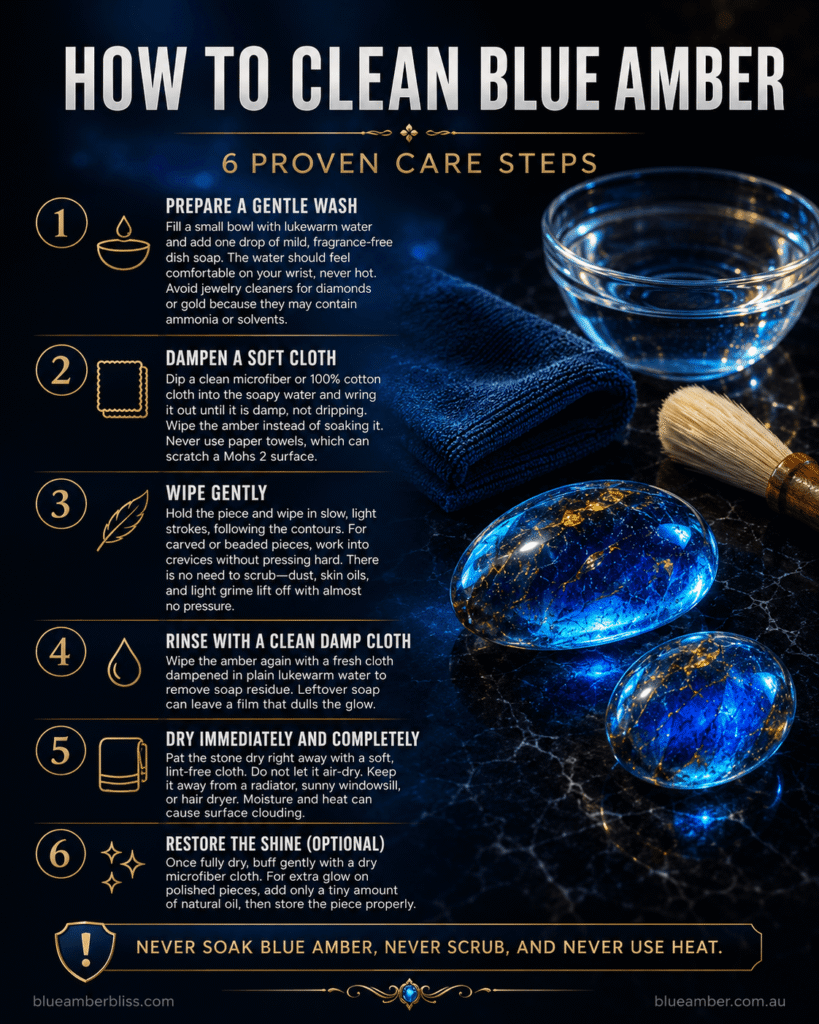
- Prepare a gentle wash. Fill a small bowl with lukewarm water and add a single drop of mild, fragrance-free dish soap. The water should feel comfortable on your wrist, never hot. Skip any “jewelry cleaner” labeled for diamonds or gold, as those often contain ammonia or solvents.
- Dampen a soft cloth. Dip a clean microfiber or 100% cotton cloth into the soapy water and wring it out so it is damp, not dripping. You want to wipe the amber, not soak it. Never use paper towels, which can contain fibers abrasive enough to scratch a Mohs 2 surface.
- Wipe the surface gently. Hold the piece and wipe in slow, light strokes, following the contours. For carved or beaded pieces, work the cloth into crevices without pressing hard. There is no need to scrub. Dust, skin oils, and light grime lift off with almost no pressure.
- Rinse with a clean damp cloth. Wipe the amber a second time with a fresh cloth dampened in plain lukewarm water to remove soap residue. Leftover soap can leave a film that dulls the glow, so this rinse step matters more than people think.
- Dry immediately and completely. Pat the stone dry with a soft, lint-free cloth right away. Do not let it air-dry and do not place it near a radiator, sunny windowsill, or hair dryer. Trapped moisture and heat are two of the biggest causes of surface clouding.
- Restore the shine (optional). Once fully dry, buff gently with a dry microfiber cloth. For an extra glow on polished pieces, you can add a tiny amount of natural oil, which I cover in the polishing section below. Then store the piece properly.
That is the entire routine. Notice what is missing: no brushing, no soaking, no chemicals, no heat. When in doubt, do less. A quick dry-cloth wipe after each wear keeps most amber clean enough that you only need to fully clean blue amber every few weeks.
What Damages Blue Amber? The Things to Avoid
Knowing what to avoid is just as important as knowing how to clean blue amber safely. Amber’s softness and organic chemistry make it vulnerable to several everyday hazards that would never bother a sapphire. Here is what does the real harm.
Heat and Sudden Temperature Changes
Amber softens and can deform at temperatures above roughly 150 degrees Celsius and will begin to char and burn well below the melting point of most gems. Long before that, ordinary heat does damage. A hot car dashboard, a sunny windowsill, hot tap water, or a hair dryer can cause thermal stress that produces fine internal fractures, often called “sun spangles” or crazing. These cracks scatter light and steal the glow.
Solvents, Alcohol, and Acetone
Because amber is essentially hardened resin, prolonged contact with organic solvents will attack its surface. Acetone (nail polish remover), isopropyl alcohol, ammonia, paint thinner, and many commercial jewelry dips can etch, cloud, or sticky-soften the polish if they sit on the stone. Even alcohol-based hand sanitizer can leave a dull patch if it pools there. Keep all of these away from your amber entirely, and never reach for them when you clean blue amber.
One point worth clearing up, because it is often stated backwards: in a quick acetone authenticity test, genuine amber is the material that stays unaffected. Touch a cotton swab of acetone to an inconspicuous spot and real, fully fossilized amber remains hard and smooth as the solvent evaporates, while copal and many plastic imitations turn sticky or tacky, cloud, or partially dissolve where the swab touched. So a piece that clouds or goes tacky is the suspect, not the proof of authenticity. Brief contact for testing is fine; leaving acetone on any amber is not.
Perfume, Hairspray, Lotion, and Cosmetics
The alcohols and oils in fragrances, hairsprays, and lotions are slow-acting solvents. Repeated contact builds a hazy film and gradually breaks down the surface, dimming fluorescence over time. The golden rule of blue amber maintenance is simple: amber goes on last. Apply all your cosmetics, let them dry, and put your amber on as the final step.
Ultrasonic and Steam Cleaners
Never put blue amber in an ultrasonic or steam cleaner. The intense vibration and heat are designed for hard, stable stones like diamonds. On a soft, brittle, often internally-flawed material like amber, ultrasonic energy can shatter the piece or open up every micro-crack at once. Jewelers and labs including GIA specifically warn that organic gems like amber and pearl should never see an ultrasonic bath. To clean blue amber safely, hand washing is the only route.
Abrasion and Hard Contact
Anything harder than your fingernail can scratch amber, which means most other gemstones, metal clasps, keys, and even some grit and dust act like sandpaper. We will look at scratching in more detail below, but the takeaway is to keep amber away from physical contact with harder objects at all times.
Does Blue Amber Scratch Easily?
Yes. Because blue amber is only 2 to 2.5 on the Mohs scale, it scratches far more easily than the gems most people are used to. A diamond ring sharing a drawer with your amber pendant will scratch the amber every single time they touch. Even quartz dust, which is common in ordinary household dust, is hard enough to leave micro-scratches that gradually frost the surface and reduce that prized blue clarity. That is one more reason to clean blue amber with a soft cloth only, never anything stiff or gritty.
This is the single most common way owners unknowingly damage their pieces. The fix is purely about storage and handling, which I cover next. The reassuring news is that minor surface scratches on amber can often be polished out by a professional, because the material is soft enough to re-polish, unlike a hard gem where a deep scratch is permanent. Still, prevention beats repair, and protecting the surface protects the glow.
How to Store Blue Amber to Prevent Cracks and Oxidation
Storage is where most long-term damage is won or lost. Cracks, clouding, and oxidation usually do not happen during wear; they happen slowly in a drawer over months and years. Knowing how to store blue amber correctly is half the battle of keeping it beautiful, and it is what lets you clean blue amber far less often, because a well-stored piece simply stays cleaner. Here is what works.
- Use a soft, individual pouch. Keep each piece in its own soft cloth pouch or a fabric-lined compartment so it never touches other jewelry. This prevents scratches from harder stones and metal.
- Avoid direct sunlight and heat sources. Store amber away from windows, radiators, and lamps. UV exposure and heat slowly oxidize the surface, darkening it and encouraging crazing over time.
- Keep humidity stable. Very dry air pulls moisture from amber and can cause it to shrink and crack, while damp air encourages a dull film. A stable indoor environment is ideal; avoid bathrooms and unheated attics or garages.
- Do not seal it airtight long-term. A breathable pouch is better than a sealed plastic bag, which can trap off-gassing and moisture against the surface.
- Lay strands flat. Store bead necklaces and bracelets flat rather than hanging, so the weight does not stress the drill holes or stretch the cord.
Oxidation is the slow enemy. Over years, exposure to air, light, and heat causes amber’s outer layer to darken and develop a crust. Good storage dramatically slows this. If you wear a piece regularly, the natural oils from your skin actually help keep it supple, so a well-loved amber that is properly stored between wears tends to age more gracefully than one left forgotten in a hot box. Store it well and you will rarely need to deep-clean blue amber at all.
Can Blue Amber Get Wet?
Briefly, yes, which is why the soap-and-water cleaning method is safe. A quick wipe with a damp cloth or a fast rinse will not hurt amber. What harms it is prolonged exposure: long soaks, hot water, chlorinated pools, salt water, and the steamy heat of a shower. These combine moisture with heat and chemicals, the exact mix that causes clouding and cracks.
So the practical answer to “can blue amber get wet” is: light and brief is fine, long and hot is not. Always remove amber jewelry before showering, swimming, soaking in a hot tub, washing dishes, or doing the laundry. After any contact with water, dry the piece immediately and completely. Treat water as a tool to clean blue amber, not an environment for the stone to live in.
How Do You Restore the Shine and Protect the Glow?
After cleaning, polished blue amber sometimes looks a little flat. You can safely bring back its depth and protect the fluorescent surface with a tiny bit of natural oil, no chemicals required.
- Make sure the piece is clean and fully dry.
- Put one small drop of a natural oil, such as jojoba, olive, or sweet almond oil, on a soft cloth, not directly on the stone.
- Rub the oil into the cloth so it is barely damp, then buff the amber in gentle circles.
- Wipe off all excess with a clean dry cloth so the surface is not greasy.
This thin oil layer fills micro-scratches, deepens the color, and adds a light protective barrier against dry air. Do it occasionally, perhaps every month or two, not daily. Over-oiling attracts dust. For pieces you wear often, the natural oils from your skin already do much of this work, so you may rarely need to oil at all.
To protect the glow specifically, remember that the blue fluorescence depends on a clear, intact surface. This matters especially for Sumatran blue amber, whose bold daylight blue is its calling card. Anything that clouds, scratches, or chemically etches that surface dims the effect. So the same habits that let you clean blue amber gently, store it carefully, and keep chemicals away are exactly what preserve that glow under sunlight and UV. Surface care and color are the same project.
Comparison: Safe vs. Risky Blue Amber Care
This quick reference table summarizes the dos and don’ts of blue amber care so you can scan it before your next session to clean blue amber.
| Care Action | Safe Approach | Risky or Damaging Approach |
|---|---|---|
| Cleaning agent | Lukewarm water + a drop of mild soap | Alcohol, acetone, ammonia, jewelry dips |
| Tools | Soft microfiber or cotton cloth | Ultrasonic cleaner, steam, stiff brush, paper towel |
| Water exposure | Quick rinse or damp wipe, dried at once | Long soaks, hot water, showers, swimming |
| Cosmetics | Apply perfume and lotion before wearing | Spraying perfume or hairspray onto the stone |
| Storage | Individual soft pouch, stable cool room | Loose with other jewelry, hot or sunny spots |
| Shine restoration | Tiny amount of natural oil, buffed off | Polishing compounds, abrasive pastes, heat |
How Often Should You Clean Blue Amber?
For everyday-wear pieces like a pendant or bracelet, a quick dry-cloth wipe after each wear is enough to remove skin oils and dust. Plan to fully clean blue amber with soap and water every two to four weeks to keep it bright. For pieces you wear only occasionally, clean them before and after each use and otherwise leave them safely stored. Over-cleaning is its own risk, because every time you clean blue amber you introduce a chance to add water, soap residue, or handling stress, so do not clean more than the piece actually needs.
Before any first cleaning of a new or inherited piece, it is worth confirming you truly have natural amber rather than copal or plastic, since imitations react very differently when you try to clean blue amber. Our guide on how to spot real blue amber walks through the float test, the UV glow test, and the warm-resin scent test so you can be sure before you start.
What We Notice When Cleaning Sumatran Blue Amber
At Blue Amber Bliss, cleaning is when a Sumatran piece really shows its character: as we wipe away the day’s dust and oils with a soft, barely-damp cloth, that deep cognac-dark body wakes up and the blue rises the moment it catches indoor light, then shifts again out in daylight. We keep our routine deliberately gentle because these are ancient natural resins, millions of years in the making, and harsh solvents or ultrasonic baths can dull the polish and stress natural inclusions that give each specimen its collector appeal. Every stone we hand-select is cleaned and inspected this way before it ever reaches you, so what you receive already holds its truest glow.
If you would like to see this daylight-to-glow character up close, we warmly invite you to explore our hand-selected Sumatran blue amber at Blue Amber Bliss. Shop hand-selected Sumatran blue amber →
Frequently Asked Questions
Can I clean blue amber with alcohol or hand sanitizer?
No. Alcohol is a solvent that softens and clouds amber’s surface, dulling the fluorescent glow. Even hand sanitizer can leave a hazy patch if it sits on the stone. To clean blue amber safely, stick to lukewarm water with a drop of mild soap, and apply sanitizer before, not after, handling your amber.
Does blue amber scratch easily?
Yes. At Mohs 2 to 2.5, blue amber is one of the softest gems, so almost any harder object, including other jewelry, metal clasps, and even gritty dust, can scratch it. Store each piece separately in a soft pouch, and remember that minor scratches can usually be re-polished by a professional.
Can blue amber get wet?
Briefly, yes. A quick rinse or damp-cloth wipe is fine and is the basis of safely cleaning the stone. Avoid long soaks, hot water, showers, pools, and salt water, which combine heat, moisture, and chemicals to cause clouding and cracks. Always dry the piece immediately afterward.
Will cleaning damage the blue glow?
Not if you do it gently. The fluorescence lives in the clear surface layer, so when you clean blue amber with soap and water and a soft cloth, the glow is protected. It is harsh methods, solvents, ultrasonic cleaners, heat, and abrasives, that etch or cloud that layer and dim the blue under UV and sunlight.
How do I store blue amber long-term?
Keep each piece in its own soft, breathable pouch, away from direct sunlight, radiators, and harder jewelry. Aim for a stable, cool room with moderate humidity. Lay strands flat to protect the cord, and avoid sealed plastic bags that trap moisture and off-gassing against the surface.
Can I use a jewelry ultrasonic cleaner on amber?
Never. Ultrasonic and steam cleaners are made for hard, stable stones like diamonds. On soft, brittle amber the vibration and heat can shatter the piece or open every micro-crack at once. To clean blue amber, hand washing with a damp cloth is the only safe method.
Why does my amber look cloudy or dull?
Cloudiness usually comes from chemical film (perfume, lotion, soap residue), micro-scratches, or oxidation from heat and light over time. A gentle soap-and-water clean removes film, and a light buff with natural oil can restore depth. Deep crazing from old heat damage may need professional polishing.
Should I oil my blue amber?
Occasionally, yes. A tiny amount of natural oil like jojoba on a cloth, buffed and wiped off, fills micro-scratches and protects against dry air. Do it every month or two at most. If you wear the piece often, your skin’s natural oils may make extra oiling unnecessary.
Does perfume really damage amber?
Yes, over time. The alcohols and oils in perfume, hairspray, and lotion slowly break down the surface and leave a haze that dims the glow. Always apply cosmetics first, let them dry, and put your amber on last to keep direct contact to a minimum.
Is Sumatran blue amber different to care for than Dominican?
No, the care routine is identical, because both are soft fossilized resins at Mohs 2 to 2.5. Sumatran blue amber, the newer source we specialize in, is famous for its dramatic daylight blue glow and larger nodules, and many collectors consider those bigger, vivid pieces the standout of the two. Whichever you own, you clean blue amber the same gentle way: lukewarm water, mild soap, a soft cloth, and immediate drying.
Can scratches on blue amber be repaired?
Often, yes. Because amber is soft, a skilled jeweler or lapidary can usually re-polish light surface scratches and restore the shine, something impossible on hard gems. Deep cracks from heat are harder to fix, which is why prevention through careful storage matters most.
Related Blue Amber Guides


