
Indonesian blue amber — also known as Sumatran blue amber — is fossilized tree resin from Jambi Province in Sumatra that glows a striking daylight blue. Formed millions of years ago from Dipterocarp trees, it is prized for large, clean nodules and a dramatic blue fluorescence that make it the standout blue amber on the market today.
If you have been researching blue amber, you have almost certainly run into two names: Sumatra and the Dominican Republic. This guide is the definitive origin-and-quality profile of the Sumatran material — the hero gemstone we specialize in — so you understand exactly what you are buying, why it looks the way it does, and what a fair price feels like.
Key Takeaways
- Indonesian blue amber (Sumatran) comes from the Sinamar Formation in Jambi Province, within the coal-bearing sediments of the South Sumatra Basin.
- It formed in the Miocene epoch, roughly millions of years ago, from resin of Dipterocarpaceae trees — most likely the genus Shorea.
- It is the newer source, yielding larger, cleaner nodules and a vivid daylight blue glow that make it more valuable than older-known deposits.
- Physical properties: specific gravity ~1.05–1.10, hardness 2–2.5 Mohs, fluorescing blue under long-wave UV (~365 nm) and even in direct sunlight.
- Loose rough runs roughly $1–$15+ per gram depending on color intensity, clarity, and size; top “sky blue” material commands the premium.
- Always buy verified natural material — genuine Sumatran amber floats in salt water and shows a natural blue-to-honey color shift.
What Is Indonesian Blue Amber?
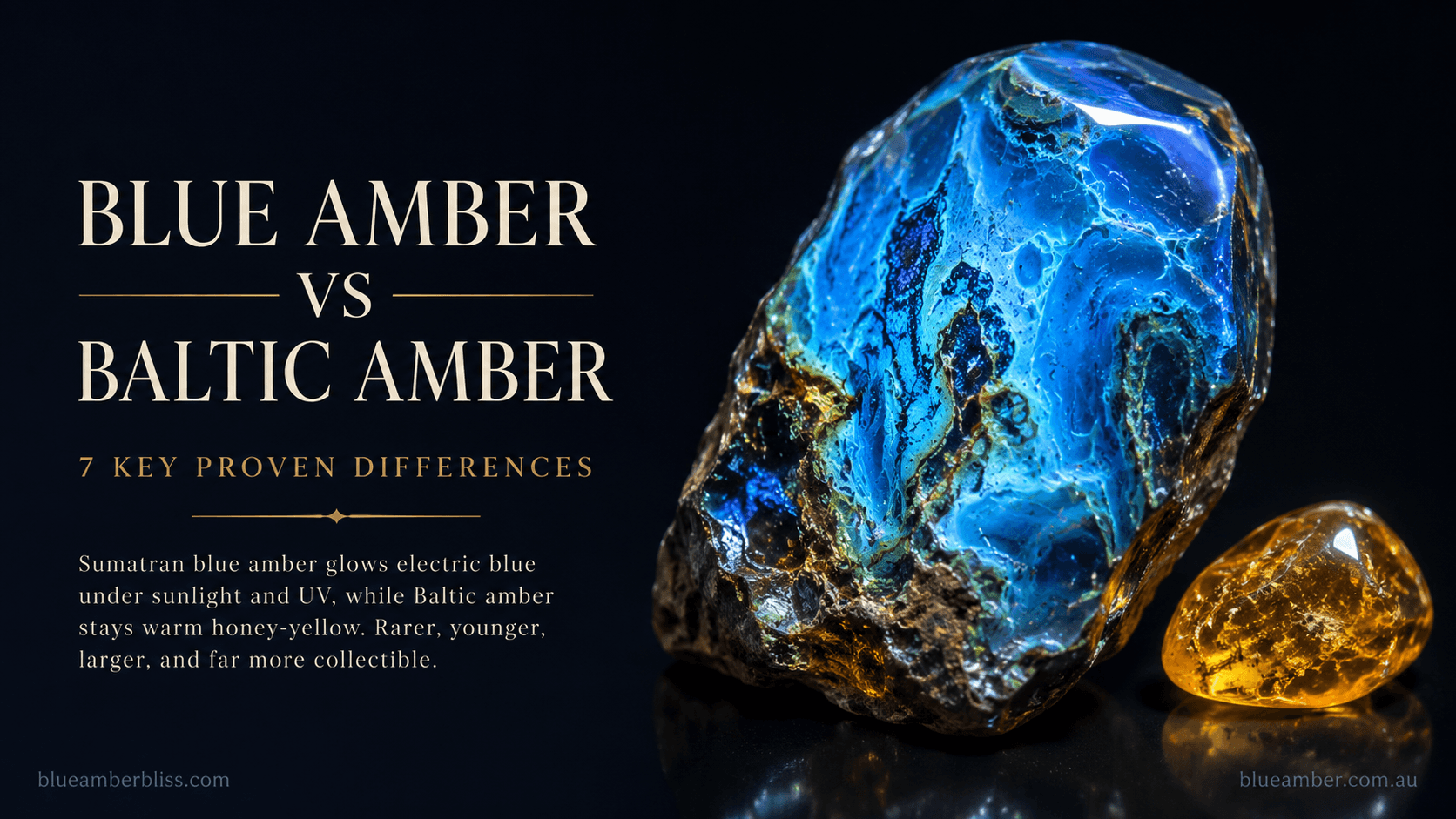
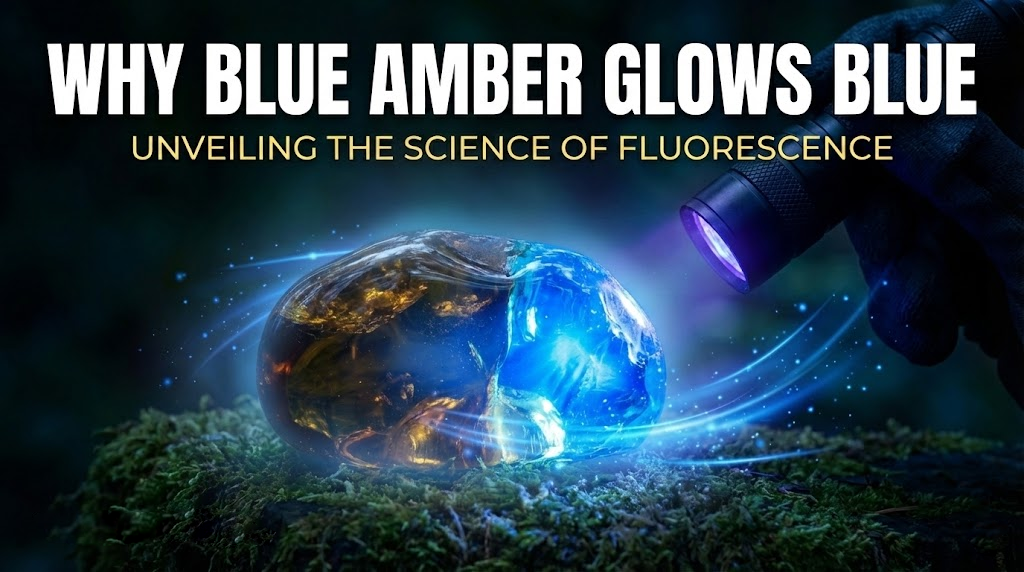
Sumatran blue amber is not blue because of any pigment. Like all amber, the base body color is a warm honey-to-cognac tone. The blue you see is a physical optical effect: the amber absorbs invisible ultraviolet light and re-emits it as visible blue — fluorescence. Under the right lighting, the surface appears to float in a cool blue haze.
What sets the Sumatran material apart is how easily that glow appears. You do not need a laboratory UV lamp. Ordinary daylight carries enough ultraviolet to trigger a visible blue sheen, especially against a dark background. That “daylight blue” behavior is the signature of premium Sumatra blue amber and a big reason collectors seek it out.
Chemically it is a fossilized resin, an organic gemstone rather than a mineral. That is why its hardness sits low on the Mohs scale (about 2–2.5) and why it feels warm, not cold, in the hand. For a wider view of how it fits among other varieties, see our overview of blue amber types.
Where Does Indonesian Blue Amber Come From?
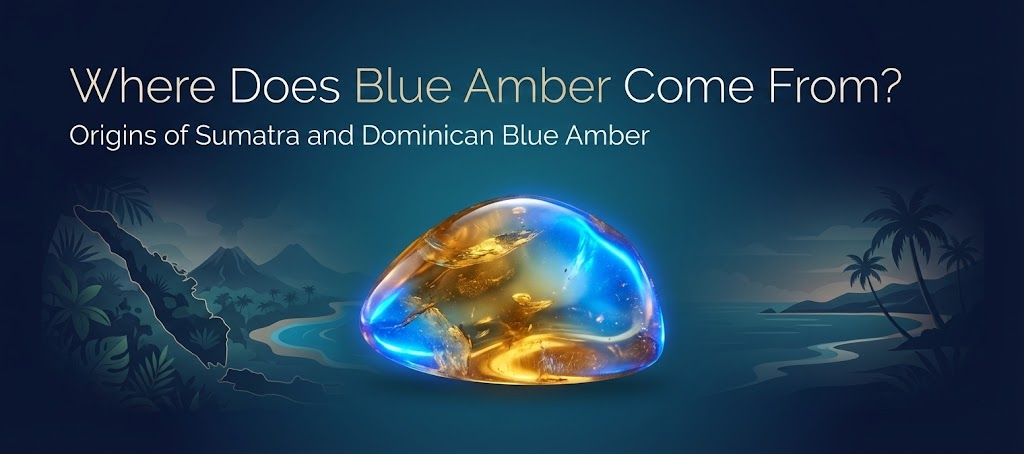
The heart of the deposit is the Sinamar Formation in Jambi Province, on the island of Sumatra. Geologically it sits within the South Sumatra Basin, a broad basin of coal-bearing sediments that accumulated along the foothills of the Bukit Barisan mountain range. Much of the amber surfaces alongside lignite and coal seams.
This coal association is a key clue to its origin. Millions of years ago, dense tropical forests shed resin that was buried in swampy, low-oxygen sediment — the same conditions that later formed the coal. Over deep time, heat and pressure polymerized that resin into the hard amber miners recover today from these Jambi beds.
Because the deposit is comparatively young in mining terms, Sumatra blue amber only reached international collectors in significant volume over the last two decades. That newness matters: the beds are still productive and, crucially, yield unusually large pieces. For the global picture of the world’s deposits, read where does blue amber come from.
How Did the Sumatran Deposit Form?
The story begins in a Miocene rainforest. Dipterocarp trees oozed resin to seal wounds and repel insects. Gobs of that sticky resin dropped into swamp mud and river deltas, where low oxygen slowed decay and let the resin survive instead of rotting away.
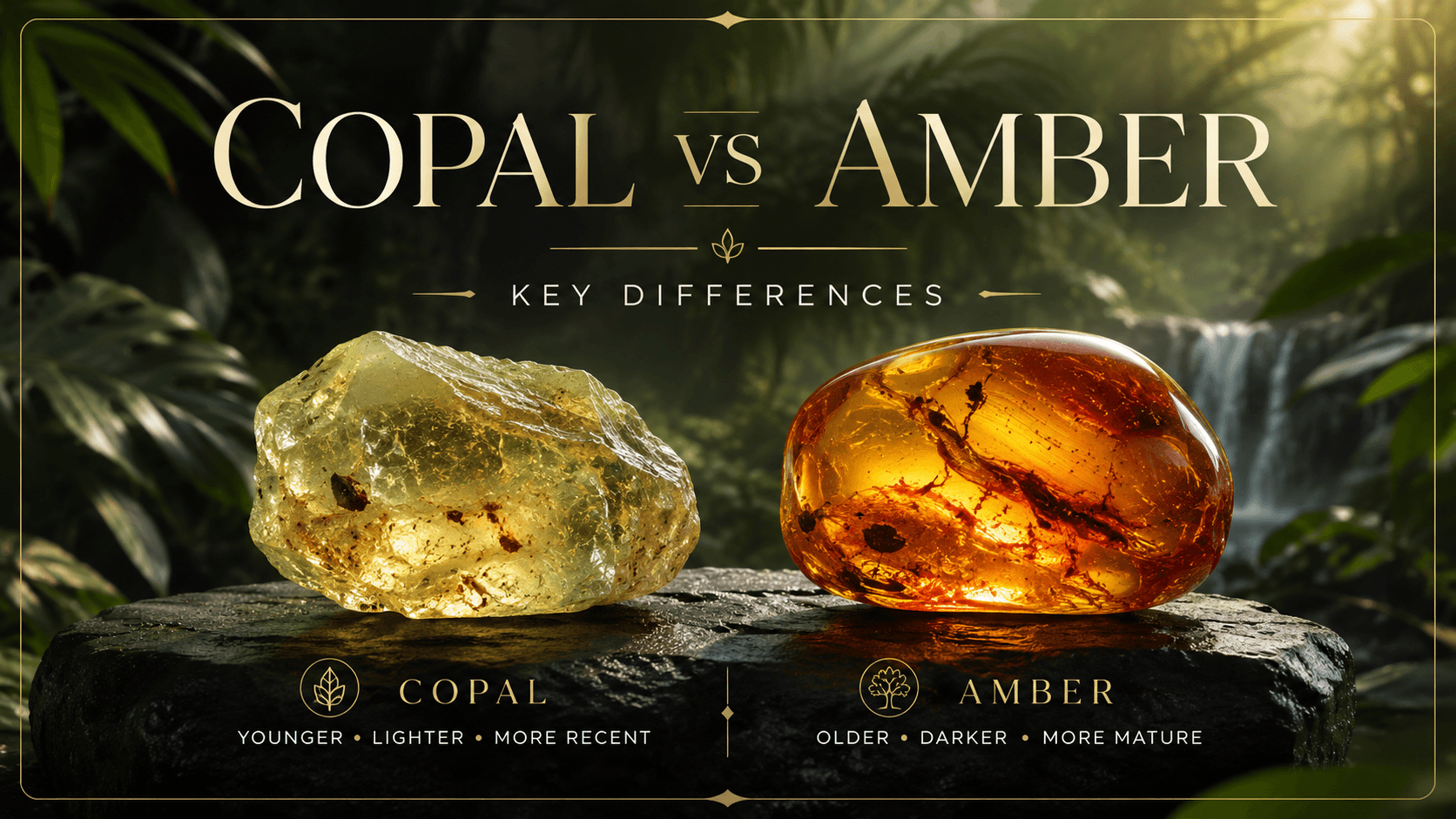
Over millions of years, burial heat and pressure drove off volatile terpenes and cross-linked the resin’s molecules — a process called polymerization. Soft resin became copal, and copal matured into hard, stable amber. The same swampy carbon-rich setting compressed nearby plant matter into the lignite and coal that miners find beside the amber today.
How Is Sumatran Blue Amber Mined in Jambi?
Extraction here is largely small-scale and labor-intensive rather than industrial. Miners follow the coal and clay layers, often digging narrow shafts and tunnels by hand to reach amber-bearing seams. Because the amber travels with lignite, spotting the seams is a skill built over years of local experience.
Once rough is hauled to the surface, it is cleaned, sorted by size and color, and graded before sale. The best sky-blue masses are set aside for cutters; smaller and greener pieces feed beads and tumbles. For a closer look at these methods, see our guide to blue amber mining.
Why Is the Jambi Deposit So Important?
Jambi blue amber is the commercial center of gravity for the Sumatran trade. The province’s beds produce the bulk of the rough that reaches cutters and, from there, the global market. When collectors say “Sumatran,” they very often mean material that originated in these Jambi coal districts.
The size of the nodules here is genuinely unusual. Where many amber deposits yield small chips and beans, the Jambi beds regularly give up palm-sized and larger masses. That opens the door to carvings, large cabochons, and statement jewelry that simply are not possible with smaller rough. To see extraction firsthand, explore blue amber mining.
How Old Is Sumatran Blue Amber and What Tree Made It?
The consensus age places Indonesian blue amber in the Miocene epoch, roughly millions of years in the making. Some estimates stretch the range slightly, but Miocene is the reliable anchor. That makes it younger than many famous ambers, yet more than old enough to be fully fossilized and stable.
The source tree is the standout part of the story. Unlike Baltic amber, which came from conifers, Sumatran amber is an angiosperm resin from the Dipterocarpaceae family — tropical hardwoods that still dominate Southeast Asian rainforests. Researchers most often point to the genus Shorea as the likely producer.
This botanical difference is not trivia. The chemistry of Dipterocarp resin helps explain the amber’s warm base color and, in combination with trace compounds, its willingness to fluoresce so readily. In other words, the tree is part of why the blue glow is so strong. The GIA’s amber reference is a solid primer on how resin becomes amber.
7 Reasons Indonesian Blue Amber Is the Best
Sumatran and Dominican amber are genuinely equal in quality and value as gemstones — both are real, both are beautiful, and neither is a knockoff of the other. That said, the Sumatran material is the newer, bigger-piece source, and several concrete factors make Indonesian blue amber the standout choice for most buyers today.
1. It Glows Blue in Plain Daylight
The single most dramatic trait is the daylight blue effect. Sumatran material fluoresces so efficiently that ordinary sunlight — not just a UV lamp — brings out a cool blue shimmer across the surface. That visible-in-hand glow is the effect most people picture when they imagine blue amber, and it photographs beautifully.
2. The Nodules Are Larger
The Jambi beds yield unusually big masses of rough. Larger nodules mean cutters can produce sizable cabochons, beads, and one-of-a-kind carvings without stitching together small scraps. If you want a bold pendant or a substantial statement piece, this source gives you the raw material to do it.
3. The Material Tends to Be Cleaner
Bigger rough also tends to offer cleaner, more workable zones. Cutters can navigate around fractures and inclusions to isolate glassy, even-toned windows of color. The result is polished pieces with fewer distracting flaws and a more uniform, saturated blue.
4. It Is a Newer, Actively Worked Source
Because Sumatran amber only reached the world market broadly in recent decades, it is a fresher supply with active production. That newness is part of why Indonesian blue amber has become the rising standard for collectors chasing the strongest, largest, most modern blue material.
5. The Color Range Is Wonderfully Broad
Sumatran rough spans a spectrum — from deep teal-green and dark “blue-black” to bright sky blue — often within a single piece. That range lets you choose exactly the mood you want, whether a moody forest-green cabochon or a luminous electric-blue bead strand.
6. The Value Proposition Is Excellent
For the size and glow you get, the pricing is compelling. Because the source is productive and the pieces large, you can own a substantial, vividly fluorescent gem for far less than an equivalent-sized stone in most colored gem categories. That combination of drama and value is hard to beat.
7. It Carries a Distinct Origin Story
Provenance matters to collectors, and this one is vivid: resin from Miocene Dipterocarp forests, buried with coal in the Bukit Barisan foothills, now glowing blue in your hand. Owning verified Indonesian blue amber means owning a traceable piece of Sumatra’s deep geological past.
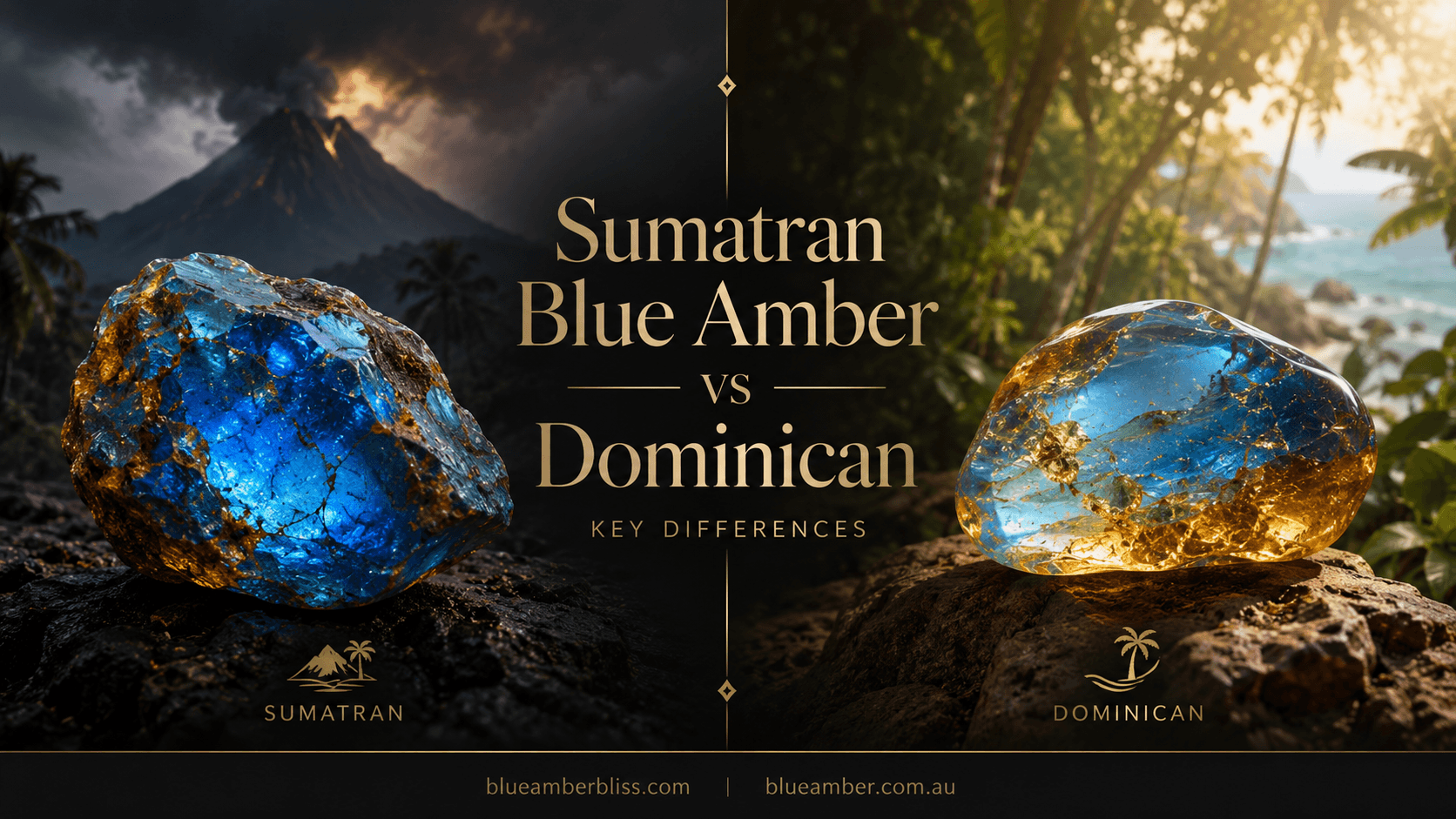
For the full head-to-head that puts these points in context, read our detailed breakdown of Sumatran vs Dominican blue amber.
Is Indonesian Blue Amber Good? A Quality Assessment
Yes — the Sumatran material is genuinely excellent, and the question “is Indonesian blue amber good” deserves a straight answer. It is authentic fossilized resin, chemically and physically indistinguishable in class from other world ambers, and it ranks at the very top for size and daylight fluorescence.
Quality within the source still varies, so judge each piece on its own merits. The factors that separate an ordinary stone from an exceptional one are color intensity, clarity, the strength of the blue fluorescence, and the size and cut of the finished gem. A large, clean, sky-blue cabochon is a rare and desirable thing.
Durability is the one honest caveat. At 2–2.5 on the Mohs scale, amber is soft and warrants gentle care — no ultrasonic cleaners, no harsh chemicals, and protection from sharp knocks. Treated kindly, it lasts generations, as countless antique amber heirlooms prove.
How Can You Tell Real Sumatran Blue Amber From Fake?
Genuine amber has tells. It is warm and lightweight, and it floats in saturated salt water (about 2 tablespoons of salt per cup) while plastic and glass usually sink. Rubbed briskly, it can carry a faint resinous scent and build a static charge — signs of true fossilized resin.
The most reassuring test for this variety is the color shift. Real Sumatran material shows a honey-to-cognac body color that flips to a blue sheen as light and angle change, and it fluoresces under a 365 nm UV light. Dyed glass and plastic imitations cannot reproduce that natural, angle-dependent blue behavior.
What Are Sumatran Blue Amber’s Physical Properties?
Knowing the numbers helps you both identify and care for the stone. Amber is remarkably light — its specific gravity of about 1.05–1.10 is barely denser than water, which is exactly why genuine pieces float in a saturated salt solution while denser plastics and glass sink to the bottom.
On the Mohs scale it measures 2–2.5, similar to a fingernail’s resistance, so it scratches easily and needs thoughtful handling. It has no cleavage, breaks with a conchoidal (shell-like) fracture, and takes a warm, high polish. The Britannica entry on amber covers these mineralogical basics well.
Its defining optical property is fluorescence. Under long-wave UV around 365 nm it lights up an intense blue, and — uniquely for this source — a lesser dose of daylight UV produces a visible blue sheen without any lamp at all. That efficiency is the trait buyers pay a premium to see in person.
Indonesian Blue Amber Grades and Price Per Gram
Blue amber is typically sold by the gram, and price is driven mostly by color and clarity. Use the table below as an orientation, not a rigid rulebook — an exceptional single piece can outrun its grade. These figures reflect loose rough and cut material; finished jewelry adds design and labor cost.
| Grade | Color & Character | Fluorescence | Typical Price / Gram |
|---|---|---|---|
| Entry / Green | Teal-green, darker body, minor inclusions | Moderate, best under UV | ~$1–$3 |
| Mid / Blue-Green | Clear blue-green, good clarity | Strong under UV, visible in daylight | ~$3–$7 |
| Premium / Blue | Vivid blue, clean, even tone | Strong daylight blue glow | ~$7–$12 |
| Top / Sky Blue | Bright electric “sky blue,” very clean, large | Intense daylight fluorescence | ~$12–$15+ |
A few practical notes. Size multiplies value: a clean 10-gram sky-blue piece is worth far more per gram than a 1-gram chip of the same color, because large clean rough is scarce. Cut and polish quality matter too — a well-oriented cabochon maximizes the glow.
Green material is not “lesser” so much as different; many collectors love its moody depth, and it is the affordable entry into the source. As you climb toward clean, daylight-blue stones, prices rise steeply because that combination of clarity, color, and size is genuinely uncommon.
A Buyer’s Note: How to Shop Sumatran Blue Amber Wisely
Buy from sellers who state origin plainly and stand behind authenticity. Ask whether the piece is natural (untreated) versus heated or reconstructed, and request photos in both ordinary daylight and under UV so you can see the real color shift and the strength of the fluorescence before you commit.
Match the grade to your goal. For an everyday pendant, a mid blue-green stone offers wonderful glow at a friendly price. For a collector’s centerpiece, hold out for a clean, large, sky-blue cabochon — that is where Indonesian blue amber truly shines and holds value. When you are ready, see our guidance on where to buy blue amber.
Finally, factor in care and setting. Because the stone is soft, a protective bezel setting outlasts exposed prongs, and gentle cleaning with a soft cloth keeps it bright. Store it away from direct heat and prolonged sunlight, which can dry the surface over decades. Treated well, a quality piece of Sumatran amber becomes an heirloom you can pass down — a glowing fragment of Miocene Sumatra that still lights up in your grandchildren’s hands.
Where Does Sumatran Material Sit Among Amber Varieties?
Most of the world’s amber is not blue at all. Baltic amber, the most abundant variety, formed from conifer resin and shows warm yellows and cognacs with little to no blue glow. Burmese amber (burmite) is ancient and often reddish. True blue fluorescence is rare, and only a couple of sources produce it strongly.
Among those blue-capable sources, the Sumatran deposit is the newer arrival — and it earns its standout status through sheer size and its vivid daylight glow. Dominican blue amber is its genuine equal in quality and value, but the two are distinct origins with their own character. For the full side-by-side, read Sumatran vs Dominican blue amber.
Put simply, if you want the biggest, boldest, most daylight-reactive blue material available today, the Sumatran source is where seasoned collectors look first. It is the modern face of a very old, very rare phenomenon.
What We Notice When Selecting Sumatran Blue Amber
At Blue Amber Bliss, what convinces us of Sumatran blue amber’s edge is the sheer drama of its transformation: in daylight the stones read as deep cognac to near-black, then shift to a vivid electric blue the moment UV or bright sun catches them. We handle each piece for that indoor-to-daylight swing, and Sumatran material consistently gives the strongest, most theatrical glow of anything we source. We also see it arrive in bigger, cleaner nodules with genuine specimen character, natural inclusions and a dark body that makes the blue seem to float above the surface. For collectors, that contrast and presence is exactly what separates a good piece from one worth keeping.
If you’d like to see that daylight-to-glow shift in person, we warmly invite you to explore our hand-selected Sumatran blue amber at Blue Amber Bliss. Shop hand-selected Sumatran blue amber →
Frequently Asked Questions
Is Indonesian blue amber real amber?
Yes. It is authentic fossilized tree resin, millions of years in the making, from the Dipterocarpaceae family. It is amber in every scientific sense — the blue is a natural fluorescence effect, not a dye or coating.
Is Indonesian blue amber good compared to other sources?
It is excellent. As gemstones, Sumatran and Dominican amber are equal in quality and value, but the Sumatran source is newer and yields larger, cleaner nodules with a dramatic daylight blue glow — which makes it the standout, more valuable choice for many buyers.
Where exactly does Sumatra blue amber come from?
It comes from the Sinamar Formation in Jambi Province, Sumatra, within the coal-bearing sediments of the South Sumatra Basin near the Bukit Barisan foothills. Jambi blue amber makes up the bulk of the Sumatran material on the market.
Why does Sumatran blue amber glow blue?
The amber absorbs ultraviolet light and re-emits it as visible blue — fluorescence. Sumatran material fluoresces so efficiently that ordinary daylight (which contains UV) triggers a visible blue sheen, especially against a dark background, without needing a lab lamp.
How much does Indonesian blue amber cost?
Loose material generally runs about $1–$15+ per gram. Entry green rough sits near the low end, while clean, large, sky-blue pieces with strong daylight fluorescence command the premium. Finished jewelry adds design and labor on top.
What tree produced Sumatran blue amber?
It formed from the resin of Dipterocarpaceae trees — tropical hardwoods that still dominate Southeast Asian rainforests — most likely the genus Shorea. This angiosperm origin differs from conifer-based ambers like Baltic and helps explain its color and glow.
How can I tell if my blue amber is genuine?
Genuine amber floats in saturated salt water, feels warm and light, and shows a honey-to-blue color shift with angle and lighting. It fluoresces under 365 nm UV. Plastic and glass imitations sink and cannot reproduce that natural, angle-dependent blue.
How old is Sumatran blue amber?
It dates to the Miocene epoch, millions of years in the making. That is young compared with some famous ambers but far more than old enough to be fully fossilized, hardened, and stable for jewelry and collecting.
Is blue amber durable enough for jewelry?
Yes, with sensible care. Amber is soft at 2–2.5 on the Mohs scale, so avoid ultrasonic cleaners, harsh chemicals, and hard knocks. A protective bezel setting and gentle cleaning keep it beautiful for generations, as antique amber heirlooms attest.
What colors does Sumatran blue amber come in?
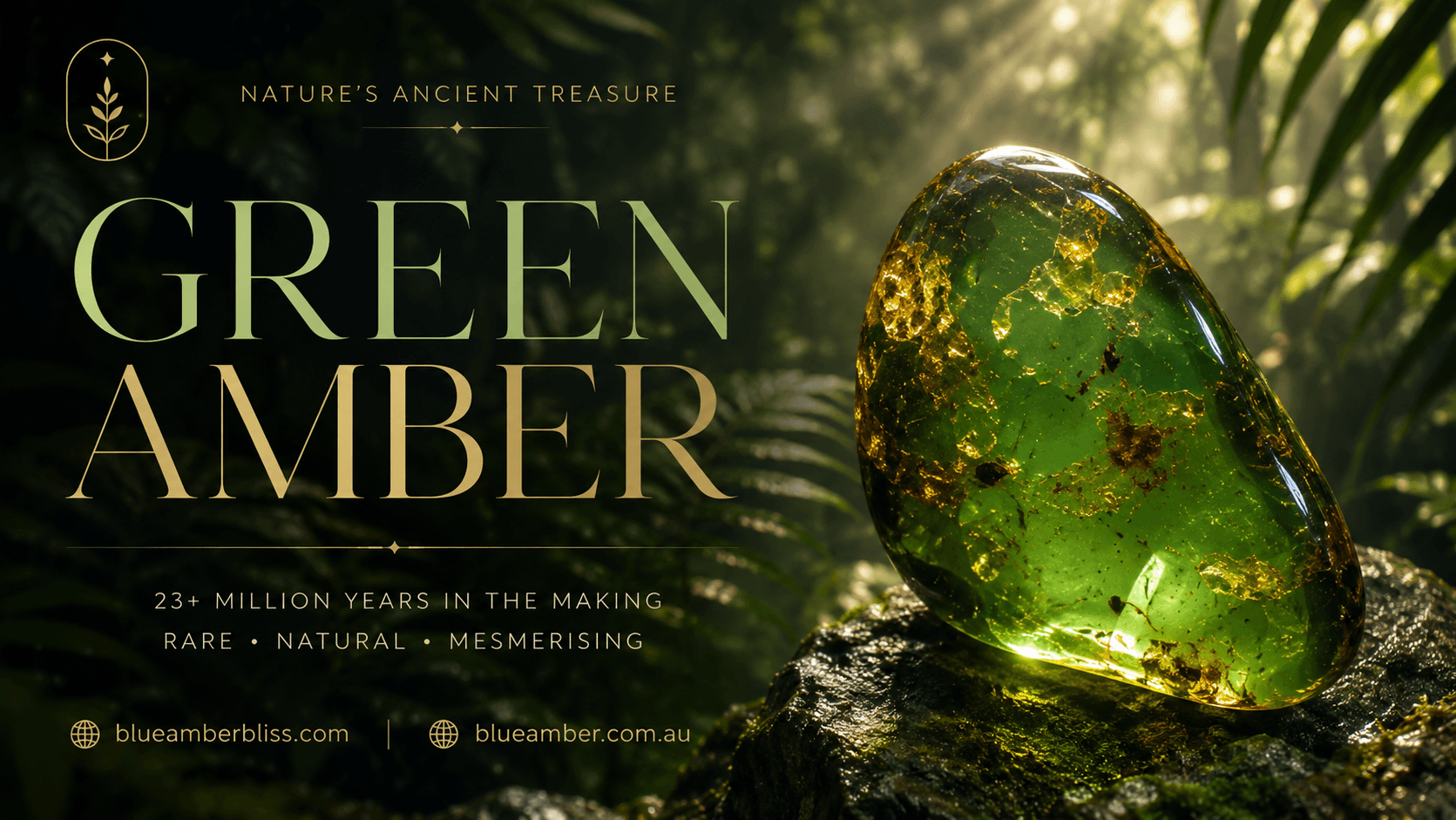
It spans teal-green, deep blue-black, mid blue-green, and bright sky blue, sometimes within a single piece. Green is the affordable entry point for new collectors; clean, vivid sky-blue stones with strong daylight fluorescence are by far the rarest, most sought-after, and most prized.