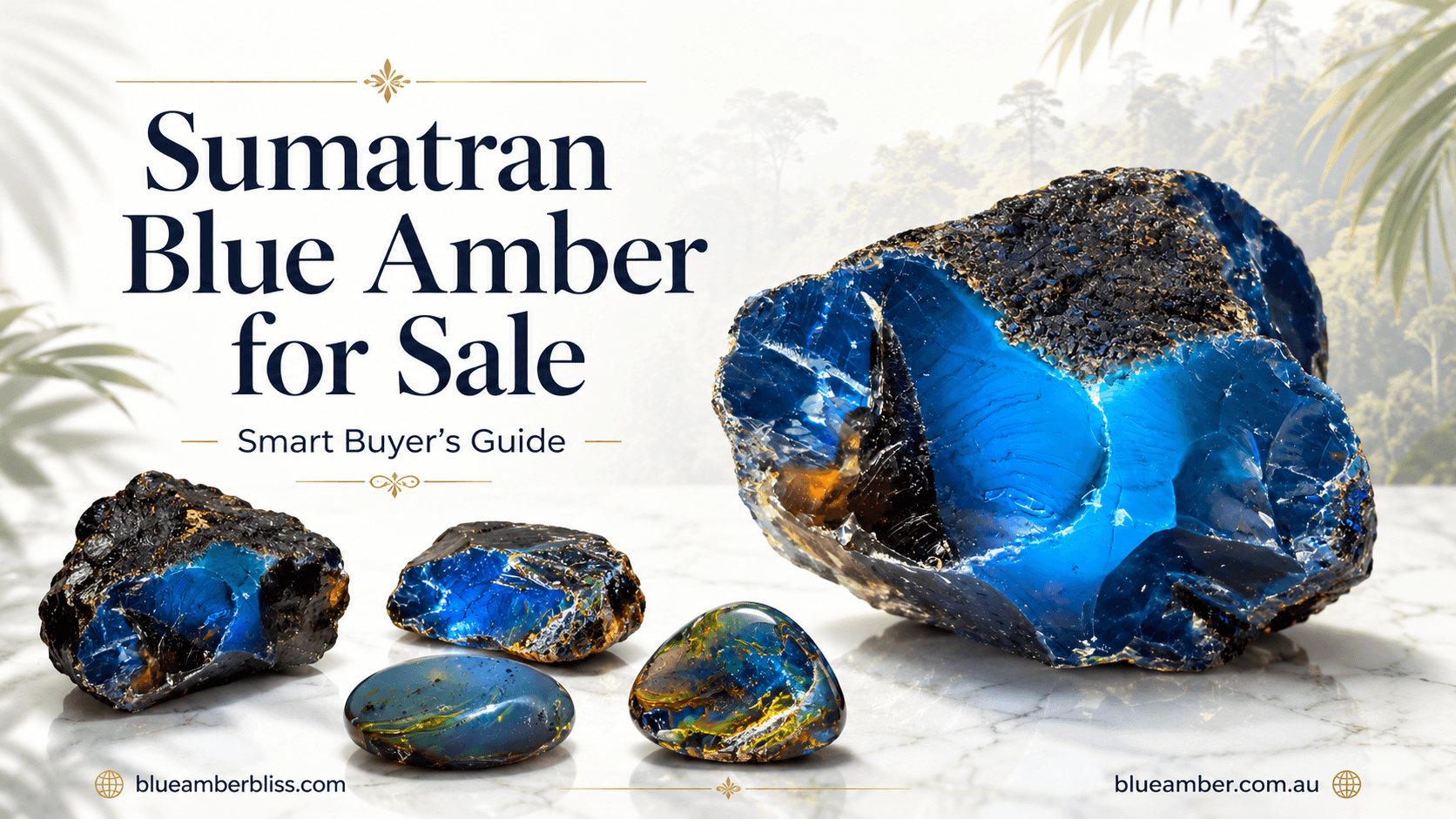
If you have ever held a piece of blue amber under sunlight and watched it ignite into an electric, almost liquid blue, you already understand why this material fascinates collectors and gemologists alike. As a brand that works exclusively with Sumatran blue amber, we want to walk you through exactly what makes expensive blue amber worth its price, and which pieces have set the records. This guide is honest, specific, and built to help you buy with confidence rather than hype.
Key Takeaways
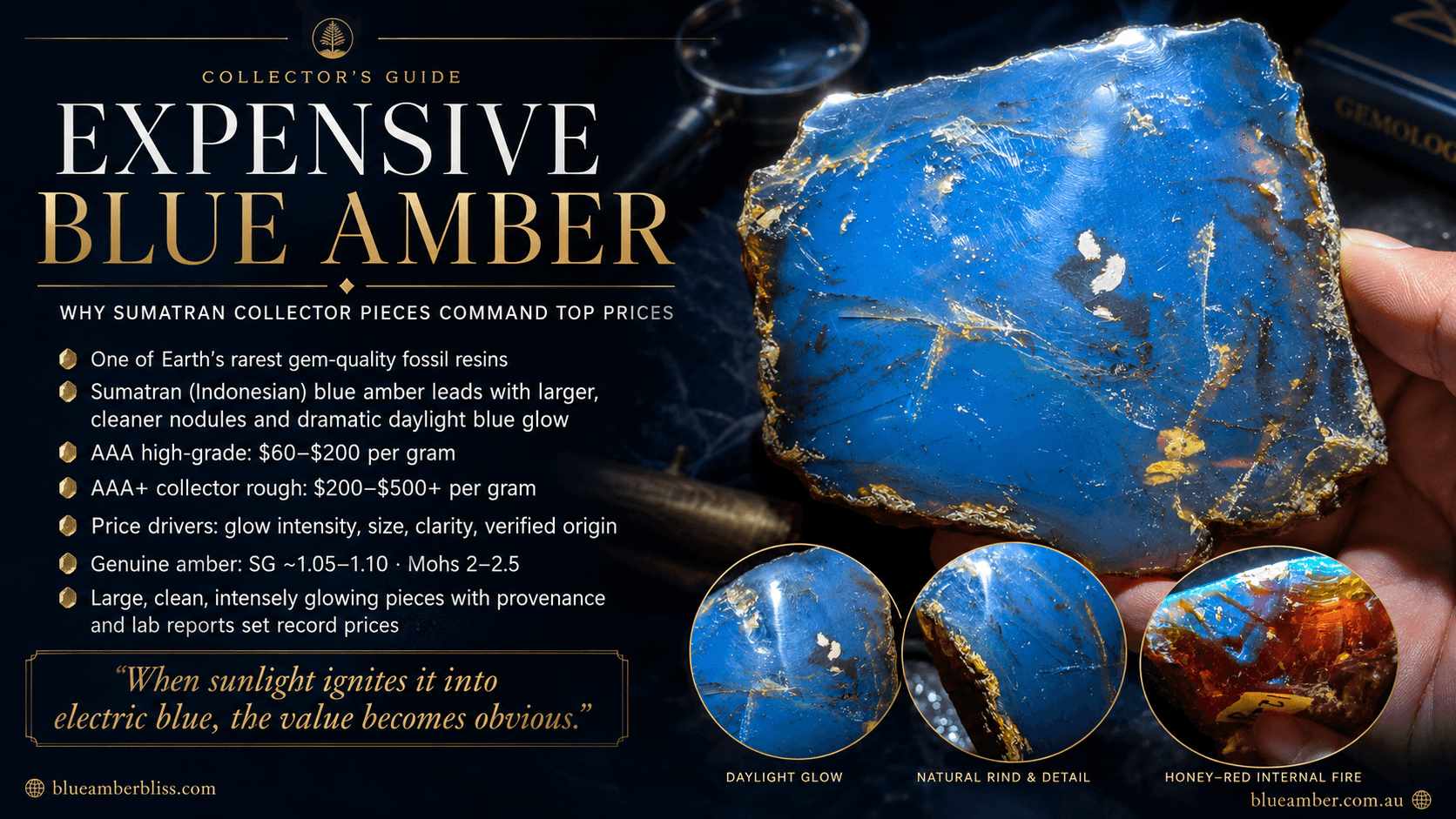
- Sumatran (Indonesian) blue amber leads the market as a newer source with larger, cleaner nodules and a dramatic daylight blue, making it the standout AAA+ material.
- The most expensive blue amber typically sells for $60-$200 per gram for high-grade AAA, with top AAA+ collector rough reaching $200-$500+ per gram.
- Price is driven by four levers: glow intensity, size, clarity, and verified origin, formalized as AA / AAA / AAA+ grading tiers.
- The blue is fluorescence from perylene and other PAHs, not pigment; genuine amber shows specific gravity ~1.05-1.10 and Mohs 2-2.5.
- Sumatran and Dominican blue amber are equal in quality, but Sumatran’s bigger, cleaner premium nodules and daylight glow give it the edge.
- Large, clean, intensely glowing pieces with documented provenance and lab reports set every blue amber record price.
Why Is Blue Amber Expensive in the First Place?
Blue amber is expensive because it is extraordinarily scarce. Of all the amber mined worldwide, only a tiny fraction shows the true blue fluorescence that defines this gem. Most amber on Earth is yellow, honey, or cognac. Blue is the exception, and that rarity is the foundation of every price you will see.
The blue you see is not a dye or a mineral inclusion. It is fluorescence: the resin absorbs ultraviolet and short-wavelength violet light, then re-emits it as a glowing blue. The fluorophores responsible are perylene and other polycyclic aromatic hydrocarbons (PAHs), trace molecules formed during the slow amberization of the original tree resin. According to GIA, amber is fossilized tree resin; Sumatran and Dominican blue amber formed in the Miocene epoch, roughly millions of years ago, far younger than themillions of years sometimes quoted for Baltic deposits.
Because the conditions that create this fluorescent chemistry are uncommon, expensive blue amber sits in a category of its own. You are not paying for prettiness alone; you are paying for a fossil that nature almost never makes. That scarcity, combined with strong collector demand, is the simplest answer to why blue amber is expensive.
There is also a labor and yield factor. Miners working the coal-bearing sediments of the Sinamar Formation in Jambi Province, South Sumatra, may dig through enormous volumes of ordinary material to recover a single gem-grade blue piece. When you understand the rejection rate at the source, the per-gram figures on expensive blue amber start to feel reasonable rather than inflated.
Why Is Blue Amber Actually Blue? The Perylene and Scattering Story
Here is the detail that separates an informed buyer from a hopeful one: blue amber has no blue body color. Hold a thin slice to a window and it reads green, teal, or amber-brown in transmitted light. The blue is generated by light, not contained in the stone, and two physical mechanisms produce it.
First, fluorescence. Perylene and related PAHs absorb UV and violet photons and re-emit them at longer, visible blue wavelengths. GIA’s Gems & Gemology (Winter 2020) measured Dominican blue amber emitting near 450, 474, and 508 nm, the spectral signature of that perylene-driven glow. This is true fluorescence, not phosphorescence: the blue stops the instant the exciting light is removed, so blue amber never glows in the dark.
Second, surface Tyndall and Rayleigh scattering. Submicroscopic structures scatter short-wavelength blue light back toward your eye, the same physics that makes the sky blue, layering a cool sheen over the fluorescent glow. The strongest Sumatran material does both at once under sunlight, which contains enough UV to trigger the signature daylight blue, the single priciest trait in the gem. For the deeper optical chemistry, see our breakdown of blue amber properties.
What Drives the Price of Expensive Blue Amber?
Four factors decide whether a piece is merely nice or genuinely valuable. Think of them as dials: turn several to maximum and you get record-setting, expensive blue amber. Turn only one and you get a pleasant but affordable stone. The trade formalizes these dials into AA / AAA / AAA+ grading tiers, scored chiefly by glow intensity and evenness, then clarity, body color, and size.
How Much Does Glow Intensity Affect Value?
Glow is the single most important value driver. A piece that flashes a strong, saturated blue in ordinary daylight is worth dramatically more than one that only hints at blue under a UV torch. Sumatran blue amber is famous for exactly this dramatic daylight glow, which is why it dominates the AAA+ tier.
The standard test wavelength is long-wave 365 nm, which delivers the strongest, truest visible blue. Beware the cheap 395 nm “UV” torches: 395 nm is partly visible violet, so it gives a weaker, washed-out glow that flatters mediocre material. The best pieces light up vividly at 365 nm and, crucially, also glow in plain sunlight. That daylight performance is what separates truly expensive blue amber from material that merely passes a torch test.
Does Size Really Command a Premium?
Yes, and disproportionately so. Large clean blue amber is exponentially rarer than small pieces, so price per gram climbs as size increases. This is where Sumatran blue amber shines: the Sinamar Formation yields big nodules that simply are not common elsewhere.
A 5-gram bead and a 50-gram carving are not priced linearly. The carving may cost many times more per gram because finding a flawless 50-gram block of glowing blue resin is a genuine event. Sumatran’s premium large nodules are the reason so many high-value, expensive blue amber pieces today trace back to Indonesia.
How Important Is Clarity and Color?
Clarity matters because cracks, cloudiness, and excessive debris reduce both beauty and durability. The cleanest expensive blue amber is transparent in transmitted light, showing a warm body color (often green, teal, or amber-brown) that erupts into blue when light hits it from above. That contrast is the magic.
Color quality is about the strength and tone of the blue itself. A clean, electric blue with even distribution beats a patchy or weak blue every time. When clarity and color align in a large piece, you are looking at the kind of expensive blue amber that anchors serious collections.
Why Does Origin Change the Price?
Origin matters because each source has a reputation and a typical size-and-glow profile. Sumatran (Indonesian) blue amber from the Sinamar Formation is the newer, headline source, prized for large nodules and a dramatic daylight blue, which makes it the standout. Dominican blue amber, mined at the La Cumbre, La Toca, and Palo Quemado mines in the Cordillera Septentrional near Santiago, is its respected equal in quality and value.
Both are retinite-class fossil resins with little or no succinic acid, distinct from Baltic succinite. Both origins produce beautiful, collectible, genuinely expensive blue amber on equal quality footing. The practical edge goes to Sumatran because its bigger, cleaner pieces give cutters and collectors more to work with. For the full provenance story, see where blue amber comes from.
Most Expensive Blue Amber: 7 Proven Price Records
Below are seven recurring, real-world price benchmarks that define the most expensive blue amber tiers. These reflect patterns seen across dealers, auctions, and collector sales rather than a single headline number, so you can calibrate expectations honestly. Sumatran appears first because it consistently leads the high end.
- Top AAA+ Sumatran daylight-glow rough: Exceptional large Indonesian nodules with strong even sunlight blue and clean mass reach $200-$500+ per gram as collector pieces, the genuine top of the market.
- High-grade AAA Sumatran nodules: Clean pieces with strong daylight glow routinely trade at $60-$200 per gram, the everyday ceiling for serious gem-grade rough.
- Sumatran carved sculptures: Master-carved pieces that preserve glow across a large surface command $100-$300+ per gram because artistry plus rarity compounds value.
- Dominican gem-grade transparent blue: Top clean Dominican material sits in the same elite band, often $60-$200 per gram, an equal peer to Sumatran on quality.
- Faceted blue amber gemstones: Cut gems with maximum fluorescence frequently trade at $60-$150 per gram, since faceting amplifies the glow (more on the value math below).
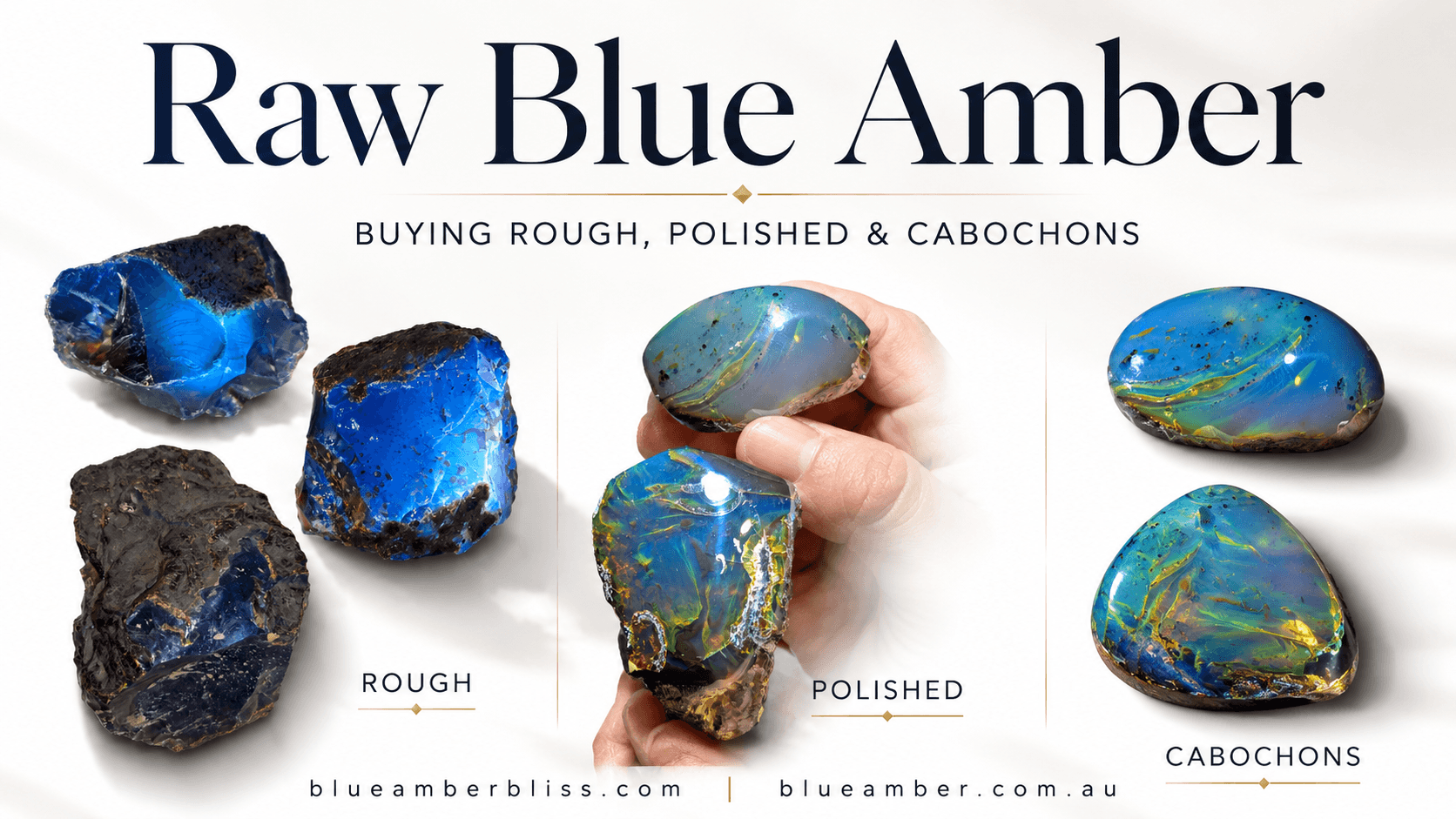
- Collector cabochons: Well-oriented cabochons that flash blue from the dome typically run $30-$90 per gram.
- Inclusion specimens: Rare blue amber containing a clear ancient insect can multiply value beyond weight, sometimes into four or five figures per piece, and museum specimens of this kind rarely reach the open market at all.
Documented public record sales are scarce because the finest blue amber changes hands privately among collectors and dealers rather than at named auction houses; the per-gram bands above are the honest, verifiable benchmarks. For a regularly updated breakdown, our guide to blue amber price per gram tracks current bands across grades and formats.
Faceted vs Cabochon: Worked Value Logic
Cut style changes the per-gram figure in a predictable way. Faceting a transparent blue amber maximizes total internal reflection and surface UV exposure, so the glow reads more intensely and evenly, which buyers pay for. The catch is yield: faceting a rough nodule can discard 50-70% of the mass, so the surviving gem carries the lost weight in its price.
Worked example: a clean 20 g AAA rough at $120/g costs $2,400. Faceted down to a 7 g gem (a 65% loss), that surviving stone must recover the full $2,400, or about $343/g, before any cutting labor or margin. A cabochon from the same nodule might retain 12 g, spreading the cost to roughly $200/g. This is why faceted blue amber posts higher per-gram numbers than cabochons cut from identical rough, and why high-yield cabochons remain the value-conscious entry to gem-grade glow.
How Does the Blue Amber Record Price Compare by Type?
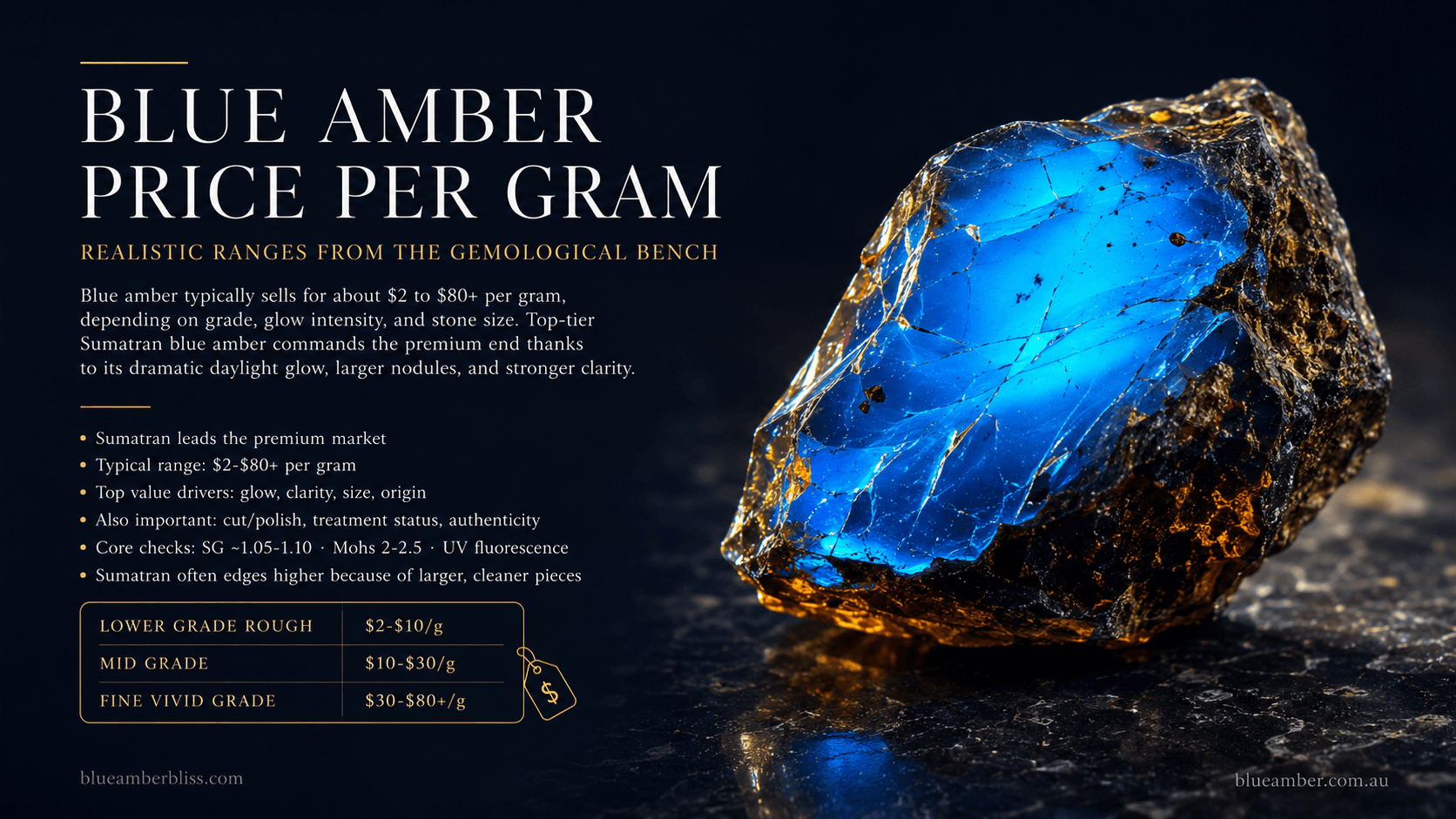
The table below shows realistic per-gram ranges so you can see where expensive blue amber sits relative to common amber. Sumatran is listed first as the standout. Treat these as honest planning numbers, not guarantees, because individual pieces vary with glow and size.
| Type / Origin | Typical per-gram price | What drives the price | Value tier |
|---|---|---|---|
| Sumatran (Indonesian) top AAA+ collector rough | $200-$500+ | Large clean size, intense even daylight glow | Top / standout |
| Sumatran high-grade AAA nodule or carving | $60-$200 | Strong daylight glow, clean mass, artistry | High |
| Dominican gem-grade transparent blue | $60-$200 | High clarity, strong glow (equal peer) | High |
| Polished, good-blue mid-grade | $15-$60 | Moderate but clear blue glow | Mid |
| Rough or low-glow blue amber | $3-$15 | Weak or uneven blue, unworked | Accessible |
| Common yellow / honey amber | $0.50-$5 | Abundant, no rare fluorescence | Baseline |
Related Blue Amber Guides
Notice the gap between common amber and expensive blue amber. Ordinary amber is plentiful and cheap; top blue is scarce and can cost a hundred times more per gram. That contrast is the clearest illustration of why blue amber is expensive and why provenance is worth protecting.
Why Is Sumatran Blue Amber the Standout?
Sumatran blue amber earns its lead through a combination of timing, size, and glow. As a newer source, Indonesia entered the market with abundant large nodules from the Sinamar Formation just as global collector interest was peaking. That gave it a reputation for big, dramatic, daylight-glowing pieces that defined a new ceiling for expensive blue amber.
The daylight glow is the headline. Many Sumatran pieces flash a deep, electric blue under ordinary sunlight without any UV torch, because perylene fluorescence plus surface scattering combine in unusually concentrated material. That is the most coveted optical behavior in the entire category, and it is why Sumatran dominates the AAA+ tier.
This is why we built Blue Amber Bliss around Sumatran material exclusively. The combination of size, glow, and clean nodules makes it the most compelling expensive blue amber on the market today. It is not that other origins are poor; it is that Sumatran simply gives you more of what makes blue amber special.
If you want to understand just how uncommon this material is, our explainer on how rare blue amber is puts the scarcity into perspective with concrete numbers and source comparisons.
What Are the Physical Properties Behind the Value?
Understanding the science helps you judge expensive blue amber objectively rather than emotionally. Blue amber is true amber, so it shares amber’s core physical signature, with the addition of that rare perylene fluorescence. Knowing these numbers lets you spot fakes and appreciate authenticity.
- Specific gravity: roughly 1.05-1.10, so genuine amber floats in saturated saltwater (brine SG ~1.15-1.16) but sinks in fresh water, per mindat.org.
- Hardness: Mohs 2-2.5, soft enough to scratch with a knife, which is why fine pieces need protective settings.
- Fluorescence: strong blue emission under long-wave 365 nm UV (peaks near 450/474/508 nm), with the best pieces glowing in daylight too.
- Composition: amorphous, non-crystalline fossil resin, a retinite low in succinic acid; not a true mineral.
- Refractive index: around 1.54, and warm to the touch rather than cold like glass.
These properties are your authentication starting point. Genuine blue amber behaves consistently across all of them, while copal (immature resin under millions of years in the making) gives itself away by turning tacky in an acetone test within seconds. For definitive identification, FTIR spectroscopy and a GIA or IGI lab report distinguish mature amber from copal and retinite from succinite. For the full hands-on battery, see how to tell if blue amber is real.
Is Expensive Blue Amber a Good Investment?
Blue amber has appreciated meaningfully over the past two decades as awareness has grown and the most accessible deposits have been worked. The most expensive blue amber, particularly large Sumatran nodules with documented provenance and lab certification, has shown the strongest and most resilient demand. Scarcity plus a clear quality story tends to hold value well.
That said, treat any collectible as a long-horizon, passion-led asset rather than a guaranteed return. The pieces that perform best combine all four value drivers: strong even glow, large clean size, high clarity, and verified origin. Buy the best single piece you can rather than several mediocre ones.
Liquidity matters too. Truly exceptional, lab-documented expensive blue amber finds buyers more readily than middling material, because serious collectors are always hunting for top-tier pieces. If you are weighing whether blue amber is a good investment, our deep dive covers grading, provenance, and resale dynamics.
How Do You Buy Expensive Blue Amber Without Overpaying?
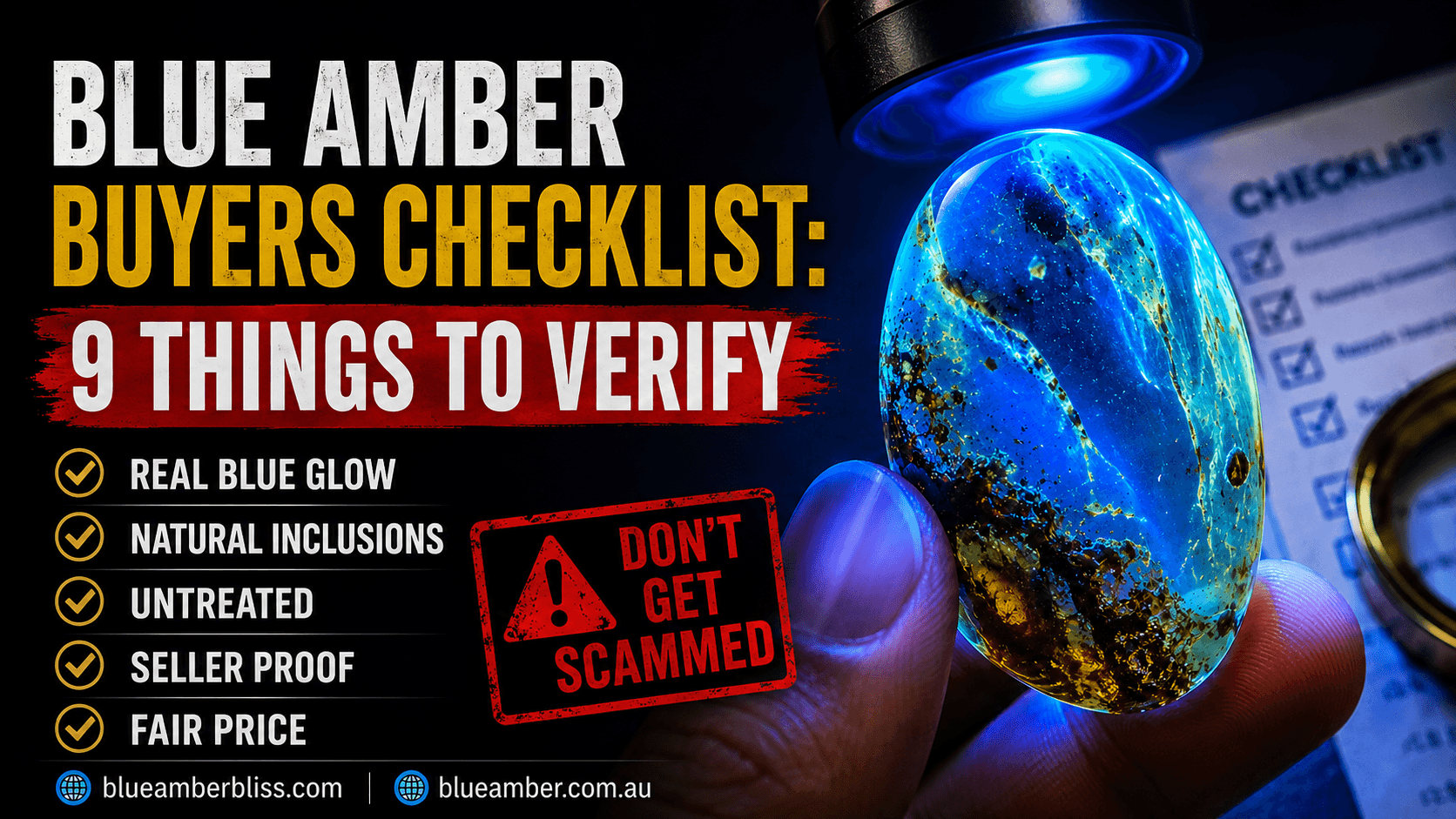
The biggest risk with expensive blue amber is not price; it is authenticity and misgrading. A weak-glowing piece sold as AAA+, or treated copal sold as amber, can cost you far more than a fair premium on the real thing. Protect yourself with a simple, disciplined checklist.
- Demand daylight glow evidence, not just 365 nm torch photos, since daylight performance is what justifies a top price.
- Ask for origin documentation, favoring Sumatran or Dominican provenance from a transparent seller.
- Verify weight and dimensions, because per-gram math only works with honest measurements.
- Confirm the grade and tier, matching the seller’s AA/AAA/AAA+ claim to the glow and clarity you can see.
- Buy from specialists, who stake their reputation on the material and can supply a GIA or IGI report on request.
When you follow these steps, you turn a potentially intimidating purchase into a confident one. The goal is to pay a fair premium for genuine, well-graded expensive blue amber, not a fantasy markup for ambiguous material. For trusted sourcing, see our guidance on where to buy blue amber.
What Should You Remember About Expensive Blue Amber?
Step back and the picture is simple. Expensive blue amber is expensive because nature rarely makes it, and the very priciest pieces stack every value driver at once: a dramatic perylene-driven glow, generous clean size, high clarity, and verified origin. Sumatran blue amber leads that high end as the standout source.
You do not need a record-setting budget to own genuine blue amber. But if you are chasing the most expensive blue amber tier, you now know exactly what to look for and what to pay. Buy the glow, buy the size, buy the provenance, and you will own a fossil that almost no one else on Earth can match.
What Actually Commands a Record Price
When we handle the pieces that fetch the highest prices at Blue Amber Bliss, the value almost always tracks the same Sumatran traits: a deep cognac-to-near-black body in daylight that flips to an intense blue glow the moment it catches UV or open sky, with that daylight-to-glow contrast being the single strongest driver of what serious collectors will pay. Size and cleanliness compound it fast, a large, well-formed nodule with a clean polish and just enough natural inclusion to prove it’s untreated ancient resin sits in a different price bracket than a small or milky stone. We’ve noticed buyers chasing records consistently underrate glow strength and overpay for sheer weight, when in truth a mid-size Sumatran piece with dramatic transformation will outperform a heavier dull one every time.
If you’d like to see how these qualities show up in person, you’re welcome to explore our hand-selected Sumatran blue amber at Blue Amber Bliss. Shop hand-selected Sumatran blue amber →
FAQ
What is the most expensive blue amber ever sold?
The most expensive blue amber pieces are typically large top AAA+ Sumatran nodules and master carvings with intense daylight glow, reaching $200-$500+ per gram, and for unique inclusion specimens, four or five figures per piece. Exact record numbers vary because the finest pieces sell privately among collectors rather than at named auctions.
Why is blue amber expensive compared to regular amber?
Blue amber is expensive because its rare perylene fluorescence occurs in only a tiny fraction of all amber. Common yellow amber is abundant and may cost a few dollars per gram, while expensive blue amber can cost a hundred times more due to scarcity, daylight glow, and collector demand.
What is the priciest blue amber per gram?
The priciest blue amber, large clean Sumatran pieces with strong even daylight blue, reaches $200-$500+ per gram for top AAA+ collector rough. High-grade AAA material trades at $60-$200 per gram, and faceted gems that maximize glow also sit near the top of the per-gram range.
Is Sumatran or Dominican blue amber more valuable?
They are equal in quality and value, but Sumatran (Indonesian) blue amber from the Sinamar Formation is the newer source with larger, cleaner nodules and a dramatic daylight glow, which makes it the standout. Both produce genuinely expensive blue amber, and verified provenance protects either choice.
What drives a blue amber record price?
A blue amber record price is driven by four factors working together: intense even daylight glow, large clean size, high clarity, and verified origin, formalized as AA/AAA/AAA+ tiers. When a single piece maximizes all four, especially a big Sumatran nodule, it commands the highest prices in the market.
How can I tell if expensive blue amber is real?
Genuine blue amber has a specific gravity near 1.05-1.10 (it floats in brine), Mohs hardness 2-2.5, and strong blue fluorescence under 365 nm UV. Copal turns tacky in an acetone test, while FTIR spectroscopy and a GIA or IGI report give definitive identification of mature amber.
Why does blue amber glow blue if it is not really blue?
Blue amber has no blue body color. The glow comes from perylene and other PAHs fluorescing, absorbing UV and violet light and re-emitting blue near 450-508 nm, plus Tyndall and Rayleigh scattering of short wavelengths at the surface. It is fluorescence, not phosphorescence, so it never glows in the dark.
How old is blue amber?
Sumatran and Dominican blue amber formed in the Miocene epoch, millions of years ago, not themillions of years sometimes quoted for older Baltic deposits. Sumatran amber comes from the Sinamar Formation and likely a Dipterocarpaceae (Shorea) tree resin, while Dominican amber derives from the extinct Hymenaea protera.
Is expensive blue amber a good investment?
Blue amber has appreciated as awareness has grown, and top-tier Sumatran pieces with provenance and lab reports show the most resilient demand. Treat it as a long-horizon passion asset, buy the best single piece you can, and prioritize even glow, size, clarity, and origin to protect resale value.
Where should I buy expensive blue amber safely?
Buy from specialists who provide daylight glow evidence, origin documentation, honest grading, and a GIA or IGI report on request, rather than generalist marketplaces. Sumatran-focused dealers who stake their reputation on the material give you the best protection when purchasing expensive blue amber at premium prices.