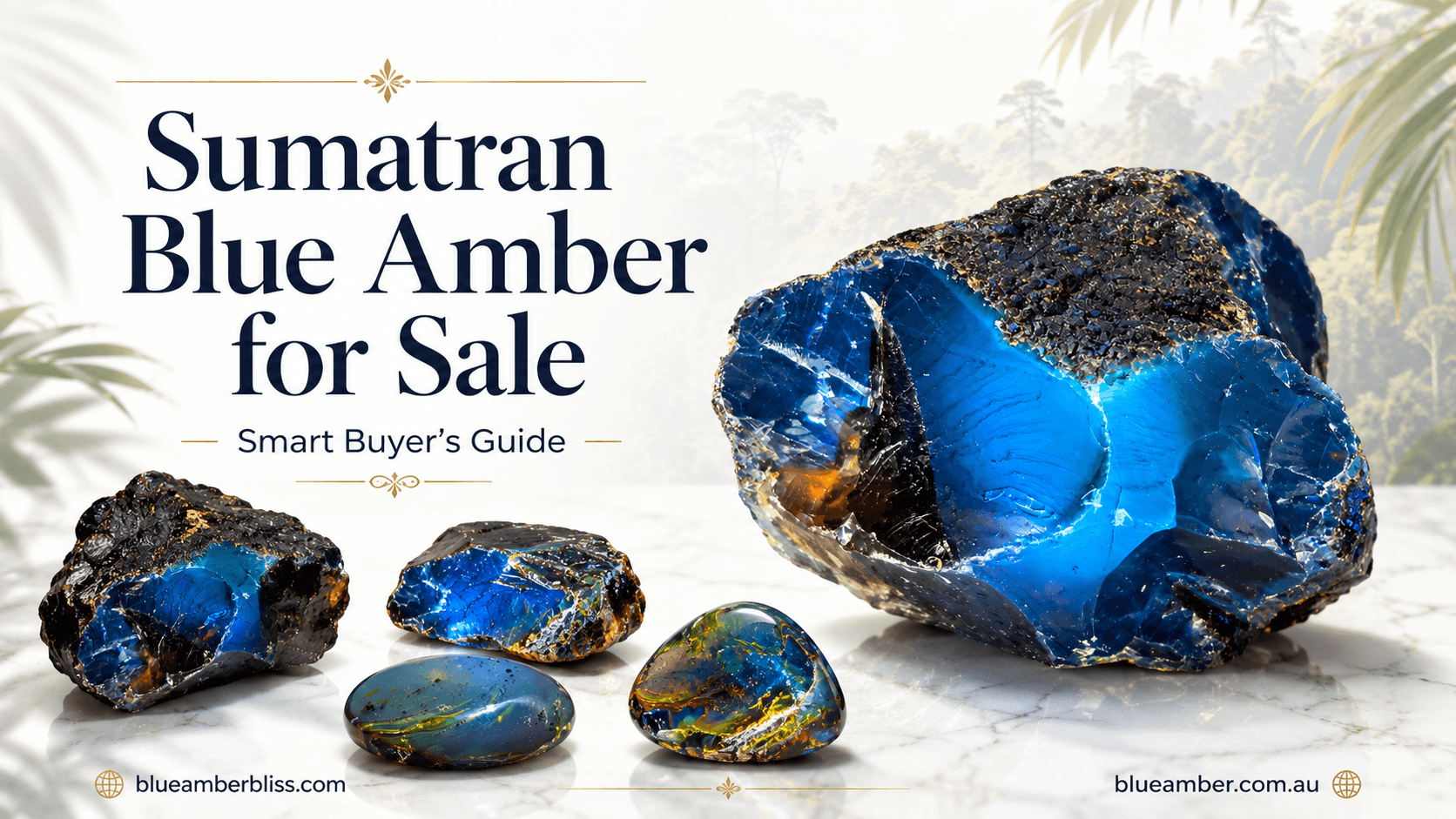
This blue amber price guide gives you the short answer up front: Sumatran blue amber runs $3–15 per gram for rough or low-glow material and $200–500+ per gram for top AAA+ collector pieces, with glow strength — not size — driving most of the price. Everything below shows you why.
If you have been researching blue amber price information, you have seen everything from $20 trinkets to $1,000+ “museum pieces” with almost no explanation of why the gap is so wide. This blue amber price guide closes that gap. The short answer: price tracks one thing above all else, the strength and evenness of the blue glow, then clarity, size, and craftsmanship layer on top.
Most older blogs still default to Dominican blue amber. Quietly, another source has overtaken the conversation among collectors:
Sumatran blue amber from Indonesia — fossil resin that glows electric blue, drawn from the Miocene coal-bearing sediments of the Sinamar Formation in Jambi Province, ethically mined and curated by specialists who deal in nothing else.
This guide is written for the serious buyer or collector, especially in the US, who wants to understand what drives Sumatran blue amber prices, realistic 2025 ranges based on curated pieces, and how to know when you are getting fair value. All prices are in USD.

Key takeaways
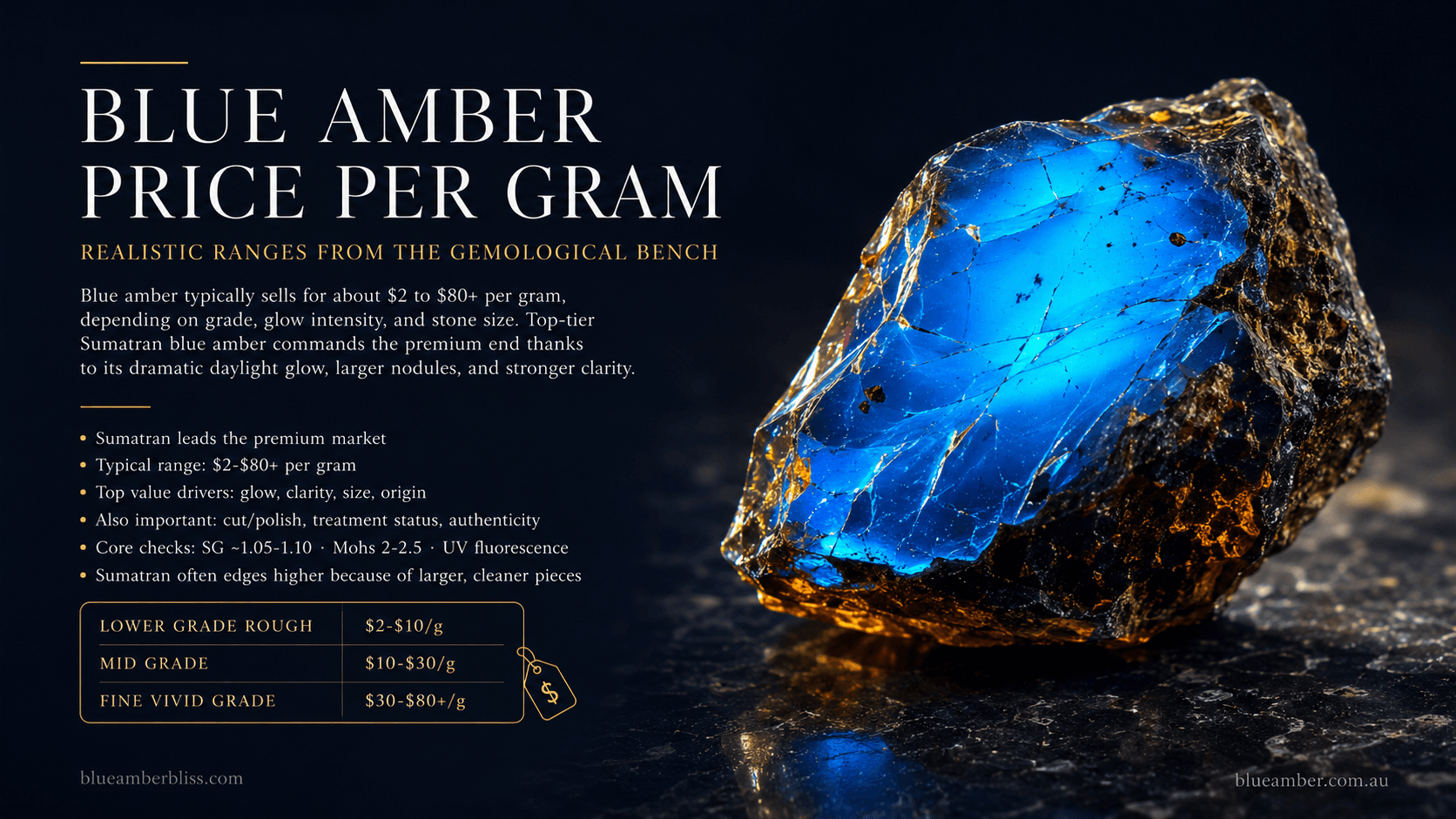
- One canonical price scale: rough/low-glow runs $3–15/g, polished good-glow $15–60/g, high-grade AAA $60–200/g, and top AAA+ collector material $200–500+/g. Every figure in this guide maps back to that scale.
- Glow is the price engine: the blue is fluorescence, not body color, so an even, daylight-visible blue is what separates a $15/g stone from a $300/g one.
- Grade in the trade vocabulary: AA, AAA, and AAA+ tiers track glow intensity and evenness, clarity, and size — learn them and you can read any listing.
- Authenticity justifies price: UV fluorescence, the saltwater float, the acetone copal test, and a GIA/IGI or FTIR report are what stop you overpaying for plastic or copal.
- Sumatran is the standout: equal in quality to Dominican but newer, with larger, cleaner nodules and a dramatic daylight blue — often still priced like a secret.
What makes Sumatran blue amber so valuable?
Sumatran blue amber is not “amber that happens to glow.” It is a retinite-class fossil resin millions of years in the making, formed in the Miocene epoch from the resin of Dipterocarpaceae trees (most likely Shorea), a tropical hardwood. Over millions of years that terpenoid resin polymerised and matured into amber. Unlike Baltic amber (succinite), it carries little to no succinic acid, which is part of why it fluoresces the way it does.
Three things lift it out of the “cheap gemstone” category: a rare locality (the Sinamar Formation in the South Sumatra Basin, in the Bukit Barisan foothills near Jambi, mined from coal-bearing sediments), a dramatic optical effect, and specialist curation. For the full provenance story, see where Sumatran blue amber comes from.
Why is it blue — and why does that matter for price?
The blue is not pigment. It is fluorescence: trace perylene and other polycyclic aromatic hydrocarbons (PAHs) absorb ultraviolet and violet light and re-emit it as visible blue, helped by Rayleigh and Tyndall scattering of short-wavelength light at the surface. The effect is fluorescent, not phosphorescent — the glow stops the instant the exciting light is removed.
The GIA journal Gems & Gemology (Winter 2020) measured Dominican blue amber emission peaks near 450, 474, and 508 nm. The deeper chemistry lives in blue amber properties; the short version is what you need at the till: the more PAH-rich the resin, the stronger and more even the glow, and the higher the price.
Key factors in this blue amber price guide
Before the numbers, understand the levers behind the tag. Every section of this blue amber price guide circles back to one idea: you are paying for fluorescence first, then clarity, size, and craftsmanship.
Glow strength (this is factor number one)
For blue amber, glow equals value. Top Sumatran pieces show a clearly visible blue cast in strong daylight or LED light, not just under a UV torch — the signature “daylight blue” that only strong material produces. Under 365 nm long-wave UV, the standard test wavelength, the best stones turn blazing cobalt with swirling internal patterns. Cheaper “395 nm” torches are partly visible violet and give a weaker, washed-out glow, so always judge against 365 nm or sunlight. If the glow is faint, patchy, or visible from only one angle, the price should sit at the low end of the scale.
Clarity, texture and “story”
Sumatran blue amber arrives in many flavors: clear zones you can look deep inside, bark-skin surfaces, and swirls, clouds, and occasional inclusions that record its ancient life. In general, strong glow plus attractive clarity (or dramatic internal patterns) raises value; “world map” bark-skin textures lift collector interest; excessive fractures, muddy zones, or messy fills pull the price down.
Size and presence
Price does not rise in a straight line with weight. A 20–30 g stone with intense, even glow and a perfect face can be worth more per gram than a 200 g lump with average glow. For collectors and styling, presence matters: how it sits on a stand, how it catches light, how it photographs. Smaller ultra-glowy pieces are often priced higher per gram than big, average chunks. Sumatran deposits do, however, yield the larger, cleaner nodules that produce show-stopping AAA+ centerpieces — one reason the material is so prized. See how rare blue amber really is.
Raw vs. polished vs. finished jewelry
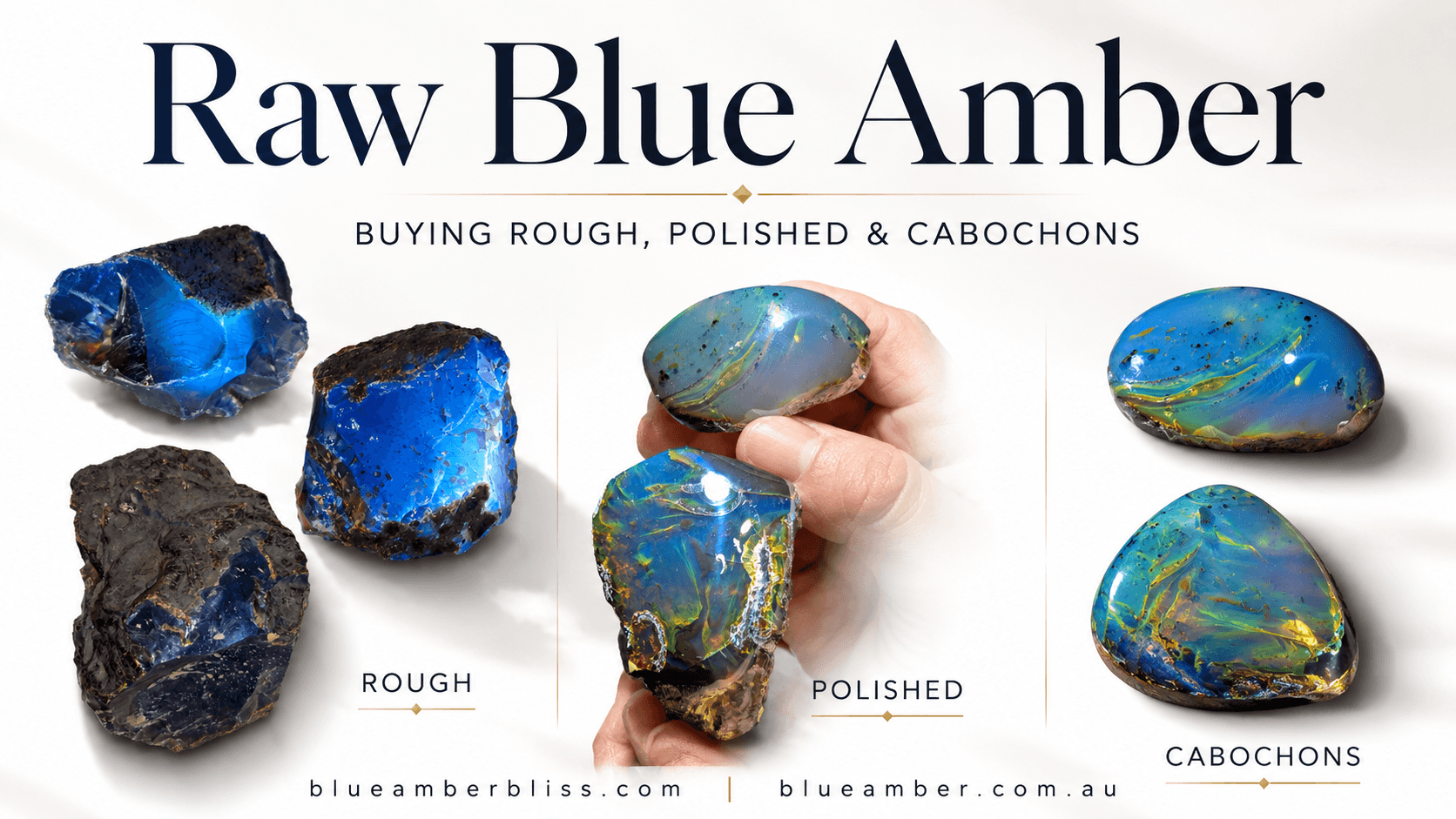
- Raw specimens — sunlight-glowing rough stones; great for collectors and display.
- Polished stones — sculpted faces, tumbled or cabochon shapes that show off glow.
- Finished jewelry — pendants, bracelets, necklaces; stone value plus metal plus craftsmanship.
Each level adds skill, time, and risk, because cutting always sacrifices material. At Mohs 2–2.5 the stone is soft and scratches easily, so good cutting and protective settings are part of what you pay for. Naturally, price per gram increases as you move from raw to polished to jewelry.
Grading: what AA, AAA and AAA+ actually mean
The trade grades blue amber on glow intensity (the percentage of the stone that glows and how evenly), clarity, body color, and size. Mapping that to the price scale:
- AA — partial or uneven glow, more visible body color or fracturing. Mostly rough and entry polished, roughly $3–15/g rough, $15–40/g polished.
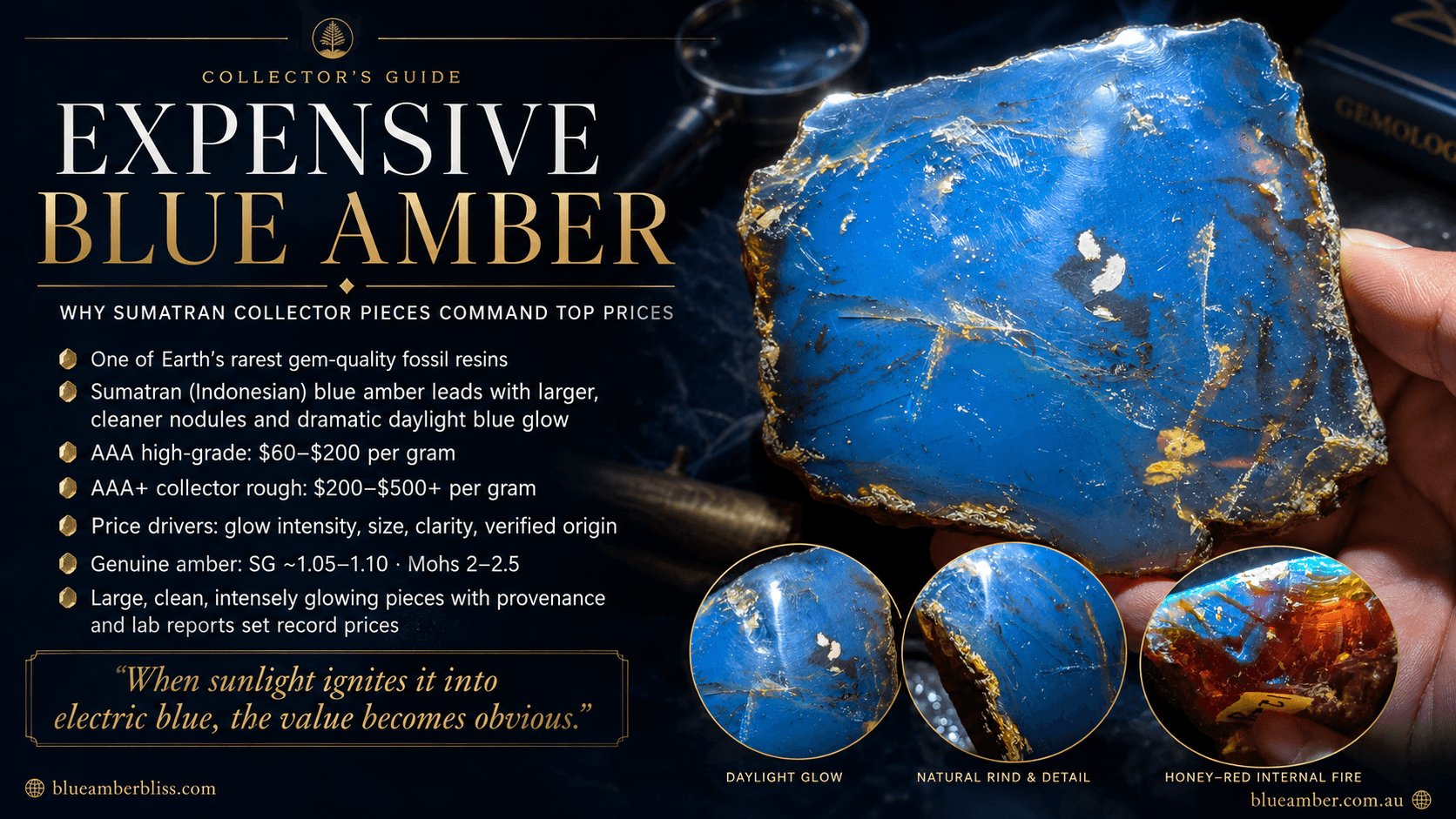
- AAA — strong, broadly even glow, good clarity, clean face. Typically $60–200/g in polished form.
- AAA+ — large, clean, intense and even daylight glow, the standout collector tier Sumatran material is famous for, $200–500+/g.
Curation and trust
You can always find cheaper “blue amber” in random kilo lots, often shot with a heavy blue filter to fake the glow. Curated Sumatran blue amber from a specialist such as Blue Amber Bliss offers verified Sumatran origin, individual photos and videos of the exact piece including its real glow, and clear grading by size, glow, and character. That transparency is part of what you are paying for — and it ties directly to ethics, which you can read about in our note on ethical, conflict-free blue amber sourcing.
How authenticity justifies the price
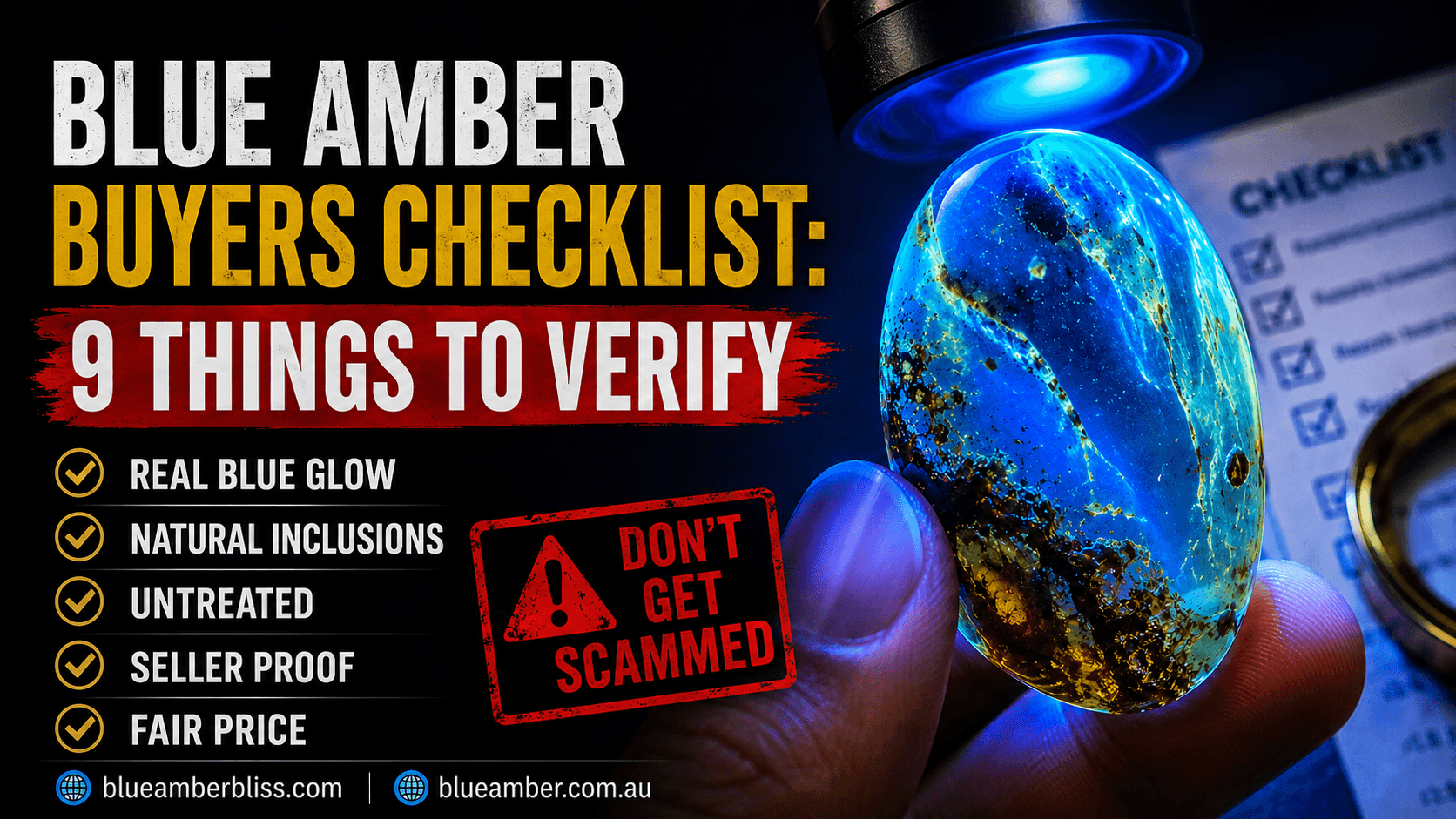
A strong-glow Sumatran piece is only worth top dollar if it is genuinely fossil amber, not copal, plastic, or dyed glass. Four field tests and one lab test do the work; here is the short version, with the full battery in how to tell if blue amber is real.
- 365 nm UV / daylight blue glow: real blue amber fluoresces a clean blue; most plastics and dyes glow flat, the wrong color, or not at all.
- Saltwater float: with a specific gravity of about 1.05–1.10, amber floats in saturated brine (SG ~1.15–1.16) and sinks in fresh water. Most plastics and glass sink in brine.
- Acetone (copal) test: a drop of acetone turns immature copal tacky in 20–60 seconds; mature amber resists it. This separates millions-of-years-old amber from recent resin.
- Succinic-acid / class check & hot-needle: Sumatran and Dominican are retinite (low/no succinic acid), distinct from Baltic succinite; a hot needle on an edge releases a piney, resinous scent rather than burnt-plastic fumes (destructive, edge only).
- Lab documentation: FTIR spectroscopy and a GIA or IGI report give definitive ID and confirm amber-vs-copal maturity. Understanding what a real amber lab report (GIA/IGI/FTIR) certifies is the single best protection on a four-figure purchase.
Every one of these is a reason a documented stone costs more than an anonymous kilo-lot piece — you are buying certainty, not just glow.
Geology and supply: why locality sets a floor under the price
Per-gram value ultimately rests on geology. Sumatran blue amber is an amorphous, non-crystalline fossil resin with a refractive index near 1.54 and a specific gravity of roughly 1.05–1.10 — light enough to float in saturated brine yet sink in fresh water. That softness (Mohs 2–2.5) means every cut, drill, or polish risks the stone, so labor adds real cost on top of raw rarity.
The deposit itself is finite. Sumatran material is recovered from the Miocene coal-bearing sediments of the Sinamar Formation in Jambi Province, a single regional system in the Bukit Barisan foothills. You can confirm amber’s mineraloid status and properties on mindat. Because output is localized and hand-sorted, strong-glow nodules large enough to yield clean AAA+ faces are genuinely scarce — and scarcity, not marketing, is what holds the top of this blue amber price guide.
Realistic price ranges in this blue amber price guide for 2025
These ranges are based on real specialist listings — raw specimens, polished pieces, and bead jewelry — and they all reconcile to the canonical per-gram scale above. For the deep dive, see blue amber price per gram.
Raw Sumatran blue amber (collector specimens)
- Medium-large sunlight-glowing pieces around 100–200 g typically list in the $300–$600 range — effectively the low single digits to low teens per gram, consistent with rough-to-good AA/AAA material.
- Larger 250–350 g centerpieces with strong daylight glow run roughly $600 up to around $1,600+, depending on glow and presence.
That is serious collector territory, not bargain-bin rough.
Polished Sumatran blue amber stones
- Smaller polished stones around 20–30 g, priced roughly $100–$260 depending on glow — the higher figures reflect AAA/AAA+ per-gram values.
- Mid-sized polished specimens between 50–150 g, often $250–$450.
- A spread of 50–150 g showpieces (64 g, 72 g, 76 g, 104 g, 122 g, 148 g) from about $296 to $428.
You are paying not just for weight but for a ready-to-display, ready-to-photograph face with strong glow.
Blue amber necklaces and bracelets (beads)
- Authentic raw-skin bead necklaces (20–25 beads) sit around $1,100–$1,200.
- 15 mm bead bracelets in different tones fall in the $650–$900 corridor.
Because beadwork demands drilling, matching, and stringing — risky on a soft Mohs 2–2.5 stone — the per-gram value is naturally higher than loose stones, but the result is a ready-to-wear statement piece. New to beads? Start with our guide to blue amber beads.
Pendants, rings and carvings
- Simple silver-set pendants with strong-glow stones: ~$200–$400.
- Larger or more intricate silver designs, or pieces with particularly rare stones: ~$400–$800.
- Gold or art-jewelry pieces and detailed carvings: $800 and up, depending on size, metal, and design.
Jewelry pricing = stone value + metal + craftsmanship + brand story.
If the metal is substantial, the design complex, and the glow intense, a higher tag makes sense. Looking for wearable pieces specifically? Browse our notes on blue amber earrings and the wider where to buy blue amber overview.
How to tell if a Sumatran blue amber price is fair
Instead of “Is this cheap or expensive?”, ask “Does this price make sense for what I’m seeing?”
Check the glow
- Do you see clear blue glow in photos or videos under strong white light or sunlight, not just a dark UV shot?
- Does the glow cover a broad area, or only a few tiny patches?
Strong, even glow (AAA/AAA+) justifies higher pricing. Weak or localized glow (AA) belongs at the lower end of the ranges above.
Check the piece type
- 20–30 g polished, great glow → roughly $100–$260
- 50–150 g polished display piece → roughly $250–$450
- 100–200 g raw display piece → roughly $300–$600
- 200–350+ g centerpiece → $600–$1,600+
- Quality bracelets → $650–$900
- 20–25 bead necklace → $1,100–$1,200
If a seller asks “mega-centerpiece” money for a small, average-glow stone, something is off.
Check the seller, origin and documentation
For blue amber you should see real photos of the exact piece (not stock), glow shown from multiple angles under real light, and a clear answer on origin. On higher-value pieces, ask whether FTIR or a GIA/IGI report is available. If origin is vague, there are no glow videos, and every listing reuses the same photo, the low price is not a bargain — it is risk.
What different budgets can buy you in 2025
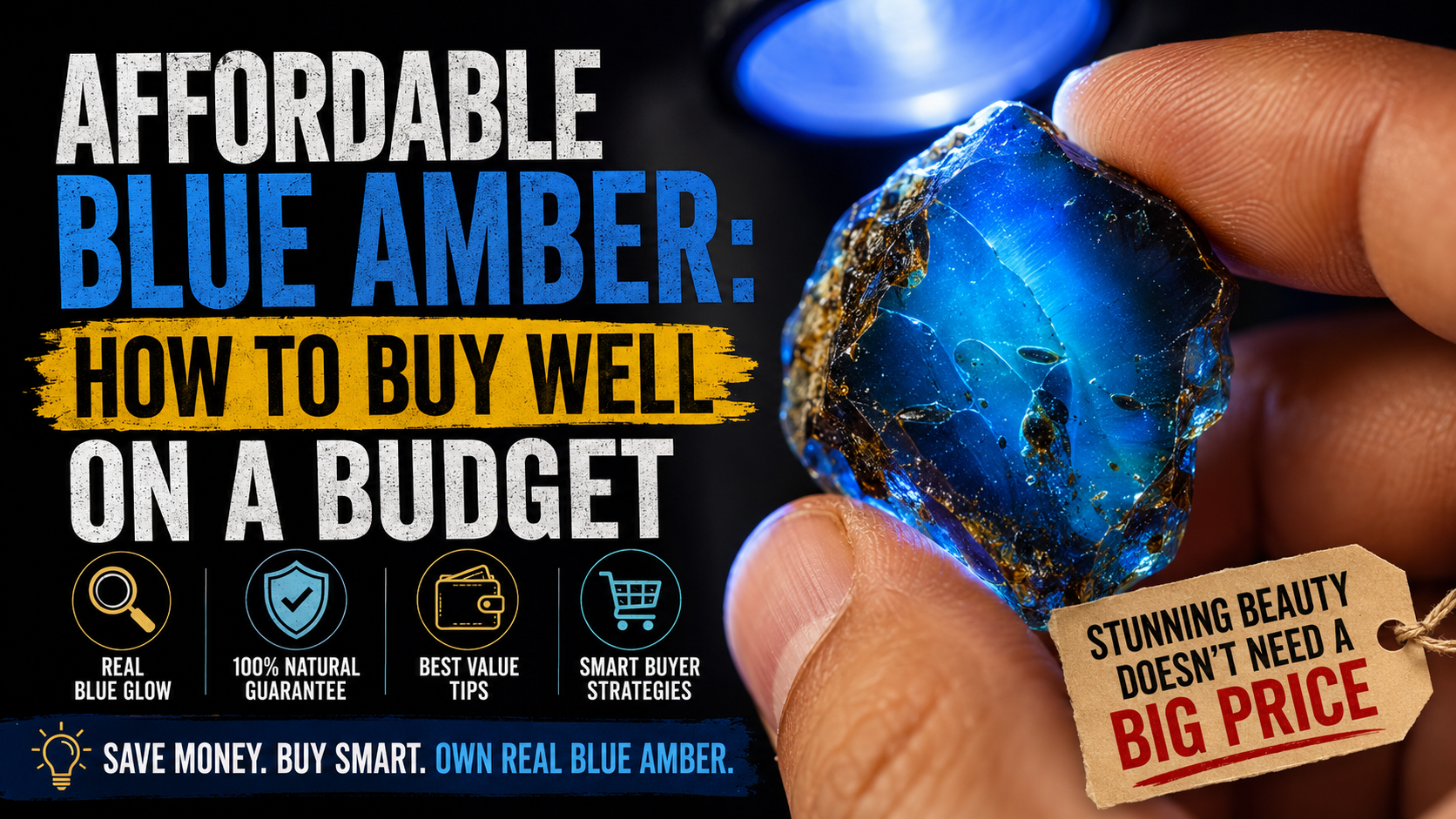
Under $150
- Small polished or tumbled pieces; entry-level 20–30 g stones with visible blue glow (AA–AAA), occasionally a discounted mid-sized stone on sale.
$150 – $400
- Stronger-glow polished stones in the 30–80 g range, some 50–100 g showpieces, and simple silver pendants.
$400 – $1,000
- High-grade AAA polished specimens (50–150 g) with very good glow, raw specimens in the 150–300 g range with clear daylight glow, quality bead bracelets, and more complex silver jewelry.
$1,000+
- Museum-style AAA+ raw centerpieces (250–350+ g) with strong sunlight glow, full matched bead necklaces, detailed carvings, and high-end statement jewelry.
In this tier you are collecting art plus geology plus story, not just grams. Protect that investment by reading how to clean blue amber safely and how to store blue amber safely — a soft, light-sensitive gem rewards careful handling.
Is Sumatran blue amber “good value” vs Dominican?
This is where Sumatran blue amber shines. The two materials are equal in quality — both retinite-class resins, both fluorescing blue from perylene and PAHs — but Sumatran is the newer, bigger-nodule, more dramatic source.
While Dominican (Oligocene–Miocene, millions of years in the making, from the Hymenaea protera tree, mined at La Cumbre, La Toca, and Palo Quemado in the Cordillera Septentrional near Santiago) still carries the old marketing halo, Sumatran offers comparable or stronger daylight fluorescence, larger clean display pieces, and full bead sets that, for now, often cost less than Dominican pieces of similar impact. For a side-by-side, see Sumatran vs Dominican blue amber compared.
Blue amber that looks and feels world-class, from a locality still being fully appreciated — and still priced like it is a secret.
Blue amber price guide FAQ (2025)
Is Sumatran blue amber expensive?
Compared to generic amber, yes. Compared to other rare glowing gemstones and to Dominican blue amber, it is often strong value for the visual impact and rarity you get. Expect roughly $3–15/g for rough or low-glow material and $200–500+/g for top AAA+ collector pieces.
How much does Sumatran blue amber cost per gram?
One canonical scale: $3–15/g rough/low-glow, $15–60/g polished with good blue glow, $60–200/g high-grade AAA, and $200–500+/g top AAA+ large, clean, intense-glow collector pieces. Curated stones are usually sold per piece, but every per-piece figure in this guide reconciles to that range. See blue amber price per gram for worked examples.
Why do some Sumatran blue amber pieces cost over $1,000?
They tend to be large sunlight-reactive AAA+ centerpieces, fully beaded necklaces with matched glow, or artist-level jewelry and carvings. You are paying for size plus glow plus rarity plus design — landing those pieces in the $200–500+/g top tier — not just weight.
How do I make sure I am not overpaying for a fake?
Verify the glow under 365 nm UV or daylight, confirm it floats in saturated saltwater but sinks in fresh water, and on a serious purchase ask for FTIR or a GIA/IGI report. Copal turns tacky under acetone in under a minute; mature amber does not. Documentation is what justifies a premium price.
Is Sumatran blue amber a good investment?
No gemstone is guaranteed, but Sumatran blue amber has limited, localized supply, surging collector awareness, and visual impact that photographs and films extremely well. Choose pieces you genuinely love, keep their documentation, and you gain emotional value now and potential collector value later.
Final thoughts: buying Sumatran blue amber smart in 2025
If you remember only three things from this blue amber price guide, let them be these:
- Glow first, everything else second. If you do not see strong, even blue under daylight or 365 nm UV, the price should be lower.
- Match your budget to realistic bands. Use the per-piece ranges above, all anchored to the $3–500+/g canonical scale.
- Prioritize trusted, Sumatra-focused, documented sellers. That is where you find true AAA+ “new star” material — carefully chosen, verifiable stones that show why blue amber from Sumatra is capturing serious collectors’ hearts.
What We Notice About Value When Selecting Sumatran Blue Amber
At Blue Amber Bliss, the pieces that hold their value are the Sumatran stones that earn it in the hand: a dark cognac body that pulls to a deep blue glow as you move from indoor light out into daylight, with the strength and clean transition doing far more for price than raw weight. We pay close attention to how far that glow travels, the polish, and whether natural inclusions read as genuine specimen character rather than flaws, since those are the traits collectors return for. A larger nodule with a lazy shift is worth less to us than a well-cut piece that transforms convincingly, and that is usually where a buyer’s budget is best spent. These are ancient natural resins, millions of years in the making, so we grade each one individually rather than by a fixed rate card.
If you would like to see how these qualities come together in person, we warmly invite you to explore our hand-selected Sumatran blue amber at Blue Amber Bliss. Shop hand-selected Sumatran blue amber →
Related Blue Amber Guides
- Where to Buy Blue Amber
- Blue Amber Price Per Gram
- Blue Amber Investment
- Most Expensive Blue Amber
- How Rare Is Blue Amber? Rarity, Value and Price Guide
- Sumatran Blue Amber for Sale