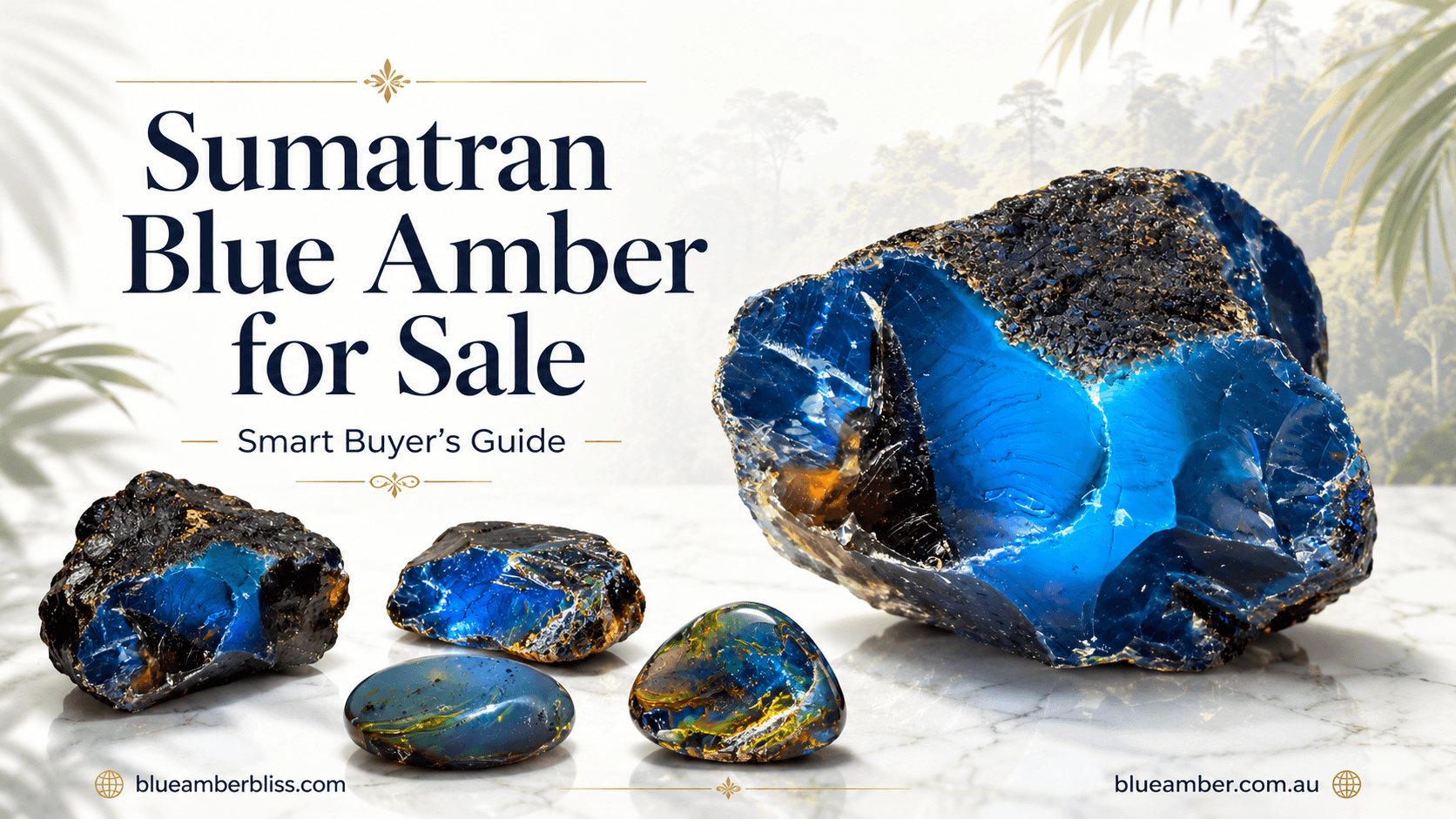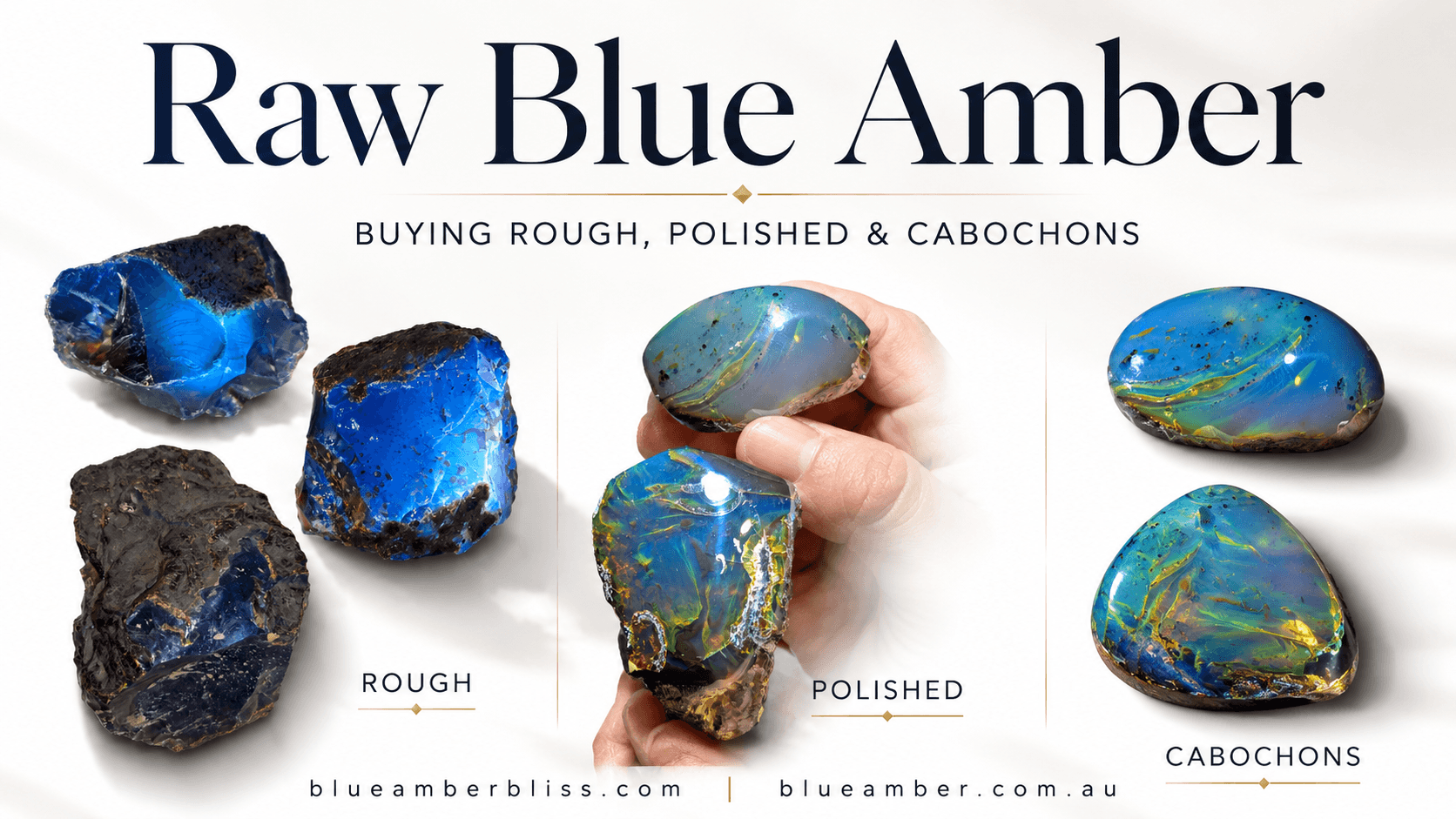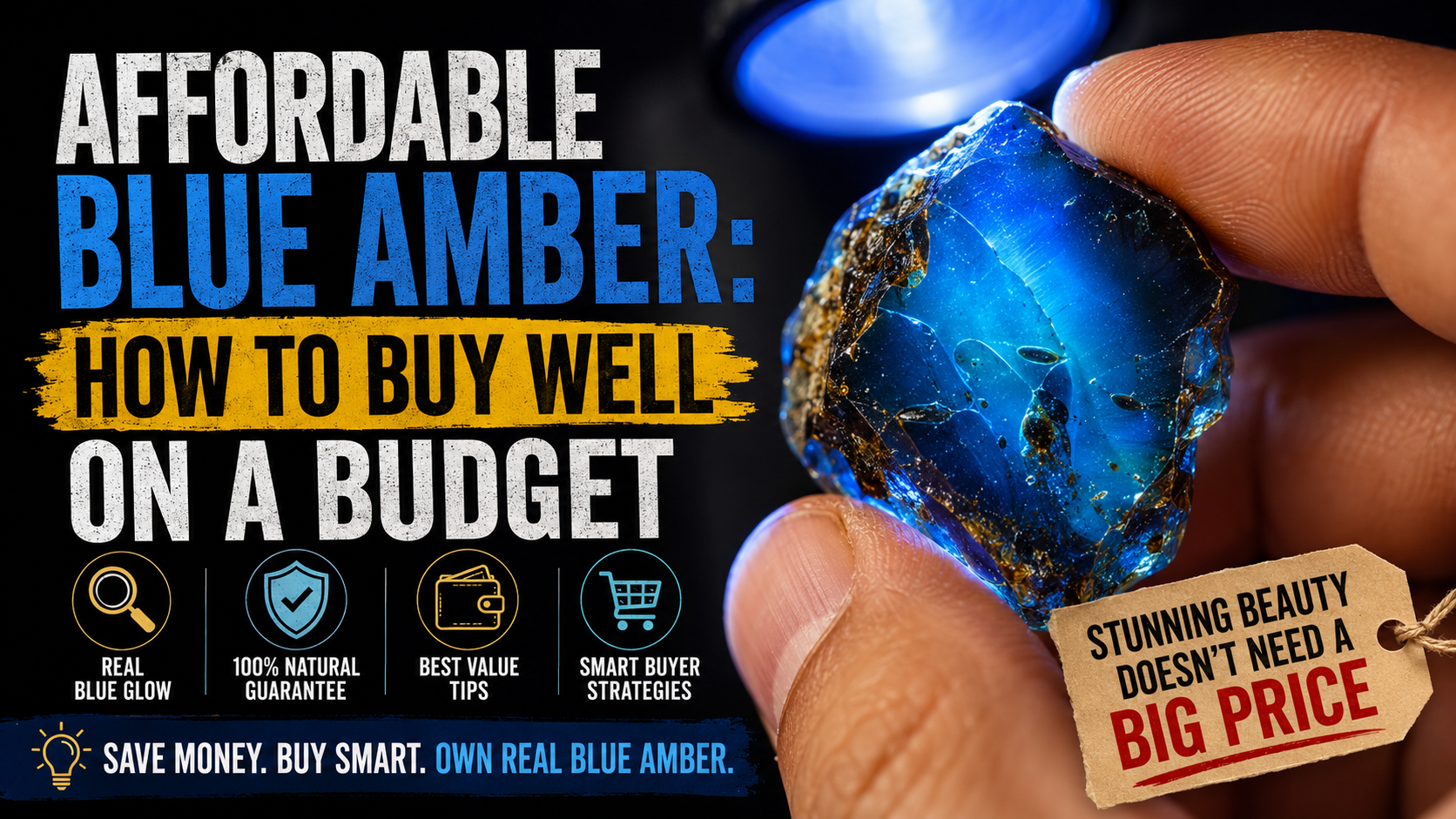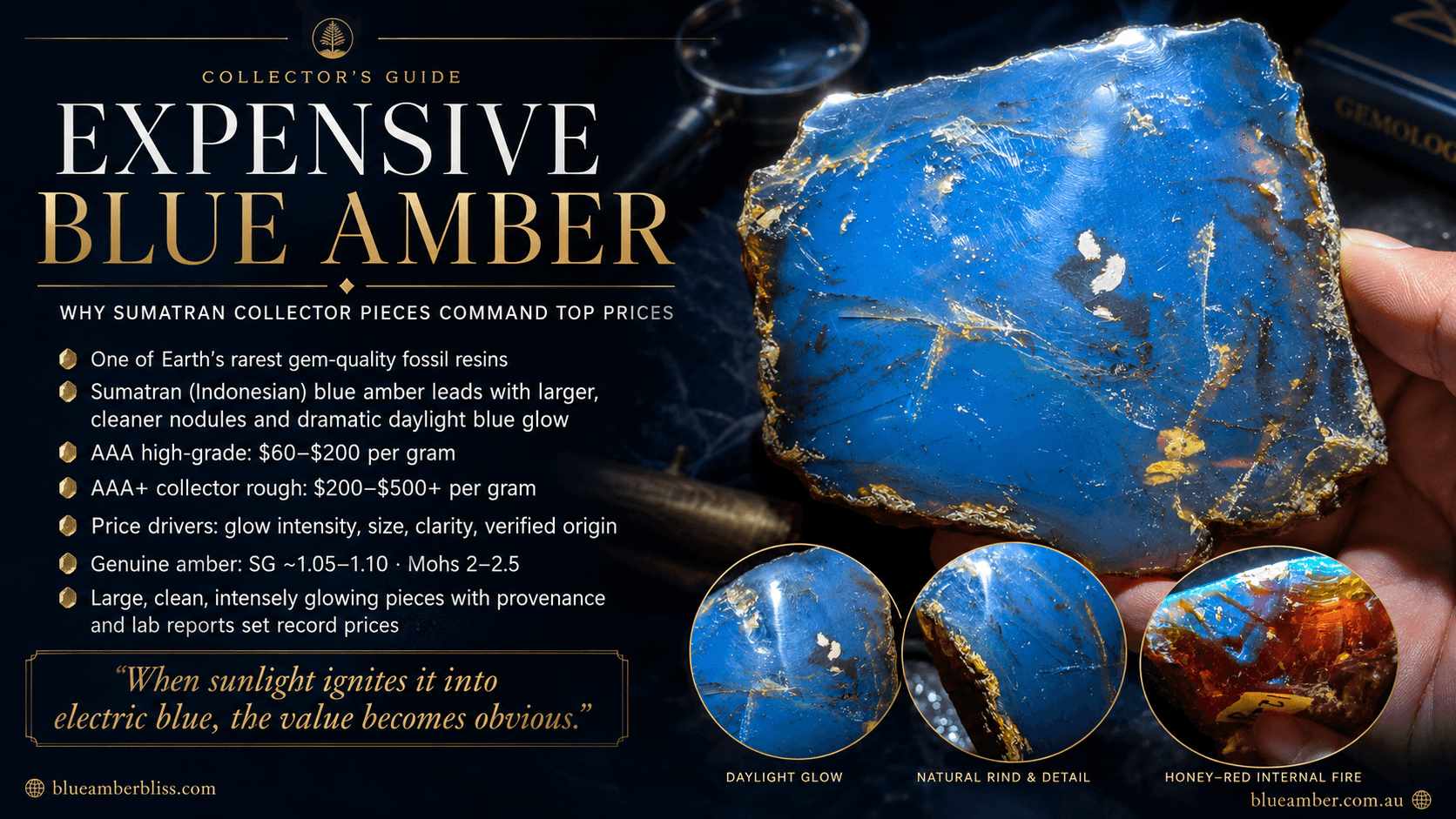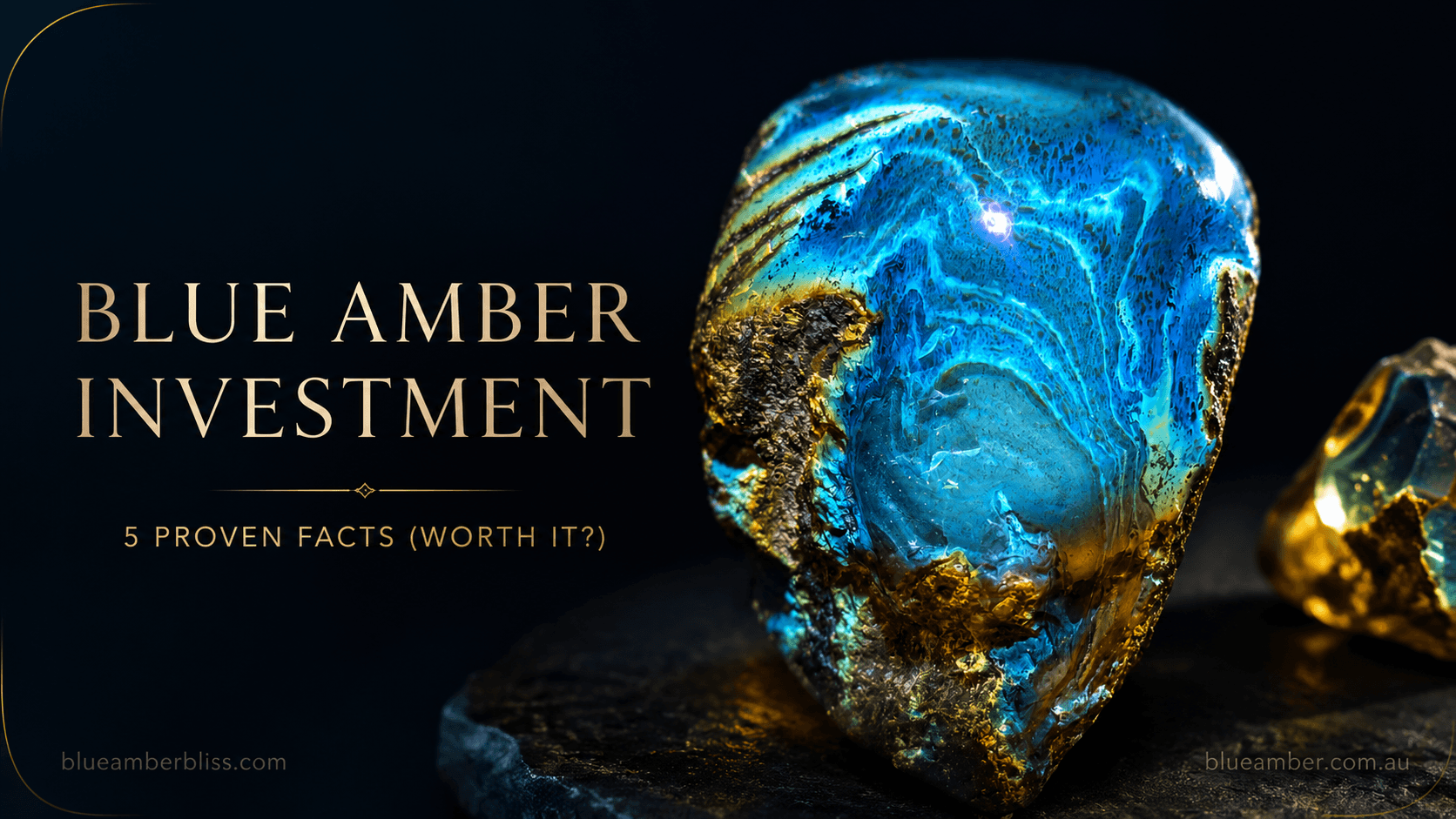
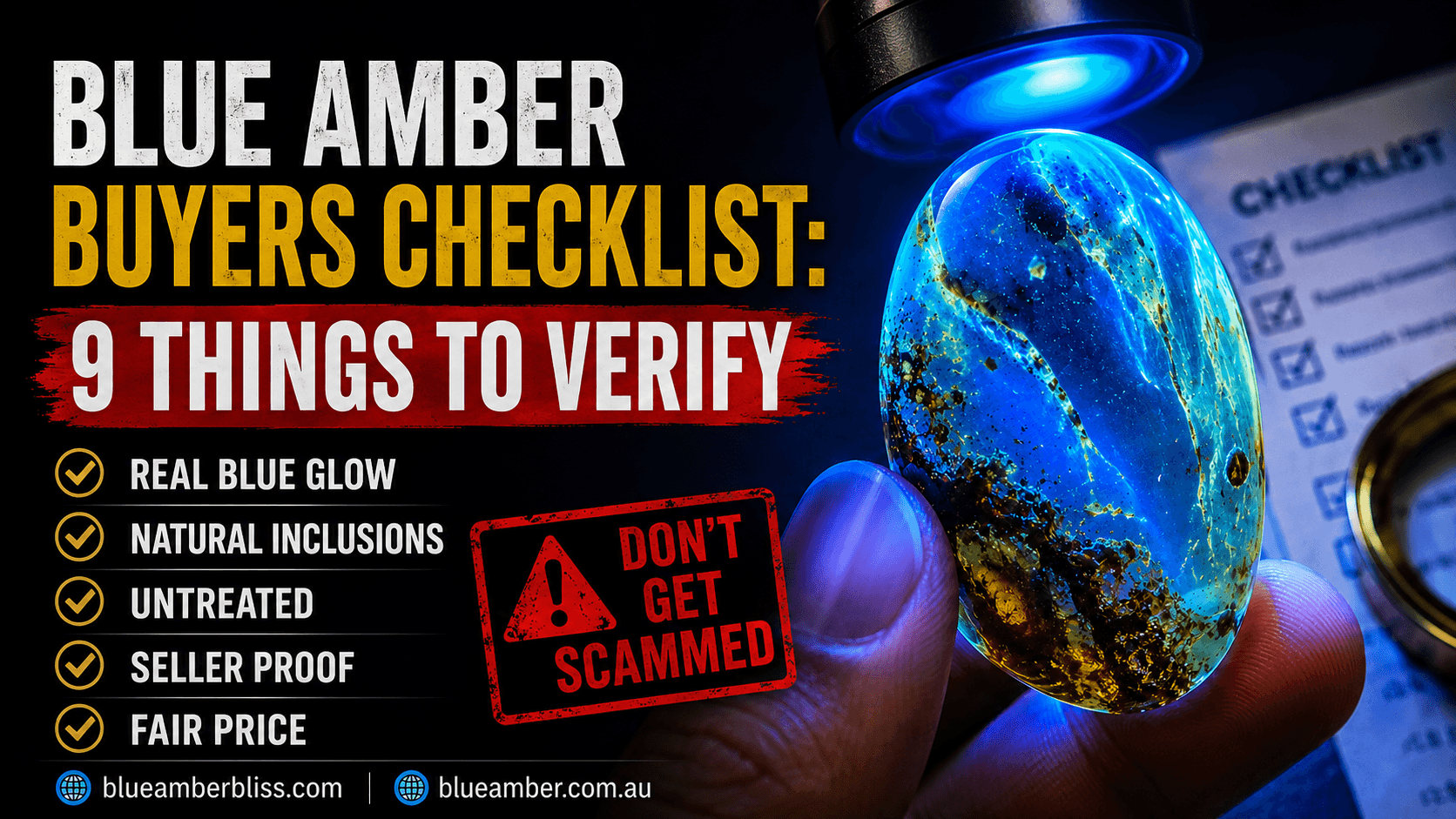
Your blue amber buyers checklist comes down to nine things to verify before you pay: confirm Sumatran (Jambi) provenance, get a lab report or certificate, see UV-365nm and daylight glow media, confirm natural (untreated) status, check the saltwater float, sanity-check price against grade, read the return policy, vet the seller, and get every claim in writing.
That is the short version. Below, a working gemologist walks you through each step so you can spend with confidence rather than hope. Sumatran blue amber is the standout of the market, and a disciplined blue amber buyers checklist is how you make sure the stone in the photo is the stone that reaches your door.
Key Takeaways
- Provenance first: Sumatran (Indonesian, Jambi-region) blue amber is the hero of the market — newer source, larger nodules, and a dramatic daylight blue glow — so your blue amber buyers checklist should demand it by name.
- Documentation beats adjectives: a lab report or FTIR result and a written certificate of authenticity outrank any “trust me” description.
- Two lights, always: insist on UV (365nm) fluorescence and natural-daylight photos or video — a single flattering shot is not proof.
- Physics you can cite: real amber floats in saltwater (specific gravity ~1.05–1.10) and is soft at Mohs 2–2.5; know the numbers before you buy.
- Money protection: a clear blue amber return policy, fair price-to-grade, and written confirmation turn a leap of faith into a confident purchase.
Why Does a Blue Amber Buyers Checklist Matter?
Blue amber is one of the rarest colors of amber on Earth, and rarity attracts imitations. Copal, pressed amber, plastic, and dyed resin all get sold as the real thing. A structured blue amber buyers checklist is your defense: it converts vague trust into specific, verifiable facts before your money leaves your hands.
The stakes are real. Fine Sumatran material can command hundreds of dollars per gram at the top grades, so a single confident-but-wrong purchase hurts. Knowing what to look for when buying blue amber — and asking for it up front — protects both your wallet and your collection’s integrity.
This page owns one job: what to verify before you pay. For the full at-home test battery, see our guide on how to spot real blue amber, and for lab documentation in depth, read blue amber certification. Here we focus on the pre-purchase conversation.
The 9-Point Blue Amber Buyers Checklist (Table)
Use this table as your quick-reference. Screenshot it, then work top to bottom with any seller. Each row is a gate — if a seller cannot clear it, treat that as a signal, not a shrug. A complete blue amber buyers checklist should leave no row blank.
| # | Verify This | What to Ask For | Green Flag | Red Flag |
|---|---|---|---|---|
| 1 | Provenance | Country + region of origin | Sumatra / Jambi, Indonesia stated plainly | “Baltic blue,” vague, or shifting origin |
| 2 | Documentation | Lab report / FTIR / certificate | Named lab, FTIR spectrum, matching weight | No paperwork, or a generic PDF |
| 3 | Two-light proof | UV-365nm + daylight photo/video | Blue glow shown under both | One shot only, or heavy editing |
| 4 | Treatment status | Natural vs treated/pressed disclosure | “Natural, untreated” in writing | Silence or “enhanced” without detail |
| 5 | Float test | Saltwater float video | Floats in ~1.10 SG brine | Sinks, or test refused |
| 6 | Price vs grade | Price per gram + grade | Sits within market range | Too cheap, or unexplained premium |
| 7 | Return policy | Written refund window | Clear returns + who pays shipping | “All sales final” on a big buy |
| 8 | Seller reputation | Reviews, history, specialization | Verifiable track record | Brand-new, no reviews, pressure |
| 9 | Written confirmation | Claims in the receipt | Origin + natural status on invoice | Verbal-only promises |
1. Demand Provenance: Is It Sumatran (Jambi) Blue Amber?
Start every blue amber buyers checklist here, because origin drives everything else. Ask directly: what country and region is this from? The answer you want is Sumatra, Indonesia — specifically the Jambi province deposits that made Indonesian blue amber famous for large, clean nodules and an intense daylight glow.
Sumatran blue amber is the newer, standout source. Its bigger rough and strong blue fluorescence make it more valuable and the market’s leading choice. Dominican blue amber is a fine, respected material of equal underlying quality — but Sumatran’s larger sizes and top-tier clarity make it the piece to own.
Blue amber provenance is not a formality. Origin affects glow character, typical size, and price, so a seller who cannot name the deposit cannot really price the stone. If the answer is evasive, or suddenly “Baltic blue” (Baltic amber is not naturally this blue), pause. Genuine sellers state Sumatran origin without hesitation.
2. Ask for a Lab Report, FTIR, or Certificate of Authenticity
The single strongest line on any blue amber buyers checklist is documentation. Ask: is there a blue amber certificate of authenticity, and can I see a lab report? For higher-value pieces, request an FTIR (Fourier-transform infrared) spectrum, the gold-standard test that separates true amber from copal and plastic.
FTIR reads a material’s molecular fingerprint. Amber, copal, and modern resins each produce distinct spectra, so a lab can confirm “natural amber” objectively rather than by eye. According to the GIA’s amber overview, infrared spectroscopy is a primary tool for identifying amber and detecting imitations and treatments.
A good certificate names the issuing lab, describes the specimen, states weight and dimensions, and confirms natural status. Cross-check the weight on the certificate against the weight in the listing — they should match. Learn what a strong document looks like in our blue amber certification guide before you rely on one.
3. Require UV (365nm) and Daylight Glow Media
Blue amber earns its name from fluorescence, so your blue amber buyers checklist must demand proof under two lights. Ask for a photo or short video under a 365nm UV torch and a second under natural daylight. One flattering studio shot proves nothing; two independent lights are much harder to fake.
Under 365nm UV, quality Sumatran blue amber lights up an electric, almost neon blue. In direct sunlight against a dark background, top material shows that signature daylight blue haze that makes the source so celebrated. The glow is a surface-and-body optical effect, not a dye, so it should look alive and depth-filled, not painted on.
Ask the seller to include something for scale and to film continuously rather than cutting between clips. A live video that pans from daylight to UV in one take is one of the most convincing items on any blue amber buyers checklist. For the physics behind the glow, see how to spot real blue amber.
4. Confirm Natural vs Treated or Pressed — In Writing
Amber is commonly heated, clarified, or reconstituted, so a serious blue amber buyers checklist forces this disclosure. Ask plainly: is this natural and untreated, or has it been heated, autoclaved, or pressed (ambroid)? You want the answer in writing, not a shrug.
Pressed amber (ambroid) is made by fusing small fragments under heat and pressure. It is real amber in a technical sense, but it is worth far less than a solid natural nodule and should never be sold at natural prices. Treatment disclosure is standard ethics; the GIA’s amber quality factors page discusses how clarity and treatment affect value.
Signs that invite a treatment question include suspiciously uniform “sun spangles” (disc-like stress cracks from rapid heating) and glassy, bubble-free perfection across a large piece. None of these are automatic disqualifiers — but each deserves a straight answer. A seller who documents natural status protects you; one who dodges it belongs lower on your list.
5. Check the Saltwater-Float Claim
Physics is your friend, and this is the most quotable line on a blue amber buyers checklist. Amber’s specific gravity runs roughly 1.05–1.10, so it floats in a saturated saltwater solution (about 1.10 SG, made with roughly two tablespoons of salt per cup of water) while most plastics, glass, and heavier fakes sink.
Ask the seller for a short float-test video in brine. Real amber will bob at or near the surface; a phenolic resin or a doublet with a glass core will drop. It is a fast, cheap screen that a legitimate seller can perform in two minutes and will not resist.
One caveat to keep this honest: copal, an immature resin, also floats, so the float test proves “resin, low density,” not “genuine ancient amber.” That is exactly why it lives beside FTIR and UV on your blue amber buyers checklist rather than standing alone. Combine tests; never lean on one.
6. Sanity-Check Price Against Grade
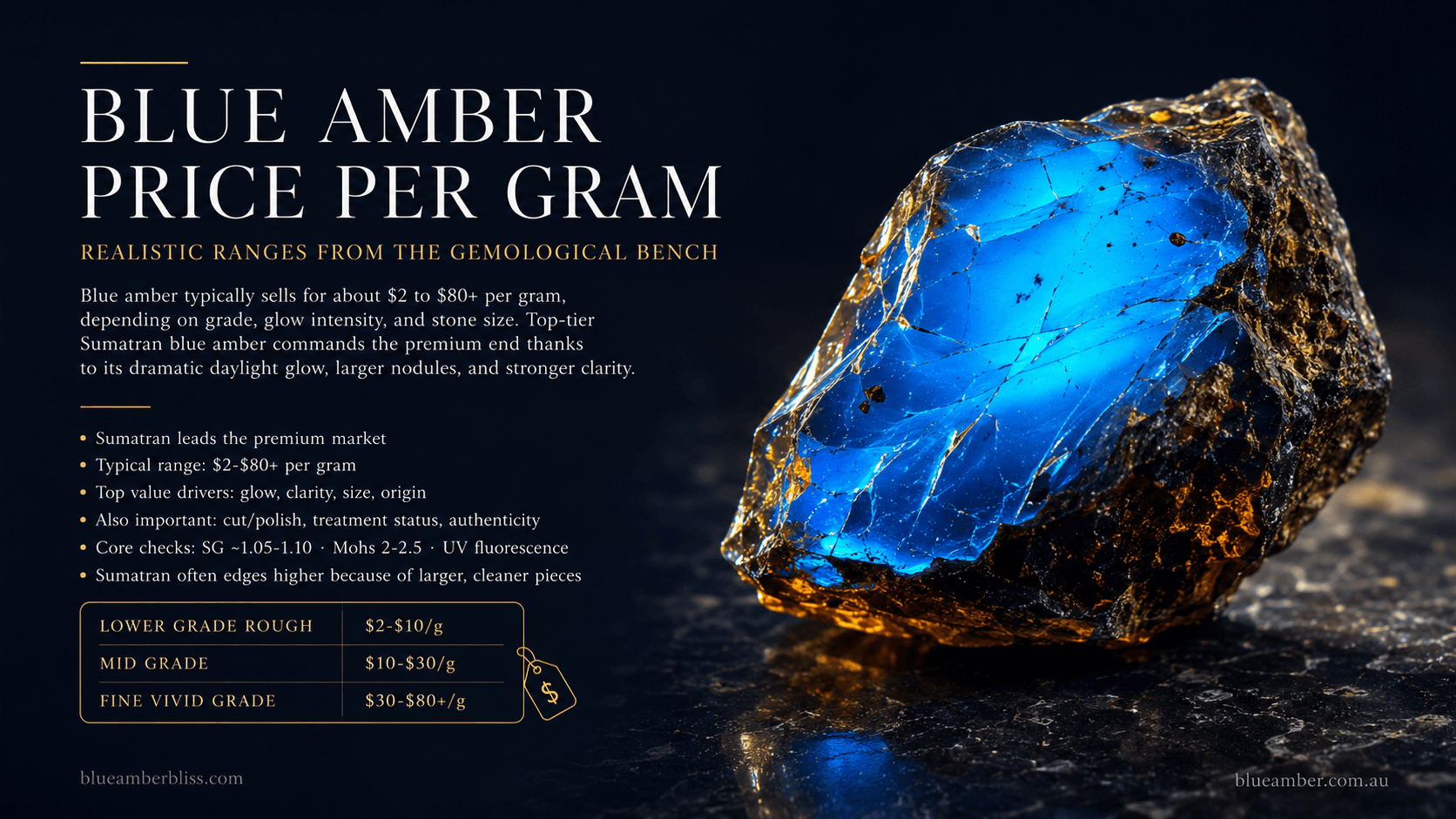
Now bring economics to your blue amber buyers checklist. Blue amber is priced per gram, and price scales steeply with the strength and evenness of the blue, clarity, size, and whether it is a finished cabochon or rough. A price that looks too good almost always is.
As a rough map: entry-grade blue material may sell in the low tens of dollars per gram, mid-grade Sumatran cabochons often run higher, and top “sky-blue” specimens can exceed several hundred dollars per gram. A “rare blue amber” nodule priced like ordinary cognac Baltic amber is a warning, not a bargain.
Compare like with like — grade, weight, and form — using our blue amber price guide. If a price sits far below the range for its stated grade, either the grade is overstated or the material is not what it claims. Understanding value is where a blue amber buying checklist quietly saves you the most money.
7. Read the Return and Refund Policy Before You Pay
A confident purchase is a reversible one, so the blue amber return policy is non-negotiable on your blue amber buyers checklist. Read it before checkout, not after. You want a clear window (commonly 14–30 days), stated condition requirements, and an explicit answer on who pays return shipping.
“All sales final” can be acceptable on a small, fully documented curio. On a four-figure Sumatran cabochon, it should give you pause — a seller confident in authenticity rarely needs to block returns. The willingness to stand behind a piece after it arrives is itself a form of proof.
Confirm how disputes are handled and whether the platform (if any) adds buyer protection. A written, findable refund policy signals a professional operation. If you have to ask twice to see it, that hesitation is data. Where you buy shapes these protections — our guide on where to buy blue amber covers reputable channels.
8. Verify Seller Reputation and Specialization
Who you buy from can matter as much as what you buy, so weight this heavily on your blue amber buyers checklist. Look for a track record: reviews across time, consistent photography, transparent origin claims, and genuine specialization in amber rather than a catch-all shop that lists “rare gems” beside phone cases.
Read the substance of reviews, not just the star count. Do buyers mention accurate color, prompt shipping, and honored returns? A specialist who talks fluently about Jambi deposits, FTIR, and UV response is far safer than a generalist reciting marketing lines. Expertise leaks into every message they send you.
Be wary of manufactured urgency — “last one, price rising tonight.” Pressure is a tactic to short-circuit your blue amber buyers checklist, not a real market condition. A reputable seller welcomes your questions and gives you time to verify. To understand the imitations a good seller helps you avoid, see our breakdown of fake blue amber.
9. Get Every Claim in Writing
The final gate on your blue amber buyers checklist ties the rest together: get it in writing. Verbal promises evaporate; an invoice does not. Ask that the receipt or order confirmation states origin (Sumatra/Jambi), natural/untreated status, weight, and any grade description you were quoted.
Written claims give you recourse. If a stone arrives that contradicts a documented statement — say it was billed as “natural, Sumatran” but shows pressed-amber flow lines — you now have grounds for a return or dispute. Without writing, it is your memory against theirs, and that is a weak position.
This step costs nothing and changes everything. Sellers acting in good faith will happily put the facts on paper, because those facts are true. A refusal to document simple, factual claims is the clearest signal a blue amber buyers checklist can surface. When origin and treatment are printed on your invoice, trust becomes a confident buy.
What to Look For When Buying Blue Amber: Quick Field List
Beyond the nine gates, keep this short field list handy while you scroll listings. It captures the sensory cues that separate real Sumatran material from imitations and pairs naturally with the formal blue amber buyers checklist above.
- Daylight glow: a living blue haze over the base color, strongest against dark backgrounds and in sunlight.
- UV response: vivid blue under 365nm — copal glows weakly and plastic often not at all.
- Warmth and weight: amber feels warm to the touch and light in hand (SG ~1.05–1.10); glass feels cold and heavy.
- Softness: at Mohs 2–2.5 it is easily scratched, so beware suspiciously hard “amber.”
- Natural inclusions: genuine bubbles, plant debris, or flow lines — not repeating patterns that hint at a mold.
- Scent when warmed: gentle pine-resin aroma with friction; a chemical smell suggests plastic.
How Does This Checklist Compare to At-Home Testing?
Think of them as two halves of one workflow. The blue amber buyers checklist governs the pre-purchase conversation — what you demand from a seller before paying. At-home testing governs the post-arrival confirmation — what you verify once the stone is in your hand.
| Aspect | Blue Amber Buyers Checklist (before you pay) | At-Home Testing (after it arrives) |
|---|---|---|
| Goal | Screen the seller and the claims | Confirm the physical stone |
| Tools | Questions, documents, media requests | UV torch, saltwater, loupe, hot needle |
| Key proof | Certificate, FTIR, provenance, policy | Float, fluorescence, scent, hardness |
| Risk covered | Fraud, misdescription, no recourse | Swaps, undisclosed treatment |
| Where it lives | This page | Real vs fake guide |
Run the blue amber buyers checklist first to avoid bad purchases, then run the at-home tests the day your package lands — while the return window is still open. Used together, they close nearly every gap a counterfeiter might exploit.
What We Check Before a Sumatran Piece Earns Its Place
At Blue Amber Bliss, verification is not a formality for us, it is how every Sumatran stone earns its place before we list it. We move each piece from indoor light into daylight and watch for that decisive shift, where a dark cognac body suddenly wakes into deep blue glow, because a genuine Sumatran will transform rather than merely tint. We check that inclusions and specimen character read as natural under a loupe, that the polish is clean without masking the body, and that the nodule size holds up to what the description promises. When a stone passes all of it and still holds collector presence in the hand, that is when we know it is worth offering.
If you would like to see what a fully vetted stone looks like, we warmly invite you to explore our hand-selected Sumatran blue amber at Blue Amber Bliss. Shop hand-selected Sumatran blue amber →
FAQ
What is the most important item on a blue amber buyers checklist?
Provenance and documentation tie for first. Confirm Sumatran (Jambi) origin, then secure a certificate of authenticity or FTIR report. Origin sets value and expected glow, while lab documentation objectively proves the material is natural amber rather than copal, pressed amber, or plastic.
What should I look for when buying blue amber online?
Knowing what to look for when buying blue amber online means insisting on two-light media (365nm UV plus daylight), a stated origin, treatment disclosure, a fair per-gram price for the grade, and a clear return policy. If a listing lacks any of these, ask before you buy.
Do I really need a blue amber certificate of authenticity?
For anything beyond an inexpensive curio, yes. A blue amber certificate of authenticity from a named lab — ideally backed by an FTIR spectrum — is the strongest single assurance you can hold. It confirms natural amber and supports any future resale. See our certification guide for what a real one contains.
How do I confirm blue amber provenance?
Ask the seller to state country and region outright; genuine blue amber provenance for our market is Sumatra, Indonesia (Jambi). Cross-reference with size and glow — Sumatran material tends toward larger nodules and a strong daylight blue. Vague or shifting answers, or “Baltic blue,” are warning signs.
Is Sumatran or Dominican blue amber better?
Both are genuine, high-quality blue ambers of equal underlying merit. Sumatran is the newer source and the standout: it yields larger nodules with excellent clarity and a dramatic daylight blue glow, which makes it more valuable and the piece most collectors chase. List and prioritize Sumatran first.
Does real blue amber float in water?
In saturated saltwater (about 1.10 specific gravity), yes — amber’s SG of roughly 1.05–1.10 lets it float while denser fakes sink. It floats in fresh water only marginally, so use brine. Note that copal floats too, so pair this with UV and, ideally, FTIR.
What should a blue amber return policy include?
A fair blue amber return policy states a clear window (often 14–30 days), the condition the item must be returned in, who pays return shipping, and how refunds are issued. On higher-value Sumatran pieces, avoid “all sales final” — confident sellers stand behind authenticity.
How much should I expect to pay per gram?
Prices scale with grade. Entry material can start in the low tens of dollars per gram, mid-grade Sumatran cabochons run higher, and top sky-blue specimens can exceed several hundred dollars per gram. Use our price guide to match price to grade before you commit.
Can I skip the checklist if the seller has good reviews?
No. Reviews are one item on the blue amber buying checklist, not a replacement for it. Even honest sellers occasionally misdescribe pieces. Reputation lowers risk, but documentation, two-light proof, and a written invoice are what actually protect your money.
How do I tell natural blue amber from pressed or treated amber?
Ask for explicit disclosure in writing, then watch for tell-tale signs: uniform disc-shaped “sun spangles,” flow lines from fused fragments, or glassy bubble-free perfection over a large area. FTIR and a specialist’s opinion settle it. Our fake blue amber guide shows the imitations to rule out.
Turn Your Blue Amber Buyers Checklist Into a Confident Buy
Verification is not paranoia — it is how confident collectors buy. Work these nine gates in order, keep Sumatran (Jambi) origin at the front of your mind, and treat every unanswered question as useful data. A seller who clears the full blue amber buyers checklist has earned your purchase.
When you are ready, start with vetted sources in our where to buy blue amber guide, and keep this blue amber buyers checklist open in another tab. Do the work before you pay, and the stone that arrives will be exactly the brilliant Sumatran blue amber you fell for.
Related Blue Amber Guides