
Blue amber jewelry is fine jewelry set with rare blue amber, a fossilized tree resin that glows blue under daylight and ultraviolet light. Sumatran (Indonesian) blue amber leads the field, prized for its dramatic daylight glow and large nodules. The main styles are rings, pendants, necklaces, bracelets, and earrings, usually set in silver or gold.
If you have ever turned a stone in the sun and watched it light up electric blue, you already understand the magic. As a gemologist who handles this material constantly, my goal here is to help you choose a piece that suits your life, lasts, and shows that glow at its best. This is the hub guide we point new collectors to first, and it links out to every detail you could want.
Key Takeaways
- Sumatran blue amber is the standout. A newer source famous for bigger nodules and a vivid daylight blue glow, it is the most valuable and sought-after blue amber today.
- Five core styles dominate: rings, pendants, necklaces, bracelets, and earrings, each showing the glow differently.
- Settings matter: open-back silver or gold settings (and proper bezel or cabochon cutting) let light pass through and maximize the blue fluorescence.
- Amber is soft (Mohs 2-2.5, specific gravity ~1.05-1.10, refractive index ~1.54), so pendants and earrings face less wear than rings and bracelets.
- Grade governs price: AA, AAA, and AAA+ tiers map to glow intensity, clarity, and size, driving a range from about $3 to $500+ per gram.
- Care is simple: avoid heat, chemicals, and ultrasonic cleaners; wipe with a soft, damp cloth.
What Is Blue Amber Jewelry?
Blue amber jewelry is jewelry made with blue amber, a natural fossilized resin millions of years in the making in Sumatran material (Miocene epoch). In ordinary indoor light it often looks honey, cognac, or greenish. The “blue” appears as a fluorescence when ultraviolet light, including sunlight, strikes it.
That glow is not body color. Blue amber contains perylene and other polycyclic aromatic hydrocarbons (PAHs) that absorb UV and violet light (around 350-400 nm) and re-emit visible blue. According to the GIA, amber is an organic gem of fossilized plant resin, not a mineral, which is why it behaves so differently from a sapphire or topaz. We unpack the optics fully in our blue amber properties guide.
For a deeper primer on the material itself, see our guide on what blue amber is. The short version: not all amber fluoresces blue, and the strongest, most dramatic glow comes from select sources, which brings us to Sumatra.
Why Does Blue Amber Glow Blue?
The blue is fluorescence, not body color. Perylene and related PAHs absorb short-wavelength UV and violet light and re-emit it as blue, peaking near 450, 474, and 508 nm in Dominican material (GIA Gems & Gemology, Winter 2020). Rayleigh and Tyndall scattering of short wavelengths at the polished surface deepens the effect, which is why people say blue amber is “not really blue.”
It is fluorescent, not phosphorescent: the glow stops the instant the exciting light is removed, with no afterglow. That single behavior, plus the saltwater float, separates real blue amber from most fakes faster than any other test.
Why Is Sumatran Blue Amber the Best for Jewelry?
Sumatran blue amber is the hero of modern blue amber jewelry. It formed from Dipterocarpaceae resin (most likely Shorea), a tropical hardwood, in the Sinamar Formation of Jambi Province in the South Sumatra Basin, along the Bukit Barisan foothills. As a newer source, Sumatra yields notably larger nodules, so jewelers cut bigger, cleaner cabochons.
It is also famous for a dramatic, easy-to-see daylight blue glow. Sumatran and Dominican blue amber are genuinely equal in quality, but because Sumatran rough is larger and somewhat cleaner, it stands out as the more valuable and collectible choice today. See the full Sumatran vs Dominican blue amber comparison for how the two deposits diverge.
Blue Amber Provenance and Properties
Two deposits supply the world’s blue amber, and both are retinite-class fossil resins, low in or free of succinic acid (unlike Baltic succinite). The table below pins down their geology and source trees; we cover the full story in where blue amber comes from.
| Attribute | Sumatran (the hero) | Dominican |
|---|---|---|
| Age / epoch | ~20-25M yr, Miocene | ~15-25M yr, Oligocene-Miocene |
| Source tree | Dipterocarpaceae (likely Shorea) | Hymenaea protera (extinct algarrobo) |
| Geology | Sinamar Formation, Jambi, South Sumatra Basin | La Cumbre, La Toca, Palo Quemado mines near Santiago |
| Nodule size | Larger, cleaner | Smaller on average |
| Resin class | Retinite (low succinic acid) | Retinite (low succinic acid) |
Both result from amberization, the slow polymerization of labdanoid and terpenoid resin over millions of years that hardens soft sap into a stable, amorphous (non-crystalline) gem. That maturity is exactly what separates true amber from young copal.
Physical Properties Spec Box
| Property | Value | Bench note |
|---|---|---|
| Hardness | Mohs 2-2.5 | Soft; scratches easily, needs protective settings |
| Specific gravity | ~1.05-1.10 | Floats in saturated brine (SG ~1.15-1.16), sinks in fresh water |
| Refractive index | ~1.54 | Single reading; amorphous, no birefringence |
| Structure | Amorphous fossil resin | Warm to the touch, not cold like glass |
| Luminescence | Fluorescent | Glow stops when the light source is removed |
Which UV Light Shows the Glow Best?
Wavelength changes everything. Long-wave 365 nm is the standard test light and gives the strongest, truest blue. The cheap 395 nm torches sold as “UV” are partly visible violet and wash the glow out. Skip 254 nm short-wave entirely for casual testing. Strong Sumatran material needs no torch at all: sunlight carries enough UV to trigger its signature daylight blue.
| Wavelength | Result | Verdict |
|---|---|---|
| Daylight (sun) | Triggers daylight blue in strong material | Best for AAA+ Sumatran |
| 365 nm (long-wave) | Strongest, truest blue | Standard test light |
| 395 nm | Weaker, washed-out glow | Avoid for grading |
| 254 nm (short-wave) | Unreliable, eye/skin risk | Do not use |
The Main Types of Blue Amber Jewelry
There are five classic styles, and each one frames the glow in its own way. Below I walk through who each suits, how durable it is, and how to get the most light through the stone. Sumatran amber is the material I assume throughout, because it gives the strongest glow. Each style defers to its dedicated spoke guide for sizing, settings, and selection.
Blue Amber Rings
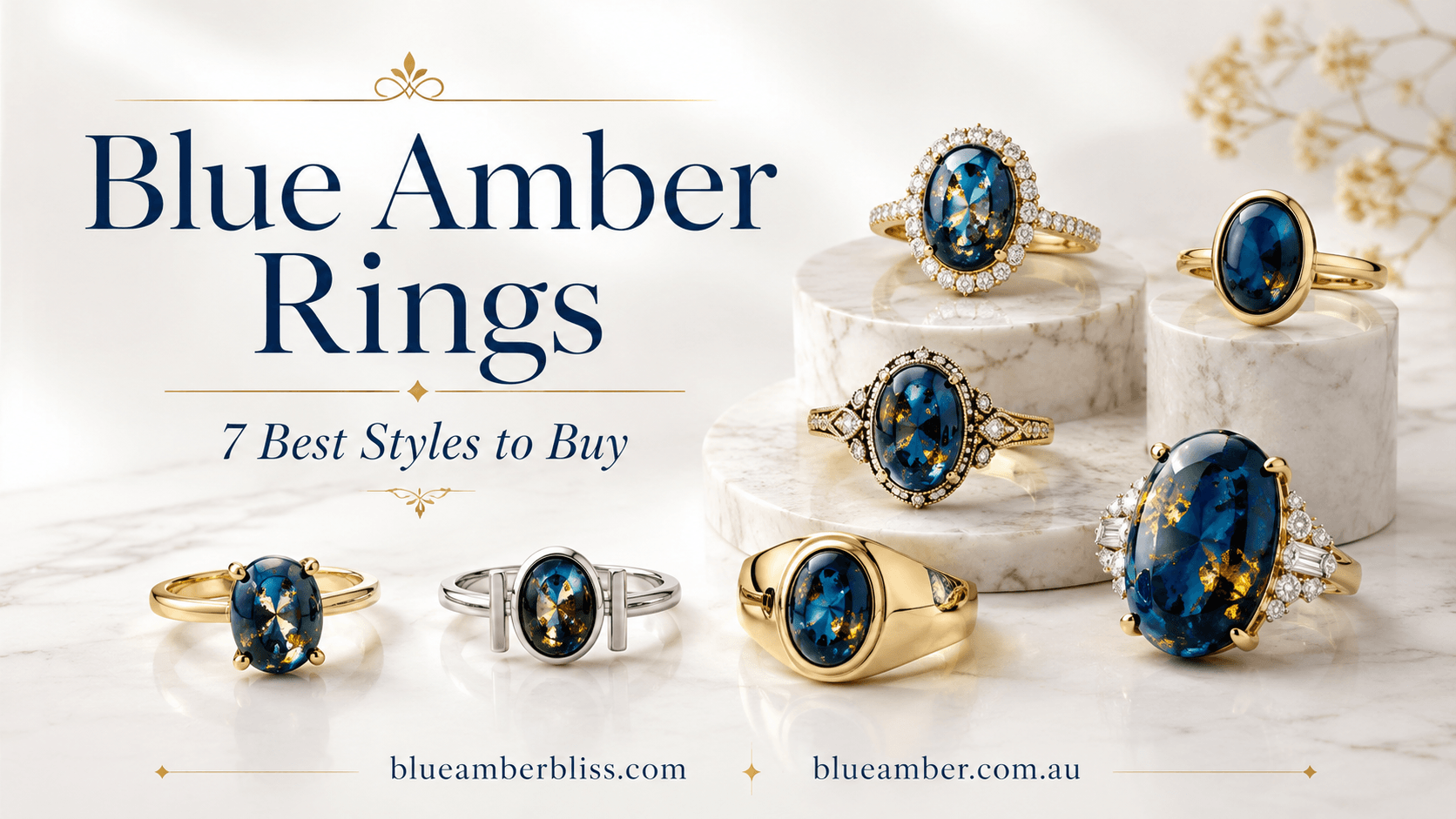
Rings are the most dramatic way to wear this gem because the stone sits right where you and everyone else can see it. In sunlight, a Sumatran cabochon ring flashes blue as your hand moves, which makes it a genuine conversation piece.
The trade-off is wear. Hands meet desks, doorframes, and grocery bags constantly, and amber is soft. Choose a slightly raised bezel setting (a metal rim that surrounds and protects the stone), wear it on a less-active hand, and remove it for chores. Explore setting styles in our blue amber rings collection.
Blue Amber Pendants
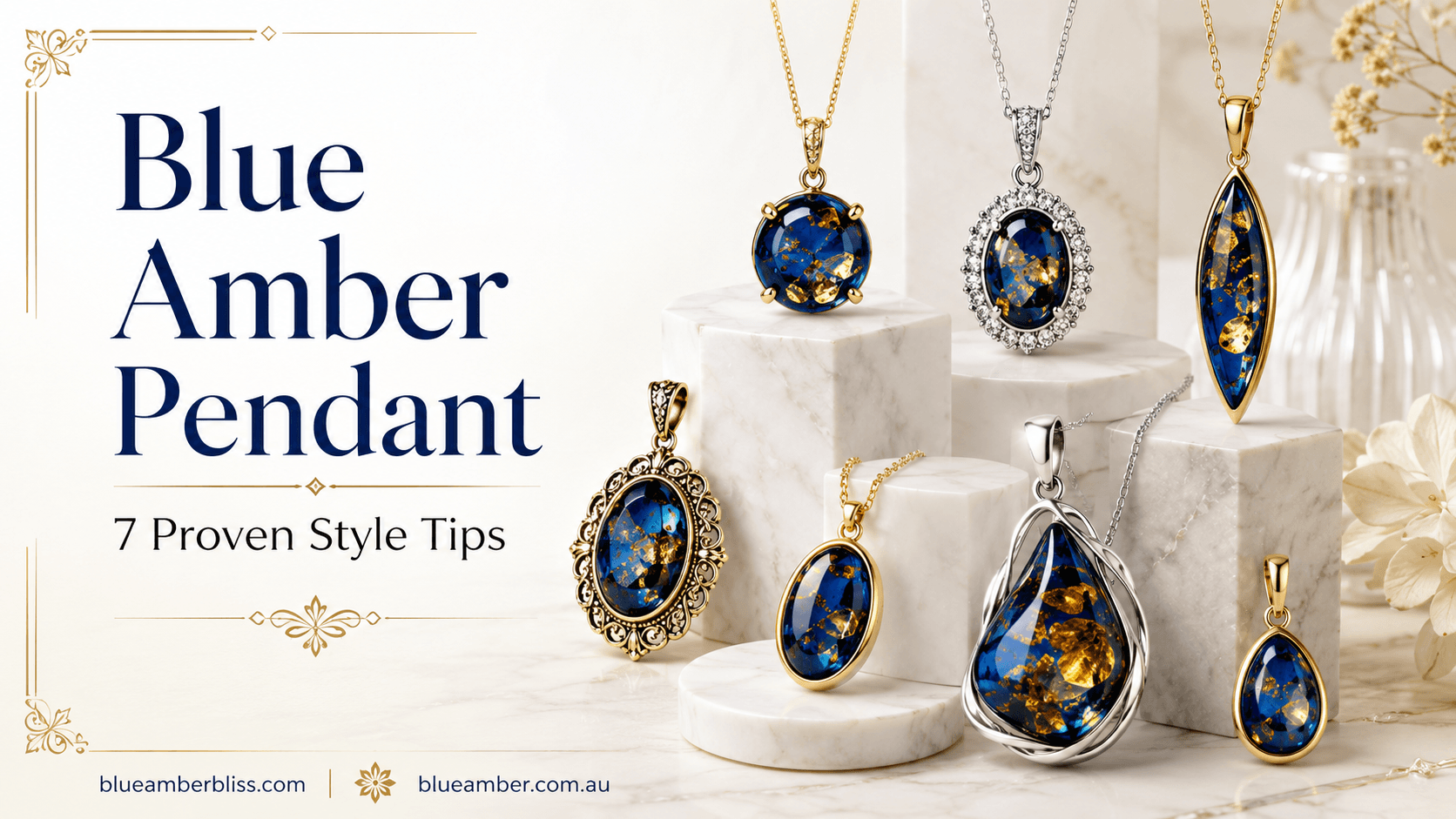
Pendants are, in my opinion, the smartest entry point. They hang freely, catch overhead and outdoor light beautifully, and face very little impact, so a larger Sumatran nodule stays safe while still being the star of the outfit.
Because pendants tolerate bigger stones, they show off Sumatra’s signature large nodules best. An open-back setting lets daylight pass through for maximum blue fluorescence. Browse shapes and bails in our blue amber pendant selection.
Blue Amber Necklaces
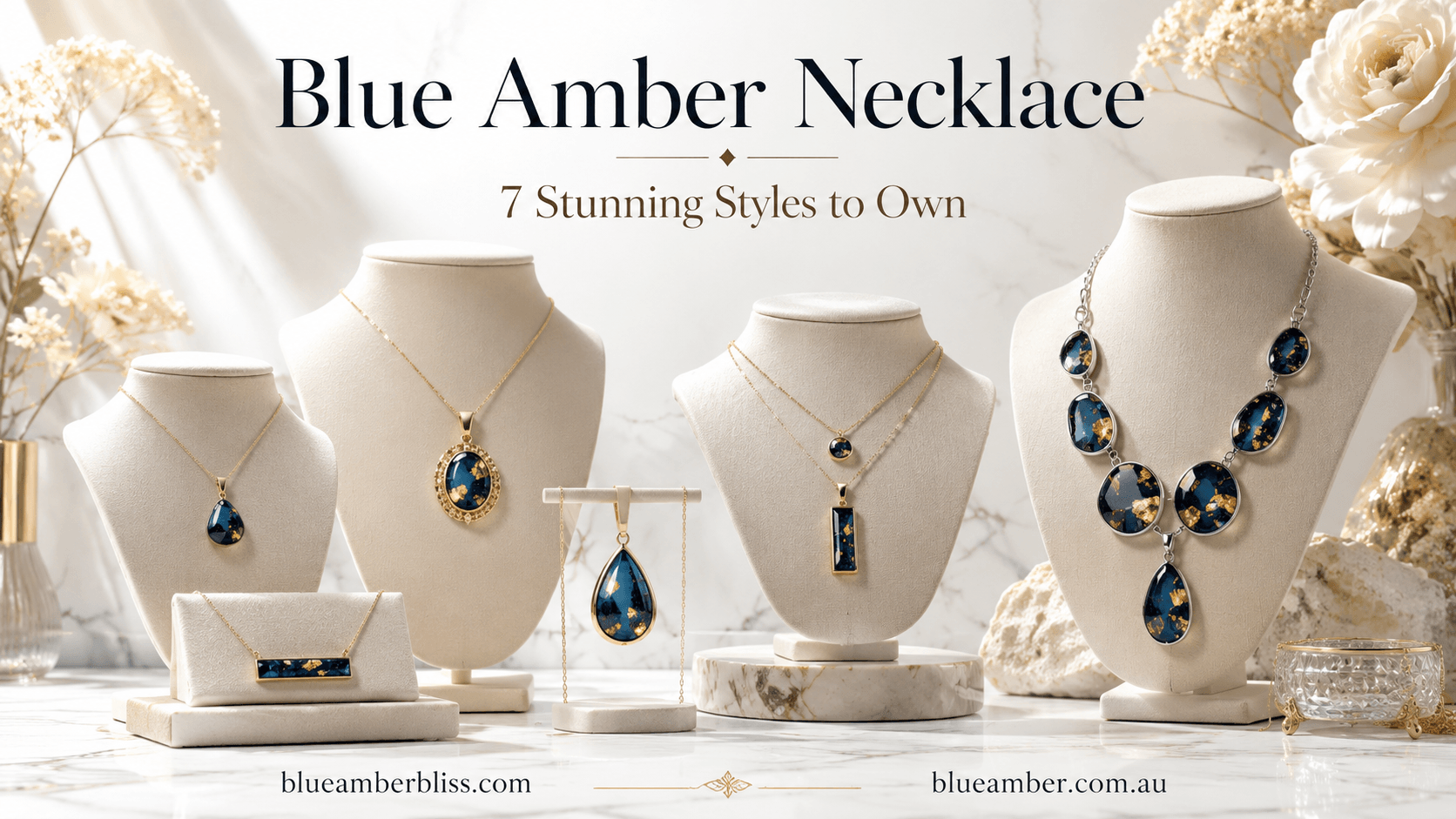
Necklaces range from a single pendant on a chain to full strands of graduated blue amber beads. A beaded Sumatran strand is striking outdoors, where each bead glows in turn as it catches the sun, creating a moving ribbon of blue.
Bead strands need a little more care because beads knock against each other; choose knotted stringing to cushion them. For layouts, lengths, and clasp options, see our blue amber necklace guide. This is also a flattering choice if you want glow near the face.
Blue Amber Bracelets
Bracelets, especially bead bracelets, deliver constant motion, so the glow is almost always catching light as your wrist moves through the day. They are popular, affordable entry pieces and stack beautifully with metal bangles.
Wrists take more knocks than necks, so bracelets are a higher-wear style. Opt for slightly smaller, well-rounded Sumatran beads, take them off before workouts, and store them apart, as our blue amber bracelet guide explains in detail.
Blue Amber Earrings
Earrings frame the face and put the glow right beside your eyes, which is wonderful if your eyes are blue, grey, or green. Studs and drops both work; drops sway and catch more daylight, intensifying the blue flash outdoors.
Earrings see almost no impact, so they are a low-wear, low-worry style, like pendants. Lightweight Sumatran cabochons keep drops comfortable for all-day wear. See styles and pairings in our blue amber earrings guide.
Blue Amber Jewelry Type Comparison Table
| Piece Type | Glow Visibility | Durability / Wear Risk | Best Stone Size | Best For |
|---|---|---|---|---|
| Pendant | High (catches overhead/outdoor light) | Low risk | Large nodule | Beginners, statement seekers |
| Earrings | High (frames the face) | Low risk | Small to medium | Everyday elegance, blue/green eyes |
| Necklace (beaded) | Very high (many beads glow) | Medium risk | Graduated beads | Outdoor wear, collectors |
| Ring | Very high (at eye level on hand) | High risk | Medium cabochon | Bold daily wearers (careful) |
| Bracelet | High (constant wrist motion) | High risk | Small rounded beads | Stackers, casual wear |
The Blue Amber Grading Scale (AA / AAA / AAA+)
There is no single global authority for amber grades, so the trade uses a practical AA to AAA+ scale built on glow intensity and evenness, clarity, body color, and size. Every style guide on this site maps back to these tiers. Sumatran deposits, with their larger, cleaner nodules and dramatic daylight blue, dominate the top AAA+ band.
| Grade | Glow (intensity & evenness) | Clarity | Size | Typical use |
|---|---|---|---|---|
| AA | Modest, partial or uneven; mostly under 365 nm | Some cloudiness or flow lines | Small | Bead bracelets, entry pieces |
| AAA | Strong, even blue; visible in daylight | Clean with minor natural inclusions | Medium | Pendants, rings, drops |
| AAA+ | Intense, full-surface daylight blue | Very clean, top body color | Large nodules | Collector statement pieces |
Price tracks grade tightly. As a rough guide, rough or low-glow material runs about $3-15 per gram; polished good-glow stones $15-60; high-grade AAA $60-200; and top AAA+ large, clean, intense-glow collector pieces $200-500+ per gram. Jewelry is priced per piece, with large flawless strong-glow Sumatran stones commanding the premium. Our full blue amber price guide breaks down every band.
How Do Silver and Gold Settings Show Off the Sumatran Glow?
The setting is half the magic. Because the glow relies on light passing through the stone, the metal’s job is to hold the piece securely while letting daylight reach as much of the amber as possible. Open-back settings do this best.
Sterling silver gives a cool, bright, modern frame. Its white tone reads as neutral and lets the blue fluorescence pop without competing warmth, which is why so much Sumatran blue amber jewelry is set in silver. It is also budget-friendly for larger stones.
Gold adds warmth and luxury. Yellow gold echoes amber’s honey body color for a classic, vintage feel, while white gold behaves like silver and keeps the blue crisp. Rose gold flatters cognac-toned stones. All three suit Sumatran amber; the choice is mostly aesthetic. Men’s pieces often lean to heavier silver and gold, as our blue amber jewelry for men guide shows.
Why Cabochon Cutting Matters
Nearly all blue amber is cut en cabochon: a smooth, domed, unfaceted shape (the process is called cabbing). A dome works better than facets here because the glow is a surface-and-volume fluorescence, not a play of reflections, so a rounded form gathers and returns the blue evenly. Faceting would only chip a Mohs 2-2.5 gem and add little sparkle.
Does an Open-Back Setting Really Matter?
Yes. An open or partially open back lets light enter from behind the stone, so the blue fluorescence is visible from more angles and looks brighter. Closed bezels protect the stone more but can dull the glow, so jewelers balance the two.
For rings and bracelets, where protection matters most, a closed or semi-closed bezel is a fair compromise. For pendants and earrings, where impact is low, choose open-back settings to let your Sumatran stone show its full daylight blue.
How Do You Choose Quality and Grade in Blue Amber Jewelry?
Quality comes down to four things: glow strength, clarity, size, and authenticity. Judge them together against the AAA scale above, and always insist on natural, untreated Sumatran amber from a seller who can prove provenance.
- Glow strength: The brighter and more even the blue under daylight or a 365 nm UV light, the better. Sumatran material typically shows a strong, dramatic glow.
- Clarity: Some internal flow lines and tiny bubbles are natural and prove authenticity. Avoid heavy cloudiness that blocks light unless it is intentional, like green or “earth” amber.
- Size: Larger clean stones are rarer and pricier. Sumatra’s big nodules make sizable pieces more attainable than other sources.
- Authenticity: Real amber is warm to the touch, lightweight, and floats in saturated saltwater. Plastic and copal imitations do not fluoresce the same way.
How Can You Tell Real Blue Amber From Fake?
Start with the non-destructive battery. Genuine amber fluoresces clean blue under 365 nm UV or daylight, floats in saturated brine (SG ~1.05-1.10 vs brine ~1.15-1.16), feels warm and light, and gives a faint pine scent when gently rubbed. Most plastics and dyes glow flat or sink, and glass sinks and feels cold.
The key trap is copal, immature resin under a million years old. An acetone test turns copal tacky in 20-60 seconds while mature amber resists; the related acid (succinic) test distinguishes Baltic succinite from retinite. For definitive identification, a GIA or IGI lab report using FTIR spectroscopy settles copal-vs-amber maturity. Our full walkthrough lives in how to tell if blue amber is real.
Is Blue Amber Good for Jewelry, Given It Is So Soft?
Yes, blue amber is good for jewelry, with realistic expectations. Amber rates only 2-2.5 on the Mohs scale, so it scratches and chips more easily than quartz or sapphire. That does not make it unwearable; it makes placement and care important.
Match the style to your habits. Low-impact pieces, pendants and earrings, can be worn daily for years with minimal worry. Higher-impact pieces, rings and bracelets, reward a gentler hand: remove them for sports, cleaning, gardening, and gym sessions to keep the glow flawless.
Amber is also a poor conductor of heat, which is why it feels warm, but heat itself is its enemy. Keep it away from open flame, hot cars, and prolonged direct sun in storage, since heat and rapid temperature swings can craze the surface over time. Our guide to storing blue amber safely covers long-term protection.
What Does Blue Amber Jewelry Mean Symbolically?
Blue amber jewelry meaning blends amber’s ancient symbolism with the rarity of the blue glow. Historically, amber has stood for warmth, protection, healing, and preserved life, since insects and plants are sometimes captured inside it, sealing a moment in time.
The blue fluorescence adds associations with calm, clarity, intuition, and transformation, the way honey-colored resin “transforms” into electric blue under light. Many wearers see Sumatran blue amber jewelry as a personal talisman: grounding like all amber, yet uniquely luminous and rare.
How Do You Build a Coordinated Blue Amber Jewelry Set?
Building a set is where collecting gets fun. The simplest, most reliable approach is to anchor your look with one statement piece, usually a large Sumatran pendant, then add quieter supporting pieces that echo it rather than compete with it.
A classic trio is a pendant plus matching drop earrings and a slim bead bracelet. Keep the metal consistent across all three, silver throughout or gold throughout, so the eye reads them as a family. Let the pendant carry the biggest, most vivid nodule. A coordinated set also makes blue amber as a gift feel intentional and complete.
For color harmony, match undertones rather than exact hues. Sumatran stones range from cognac to greenish honey, and pieces with similar body color and glow intensity feel intentional together. Mixing one very dark and one very pale stone can look mismatched outdoors when both light up.
Does Where You Wear It Change the Glow?
Absolutely, and this is the practical secret most buyers miss. Blue amber’s color is light-dependent: the more daylight and UV that reach the stone, the stronger the blue. The same piece can look amber indoors and electric blue on a sunny patio.
That is why pendants, necklaces, and drop earrings, worn out in the open, often look more dramatic than a ring tucked against your skin. If you mostly work indoors under warm bulbs, lean toward pieces that catch movement and outdoor light to enjoy the glow most.
Who Does Blue Amber Jewelry Suit?
This gem suits people who want something genuinely rare and conversation-starting rather than mass-produced. If you love organic gems with a story,millions of years of one, and a glow most people have never seen, this is your stone.
It flatters warm and neutral skin tones beautifully because of the honey body color, while the blue flash pops against cool tones too. Blue, green, and grey eyes especially benefit from earrings and necklaces that echo the glow near the face. If you are weighing it against another blue collectible, our blue amber vs larimar comparison helps.
It is also a thoughtful, meaningful gift, an alternative birthstone feel, an anniversary keepsake, or a milestone marker, since each Sumatran piece is naturally one of a kind. No two nodules glow exactly alike.
How Do You Care for Blue Amber Jewelry?
For guidance on amber softness and care, see GIA amber overview.
Caring for these pieces is easy if you respect their softness. The single most important rule: never use an ultrasonic or steam cleaner, and never soak it in jewelry dips or harsh chemicals, which can dull, pit, or crack the surface permanently.
- Wipe gently. Use a soft cloth lightly dampened with water to remove oils and dust after wearing.
- Mild soap only. For deeper cleaning, use a drop of mild soap in lukewarm water, then dry immediately with a soft cloth.
- Avoid chemicals. Apply perfume, hairspray, and lotion before putting your jewelry on, never after.
- Store separately. Keep each piece in a soft pouch away from harder gems that could scratch it.
- Mind the heat. Keep it out of hot cars and direct sunlight during long-term storage.
A light occasional buff with a microfiber cloth keeps the surface clear so the glow stays bright. For a full routine, see our guide on how to clean blue amber. Treated well, a Sumatran piece easily becomes an heirloom.
Where Can You Find Blue Amber Jewelry for Sale?
Browse current pieces in our Sumatran blue amber jewellery collection, each shown with daylight and UV glow photos.
The safest blue amber jewelry for sale comes from specialists who source verified Sumatran material and can document authenticity. Marketplaces are flooded with copal, dyed amber, and plastic, so provenance and a clear return policy matter more than the lowest price.
Look for sellers who photograph each piece under both normal light and 365 nm UV, describe size and weight precisely, and stand behind authenticity. Because every Sumatran nodule is unique, you are buying a specific stone, so detailed, honest listings are the sign of a trustworthy source. Our guide on where to buy blue amber walks through vetting sellers.
What We Notice When Selecting Sumatran Blue Amber for Jewelry
When we set Sumatran blue amber into rings and pendants, the first thing we look for is that dramatic shift from a dark cognac body in the hand to a vivid blue glow the moment it catches daylight or UV, because that transformation is what makes the piece feel alive on the skin. At Blue Amber Bliss we favour clean, well-polished nodules with genuine specimen character, and we keep natural inclusions rather than polishing them out, since they tell you the stone is authentic ancient resin, millions of years in the making. For everyday wear we tend to guide buyers toward pendants and earrings, where the blue reads strongly against skin and the amber stays protected from knocks, and we reserve the bolder, larger nodules for statement pieces meant to be admired.
If you would like to see this daylight-to-glow character in person, we warmly invite you to explore our hand-selected Sumatran blue amber pieces. Shop hand-selected Sumatran blue amber →
Frequently Asked Questions
Is blue amber good for jewelry?
Yes. Blue amber makes beautiful, lightweight, comfortable jewelry with a glow no other gem matches. It is soft (Mohs 2-2.5), so it suits pendants and earrings best for daily wear, while rings and bracelets simply need a gentler hand and occasional removal.
What is Sumatran blue amber jewelry?
Sumatran blue amber jewelry is jewelry made from Indonesian blue amber from the Sinamar Formation in Jambi, a Miocene resin millions of years in the making known for large nodules and a dramatic daylight blue glow. Its bigger, cleaner rough makes it the standout choice for statement pieces.
Why does blue amber glow blue?
Blue amber contains perylene and other polycyclic aromatic hydrocarbons that absorb ultraviolet and violet light (around 350-400 nm) and re-emit it as visible blue, aided by surface scattering. It is fluorescent, not phosphorescent, so the glow stops the instant the light source is removed. In plain indoor light the stone usually looks honey or cognac.
What is the AAA grade in blue amber?
Blue amber is graded AA, AAA, and AAA+ by glow intensity and evenness, clarity, body color, and size. AAA shows a strong, even daylight blue and clean stone; AAA+ adds intense full-surface glow and large, very clean nodules. Sumatran material dominates the top AAA+ tier.
How much does blue amber jewelry cost?
Prices vary with grade. By weight, rough or low-glow amber runs about $3-15 per gram, good-glow polished $15-60, high-grade AAA $60-200, and top AAA+ collector material $200-500+. As pieces, small Sumatran bead bracelets start modestly while large, vividly glowing pendants reach several hundred dollars or more.
Can I wear blue amber jewelry every day?
Yes, with style selection in mind. Pendants and earrings face little impact and wear well daily. Rings and bracelets are higher-wear, so remove them for chores, sports, and the gym, and avoid knocks to keep the soft surface and glow flawless.
How do I clean blue amber jewelry safely?
Wipe it with a soft, slightly damp cloth, or use a drop of mild soap in lukewarm water, then dry immediately. Never use ultrasonic or steam cleaners, jewelry dips, or harsh chemicals, and apply perfume and lotion before putting the jewelry on.
Is silver or gold better for blue amber jewelry?
Both work; it is mostly aesthetic. Silver and white gold give a cool, neutral frame that makes the blue pop, while yellow gold echoes amber’s honey warmth for a vintage feel. Open-back settings in any metal show the Sumatran glow best.
How can I tell if blue amber is real?
Genuine amber fluoresces clean blue under 365 nm UV, floats in saturated saltwater (specific gravity ~1.05-1.10), feels warm and light, and gives a faint pine scent when rubbed. Copal turns tacky in an acetone test, and definitive identification comes from a GIA or IGI report using FTIR spectroscopy.
Does Blue Amber Bliss sell Dominican blue amber?
No. Blue Amber Bliss specializes exclusively in Sumatran (Indonesian) blue amber. We focus on Sumatra because its larger nodules and dramatic daylight glow make it the standout, most valuable blue amber for fine jewelry.
Related Blue Amber Guides
- Sumatran vs Dominican blue amber compared
- blue amber earrings
- blue amber jewelry for men
- blue amber as a gift
- blue amber vs larimar
- how to store blue amber safely