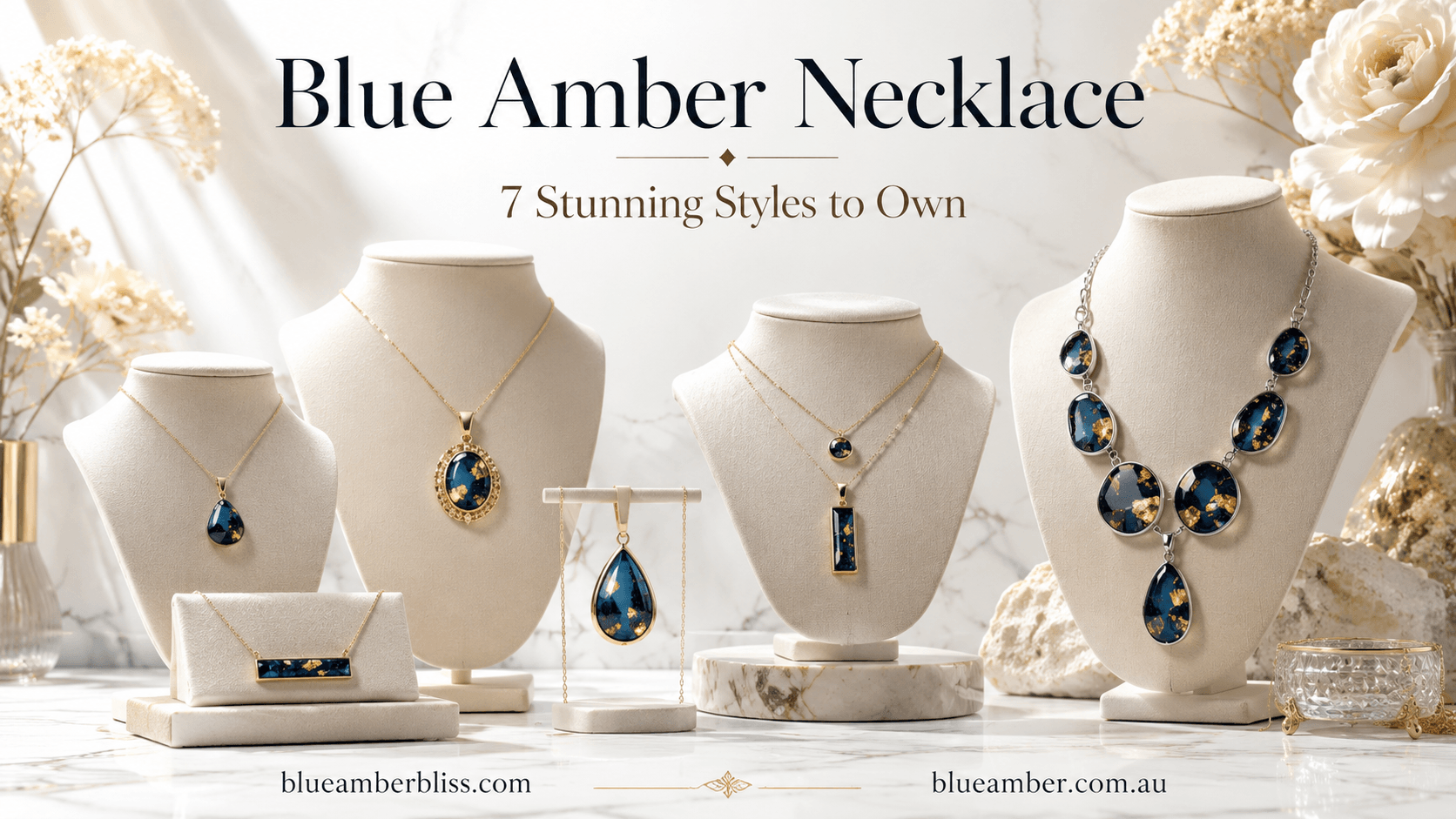
A blue amber necklace is a strand or pendant made from rare fossilized resin that glows electric blue in daylight, with Sumatran (Indonesian) blue amber leading the field thanks to its larger nodules and dramatic daylight glow. You choose between a beaded strand, which shows the most blue, or a single pendant, which spotlights one exceptional gem.
Key Takeaways
- Sumatran blue amber leads: a newer source with bigger pieces and slightly better clarity makes a Sumatran blue amber necklace the standout, equal in quality to Dominican but more valuable.
- Beaded strands maximize glow: many faces of amber catch UV-rich daylight, so a blue amber beaded necklace shimmers blue across the whole strand.
- Pendants spotlight one gem: a blue amber pendant necklace frames a single hero stone for everyday wear.
- Real amber is light: specific gravity ~1.05-1.10, Mohs 2-2.5, and it floats in salt water – a fast authenticity check.
- Care is gentle: avoid heat, alcohol, and perfume; wipe with a soft damp cloth and store away from sunlight.
What Is a Blue Amber Necklace?
A blue amber necklace is jewelry crafted from amber that appears honey or cognac in transmitted light but flashes blue, violet, or teal when light reflects off its surface. The blue is not a pigment. It is fluorescence: the resin absorbs ultraviolet light and re-emits it as visible blue. That single optical trick is what makes these necklaces so mesmerizing.
Amber itself is fossilized tree resin, typicallymillions of years in the making. According to GIA, amber is an organic gem, not a mineral, which is why it feels warm and light against your skin rather than cold like quartz or glass.
Blue amber is rare. Only a few deposits on Earth produce resin with the right molecular structure to fluoresce strongly. That scarcity, paired with the living daylight glow, is why a genuine blue amber necklace commands a premium over ordinary yellow amber.
Why Does Blue Amber Glow Blue in Daylight?
Sunlight contains ultraviolet wavelengths around 365 nm. When that UV strikes blue amber, aromatic hydrocarbons inside the resin absorb it and release the energy as visible blue light, roughly 430-470 nm. Against a dark backdrop or in shade with a bright sky, the effect is electric. Turn the piece and the blue chases the light across every surface.
Sumatran vs Dominican: Which Blue Amber Necklace Wins?
Two sources dominate the blue amber world: Sumatra (Indonesia) and the Dominican Republic. At Blue Amber Bliss we work exclusively with Sumatran blue amber, and there are real gemological reasons we built the shop around it.
A sumatran blue amber necklace tends to come from larger raw nodules, so beads and pendants can be bigger and better matched without sacrificing clarity. Sumatra is a newer commercial source, and its material is famous for a dramatic blue-to-green daylight glow that reads vividly even in ordinary outdoor light, not just under a UV lamp.
Both origins are genuine, beautiful, and equal in baseline quality and value. The difference is practical: Sumatran rough is younger geologically, comes in bigger pieces, and shows somewhat better consistency, which makes it the more valuable standout for serious collectors and the easier choice for matched strands.
| Feature | Sumatran Blue Amber | Dominican Blue Amber |
|---|---|---|
| Source age (commercial) | Newer source | Long-established source |
| Typical piece size | Larger nodules, bigger beads | Often smaller pieces |
| Daylight glow | Dramatic blue-to-green in plain daylight | Strong blue, often needs darker backdrop |
| Clarity consistency | Somewhat better, easier matching | Excellent, varies by mine |
| Quality and value | Equal baseline, more valuable standout | Equal baseline, genuine and prized |
| Best for strands | Ideal for matched beaded necklaces | Beautiful, harder to size-match |
Bottom line: a Sumatran blue amber necklace is the one to reach for first. You get the size, the glow, and the matchability that make a strand sing, and you are buying the source that is rising fastest among collectors.
Blue Amber Beaded Necklace vs Pendant: How to Choose?
The biggest decision you will make is strand versus pendant. Both are stunning; they simply show the glow differently and suit different wardrobes and budgets.
What Makes a Blue Amber Beaded Necklace Special?
A blue amber beaded necklace is a continuous strand of polished beads. Because each bead has a fully rounded surface, light hits the amber from dozens of angles at once. Step outside and the entire strand lights up blue, with the color shifting bead to bead as you move. No other format shows off the daylight fluorescence so completely.
Strands also let you scale impact. A graduated strand places larger beads at the center front, where the glow is most visible, and tapers toward the clasp. A uniform strand keeps every bead the same diameter for a clean, modern look. Sumatran rough makes both styles easier because the bigger nodules yield well-matched beads.
When Is a Blue Amber Pendant Necklace the Better Pick?
A blue amber pendant necklace features one carefully chosen amber piece suspended from a chain or cord. This is the everyday hero. You can wear it under a collar at work and let it flash blue at lunch, then dress it up for evening. Pendants put all the attention on a single exceptional gem, so a top-clarity Sumatran cabochon truly shines.
Pendants are also the gentler entry point on price, since you buy one gem rather than fifty. If you want a deeper look at single-stone styles, our blue amber pendant guide walks through cuts, settings, and chain pairings. For the full landscape of formats, see our blue amber jewelry overview.
| Consideration | Beaded Strand | Pendant |
|---|---|---|
| Glow display | Whole strand glows, color shifts as you move | One concentrated point of blue |
| Daily wearability | Statement piece, more occasion-driven | Easy everyday, layers well |
| Typical entry price | Higher (many matched gems) | Lower (single gem) |
| Matching difficulty | Requires careful bead grading | Single stone, simpler selection |
| Best Sumatran advantage | Big nodules ease size matching | Large clear cabochons |
How Are Blue Amber Beads Graded and Matched?
Bead quality is where a strand earns its price. When you understand grading, you can judge any blue amber necklace on sight instead of trusting a label. Jewelers weigh four things: glow strength, clarity, color body, and consistency across the strand.
What Should You Look for in Bead Glow and Clarity?
- Glow strength: take the strand into daylight or shine a 365 nm UV light. Top Sumatran beads turn vivid blue-green; weaker material stays pale or patchy.
- Clarity: some beads are crystal clear, others have natural inclusions, plant debris, or tiny gas bubbles. Inclusions are proof of nature, not flaws, but heavy cloudiness dims the glow.
- Body color: in transmitted light, expect cognac, amber, or greenish tones. The blue lives on the surface.
- Surface: a good polish has no dull spots, pits, or crazing lines.
Why Does Bead Matching Matter So Much?
Matching is the art of making fifty separate gems look like one designed object. Skilled stringers sort beads so diameters step evenly, glow intensity is balanced left to right, and body color flows without a jarring dark bead beside a pale one. Poor matching is the single fastest way to spot a cheap strand.
This is where Sumatran amber quietly wins. Larger raw nodules mean a cutter can pull many beads of similar size and glow from one piece, so a Sumatran blue amber necklace reaches a tighter match more easily. The result is a strand that reads as deliberate and luxurious rather than a random assortment.
What Length and Clasp Should Your Blue Amber Necklace Have?
Length changes the whole personality of a piece. Picking the right one ensures your blue amber necklace sits where the glow is most visible against your skin and clothing.
Which Necklace Length Suits You?
- Collar (12-13 in): hugs the throat; bold and modern.
- Choker (14-16 in): sits at the base of the neck; flatters most necklines.
- Princess (17-19 in): the classic, versatile length; great for a pendant.
- Matinee (20-24 in): reaches the chest; elegant over knitwear.
- Opera (28-36 in): dramatic; can be doubled into two strands.
For a beaded strand, princess and matinee lengths give the glow room to catch light across a wide arc. For a pendant, princess length centers the gem on the sternum where it draws the eye.
Which Clasp Is Best for Amber?
Because amber is light, you do not need heavy hardware, but you do want a secure, gentle closure. A sterling silver lobster clasp is the practical workhorse: easy to open, very secure. A box clasp or a screw clasp suits formal strands and adds a finished look. For elastic or knotted-cord pieces, choose a knotted-silk strand with knots between beads so a single break never spills the whole necklace.
Avoid magnetic clasps for valuable strands; they can release if snagged. Whatever you pick, the clasp metal should be hypoallergenic and the connection rings soldered closed.
How Does a Strand Show the Glow in Daylight?
This is the magic moment. Take any blue amber beaded necklace outdoors on a bright day, ideally with a darker top so the beads have contrast. As sunlight delivers its natural UV, every rounded bead fluoresces and the strand reads as a ribbon of moving blue. Indoors under warm bulbs, the same strand looks like ordinary cognac amber, which is exactly why blue amber feels like a secret only daylight reveals.
The science is consistent. Strong fluorescence peaks when UV around 365 nm hits the resin, and Sumatran material is prized for glowing in plain open shade, not just under a lamp. To test a strand before buying, ask the seller for a daylight video and a 365 nm UV clip side by side.
A pendant glows the same way but from one face, so angle matters more. Tilt it toward the sky and the single gem ignites. This is part of the charm of a blue amber pendant necklace: you control the reveal with a small turn of the wrist.
What Are the Blue Amber Necklace Benefits and Meaning?
Beyond beauty, many wearers value the metaphysical side. The blue amber necklace benefits most often described are calm, clarity, and grounded energy. Because the gem sits at the throat and heart, it is traditionally linked to honest communication and emotional balance.
In crystal tradition, blue amber is associated with the throat and third-eye chakras, helping you speak your truth and think clearly. It is also seen as a protective, warming stone that carries the ancient life force of the trees that made it. Worn daily, a strand becomes a quiet anchor you reach for in stressful moments.
We keep claims honest: these are traditional and personal benefits, not medical ones. If the spiritual dimension draws you in, our deep dive on blue amber meaning and healing covers chakras, rituals, and intention-setting in detail. Many owners simply love that the blue amber necklace benefits pair real calm with a striking daylight glow.
How Do You Verify a Real Blue Amber Necklace?
Counterfeits exist, from dyed glass to plastic and pressed copal. A few fast tests protect you before you buy any blue amber necklace.
- Weight: real amber is very light. Per Britannica, amber’s specific gravity sits near 1.05-1.10, so it floats in salt water (about two tablespoons of salt per cup) while glass and most plastics sink.
- Hardness: amber is soft at Mohs 2-2.5; glass is far harder, so a glass bead will not scratch with a fingernail-pressure test the way amber’s surface behaves.
- Warmth: amber warms quickly in your hand and feels warm, not cold like glass.
- UV glow: genuine blue amber fluoresces blue under 365 nm light and in daylight; dyed fakes usually do not.
- Smell: gently warmed real amber gives a faint pine-resin scent; plastic smells chemical.
Buy from a seller who shows daylight and UV video, states the Sumatran origin plainly, and offers returns. Our guide on where to buy blue amber details how to vet listings and avoid the most common scams.
How Do You Care for and Clean a Blue Amber Necklace?
Amber is soft and organic, so a little care keeps your blue amber necklace glowing for decades. The golden rule: gentle everything, and put it on last.
What Is the Right Daily Care Routine?
- Wipe after wear: use a soft, slightly damp cloth, then dry. Skip ultrasonic and steam cleaners entirely.
- Avoid chemicals: perfume, hairspray, alcohol, and household cleaners can craze the surface and dull the glow. Apply scent first, jewelry last.
- Mind the heat: amber softens and cracks with high heat, so keep it away from hot cars, saunas, and direct radiators.
- Limit harsh sun storage: wear it in daylight freely, but store it in a dark, cool drawer to prevent long-term drying.
- Store separately: keep it in a soft pouch so harder gems do not scratch the soft surface.
For knotted strands, have them restrung every few years; silk stretches and weakens with body oils. A full step-by-step lives in our how to clean blue amber guide.
How Much Does a Blue Amber Necklace Cost?
Price depends on origin, size, glow strength, clarity, and how well the strand is matched. As a rough guide, simple pendant pieces often start in the low hundreds, while large, top-glow Sumatran beaded strands can run well into the thousands. The premium reflects rarity: blue amber represents a tiny fraction of all amber mined.
A Sumatran blue amber necklace sits at the upper, more valuable end because of its bigger beads and dramatic daylight glow. You are paying for matched gems, not filler, and for the source collectors increasingly seek out. Value holds best when the strand is well matched and the origin is documented.
What We Notice When Stringing Sumatran Blue Amber Necklaces
When we assemble a necklace, we hand-match Sumatran blue amber bead by bead so the strand reads as one family rather than a mix of odd stones. In daylight the beads sit deep cognac and honey-dark, then the whole strand lifts into that electric blue glow the moment it catches UV or a bright sky, which is why we favour it for pieces meant to be worn out and noticed. We watch the drill holes closely on Sumatran material, keeping them clean and centred so larger nodules hang true and the natural inclusions face forward as character rather than flaw. Because this resin has been millions of years in the making, no two beads glow at quite the same intensity, and we grade each strand so the strongest stones fall naturally at the centre.
If you would like to see how these strands shift from dark to glow in person, we warmly invite you to explore our hand-selected Sumatran blue amber at Blue Amber Bliss. Shop hand-selected Sumatran blue amber →
FAQ
What is a blue amber necklace?
It is a strand or pendant made from rare fossilized resin that looks cognac in transmitted light but glows blue under daylight UV. Sumatran blue amber is the standout, prized for large beads and a dramatic blue-to-green daylight glow.
Is a Sumatran blue amber necklace better than Dominican?
Both are genuine and equal in baseline quality and value. Sumatran is the newer source with bigger nodules, somewhat better clarity, and an easier match for strands, making a sumatran blue amber necklace the more valuable standout most collectors reach for first.
Why does my blue amber necklace only glow outside?
The blue is fluorescence triggered by ultraviolet light around 365 nm, which sunlight provides but warm indoor bulbs do not. Take the necklace into daylight or shine a 365 nm UV torch and the blue glow appears instantly.
What are the blue amber necklace benefits?
Traditionally, blue amber necklace benefits include calm, mental clarity, honest communication, and grounded energy, linked to the throat and third-eye chakras. These are personal and metaphysical benefits, not medical claims, paired with a beautiful daylight glow.
How can I tell if my blue amber necklace is real?
Real amber is light (specific gravity ~1.05-1.10) and floats in salt water, is soft at Mohs 2-2.5, warms quickly in hand, gives a faint pine scent when warmed, and fluoresces blue under 365 nm UV. Fakes usually fail these tests.
Beaded strand or pendant: which should I buy first?
Choose a blue amber beaded necklace if you want the whole piece to glow and shift color as you move. Choose a blue amber pendant necklace for easy everyday wear, layering, and a lower entry price on a single hero gem.
What length is best for a blue amber necklace?
Princess (17-19 in) suits both pendants and strands and centers the gem on the sternum. Matinee (20-24 in) gives a beaded strand more arc to catch daylight. Pick the length that places the glow where it shows best on you.
How do I clean a blue amber necklace?
Wipe with a soft, slightly damp cloth and dry it. Avoid alcohol, perfume, ultrasonic cleaners, and heat, which can craze the surface. Store it in a soft pouch in a cool, dark place and restring knotted strands every few years.
Can I shower or swim in a blue amber necklace?
No. Soap, chlorine, salt water, and hot water can dull and craze amber over time. Remove your necklace before showering, swimming, or using a sauna, and put it on last after lotions and perfume.
Does blue amber fade over time?
Worn normally, blue amber keeps its glow for decades. Long, harsh sun storage and chemical exposure can dry or craze the surface, so store it in the dark and clean it gently to preserve the fluorescence.
Related Blue Amber Guides
- blue amber beads
- blue amber bracelets
- Blue Amber Jewelry: 7 Best Styles & Care Guide
- Blue Amber Rings: 7 Best Styles to Buy
- Blue Amber Pendant: 7 Proven Style Tips
- Blue Amber Earrings: 7 Stunning Styles to Wear