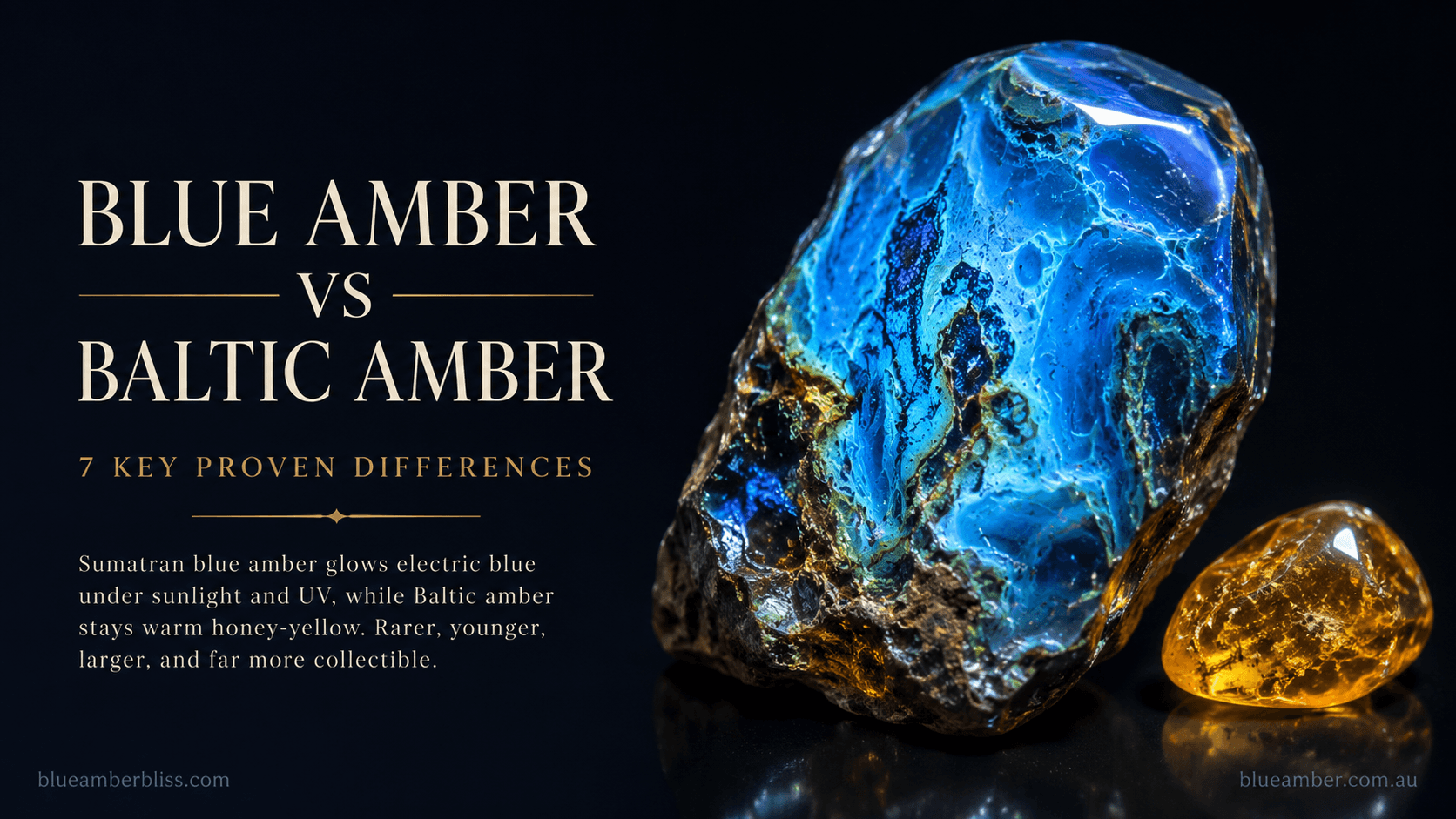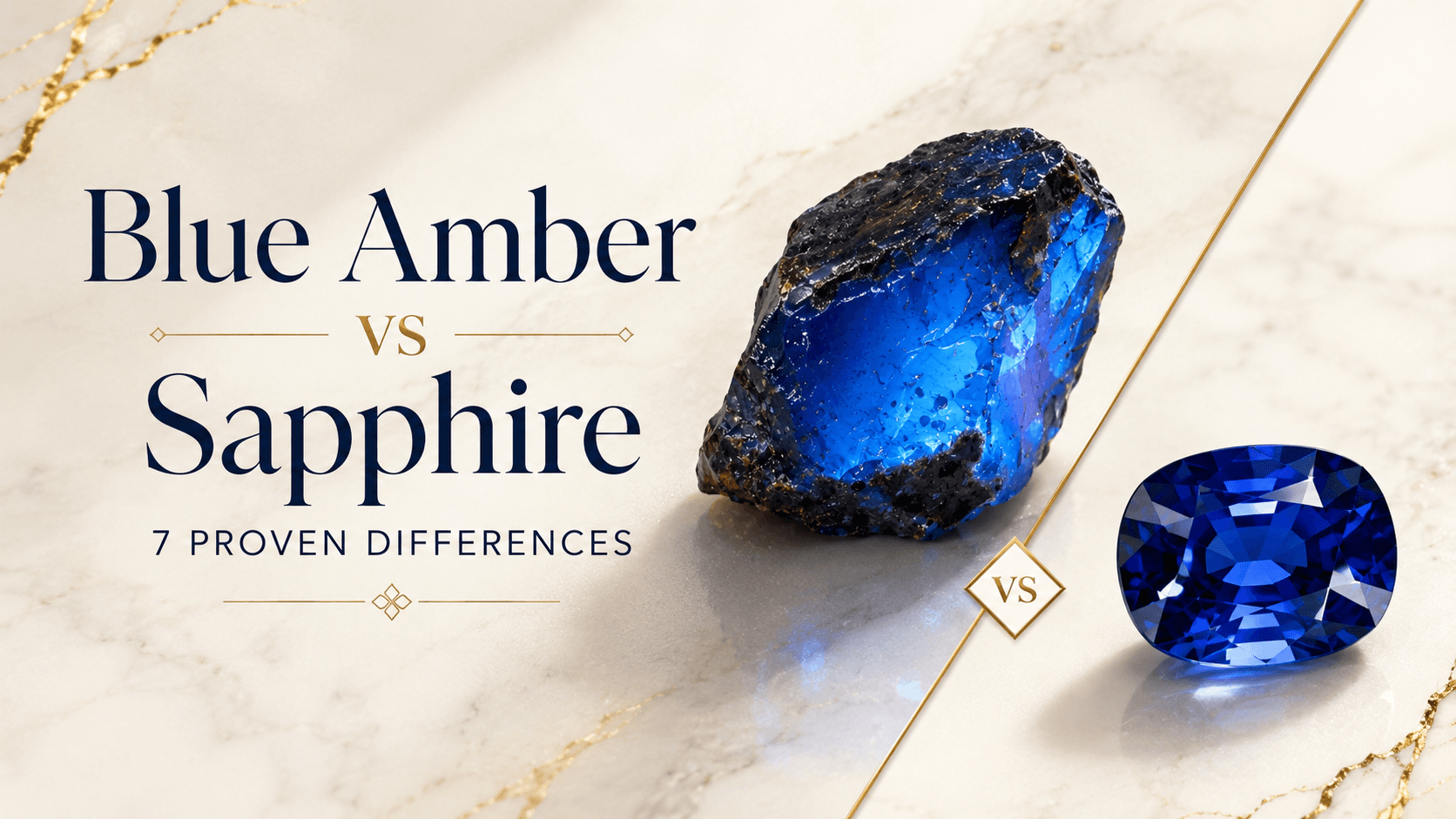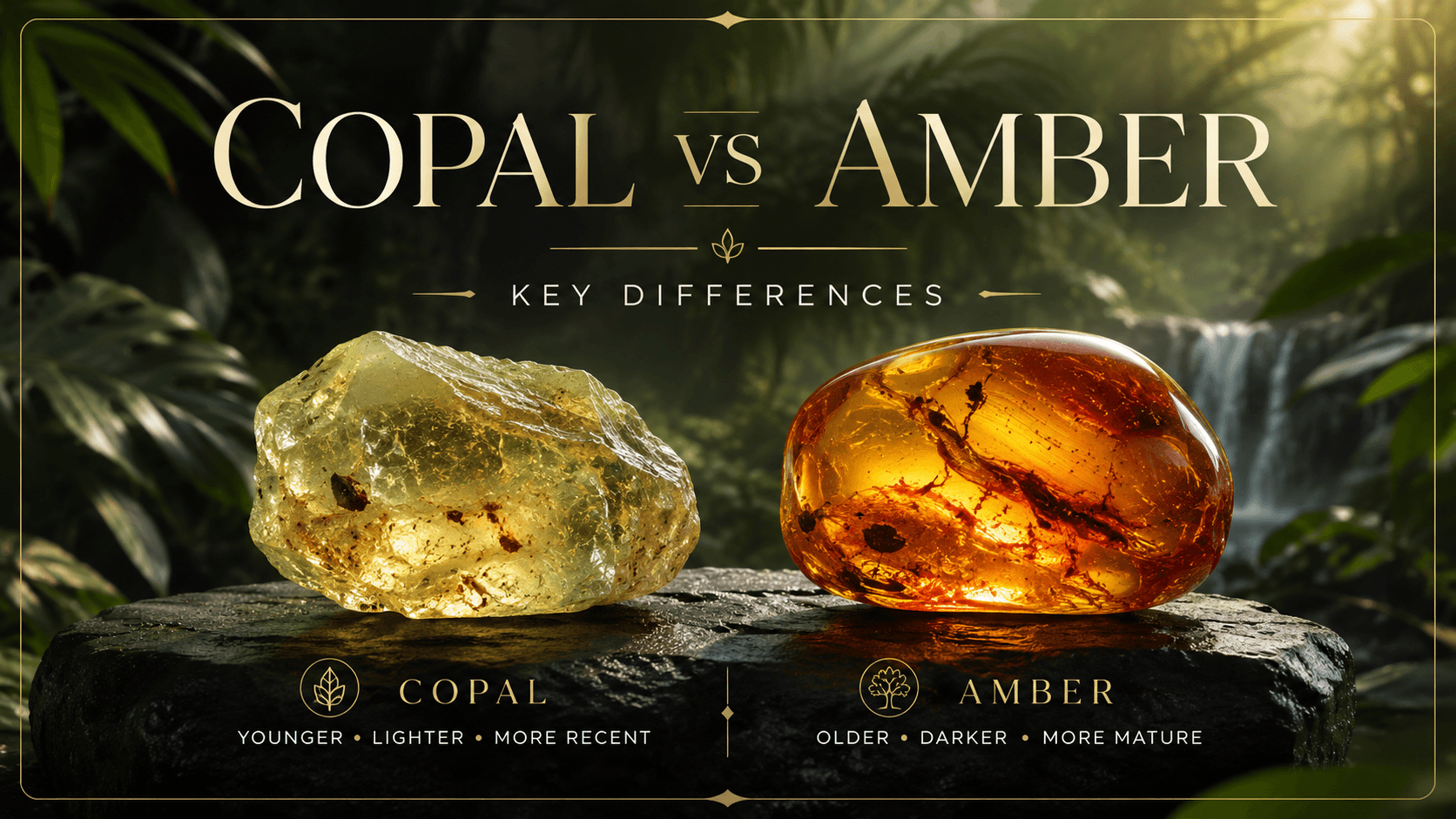
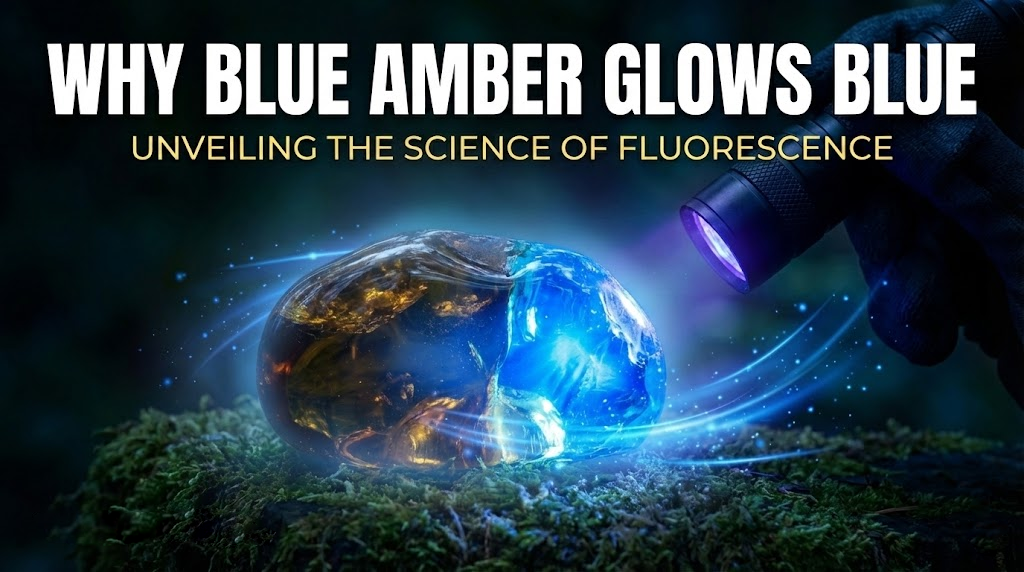
When people first hold a piece of blue amber, the question is almost always the same: why blue amber glows blue when the stone itself looks golden, cognac or cola-brown inside.
Why does blue amber glow blue, when the stone itself looks honey or cola-brown by transmitted light?
Blue amber glows blue because it is genuine fossil resin whose chemistry contains perylene and other polycyclic aromatic hydrocarbons (PAHs). These molecules absorb invisible ultraviolet (UV) and violet light and re-emit part of that energy as visible blue light. That re-emission is fluorescence — not body colour, not dye, not a coating. The blue is light the stone is actively creating, layered with a little surface scattering of short-wavelength light. This page is the deep technical hub on why blue amber glows blue: the physics, the chemistry, the provenance, and how the trade verifies it on the bench.
Key takeaways: why blue amber glows blue
-
The blue is fluorescence from perylene and PAHs, plus Rayleigh/Tyndall scattering — not the stone’s true body colour.
-
It is fluorescent, not phosphorescent: the glow stops the instant the UV light is removed.
-
365 nm long-wave UV (and full sunlight) triggers the truest, strongest blue; cheap 395 nm torches give a weaker, washed-out glow.
-
Dominican blue amber emits near 450, 474 and 508 nm (GIA Gems & Gemology, Winter 2020); Sumatran material from the Sinamar Formation tends to read brighter in daylight.
-
Glow strength is the #1 driver of price — a strong, even daylight blue separates collector-grade AAA+ from ordinary stock.
What is blue amber actually made of?
Amber is not a mineral. It is an amorphous (non-crystalline) organic solid — fossilised tree resin that hardened and polymerised over millions of years. Sumatran and Dominican blue amber are both retinite-class fossil resins: rich in labdanoid and terpenoid building blocks, with little or no succinic acid. That distinguishes them from Baltic amber, which is succinite. The distinction matters because it is the retinite chemistry — not the succinite chemistry — that hosts the blue fluorophores behind why blue amber glows blue.
millions of years (Sumatran, Miocene epoch; Dominican, Oligocene–Miocene, millions of years), the original sticky resin loses its volatiles, cross-links and stabilises. The source trees differ: Sumatran resin came from the Dipterocarpaceae family (most likely Shorea), a tropical hardwood; Dominican resin came from the extinct leguminous tree Hymenaea protera. General mineralogical data on amber as an amorphous fossil resin is catalogued by mindat.org. We cover the full molecular picture in the chemistry behind the blue (perylene & PAHs) — here we focus on how that chemistry makes light.
Why retinite, not succinite, carries the glow
The retinite-versus-succinite split is more than a naming convention. Succinite (Baltic) is defined by its succinic-acid content and a tougher, more polymerised matrix; retinite is a catch-all for fossil resins low in succinic acid, including the Sumatran and Dominican material. Crucially, the PAH fluorophores that explain why blue amber glows blue accumulate and survive in the retinite matrix. Baltic forests produced superb succinite, yet that chemistry never developed the perylene-rich fluorescence, which is one reason true blue amber is geographically restricted rather than found in every amber deposit on Earth.
How does fluorescence make the blue?
To understand why blue amber glows blue, separate two things light can do.
Normal colour vs created light
Most gems show colour by absorption and reflection: a stone absorbs some wavelengths and reflects the rest. No new light is made — it is filtered. That is why blue amber’s body colour, seen by transmission, is honey to cola-brown: it is simply absorbing the short wavelengths.
Fluorescence is different — it creates light:
-
A perylene or PAH molecule absorbs a high-energy UV/violet photon.
-
The molecule is briefly excited to a higher electronic state.
-
It releases the energy as a lower-energy photon, this time in the visible blue.
Because the emitted photon carries less energy than the one absorbed, it shifts toward the red end — the Stokes shift — landing in the blue band. The instant you remove the UV source, the glow vanishes. That created-light mechanism is the single biggest reason why blue amber glows blue rather than merely appearing tinted.
The Stokes shift in plain numbers
It helps to put energy figures on the process. A 365 nm UV photon carries roughly 3.4 electronvolts of energy; a 450 nm blue photon carries about 2.75 eV. The difference — close to 0.65 eV — is lost mostly as heat (vibrational relaxation) inside the perylene molecule before it emits. That energy gap is exactly the Stokes shift, and it guarantees the emitted light always lands at a longer, redder wavelength than the UV that pumped it. Understanding this energy budget is the cleanest way to grasp why blue amber glows blue under invisible light yet stays dark under warm indoor bulbs that carry no UV.
Fluorescence vs phosphorescence — the distinction that matters
This is the point most articles miss. Fluorescence and phosphorescence are both photoluminescence, but they are not the same mechanism. In fluorescence the excited molecule drops back almost instantly (nanoseconds), so emission stops the moment the exciting light is gone. In phosphorescence, the molecule is briefly trapped in a longer-lived state and keeps glowing for seconds or minutes after the light is removed — like a glow-in-the-dark star.
Blue amber is fluorescent, not phosphorescent. Switch off your 365 nm torch and the blue dies immediately. If a “blue amber” keeps glowing in the dark after the lamp is off, that is a red flag for treated or synthetic material, not natural fossil resin. This timing test is one of the quickest field clues tied directly to why blue amber glows blue.
Why is the emitted light blue and not green or red?
The colour is set by which fluorophores dominate. In blue amber, perylene and related PAHs are the active emitters, and their emission sits in the blue to blue-green band. GIA’s laboratory work on Dominican material recorded emission peaks near 450, 474 and 508 nm (GIA Gems & Gemology, Winter 2020) — squarely in the blue-to-cyan region the eye reads as that signature electric glow. The institute’s overview of amber gemology at GIA places these fossil resins among the organic gem materials whose luminescence is a defining identifier.
Layered on top of fluorescence is a second, smaller effect: Rayleigh and Tyndall scattering. Very short-wavelength (blue) light scatters most strongly at the polished surface and in micro-fine structure — the same physics that makes the sky blue. That surface scatter deepens the apparent blue, especially at glancing angles, but the dominant cause is still molecular fluorescence. In short, why blue amber glows blue is roughly 80% emission and 20% scatter, with the balance shifting toward scatter on the most translucent, palest stones.
Does provenance change the blue? Sinamar vs Dominican
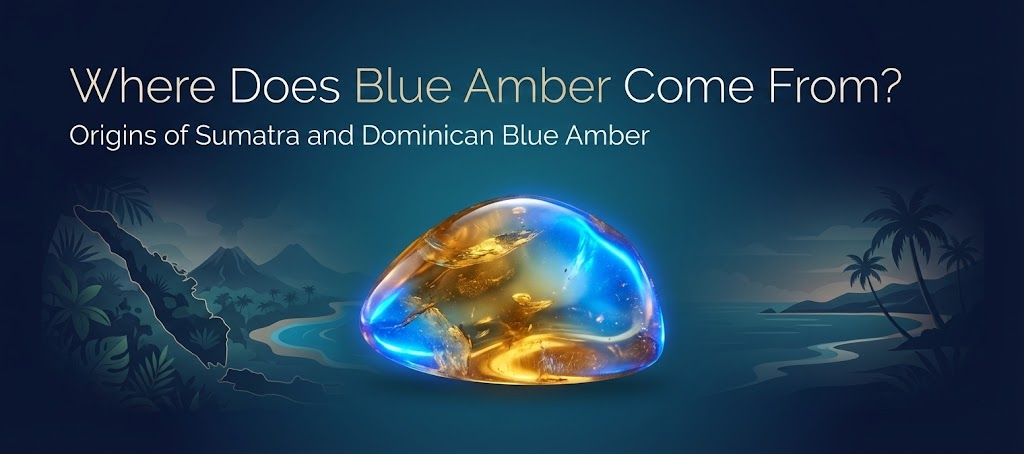
Yes — the expression of the blue tracks provenance, because the PAH balance differs between deposits. Sumatran blue amber is mined from the Sinamar Formation in Jambi Province / the South Sumatra Basin (the Bukit Barisan foothills), from coal-bearing sediments. Dominican blue amber comes from the La Cumbre, La Toca and Palo Quemado mines in the Cordillera Septentrional near Santiago.
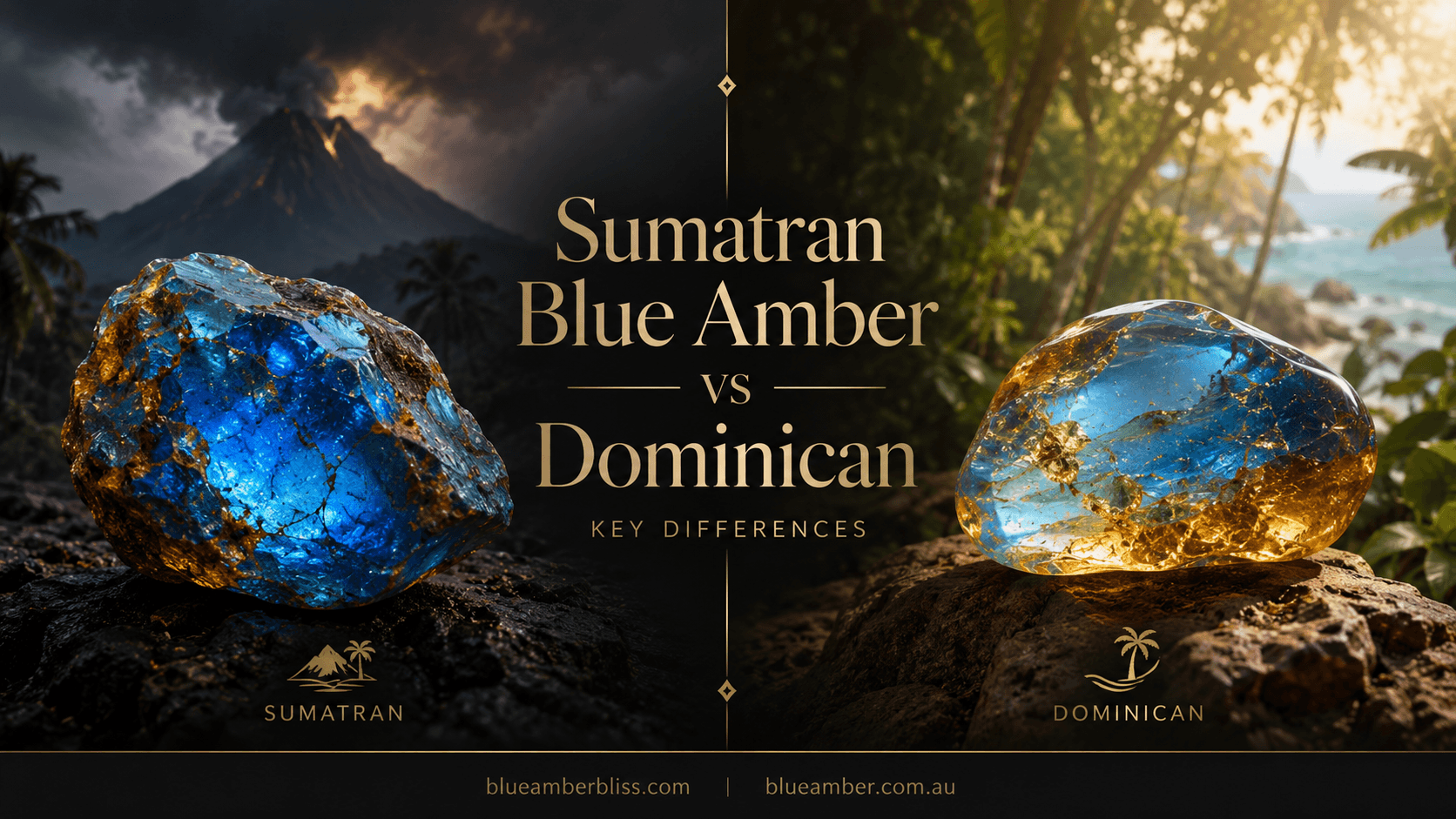
The practical, on-the-bench difference: Sumatran material tends to yield larger, cleaner nodules and a dramatic daylight blue — strong enough that full sunlight alone, without a torch, lights it up. Dominican stones often show their most striking blue under a focused UV beam against a dark body. Both are equal in quality; Sumatran is simply the newer, bigger-nodule, more-valuable standout. We break down the side-by-side in our guide to Sumatran vs Dominican blue amber compared, and map the geology in detail at where blue amber comes from.
How burial geology tunes the fluorophores
Provenance matters because the same UV physics meets a slightly different molecule mix in each basin. The Sinamar Formation’s coal-bearing sediments imply burial alongside organic-rich, low-oxygen mud — conditions that favour the formation and preservation of polycyclic aromatic hydrocarbons. The Dominican deposits, laid down in a marine-influenced Cordillera setting, produced their own characteristic PAH ratios. Because perylene concentration and the surrounding PAH family set both the emission peaks and the apparent brightness, the geological history of each deposit is quietly part of the answer to why blue amber glows blue with a Sumatran daylight punch versus a Dominican UV-beam intensity.
Why does my blue amber glow outdoors but look plain indoors?
Because light sources carry different amounts of UV and violet — the only wavelengths that pump the fluorescence.
| Light source | UV / violet content | Blue glow result |
|---|---|---|
| Midday sunlight | High (UV present even when cloudy) | Strong “daylight blue,” especially in Sumatran material |
| 365 nm long-wave UV torch | Pure long-wave UV | Strongest, truest blue — the standard test wavelength |
| 395 nm “UV” torch (cheap) | Partly visible violet | Weaker, washed-out glow |
| Warm incandescent / candle | Very low UV, mostly red/yellow | Looks plain golden-brown |
So when a pendant “switches on” as you walk to the window, the stone has not changed — the mix of wavelengths hitting it has. For accurate testing, reach for a 365 nm source, not a 395 nm one; the latter is partly visible violet and dilutes the true glow. This light-source dependence is the everyday face of why blue amber glows blue: no UV in, no blue out.
Why is the blue mostly a surface effect?
The body of the stone reads honey to cola-brown, while the blue lives in a thin layer near the surface. Three reasons:
-
Most blue light is emitted close to where the UV was absorbed — and UV penetrates only shallowly before the resin absorbs it.
-
Light travelling deeper is absorbed and scattered before it can return to your eye.
-
Surface Rayleigh scattering reinforces the effect exactly at the polished face.
This is why polish is performance. A mirror-bright surface on Sumatran blue amber gives the fluorescence a clean stage; a scratched or matte surface scatters light randomly and mutes the glow. Because amber is soft (Mohs 2–2.5), that polish scratches easily, which is why quality pieces are set protectively. A jeweller who understands why blue amber glows blue will recut or re-polish a tired surface before condemning a stone as low-grade.
How do labs and dealers verify the glow is real?
The full authenticity battery lives in our guide on how to tell if blue amber is real; here is the short, glow-focused version of why blue amber glows blue and how to confirm it:
-
365 nm UV / daylight blue: genuine fossil resin fluoresces a living blue; most plastics and dyes glow flat, the wrong colour, or not at all. Comparing the response under controlled 365 nm vs 254 nm (short-wave) UV helps separate natural amber from imitations.
-
Saltwater float: amber’s specific gravity (SG) is ~1.05–1.10, so it floats in saturated brine (SG ~1.15–1.16) yet sinks in fresh water. Most plastics and glass sink in brine.
-
Acetone test: immature copal turns tacky within 20–60 seconds, while mature amber resists — a quick maturity check on the resin that carries the fluorescence.
-
Hot-needle test: a pin-point of heat at a hidden edge releases a piney, resinous scent in real amber, not the acrid smell of burnt plastic (destructive — edge only).
-
FTIR spectroscopy: the definitive lab tool. Fourier-transform infrared spectroscopy reads the molecular fingerprint, separating mature amber from immature copal and confirming the retinite (Sumatran/Dominican) versus succinite (Baltic) class.
-
GIA / IGI report: for high-value pieces, a lab certificate settles species, maturity and treatment questions.
One quick field cue from the fluorescence/phosphorescence distinction above: real blue amber stops glowing the instant the lamp is off. Lingering afterglow points to treatment.
Why does only some amber turn blue?
Several factors must align, which is why blue amber is rare. The resin must come from a tree that produced the right precursors (Dipterocarpaceae for Sumatran, Hymenaea protera for Dominican); burial chemistry and time must convert those precursors into stable PAH fluorophores; and the material must be fully mature — young copal has not developed the same stable fluorescence and turns tacky in an acetone test, while mature amber resists.
Baltic forests made magnificent succinite but not this blue effect. The rarity of every link in that chain is the deeper reason why blue amber glows blue in so few deposits worldwide. We quantify just how scarce it is in our explainer on how rare blue amber really is.
How does the glow set the price?
Glow is price driver #1. Grading runs AA / AAA / AAA+ by glow intensity and evenness, clarity, body colour and size, and Sumatran nodules from the Sinamar Formation supply the cleanest, largest, most intensely daylight-blue AAA+ stones. As a rough orientation:
-
$3–15/g — rough or low-glow material
-
$15–60/g — polished, good blue glow
-
$60–200/g — high-grade AAA, strong even daylight glow, clean
-
$200–500+/g — top AAA+ large, clean, intense-glow collector pieces
Jewellery is priced per piece; a large, flawless, strong-glow Sumatran cabochon commands the premium. Once you know why blue amber glows blue, you understand why two stones of identical weight can differ tenfold in price — the buyer is paying for fluorescence yield, not grams. The full breakdown lives in our blue amber price guide, where glow strength leads the valuation.
Is the blue related to green amber?
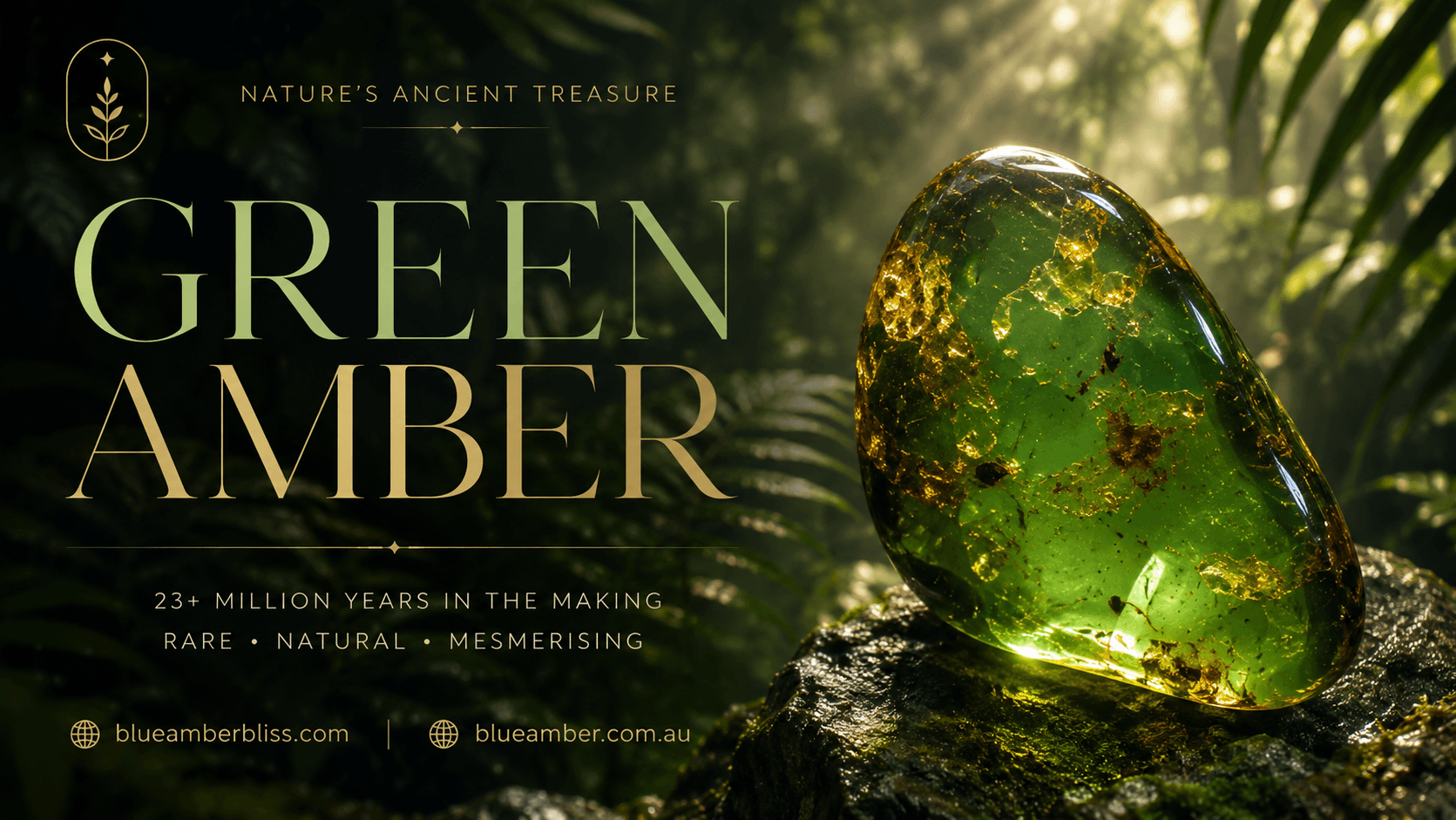
Partly. Green amber’s colour can arise from a mix of body colour, plant inclusions and sometimes treatment, rather than the perylene-driven fluorescence that defines true blue amber. The two are often confused under mixed lighting. The mechanism that explains why blue amber glows blue — molecular fluorescence from PAHs — is not the same as the body-colour-plus-treatment route behind much green material. We separate the mechanisms in our note on green amber and how it differs.
What We Notice About the Glow in Sumatran Blue Amber
Handling Sumatran blue amber every day, we’ve learned the glow is really about contrast: the piece looks like deep cognac or near-black in the palm, then throws a vivid blue as soon as UV or open daylight hits it. What we notice is that this darker Sumatran body reads as almost ordinary indoors, which makes the shift to that electric blue far more dramatic than on paler material, and the effect is strongest under direct sun or a UV torch against a dark background. Because the color is fluorescence rather than a fixed pigment, we always check each stone in several lights before it’s selected, since the strength of the blue can vary noticeably from nodule to nodule.
If you’d like to see this daylight-to-glow shift for yourself, you’re welcome to explore our hand-selected Sumatran blue amber whenever you’re ready. Shop hand-selected Sumatran blue amber →
Frequently asked questions
Why does blue amber glow blue?
Why blue amber glows blue comes down to fluorescence: perylene and other PAHs inside the fossil resin absorb UV and violet light, then re-emit it as visible blue. A smaller share comes from Rayleigh scattering at the polished surface. It is created light, not body colour, dye or coating, which is why the glow appears only when UV-rich light strikes the stone.
Is blue amber fluorescent or phosphorescent?
Fluorescent. The blue glow stops the instant the UV or sunlight is removed, because the excited perylene/PAH molecules release their energy in nanoseconds. Phosphorescence — a lingering afterglow in the dark — does not occur in natural blue amber, so any persistent glow is a warning sign of treatment.
What UV wavelength shows the blue best?
Long-wave 365 nm gives the strongest, truest blue and is the standard test wavelength. Cheap 395 nm “UV” torches emit partly visible violet and produce a weaker, washed-out glow. Full sunlight contains enough UV to trigger the signature daylight blue in strong Sumatran material.
Is the blue a dye or coating?
No. The blue is internal fluorescence from perylene and PAHs plus surface scattering. Dyes produce flat, opaque blue with no underlying amber tone and no glow that switches with light source. FTIR spectroscopy and a 365 nm test quickly expose dyed imitations.
What is the emission wavelength of blue amber?
GIA measured Dominican blue amber emitting near 450, 474 and 508 nm (Gems & Gemology, Winter 2020) — the blue-to-cyan band. Sumatran material reads similarly while tending to fluoresce more strongly in daylight.
Why does my blue amber look brown indoors?
Indoor incandescent and candle light carry almost no UV, so the fluorescence has nothing to excite it and you see only the honey-to-cola body colour. Step into sunlight or use a 365 nm torch and the surface blue switches on.
Does Sumatran or Dominican blue amber glow more?
Both are equal in quality, but Sumatran amber from the Sinamar Formation tends to show a more dramatic daylight blue and comes in larger, cleaner nodules, making it the standout AAA+ material. Dominican stones often show their strongest blue under focused UV.
Explore the Complete Blue Amber Guide
- Sumatran vs Dominican blue amber compared
- the chemistry behind the blue (perylene & PAHs)
- green amber and how it differs