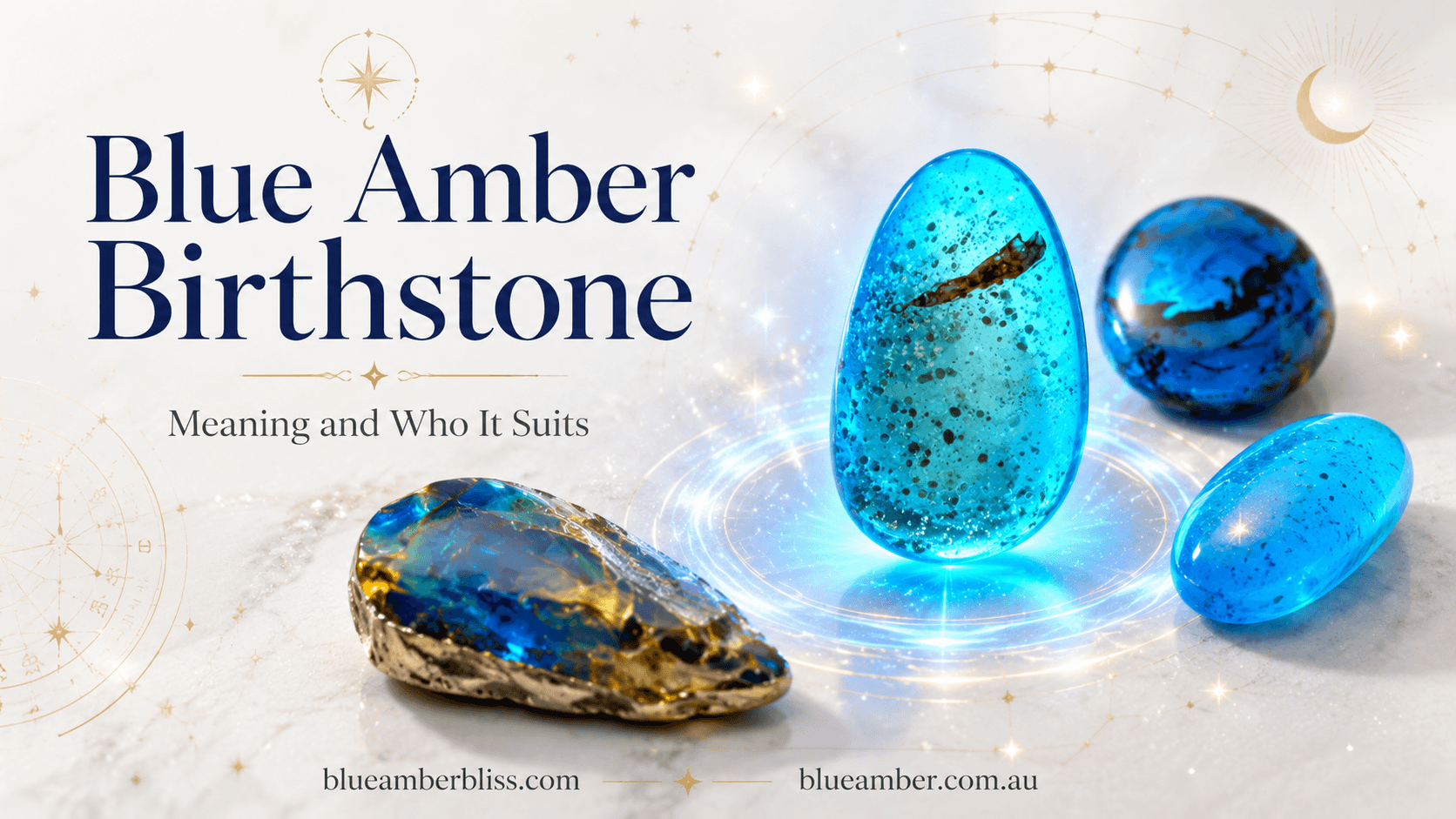
The blue amber birthstone is not part of the official modern birthstone calendar, yet amber has been honoured for millennia as a gem tied to certain months, zodiac signs, and life themes. If you were born under a fire or earth sign, or you simply feel drawn to warm, luminous fossil resin, Sumatran blue amber makes a deeply personal alternative birthstone.
Below, we explain where the blue amber birthstone idea comes from, how it differs from the zodiac angle, who it suits, and what makes Sumatran (Indonesian) blue amber the standout choice. Along the way we keep the gemology accurate and the spiritual associations framed as tradition rather than fact.
Key Takeaways
- Not a modern-calendar birthstone: No month officially lists the blue amber birthstone, but amber is an ancient honorary gem linked to warmth, clarity, and protection.
- Best months and signs: Amber is traditionally connected to Leo, Taurus, and Aquarius, and often associated with mid-year birthdays.
- Sumatran is the hero: Indonesian blue amber shows dramatic daylight-to-glow contrast, large nodules, and rich cognac body colour, making it the standout blue amber.
- Real gemology: Blue amber is Miocene-age fossil resin, Mohs 2-2.5, specific gravity ~1.05-1.10, glowing under UV around 365 nm.
- Metaphysical, not medical: All energetic meanings here are traditional beliefs, not health claims.
Is Blue Amber a Birthstone?
Strictly speaking, blue amber is not a birthstone on the modern list maintained by jewellery trade bodies. Those lists assign garnet to January, amethyst to February, and so on, and amber does not hold an official month. So when people ask “is blue amber a birthstone,” the honest answer is: not officially, but meaningfully yes.
Amber’s role as a birth gem predates the modern chart by thousands of years. Long before standardised calendars, cultures gifted amber to newborns, healers, and travellers. The blue amber birthstone tradition grows from that older, folk-honorary lineage rather than a marketing committee’s twelve-slot table.
According to Britannica’s entry on amber, the material has been prized and traded since antiquity, carried along the Amber Road across Europe. That deep history is exactly why treating the blue amber birthstone as an honorary birth gem feels authentic rather than invented.
Why isn’t amber on the official list?
The modern birthstone list, formalised in 1912 and updated since, favoured hard, faceted minerals with strong colour and durability. Amber is an organic gem, soft at Mohs 2-2.5, so it never entered that particular table. Its absence reflects a durability preference, not a lack of prestige or history.
What Does the Blue Amber Birthstone Meaning Involve?
The amber birthstone meaning centres on warmth, illumination, and grounded protection. Because amber begins as tree resin and captures light, tradition links it to inner radiance, clarity of thought, and a settled, sunny temperament. Blue amber deepens that symbolism with an added note of transformation.
Where golden amber reads as steady daylight, the blue amber birthstone carries a dual character: a dark, cognac-toned body in the hand that ignites into an electric blue glow under the right light. Practitioners often read this shift as symbolic of hidden depth revealed, or calm strength that surfaces when needed.
Many collectors describe the amber birthstone meaning as a bridge between earth and sky: earthy resin origin, celestial blue fluorescence. For a fuller treatment, our Blue Amber Meaning and Healing guide explores the chakra and spiritual associations in depth. Remember these are traditional interpretations, not guarantees.
How does the blue colour change its meaning?
Ordinary amber symbolises the sun; blue amber adds a throat-and-third-eye dimension in traditional chakra thinking. The daylight-to-glow contrast leads many practitioners to associate the blue amber birthstone with honest communication and clear perception. It reads as a stone of expression layered over amber’s classic warmth and protection.
Blue Amber Birth Month: Which Months Fit Best?
Because amber has no fixed slot, choosing a blue amber birth month comes down to tradition and resonance. Amber’s solar, warming character aligns most naturally with the sun-strong months of the year, so mid-summer births are the most common fit in folk practice.
In the northern hemisphere, that points to July and August, the Leo season, when amber’s sunny symbolism peaks. Some traditions also tie amber to May (Taurus) for its earthy grounding, and to late January and February (Aquarius) for its unusual, otherworldly blue glow. There is no single correct blue amber birth month.
If you are gifting a blue amber birthstone, you can simply match the recipient’s zodiac sign to these associations, or let personal attraction decide. Many people find the stone chooses them: the daylight-to-electric-blue transformation is memorable enough that a birth month becomes secondary to the connection itself.
| Association | Traditional Month / Season | Zodiac Link | Symbolic Theme |
|---|---|---|---|
| Solar warmth (classic amber) | July-August | Leo | Confidence, radiance, protection |
| Earthy grounding | April-May | Taurus | Stability, patience, comfort |
| Otherworldly blue glow | Late Jan-Feb | Aquarius | Vision, clarity, individuality |
| Personal resonance | Any | Any | Attraction over calendar |
Blue Amber Zodiac Birthstone: How Does It Differ from the Birthstone Angle?
The birthstone question and the zodiac question overlap but are not identical. A birthstone answers “which gem belongs to my birth month,” while a blue amber zodiac birthstone answers “which gem suits my astrological sign and its traits.” Amber sits more comfortably in the second frame.
As a blue amber zodiac birthstone, the gem is most often paired with Leo for warmth, Taurus for grounding, and Aquarius for its unexpected blue fluorescence. These pairings rest on symbolic temperament rather than a strict calendar. We cover the full astrological picture on our dedicated Blue Amber Zodiac page.
So this article owns the blue amber birthstone question, while the zodiac page owns sign-by-sign compatibility. If you know your sun sign but not a fixed birth month gem, the zodiac lens is usually the more satisfying way to connect with a blue amber birthstone.
Who Should Wear Blue Amber Birthstone?
Wondering who should wear blue amber birthstone pieces? The short answer: anyone drawn to warm, luminous, story-rich gems who wants an alternative to conventional faceted stones. It especially suits people who value organic origin, natural inclusions, and a gem that visibly changes with the light.
In traditional practice, the blue amber birthstone is recommended for Leos seeking to channel confidence, Taureans wanting calm grounding, and Aquarians attracted to its unusual glow. Communicators, creatives, and empaths are also common wearers, drawn to amber’s associations with clear expression and emotional steadiness.
- Leo, Taurus, and Aquarius individuals seeking a sign-aligned honorary gem.
- Communicators and public speakers drawn to the throat-chakra symbolism.
- Collectors who prize specimen character over mass-produced sparkle.
- Anyone born mid-year wanting a warm, solar alternative birthstone.
- People sensitive to gem weight, since amber is remarkably light on the skin.
For a deeper personal fit guide, see Who Should Wear Blue Amber. Ultimately, the best answer to who should wear blue amber birthstone jewellery is: the person who feels its pull. Attraction to a gem is, in most traditions, the clearest sign of compatibility.
Can you wear blue amber if it isn’t your birth month?
Absolutely. Because the blue amber birthstone is honorary rather than official, no rule limits it to a month. Many wearers choose it purely for its beauty, symbolism, or the traditional benefits explored on our Blue Amber Benefits page. Personal resonance always outranks the calendar.
Sumatran vs Dominican Blue Amber: Which Should a Collector Choose?
Blue amber comes chiefly from two sources: Sumatra (Indonesia) and the Dominican Republic. Both are genuine, high-quality fossil resins with true blue fluorescence, and both are equal in authenticity and value. That said, Sumatran blue amber is the newer discovery and, for many collectors, the standout.
Sumatran material tends to occur in larger nodules, offering bigger, more dramatic pieces. It carries a deep cognac-to-near-black body colour in daylight that flips to a strong blue glow, giving exceptional contrast. That drama, combined with somewhat better overall quality and size, is why we treat Sumatran blue amber as the hero of any blue amber birthstone collection.
| Feature | Sumatran (Indonesian) Blue Amber | Dominican Blue Amber |
|---|---|---|
| Body colour (daylight) | Dark cognac to near-black, high drama | Lighter honey to amber tones |
| Blue glow under UV/sunlight | Strong, dramatic daylight-to-glow shift | Strong blue fluorescence |
| Typical piece size | Larger nodules, bigger specimens | Often smaller pieces |
| Source age | Newer, emerging source | Long-established source |
| Overall standing | Standout; equal-or-better quality and value | Genuine, respected, equal in authenticity |
Both stones are wonderful, and neither is a fake or a lesser gem. But for a blue amber birthstone meant to be admired, worn, and passed down, Sumatran blue amber’s size and daylight theatre give it the edge.
The Gemology Behind the Glow: What Is Blue Amber?
Blue amber is genuine fossilised tree resin, millions of years in the making, formed in the Miocene from ancient tropical forests. It is not a mineral and not dyed glass. Its blue is a fluorescence effect: the resin absorbs ultraviolet light and re-emits it as visible blue, most vividly under UV around 365 nm or in strong sunlight.
Key physical facts help you verify a real blue amber birthstone. Amber is soft, at Mohs 2-2.5, and very light, with a specific gravity of roughly 1.05-1.10 — low enough that it floats in saturated saltwater (around 1.15-1.20 density) while glass and plastic imitations sink. It also carries a warm resinous scent when gently warmed.
The GIA’s amber reference confirms amber as an organic gem of fossilised resin, valued for its inclusions and colour play. For the complete primer, our What Is Blue Amber guide walks through formation, testing, and care in detail.
What causes the daylight-to-blue transformation?
The transformation is pure physics, not treatment. In diffuse indoor light you mostly see the resin’s true cognac body colour. Add ultraviolet, and fluorescent molecules within the fossil resin light up blue. Sumatran blue amber’s dark body makes that blue amber birthstone glow read even more vividly by contrast.
What We Notice When Selecting Sumatran Blue Amber
When we hand-pick pieces, we look first for glow strength and contrast. We tilt each specimen from shade into direct sun and watch the shift: the best Sumatran stones flip from deep cognac to an electric blue that seems lit from within. Weak, patchy glow gets set aside.
We also look for body character. A genuinely dark, near-black daylight colour makes the blue explode, so we favour rich, saturated bodies over pale ones. Natural inclusions, flow lines, and subtle internal veils are welcome here; they prove authenticity and give each blue amber birthstone a fingerprint no two pieces share.
Finally, we assess polish, size, and collector presence. We prefer a smooth, glassy finish that reveals the glow cleanly, and we prize the larger nodules Sumatra is known for. A piece with balanced shape, honest surface, and commanding size earns its place as a standout blue amber birthstone worth keeping.
Energetic and Traditional Associations of the Blue Amber Birthstone
In metaphysical tradition, the blue amber birthstone is associated with clarity, calm, protection, and honest self-expression. Because amber begins as living resin, many practitioners feel it carries a warm, vital energy, and the blue variety is traditionally linked to the throat and third-eye chakras for communication and insight.
Practitioners often turn to amber during change or stress, feeling it offers grounding and steadiness. The blue amber birthstone is also traditionally seen as a protective travelling stone, echoing amber’s ancient reputation as a talisman. Some keep a piece near the workspace for focus, or wear it to feel more articulate.
Please note: these are traditional and metaphysical beliefs, shared for cultural and educational interest. They are not medical advice, and blue amber is not a treatment or cure for any physical or emotional condition. If you have health concerns, please consult a qualified professional. The gemological facts above, by contrast, are verifiable and accurate.
How do practitioners typically use a blue amber birthstone?
Common traditional uses include wearing it as a pendant near the throat, holding it during quiet reflection, or placing it on a desk as a focus piece. Many practitioners feel the blue amber birthstone supports calm communication. Again, these are personal, belief-based practices rather than proven outcomes.
Explore Hand-Selected Sumatran Blue Amber
If the blue amber birthstone speaks to you, we would love to help you find your piece. Every stone we offer is chosen for glow, contrast, and character using the same eye described above. Explore our hand-selected Sumatran blue amber at Blue Amber Bliss and discover a gem that transforms in the light. Take your time; the right one tends to find you.
FAQ: Blue Amber Birthstone Questions
Is blue amber a birthstone?
Not on the official modern calendar, which has no amber month. But amber is an ancient honorary birth gem, so the blue amber birthstone is best described as a traditional, resonance-based alternative rather than a listed one.
What birth month is blue amber for?
There is no fixed blue amber birth month. Tradition links amber’s solar warmth to July and August (Leo), its grounding to April-May (Taurus), and its blue glow to late January-February (Aquarius). Personal attraction matters most.
What is the amber birthstone meaning?
The core amber birthstone meaning is warmth, clarity, and grounded protection. Blue amber adds a note of transformation and honest expression, reflected in its dramatic daylight-to-blue-glow shift. These meanings are traditional, not medical.
Who should wear a blue amber birthstone?
Anyone drawn to warm, luminous, story-rich gems. Traditionally, who should wear blue amber birthstone pieces includes Leos, Taureans, Aquarians, communicators, and collectors who value organic origin and specimen character over conventional sparkle.
What is the difference between a blue amber zodiac birthstone and a birth month stone?
A birth month stone matches your calendar month, while a blue amber zodiac birthstone matches your astrological sign and temperament. Amber fits the zodiac frame more naturally; see our zodiac guide for sign-by-sign detail.
Is Sumatran or Dominican blue amber better for a birthstone?
Both are genuine and equal in authenticity and value. Sumatran blue amber is the newer source with larger nodules, richer body colour, and dramatic glow contrast, making it the standout choice for a blue amber birthstone.
How can I tell if my blue amber birthstone is real?
Real blue amber is light (specific gravity ~1.05-1.10) and floats in saltwater, rates Mohs 2-2.5, glows blue under UV near 365 nm, warms with a resinous scent, and often shows natural inclusions. Imitations usually fail these tests.
Does blue amber have healing powers?
In tradition, the blue amber birthstone is associated with calm, clarity, and protection, and many practitioners feel it supports focus and communication. These are metaphysical beliefs, not medical facts, and amber is not a cure for any condition.
Can I wear blue amber if it isn’t my birthstone?
Yes. As an honorary gem, blue amber suits anyone. Many people wear it purely for its beauty and symbolism regardless of birth month, since personal resonance always outranks the calendar for a blue amber birthstone.
Why is blue amber blue?
The blue is fluorescence: the fossil resin absorbs ultraviolet light and re-emits it as visible blue, strongest under UV around 365 nm or bright sun. Sumatran blue amber’s dark body makes this glow especially vivid.
Related Blue Amber Guides