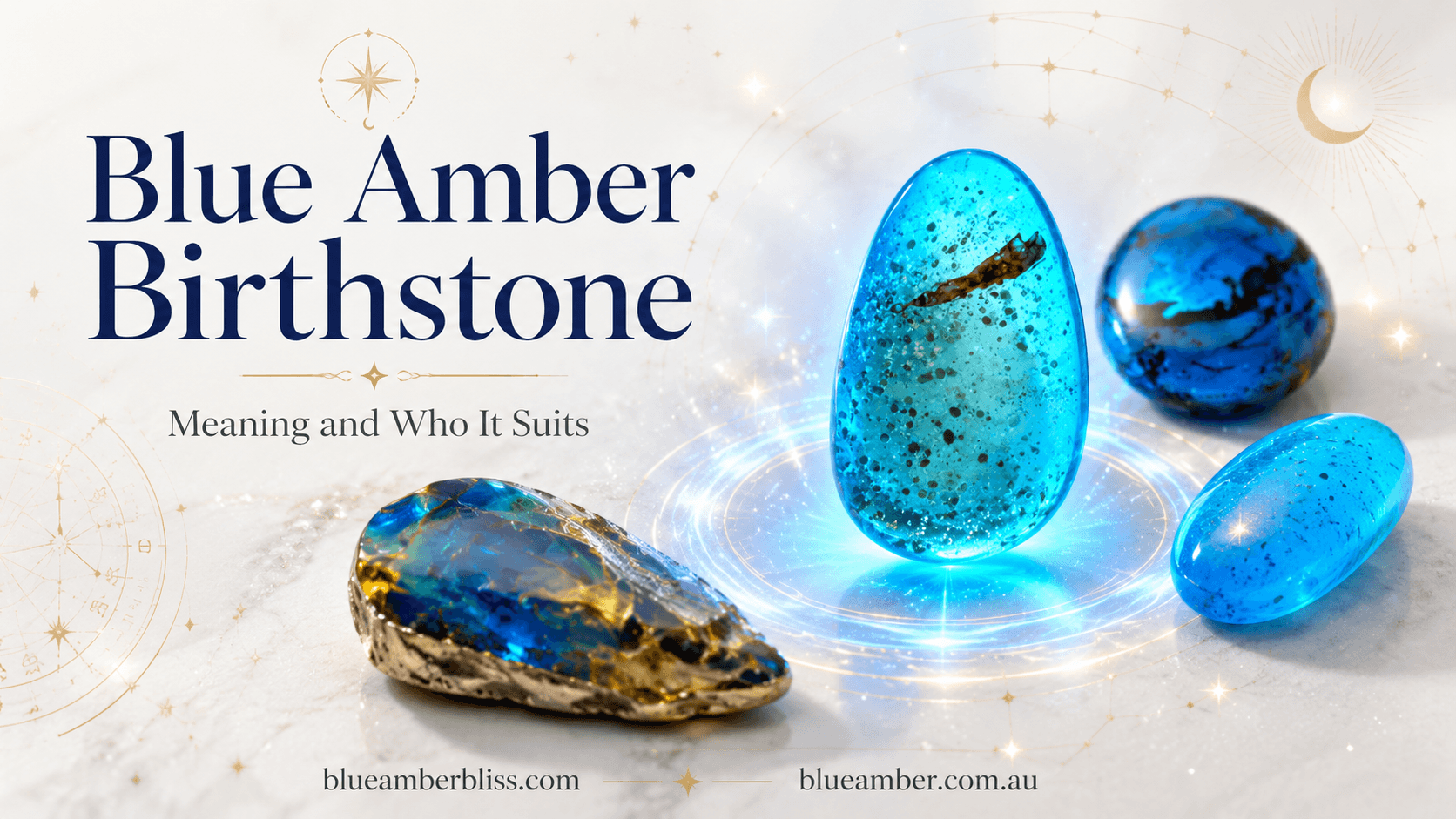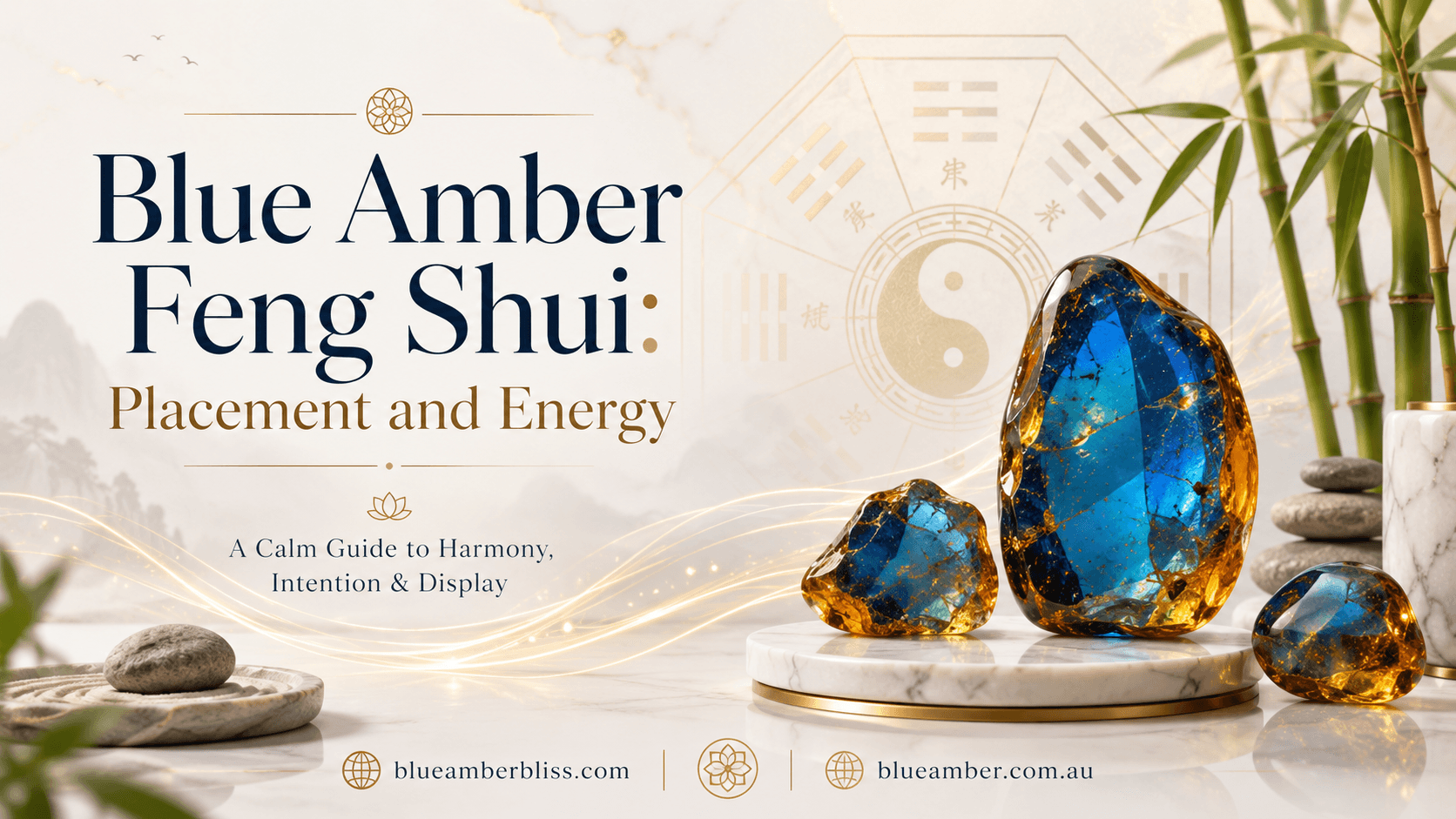
So who should wear blue amber? Anyone drawn to calm, mental clarity, or quiet protection can wear blue amber, and Sumatran (Indonesian) blue amber suits you best thanks to its dramatic daylight-blue glow and large nodules. It pairs beautifully with intention, zodiac, chakra, and personal style alike.
That short answer covers the headline, but the real value is in the nuance. Below, you will learn exactly who this fossil-resin stone fits and why, how to match a piece to your intention, which signs and chakras align, and the practical, on-the-bench question of how to wear blue amber so it works with your daily life rather than sitting forgotten in a drawer.
Key Takeaways: Who Should Wear Blue Amber
- Best stone first: Sumatran (Indonesian) blue amber is the standout choice, prized for its strong daylight glow and larger nodules; Dominican is its respected equal.
- By intention: Reach for this stone for calm, clarity, or protection, depending on what you most want to invite into your day.
- By zodiac: Air and fire signs especially resonate, though anyone can enjoy the stone regardless of their sign.
- By chakra: It links to the throat and third-eye centers, so position it high on the upper body for those goals.
- By setting: At Mohs 2-2.5 it is soft, so a protective bezel beats prongs and a ring is the worst everyday setting.
- Who should not: Manual workers, ultrasonic-cleaner households, and hot-climate ring-wearers should pick safer formats or a different stone for daily abuse.
What Makes Blue Amber Special Before You Wear It?
Blue amber is not blue the way a sapphire is. It is fossilized tree resin, millions of years in the making (Sumatran material formed in the Miocene epoch), that fluoresces blue when ultraviolet light strikes its surface. In sunlight, the best pieces glow electric blue against a honey body. That optical drama is the whole reason people want to wear blue amber rather than ordinary cognac amber.
The blue is genuinely not body color. Trace perylene and other polycyclic aromatic hydrocarbons (PAHs) act as fluorophores: they absorb invisible UV and violet light and re-emit it as visible blue, while Tyndall and Rayleigh scattering of short wavelengths at the surface adds to the effect. This is fluorescence, not phosphorescence – the glow stops the instant the exciting light is removed. GIA‘s Gems & Gemology (Winter 2020) measured Dominican blue amber emitting near 450, 474, and 508 nm.
Two sources dominate the trade. Sumatran (Indonesian) blue amber comes first: a newer source famous for big nodules, a rich greenish-to-sky daylight glow, and excellent overall quality. Dominican blue amber is its long-established equal. Both are retinite-class fossil resins (low or no succinic acid), unlike Baltic succinite. The two are equal in quality, but Sumatran’s bigger sizes and standout daylight blue make it the more valuable pick today.
Because it is organic and amorphous (non-crystalline), the material is warm to the touch and remarkably light, with a specific gravity of only ~1.05-1.10 and a refractive index near 1.54. That comfort matters when you decide to wear it as a pendant or a strand of beads all day long. You can learn more in our guide to blue amber meaning and healing, which expands on its symbolism and history.
Who Should Wear Blue Amber? The 7 Proven Matches
People ask who should wear blue amber expecting a single answer, but the honest reply is that it serves several different people for several different reasons. In traditional crystal-belief terms, here are seven well-matched profiles. Each describes a real, recognizable reason someone reaches for this glowing stone.
1. The Overthinker Who Wants Calm
If your mind races at night, you may carry this stone as a grounding anchor. Traditional belief treats amber as a warm, settling material that soothes nervous energy. Keep a smooth bead between your fingers, breathe slowly, and let the weightless warmth remind you to ease off. Many people choose it specifically as a portable calm cue.
2. The Decision-Maker Who Needs Clarity
Students, founders, and anyone facing big choices often turn to this stone for mental clarity. The throat-and-third-eye association links it to clear thinking and honest expression. It will not make decisions for you, but holding a clear-glowing piece can become a small ritual that helps you focus before you speak or commit to something.
3. The Empath Who Wants Protection
Sensitive people who absorb others’ moods traditionally treat this stone as an energetic buffer. Folklore across many cultures cast amber as a protective talisman for travelers and children. If you feel drained after crowds, a piece worn over the heart or throat acts as a gentle, symbolic shield you carry with you everywhere.
4. The Spiritual Seeker Deepening Practice
Meditators and energy workers often reach for this stone to support throat and third-eye work. Place it on the body during practice, or simply hold it while journaling. Its glow is frequently read as a bridge between earthy grounding and higher awareness, which is why it appears so often on altars and in intention rituals.
5. The Collector Who Loves Rare Beauty
Some people are drawn to this gem simply because it is stunning and uncommon. Genuine blue fluorescence is rare among gem materials, and Sumatran nodules can reach impressive sizes. If you value a conversation piece with real fossil history, owning and showing it is its own reward, with no metaphysical claim required at all.
6. The Minimalist Who Wants One Meaningful Piece
If you dislike clutter, you can wear blue amber as a single signature stone. One quality pendant on a cord covers calm, clarity, and protection at once. Its honey-to-blue shift means it reads as warm jewelry indoors and reveals its blue secret outdoors, quietly doing the work of several different pieces in one.
7. The Gift-Giver Marking a Milestone
Because amber symbolizes preserved time, it makes a meaningful gift for graduations, new jobs, recoveries, and births. The idea that something ancient now protects a brand-new chapter resonates deeply. A gifted piece carries intention from the giver to the receiver, and many recipients say that meaning is what they treasure most.
Who Should NOT Wear Blue Amber (As a Ring, At Least)?
The seven matches above are about who the stone suits in spirit. The real exceptions are physical, not mystical, and they come down to one fact: amber rates only 2-2.5 on the Mohs scale, softer than a fingernail-resistant gem and far softer than the quartz dust floating in ordinary house dust. The honest contraindications below are about format and habit, not your birth chart.
| If you are… | The risk | Wear this instead |
|---|---|---|
| A manual or trade worker | Constant knocks chip and abrade soft resin fast | Pendant or earrings worn off the job, not a ring |
| An ultrasonic-cleaner household | Ultrasonic and steam crack and craze amber | A piece you clean only by hand with a soft cloth |
| Living in a hot, dry climate | Heat and dehydration encourage surface crazing | Store cool; avoid all-day sun and dashboards |
| Set on a daily ring | Rings take the worst abrasion of any setting | Necklace or brooch; reserve amber rings for occasions |
| Heavily scented every day | Perfume, hairspray and solvents dull the polish | Apply cosmetics first, add the stone last |
| Prone to metal allergies | The amber is inert, but base-metal findings react | Sterling silver or solid gold findings only |
None of this bars you from the stone. It simply steers you toward the formats that let soft fossil resin survive real life. If you genuinely need a stone to abuse daily on your hand, blue amber is the wrong tool – choose a Mohs 7+ gem for that role and keep your amber for the necklace.
Setting and Metal: How to Protect Mohs 2-2.5 Amber
The single most important wearing decision is the setting, because it decides how much the stone gets knocked. For amber, a bezel setting – a continuous metal rim that wraps the girdle of the cabochon – is the clear winner. It shields the vulnerable edges, spreads impact into the metal instead of the resin, and hides the small chips that prongs would leave exposed.
Prong settings look airy and let more light in, which flatters the glow, but they leave the amber’s edges and surface naked to every knock. For a soft Mohs 2-2.5 material that is a poor trade. If you love the prong look, reserve it for earrings or an occasional pendant that rarely makes contact with hard surfaces, and keep daily pieces bezel-set.
On metal: the amber itself is inert and hypoallergenic, so the allergy question is entirely about findings. Sterling silver is affordable, cool-toned, and flatters the hidden blue; solid gold (not plated) resists tarnish and skin reactions best and echoes the honey body. Avoid cheap plated base metal, which both irritates sensitive skin and looks wrong against a fossil gem.
Cut and Format: Cabochon, Bead, or Faceted?
How a stone is cut decides how it wears and how the blue reads. Amber is almost never faceted the way a diamond is – it is too soft to hold crisp facet edges, and facets fight the fluorescence rather than show it. The two formats that genuinely suit blue amber are the cabochon (a smooth, domed cut produced by cabbing) and the bead. Match the format to your intention and to the Sumatran nodule sizes actually available.
| Format | Best intention / use | Typical size | Why it works |
|---|---|---|---|
| Cabochon pendant | Confidence, collecting, one signature piece | 15-30 mm; large Sumatran nodules 30 mm+ | Domed top maximizes daylight glow; bezels easily for protection |
| Bead strand / mala | Calm, meditation, throat-chakra work | 6-12 mm rounds | Smooth handling; many small points of glow; comfortable all day |
| Bracelet beads | Daily-wear clarity cue worn off the work site | 8-10 mm rounds | Light and warm on the wrist; keep clear of knocks |
| Faceted accent | Rarely advised | Small only | Facets chip on soft resin and mute the fluorescence |
Sumatran material’s advantage shows here: its larger, cleaner nodules are what make a single 30 mm-plus statement cabochon possible, the standout AAA+ piece a collector chases. Price scales with that combination of size, clarity, and even glow – polished good-glow material runs roughly $15-60 per gram, while top AAA+ collector cabochons reach $200-500+ per gram. For the full breakdown, see our blue amber price guide rather than buying on size alone.
How to Wear Blue Amber by Intention
The clearest way to choose a piece is to start from intention. Decide what you most want to invite, then let that goal guide placement and form. Below is a quick-reference list, followed by a fuller matches table so you can see how to wear blue amber for each purpose at a single glance.
- Calm: Choose wrist beads or a long pendant you can hold; the gentle weight and warmth steady you in the moment.
- Clarity: Position the stone close to the throat – a choker or short pendant – to support clear thought and honest speech.
- Protection: Keep a piece over the heart or as an everyday item you never remove, treating it as a personal talisman.
- Confidence: Pick a statement cabochon that catches sunlight, reveals its blue, and naturally starts conversations.
Intention is not magic on its own; it is direction. When you decide why you reach for it, you naturally notice the stone at the right moments, and that gentle attention is where the practical benefit lives. Pick one primary goal rather than asking a single piece to carry everything you want. Some wearers also like to pair blue amber with complementary crystals to reinforce a chosen intention.
Blue Amber for Which Sign? Zodiac Matches
Blue amber for which sign is one of the most common questions, so here is a grounded answer. In astrological tradition, amber is a solar, fiery material, which links it most naturally to fire and air signs. Still, anyone can enjoy the stone regardless of their birth chart; personal resonance always matters more than rigid rules.
Leo, ruled by the Sun, is the classic match, since the sun-charged glow mirrors Leo’s warmth and confidence. Gemini and Aquarius, both air signs tied to communication and ideas, align with the throat-and-clarity theme. Aries and Sagittarius, fellow fire signs, suit the bold, expressive look that many wearers love most of all.
Water and earth signs are not excluded, either. A Cancer might choose this stone for emotional protection, while a Virgo might value its clarity for detailed, focused work. Treat the table below as a starting point, then trust your own attraction. For the full astrological breakdown, read our blue amber zodiac guide, which owns that topic in detail.
| Zodiac Sign | Element | Why It Matches | How to Wear It |
|---|---|---|---|
| Leo | Fire | Sun-ruled; mirrors amber’s solar glow and confidence | Statement pendant in sunlight |
| Gemini | Air | Communication and quick thinking; clarity support | Throat-level choker |
| Aquarius | Air | Ideas and vision; third-eye and clarity themes | Long pendant for meditation |
| Aries | Fire | Bold, expressive energy; courage and drive | Bracelet for daily wear |
| Sagittarius | Fire | Optimism and travel; classic protective talisman | Everyday travel piece |
| Cancer | Water | Emotional sensitivity; warmth and protection | Pendant over the heart |
| Virgo | Earth | Precision and focus; clarity for detailed work | Small bead bracelet |
Which Chakra Does Blue Amber Support?
Blue amber sits at an interesting crossroads. Golden amber traditionally warms the solar plexus and sacral centers, but the blue fluorescence pulls this particular stone upward toward the throat and third-eye chakras. That is why so many people position it high on the body when working on expression and inner insight.
For throat-chakra work – honest speech, clear communication, creative voice – wear blue amber as a necklace that rests near the base of the neck. The placement is symbolic, keeping your intention literally close to the center you want to support. A choker length works especially well for this focused purpose.
For third-eye work – intuition, focus, inner clarity – you might hold the stone at the brow during meditation, then switch to a longer pendant for the rest of the day. Some wearers keep the solar-plexus warmth too, layering meaning. Our blue amber chakra guide maps each placement in detail.
How to Wear Blue Amber With Your Personal Style
Style and symbolism are not opposites. The good news is that blue amber is genuinely flattering, so you never have to choose between meaning and looking good. Its warm honey base flatters most skin tones, and the hidden blue gives it a quiet sense of mystery that suits both casual and dressy looks.
Warm Neutrals and Earthy Palettes
If your wardrobe leans cream, camel, rust, or olive, this stone is a natural fit. Pair it with brass or gold-tone metals to echo the honey body. In these palettes the stone becomes the single warm focal point that ties an outfit together indoors, then watch it light up the moment you step outside.
Cool Tones and Modern Minimalism
Against navy, grey, charcoal, or black, the blue fluorescence reads more strongly, especially in daylight. Sterling silver settings cool the look further. Here a single cabochon on a simple cord feels contemporary rather than rustic, letting the stone’s natural drama do the talking without any extra fuss or competing detail.
Bohemian and Layered Looks
For free-spirited, layered styling, blue amber loves company. Combine it with leather cord, raw brass, and other organic materials. Stack it alongside wood, turquoise, or shell beads for a collected, well-traveled feel. Mixed sizes of Sumatran nodules add genuine texture to a stacked, bohemian necklace that looks effortless rather than planned.
How to Wear Blue Amber Safely: Care and Placement
Knowing how to wear blue amber well includes protecting it. Because it is soft (Mohs 2-2.5) and light (specific gravity ~1.05-1.10, so it nearly floats in saltwater), it needs gentler handling than mineral gems. A little daily care keeps the glow bright and crack-free for decades to come.
- Put it on last. Apply perfume, lotion, and hairspray first, then add your jewelry; solvents and alcohols can dull or craze the surface over time.
- Keep it off hard knocks. Favor pendants and earrings over rings; remove pieces before cleaning, gardening, or heading to the gym.
- Clean gently. Wipe with a soft, slightly damp cloth and dry it. Never use ultrasonic cleaners, steam, or harsh jewelry dips on amber.
- Store it cool and separate. Keep it in a soft pouch away from harder gems that could scratch it, and out of prolonged direct heat.
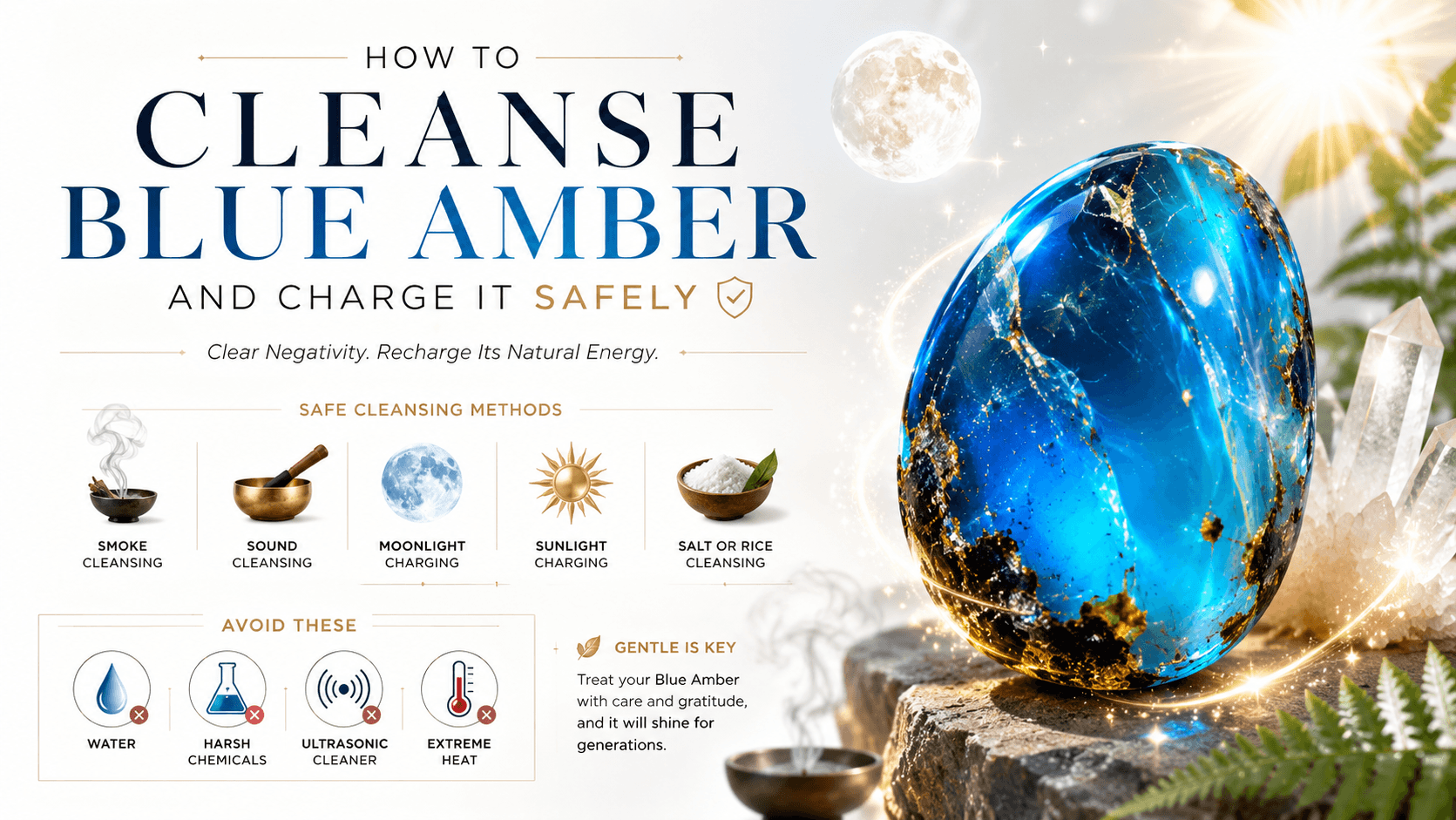
- Enjoy daylight briefly, do not bake it. A short spell outdoors lets you see the signature blue, but prolonged sun and heat dry and craze amber – so admire the glow, then store it cool.
One point worth clearing up: you may have read that you should “charge” amber in sunlight. Brief daylight is fine for viewing the fluorescence, but amber does not store light, and prolonged sun is one of the surest ways to craze the surface. Treat sunlight as something to enjoy in passing, not a charging routine – the safe rule is admire briefly, then return it to a cool, shaded spot.
Sumatran vs Dominican: Which Blue Amber Should You Wear?
Both sources are genuine and beautiful, and both make excellent jewelry. The comparison below helps you choose with confidence. As a quick summary: Sumatran (Indonesian) blue amber leads on size and availability and is the standout choice today, while Dominican is its respected equal with a slightly different glow character.
| Factor | Sumatran (Indonesian) – listed first | Dominican |
|---|---|---|
| Geology | Sinamar Formation, Jambi, South Sumatra Basin (Bukit Barisan foothills) | La Cumbre, La Toca, Palo Quemado mines near Santiago |
| Source tree | Dipterocarpaceae (likely Shorea), a tropical hardwood | Hymenaea protera, an extinct leguminous tree |
| Age | Miocene, millions of years | Oligocene-Miocene, millions of years |
| Typical size | Larger, cleaner nodules common | Often smaller pieces |
| Daylight glow | Dramatic greenish-to-sky daylight blue in sun | Distinctive blue, equally genuine |
| Quality and value | Equal quality; standout AAA+ value | Equal in quality and value |
Related Blue Amber Guides
For most buyers, Sumatran is the easy recommendation when you want presence and a strong daylight show. Choose Dominican if you prefer a lighter body and a more traditional, petite look. The full provenance story lives in our guide on where blue amber comes from; either way, buy from a seller who proves authenticity before you commit.
How Do You Verify the Piece You Plan to Wear?
Before you wear blue amber you bought online, confirm it is real. The single best quick test is fluorescence: under 365 nm long-wave UV (the standard test wavelength) genuine blue amber glows a strong, true blue. A cheap 395 nm torch is partly visible violet and gives a weaker, washed-out result, so 365 nm is the wavelength to ask about. Sunlight contains enough UV to trigger the signature daylight blue in strong Sumatran material.
A saltwater float test also helps: with a specific gravity of ~1.05-1.10, real amber floats in saturated brine (SG ~1.15) while most plastics and glass sink. The key maturity test is the acetone test – young copal (under millions of years in the making) turns tacky in 20-60 seconds, while properly amberized fossil resin resists it. That distinguishes amber from copal, not just from plastic.
For definitive identification, a lab settles it: FTIR spectroscopy reads the resin’s fingerprint, and a GIA or IGI report confirms amber versus copal and separates retinite (Sumatran/Dominican) from Baltic succinite by its succinic acid content. We walk through the entire battery, step by step, in how to tell if blue amber is real – the short version is: ask for 365 nm and daylight proof first, request a report for high-value pieces.
What We Notice When Matching People to Sumatran Blue Amber
At Blue Amber Bliss, the pieces that suit people best are almost always our Sumatran stones, where a dark cognac body in daylight flips to a deep blue glow the moment it catches indirect light or UV. We find that first-time wearers gravitate to the calmer, evenly polished nodules, while collectors ask for pronounced inclusions and specimen character that carry real presence on the hand. Because these are ancient natural resin, millions of years in the making, no two match the same person the same way, so we hand-select each one for the strength of its shift and the honesty of its markings.
If any of these matches sound like you, we warmly invite you to explore our hand-selected Sumatran blue amber and find the piece that shifts and glows in a way that feels like yours. Shop hand-selected Sumatran blue amber →
Frequently Asked Questions
Who should wear blue amber?
Anyone seeking calm, clarity, or protection is a great candidate. It especially suits overthinkers, decision-makers, empaths, spiritual seekers, and collectors. There are no traditional restrictions by age or temperament, so if you feel genuinely drawn to it, you are well suited to wear the stone every day.
Who should not wear blue amber?
No belief-based group is excluded, but practical exceptions exist. At Mohs 2-2.5, amber suffers in a daily ring, in manual work, in ultrasonic-cleaner households, and in prolonged heat. Those wearers should pick pendants, earrings, or beads in a protective bezel rather than abusing soft fossil resin on the hand.
What setting is best for soft blue amber?
A bezel setting is best because a continuous metal rim shields the cabochon’s vulnerable edges and absorbs knocks for soft Mohs 2-2.5 amber. Prongs leave the surface exposed and suit only earrings or occasional pieces. Use sterling silver or solid gold findings, never plated base metal, to avoid skin reactions.
How do you wear blue amber for the first time?
Start with a single bezel-set cabochon pendant and pick one intention – calm, clarity, or protection. Put it on after perfume and lotion, position it close to the throat or heart, and notice when you reach for it. That simple routine is how to wear blue amber meaningfully from day one.
Blue amber for which sign is best?
Leo is the classic match because amber is a solar stone, followed by air signs Gemini and Aquarius and fire signs Aries and Sagittarius. That said, water and earth signs benefit too, so truly any sign can enjoy the stone based on personal resonance rather than rules.
Which chakra does blue amber open?
The blue fluorescence links it most to the throat and third-eye chakras for communication and insight, while golden amber tones also warm the solar plexus. To target the upper centers, position a necklace near the throat or hold the stone at the brow during meditation.
Can you wear blue amber every day?
Yes, in the right format. Beads, pendants, and earrings are light and skin-friendly for daily use; a ring is the one format to avoid. Apply cosmetics first, dodge hard knocks and chemicals, clean with a soft cloth only, and the signature glow lasts for years.
Is Sumatran or Dominican blue amber better to wear?
Both are genuine and equal in quality, but Sumatran (Indonesian) blue amber is the standout, with larger, cleaner nodules and a dramatic daylight glow that make it the more valuable pick. Most people who want real presence prefer the Sumatran stone for everyday jewelry.
Does blue amber really glow blue?
Yes, but the blue is fluorescence, not body color. Trace perylene and other PAHs absorb UV and re-emit blue light, aided by surface scattering. The glow stops the moment the light is removed (fluorescence, not phosphorescence). Indoors it looks like warm honey; outdoors it reveals its blue.
Should you charge blue amber in sunlight?
No. Amber does not store light, and prolonged sun is a leading cause of surface crazing. Brief daylight is fine for viewing the fluorescence, but treat it as something to enjoy in passing, then store the piece cool and shaded. Skip any all-day “sun charging” routine.
How can I tell my blue amber is real before wearing it?
Check the glow under 365 nm UV or sunlight, try a saltwater float test, and use the acetone test to rule out young copal, which turns tacky in seconds. For high-value pieces, ask for an FTIR or GIA/IGI report. If a seller cannot prove these, do not buy.